
Research article · 2025 · Full text
International Journal of Agriculture and NutritionAssessment of iron and zinc bioavailability in biofortified pearl millet varieties
Volume 7(4) · Pages 153–156 · DOI: 10.33545/26646064.2025.v7.i4c.427 ↗
Research areasPlant Micronutrient Interactions and EffectsPhytase and its ApplicationsIron Metabolism and Disorders
Abstract
Author-writtenNearly 2 billion people worldwide suffer from iron and zinc deficiencies, with sub-Saharan Africa bearing a disproportionate share of this burden. Biofortified pearl millet (Pennisetum glaucum L.) has been promoted as a food-based strategy to address micronutrient malnutrition, yet total mineral content alone does not predict how much iron or zinc the human body can absorb. This research evaluated five biofortified pearl millet varieties—ICTP-8203Fe, Dhanashakti, AHB-1200Fe, HHB-299, and a local check—for total iron and zinc content and their in vitro bioavailability using the pepsin-pancreatin dialysis method. Grain samples were collected from research plots at the Central Kenya College of Agriculture, Nyeri, during the 2023 growing season. Total iron ranged from 4.18 mg/100 g (local check) to 8.64 mg/100 g (ICTP-8203Fe), while zinc varied between 2.97 and 5.41 mg/100 g. Dialyzable iron fractions were 7.3 to 14.8 percent of total iron, and dialyzable zinc ranged from 18.6 to 29.4 percent. ICTP-8203Fe showed the highest bioavailable iron (1.28 mg/100 g), and Dhanashakti provided the greatest bioavailable zinc (1.59 mg/100 g). Anti-nutritional factors—phytate and tannin—were inversely correlated with mineral bioavailability (r = −0.81 for phytate-iron and r = −0.74 for tannin-zinc). These findings indicate that breeding for high total mineral content must be paired with screening for low anti-nutrient levels to maximize nutritional benefit.
Summary
Source-checkedPlain-language reading of the full paper, prepared with AI and checked against the text. Each point links to the authors' own words.
Why it matters
- Iron and zinc deficiencies affect nearly 2 billion people globally, with a significant impact on sub-Saharan Africa. View evidence ↗
- While biofortified pearl millet is used to fight malnutrition, the total amount of minerals in the grain does not necessarily indicate how much the body can actually absorb. View evidence ↗
The question
- The study aimed to measure total and bioavailable iron and zinc, as well as phytate and tannin levels, in five pearl millet varieties grown in Nyeri, Kenya, to see how anti-nutrients affect bioavailability. View evidence ↗
What they did
- Five pearl millet varieties (ICTP-8203Fe, Dhanashakti, AHB-1200Fe, HHB-299, and a local landrace) were grown at the Central Kenya College of Agriculture in Nyeri during the 2022-23 season. View evidence ↗
- Total iron and zinc levels were measured using atomic absorption spectrophotometry (AAS) following wet digestion of the samples. View evidence ↗
- The researchers used a pepsin-pancreatin dialysis procedure to estimate the bioavailability of the minerals in vitro. View evidence ↗
What they found
- Total iron content varied from 4.18 mg/100 g in the local check to 8.64 mg/100 g in ICTP-8203Fe, while zinc ranged from 2.97 to 5.41 mg/100 g. View evidence ↗
- ICTP-8203Fe had the highest bioavailable iron at 1.28 mg/100 g, with a bioavailability index of 14.8%. View evidence ↗
- Dhanashakti exhibited the highest zinc bioavailability index at 29.4%, which was attributed to its low phytate content of 6.94 mg/g. View evidence ↗
- Only the local check (24.3) and HHB-299 (15.6) had phytate-to-iron molar ratios above the critical threshold of 14, which severely impairs iron absorption. View evidence ↗
What it means
- The authors conclude that breeding programs for biofortification should include screening for low-phytate levels to ensure higher mineral bioavailability. View evidence ↗
- The authors recommend ICTP-8203Fe and Dhanashakti as suitable varieties for promotion in East African nutrition programs. View evidence ↗
- A limitation of the study is that it relied on data from only one location and one growing season. View evidence ↗
Visual summary
2 visualsIllustrations explain the paper; charts are replotted from the paper's own table values.
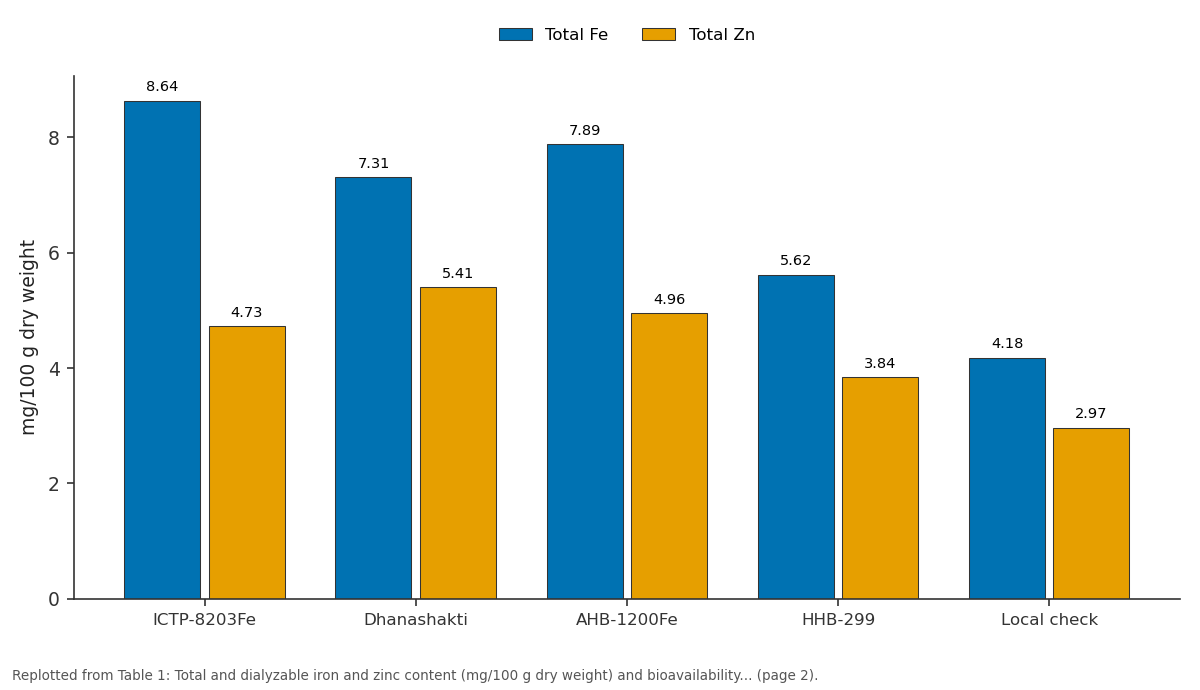
Total Fe and Total Zn: ICTP-8203Fe vs Dhanashakti vs AHB-1200Fe vs HHB-299 vs Local check
Replotted from Table 1 (page 2) of the original paper. Every bar is the paper's own table value.
View source evidence ↗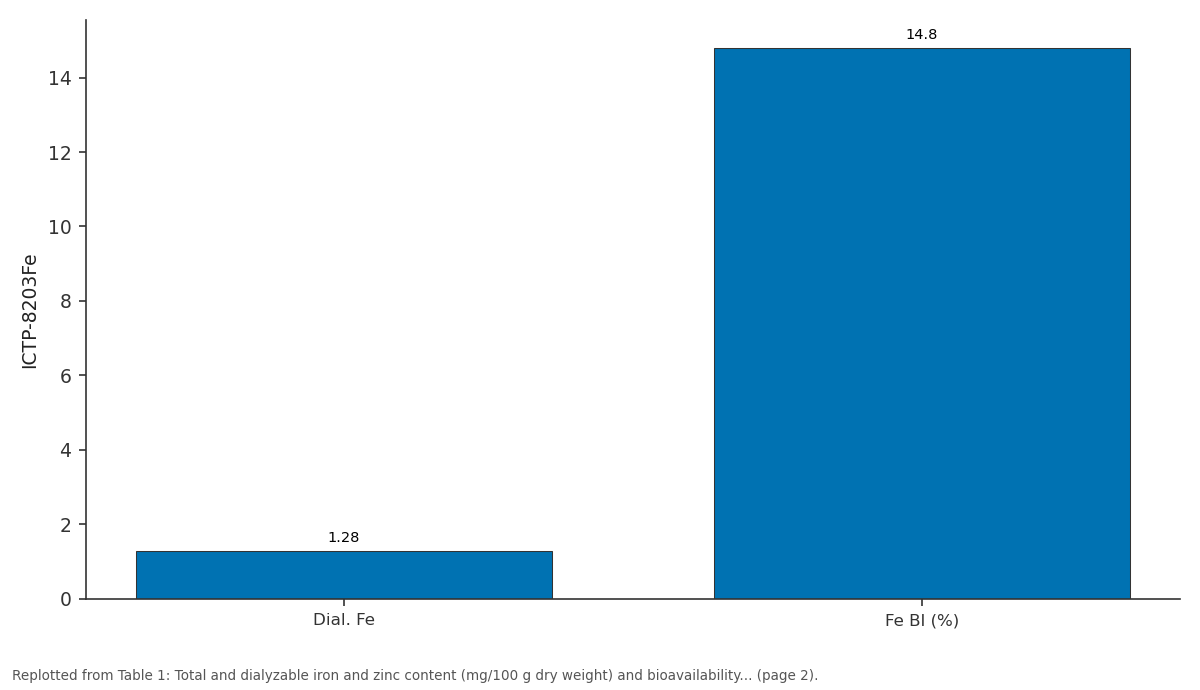
ICTP-8203Fe: Dial. Fe vs Fe BI (%)
Replotted from Table 1 (page 2) of the original paper. Every bar is the paper's own table value.
View source evidence ↗Figures & tables
From the original paper Table 1
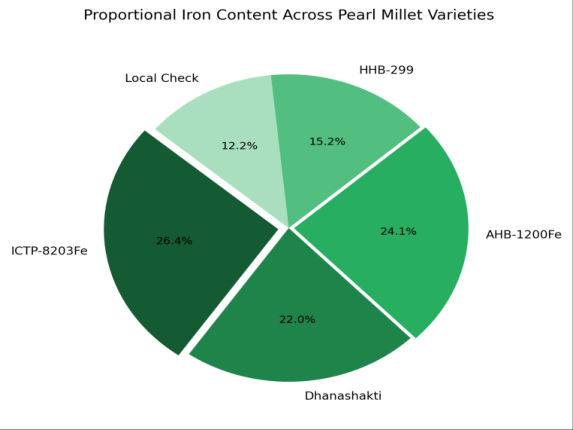 Figure 1
 Table 2
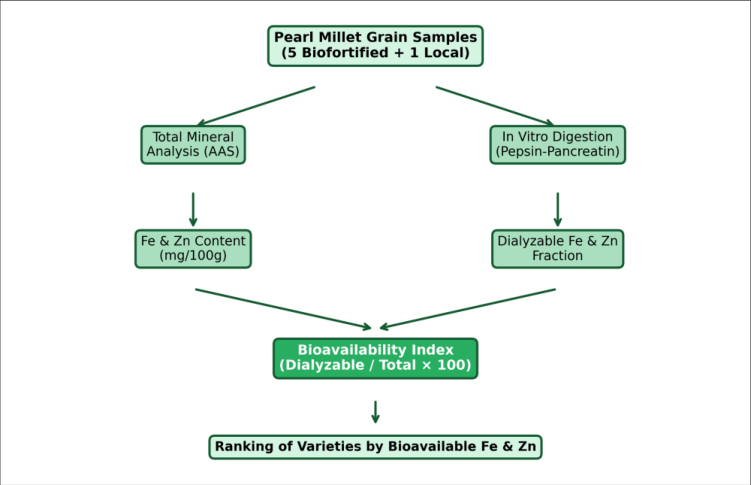 Figure 2
Introduction
About 1.8 billion individuals across the globe are affected by iron deficiency anaemia, and zinc deficiency contributes to roughly 116,000 child deaths each year in low-income countries [1] . In East Africa, pearl millet is a dietary staple for millions of rural households, making it a logical vehicle for biofortification-the process of breeding crops with elevated micronutrient concentrations [2] . Programs led by ICRISAT and HarvestPlus have released several high-iron and high-zinc pearl millet varieties over the past decade, and adoption rates in India have been encouraging [3] . But a persistent question hangs over biofortification research: does higher total mineral content in grain translate into greater mineral absorption in the human gut? The answer depends on bioavailability, which is governed by the chemical form of the mineral, the food matrix, and the concentration of absorption promoters and inhibitors [4] . Phytic acid, the main storage form of phosphorus in cereal grains, binds iron and zinc into insoluble complexes in the intestinal lumen, reducing their absorption by 40 to 70 percent in some foods [5] . Tannins and polyphenols exert a similar, though weaker, chelating effect [6] . In vitro dialyzability assays-where a simulated gastrointestinal digestion is followed by measurement of the mineral fraction that passes through a dialysis membrane-offer a rapid and cost-effective proxy for in vivo absorption trials [7] . The method has been validated against human absorption data for iron in cereal-based meals and correlates well (r = 0.89) with Caco-2 cell uptake [8] . Despite this, few reports have applied the technique to biofortified pearl millet varieties grown in East African environments, where soil type and growing conditions can alter grain mineral density and anti-nutrient profiles [9] . This research aimed to (i) quantify total and bioavailable iron and zinc in five pearl millet varieties grown at Nyeri, Kenya, (ii) measure phytate and tannin levels in the same samples, and (iii) assess correlations between anti-nutritional factors and mineral bioavailability.
Material and Methods
Material and Methods
Material
Grain samples of five pearl millet varieties-ICTP-8203Fe, Dhanashakti, AHB-1200Fe, HHB-299, and a local landrace (Nyeri Local)-were harvested from replicated trials at the Central Kenya College of Agriculture experimental farm, Nyeri (0.42°S, 36.95°E; altitude 1,759 m), during the October-February 2022-23 growing season. Each variety was grown in four replicated plots of 4 m × 3 m under uniform fertilizer management (60-30-20 kg N-P₂O₅-K₂O ha⁻¹). Grains were cleaned, dried to 12 percent moisture, and milled to pass through a 0.5 mm sieve before analysis. All reagents-pepsin (porcine, ≥250 U/mg), pancreatin (porcine, 4× USP), bile extract, and standard reference materials-were procured from Sigma-Aldrich (Steinheim, Germany).
Quality Control
Certified reference material (NIST SRM 1568b, rice flour) was analysed alongside every batch of samples to monitor analytical accuracy. Recovery rates for iron and zinc from the reference material were 96.3 ± 2.1 percent and 97.8 ± 1.7 percent, respectively. All glassware was acid-washed in 10 percent HNO₃ and rinsed with deionized water before use. Analyses were run in triplicate, and results were accepted only when the coefficient of was below 5 percent.
Methods
Total iron and zinc were determined by atomic absorption spectrophotometry (AAS; Shimadzu AA-7000, Kyoto, Japan) after wet digestion of 1.0 g sample in a tri-acid mixture (HNO₃:HClO₄:H₂SO₄ at 9:2:1 v/v) [10] . In vitro bioavailability was measured using the pepsin-pancreatin dialysis procedure described by Luten et al. [11] . Briefly, 5 g of milled grain was suspended in 50 mL deionized water, adjusted to pH 2.0 with 6 M HCl, and incubated with pepsin (16 mg) at 37 °C for 2 hours. The pH was then raised to 7.0, pancreatin-bile solution was added, and a cellulose dialysis membrane (MW cutoff 12 kDa) was introduced. After 2 hours of dialysis at 37 °C, the dialysate was collected and mineral content measured by AAS. Phytate was estimated by the method of Haug and Lantzsch [12] , and tannin content was measured using the vanillin-HCl assay [13] . Data were analysed by one-way ANOVA with Tukey's HSD test at p<0.05 using R software (version 4.3.1).
Results
Table ICTP-8203Fe recorded the highest total iron (8.64 mg/100 g) and dialyzable iron (1.28 mg/100 g), giving a bioavailability index of 14.8 percent. Dhanashakti, despite having lower total iron than AHB-1200Fe, showed the highest zinc bioavailability index (29.4%) due to its comparatively low phytate content (6.94 mg/g). The local check was consistently the poorest performer across both minerals. Phytate levels were inversely associated with bioavailability-HHB-299 and the local check carried the highest phytate loads (9.18 and 10.63 mg/g) and the lowest dialyzable mineral fractions. Figure 1 shows that ICTP-8203Fe contributed the largest share (26.3%) of the pooled iron content, followed by AHB-1200Fe (24.0%) and Dhanashakti (22.2%). The local check accounted for just 12.2 percent. The phytate-to-iron molar ratio exceeded the critical threshold of 14 (above which iron absorption is severely impaired) only in HHB-299 (15.6) and the local check (24.3). All three high-iron varieties maintained ratios below 10, which is considered favorable for adequate iron absorption [5] .
Discussion
The two-fold difference in total iron between ICTP-8203Fe (8.64 mg/100 g) and the local check (4.18 mg/100 g) confirms the genetic gains achieved by biofortification breeding programs. Comparable ranges have been reported from multi-location trials in India, where biofortified lines averaged 7.5-9.2 mg Fe/100 g against 3.8-4.6 mg/100 g in conventional cultivars [3] . That said, total mineral content alone can mislead: HHB-299 contained 34 percent more iron than the local check but delivered only 64 percent more bioavailable iron, because its higher phytate load offset the mineral advantage. The strong negative correlation between phytate and iron bioavailability (r = -0.81) aligns with earlier work on finger millet and sorghum [5,14] . Phytate chelates divalent cations in the gut lumen, forming insoluble complexes that resist enzymatic breakdown. The practical implication is straightforward: breeders should screen for low-phytate genotypes alongside high-mineral density. Low-phytate mutants exist in pearl millet and could be crossed into biofortified backgrounds without yield penalty [15] . Zinc bioavailability was generally higher than iron across all varieties-a pattern explained by the weaker binding affinity of phytate for zinc compared with iron at intestinal pH [16] . Dhanashakti's superior zinc bioavailability index (29.4%) reflects both its moderate zinc content and the lowest phytate:zinc molar ratio (11.0) in the trial. A limitation of this research is the use of a single growing season and location. Soil zinc status, rainfall distribution, and temperature during grain filling are known to modify mineral loading in pearl millet [9] . Multi-season and multisite evaluations would strengthen variety recommendations for the East African context.
Conclusion
This research demonstrated that biofortified pearl millet varieties grown at Nyeri, Kenya, contain markedly higher iron and zinc than the local landrace, and-more importantly-deliver greater bioavailable mineral fractions when assessed through in vitro dialysis. ICTP-8203Fe was the top performer for bioavailable iron (1.28 mg/100 g, BI 14.8%), while Dhanashakti excelled in bioavailable zinc (1.59 mg/100 g, BI 29.4%). Anti-nutritional factors, particularly phytate, had a strong inverse relationship with mineral bioavailability. Varieties with phytate-to-iron molar ratios below 10 consistently showed higher dialyzable iron, reinforcing the need to incorporate low-phytate screening into biofortification breeding pipelines.
For nutrition programs targeting iron and zinc deficiency in East Africa, ICTP-8203Fe and Dhanashakti appear well suited for promotion. Pairing these varieties with simple household processing techniques-soaking, germination, or fermentation-that reduce phytate could further improve mineral absorption. Multi-season trials across different agroecological zones of Kenya are warranted to confirm these findings before large-scale dissemination.
Acknowledgement
Acknowledgements Funding SourcesThis research was supported through internal funding from the Central Kenya College of Agriculture. No external grants were involved. Institutional SupportThe authors acknowledge the Department of Nutritional Sciences, Central Kenya College of Agriculture, Nyeri, for providing laboratory facilities and field space. Contributions Not Qualifying for AuthorshipLaboratory technicians at the college's analytical chemistry unit assisted with AAS operations and sample preparation.
Figures and tables from the paper
| Variety | Total Fe | Dial. Fe | Fe BI (%) | Total Zn | Dial. Zn | Zn BI (%) | Phytate (mg/g) |
|---|---|---|---|---|---|---|---|
| ICTP-8203Fe | 8.64 | 1.28 | 14.8 | 4.73 | 1.21 | 25.6 | 7.82 |
| Dhanashakti | 7.31 | 0.94 | 12.9 | 5.41 | 1.59 | 29.4 | 6.94 |
| AHB-1200Fe | 7.89 | 1.07 | 13.6 | 4.96 | 1.34 | 27.0 | 7.41 |
| HHB-299 | 5.62 | 0.51 | 9.1 | 3.84 | 0.87 | 22.7 | 9.18 |
| Local check | 4.18 | 0.31 | 7.3 | 2.97 | 0.55 | 18.6 | 10.63 |
| SEm(±) | 0.34 | 0.07 | - | 0.22 | 0.06 | - | 0.41 |
| CD (p=0.05) | 1.02 | 0.21 | - | 0.66 | 0.18 | - | 1.23 |
Table text extracted from the original PDF; superscript letters are shown inline. The original table image is below.
View original table image
| Variety | Tannin (mg CE/g) | Phytate:Fe molar ratio | Phytate:Zn molar ratio | Tannin:Fe molar ratio |
|---|---|---|---|---|
| ICTP-8203Fe | 1.43 | 8.6 | 14.2 | 2.7 |
| Dhanashakti | 1.28 | 9.1 | 11.0 | 2.8 |
| AHB-1200Fe | 1.51 | 8.9 | 12.8 | 3.1 |
| HHB-299 | 2.17 | 15.6 | 20.5 | 6.3 |
| Local check | 2.84 | 24.3 | 30.7 | 11.1 |
| r (Phytate vs Fe BI) | −0.81** | |||
| r (Tannin vs Zn BI) | −0.74* |
Table text extracted from the original PDF; superscript letters are shown inline. The original table image is below.
View original table image
References
19 in the original paper- Kassebaum NJ, Jasrasaria R, Naghavi M. A systematic analysis of global anaemia burden from 1990 to 2010. Blood. 2014;123(5):615-624.
- Rai KN, Yadav OP, Rajpurohit BS. Breeding pearl millet for nutritional quality improvement. Plant Breeding Reviews. 2020;44:197-246.
- Govindaraj M, Rai KN, Cherian B. Breeding biofortified pearl millet varieties and hybrids for iron and zinc. Indian Journal of Genetics. 2019;79(S):158167.
- Fairweather-Tait SJ, Bao Y, Broadley MR. Selenium in human health and disease. Antioxidants and Redox Signaling. 2011;14(7):1337-1383.
- Hurrell RF, Egli I. Iron bioavailability and dietary reference values. American Journal of Clinical Nutrition. 2010;91(5):1461S-1467S.
- Brune M, Rossander L, Hallberg L. Iron absorption and phenolic compounds. European Journal of Clinical Nutrition. 1989;43(8):547-557.
- Miller DD, Schricker BR, Rasmussen RR. An in vitro method for estimation of iron availability from meals. American Journal of Clinical Nutrition. 1981;34(10):2248-2256.
- Glahn RP, Wortley GM, South PK. Caco-2 cell iron uptake from meat and casein digests. Journal of Nutrition. 1999;129(11):2123-2127.
- Pujar M, Govindaraj M, Gangaprasad S. Genotype × environment interaction for grain iron and zinc in pearl millet. Crop Science. 2020;60(4):1820-1834.
- AOAC. Official methods of analysis of AOAC International. 21st ed. AOAC International; 2019.
- Luten J, Crews H, Flynn A. Interlaboratory trial on methods for in vitro mineral availability. International Journal of Food Sciences and Nutrition. 1996;47(4):277-286.
- Haug W, Lantzsch HJ. Sensitive method for the rapid determination of phytate in cereals. Journal of the Science of Food and Agriculture. 1983;34(12):14231426.
- Price ML, Van Scoyoc S, Butler LG. A critical evaluation of the vanillin reaction for tannin in sorghum grain. Journal of Agricultural and Food Chemistry. 1978;26(5):1214-1218.
- Platel K, Srinivasan K. Bioavailability of micronutrients from plant foods. European Journal of Clinical Nutrition. 2016;70(1):25-32.
- Vinoth A, Ravindhran R. Biofortification in millets: A sustainable approach for nutritional security. Frontiers in Plant Science. 2017;8:29.
- Sandberg AS, Brune M, Carlsson NG. Inositol phosphates with different numbers of phosphate groups influence iron absorption in humans. American Journal of Clinical Nutrition. 1999;70(2):240-246.
- Kodkany BS, Bellad RM, Mahantshetti NS. Biofortification of pearl millet with iron and zinc in a randomized controlled trial. Journal of Nutrition. 2013;143(9):1489-1493.
- Cercamondi CI, Egli IM, Mitchikpe E. Total iron absorption by young women from iron-biofortified pearl millet composite meals. Journal of Nutrition. 2013;143(9):1676-1681.
- Kanatti A, Rai KN, Radhika K. Grain iron and zinc density in pearl millet: Combining ability and heterosis. Crop Science. 2014;54(6):2468-2479.