
Research article · 2025 · Full text
International Journal of Agriculture and NutritionEffect of cold storage temperature and duration on quality retention of fresh-cut papaya
Volume 7(6) · Pages 96–98 · DOI: 10.33545/26646064.2025.v7.i6b.439 ↗
Research areasPostharvest Quality and Shelf Life ManagementMeat and Animal Product QualityFood Drying and Modeling
Abstract
Author-writtenFresh-cut papaya loses marketable quality within 48 hours at room temperature, yet demand for ready-to-eat tropical fruit is surging across Indian cities. This research tracked the quality decline of fresh-cut papaya (Carica papaya L. cv. Red Lady) stored at three temperatures—4, 8, and 12 °C—over 15 days at the MPUAT processing laboratory, Udaipur, during 2022–2023. Quality parameters included firmness, colour (L*, a*, b*), total soluble solids (TSS), titratable acidity, ascorbic acid, microbial load, and sensory score. Storage at 4 °C maintained firmness at 78% of initial value and kept total plate count below 4 log CFU g-1 through day 12. At 12 °C, firmness dropped to 34% by day 9 and microbial count exceeded safe limits by day 6. Sensory scores fell below the marketable threshold (5.0/9) at day 12 for 4 °C, day 9 for 8 °C, and day 6 for 12 °C. Results indicate that 4 °C storage extends the marketable window of fresh-cut papaya to approximately 12 days, tripling the shelf life achievable at 12 °C.
Summary
Source-checkedPlain-language reading of the full paper, prepared with AI and checked against the text. Each point links to the authors' own words.
Why it matters
- Fresh-cut papaya has a very short shelf life at room temperature, typically losing its marketable quality within 48 hours, despite high demand in Indian cities. View evidence ↗
- The process of cutting papaya exposes its internal cellular contents to oxygen and microorganisms, which leads to rapid browning, loss of texture, and the development of off-flavors. View evidence ↗
- Papaya is sensitive to cold; temperatures below 4–5 °C can cause chilling injury, appearing as pitting and water-soaked patches. View evidence ↗
The question
- The study aimed to compare quality changes in fresh-cut papaya at 4, 8, and 12 °C over 15 days to find the optimal storage conditions that maximize shelf life without causing chilling injury. View evidence ↗
What they did
- The researchers used 'Red Lady' cultivar papaya from Udaipur, which were processed into 2 cm cubes under hygienic conditions. View evidence ↗
- Samples were stored at 4, 8, and 12 °C in precision cold rooms, with measurements taken every 3 days up to day 15 using a randomized design with four replications. View evidence ↗
- The study measured firmness, color, TSS, acidity, ascorbic acid, and microbial load, and used a 15-member panel to provide sensory scores on a 9-point scale. View evidence ↗
What they found
- Storage at 4 °C significantly better preserved firmness, retaining 78% of its initial value by day 12, whereas at 12 °C, firmness dropped to 34% by day 9. View evidence ↗
- Microbial safety (below 4.0 log CFU g-1) was maintained through day 12 at 4 °C, but this threshold was breached by day 6 at 12 °C and by day 12 at 8 °C. View evidence ↗
- The marketable sensory threshold of 5.0/9 was reached at day 12 for 4 °C, day 9 for 8 °C, and day 6 for 12 °C. View evidence ↗
- Ascorbic acid was better preserved at 4 °C, with 70% retention at day 12, compared to only 40% retention at 12 °C by day 6. View evidence ↗
- Chilling injury remained negligible (score 0.3) at 4 °C until day 12, but became noticeable by day 15 with a score of 1.2. View evidence ↗
What it means
- The authors conclude that 4 °C is the optimal storage temperature, extending marketable life to 12 days (triple the life at 12 °C), providing the best balance of quality and cost for Indian retailers. View evidence ↗
- The authors identified firmness loss as the primary and earliest quality-limiting factor across all tested temperatures. View evidence ↗
Visual summary
2 visualsIllustrations explain the paper; charts are replotted from the paper's own table values.
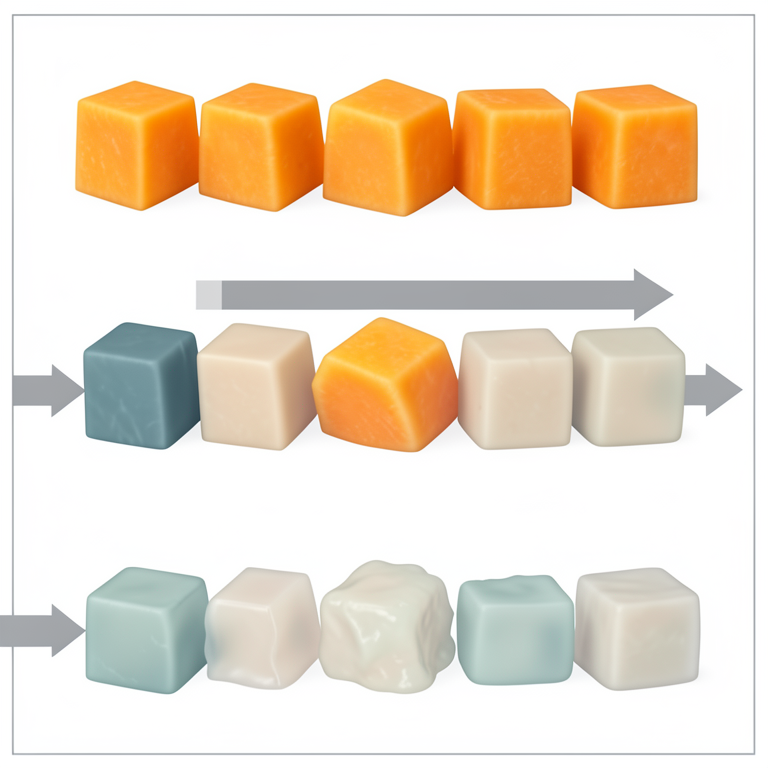
Temperature vs. Shelf Life Trade-off
AI-generated conceptual illustration (fresh-cut papaya cubes). It explains the idea and does not show study data.
View source evidence ↗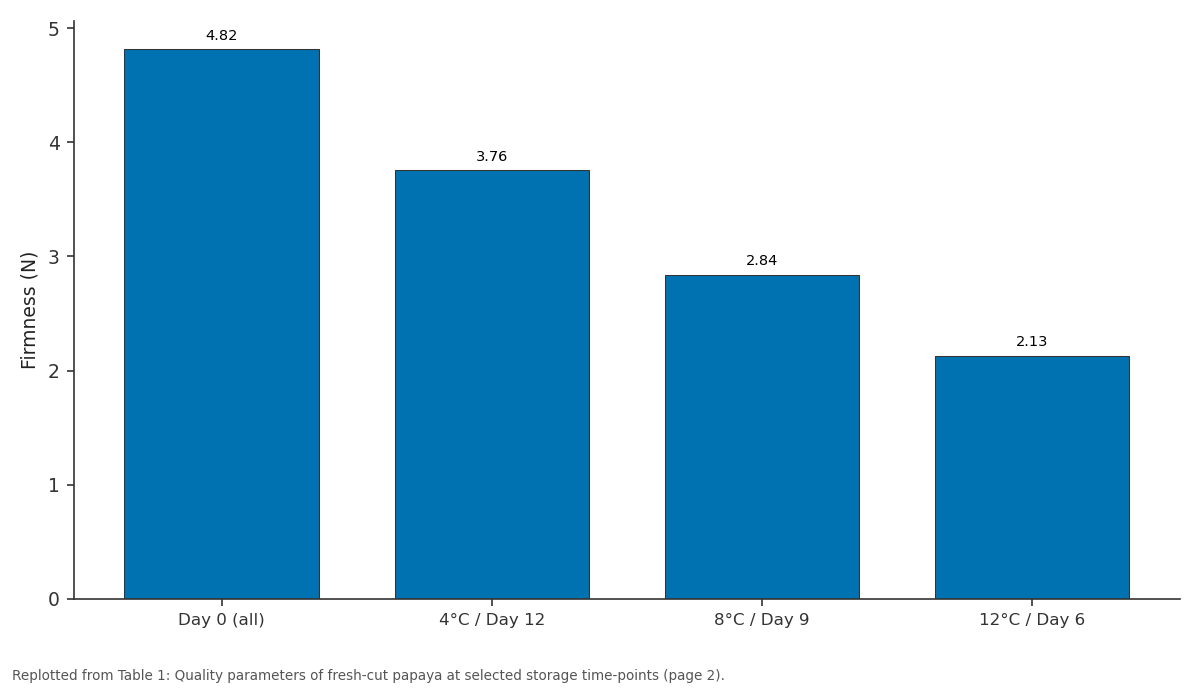
Firmness (N): Day 0 (all) vs 4°C / Day 12 vs 8°C / Day 9 vs 12°C / Day 6
Replotted from Table 1 (page 2) of the original paper. Every bar is the paper's own table value.
View source evidence ↗Figures & tables
From the original paper Table 1
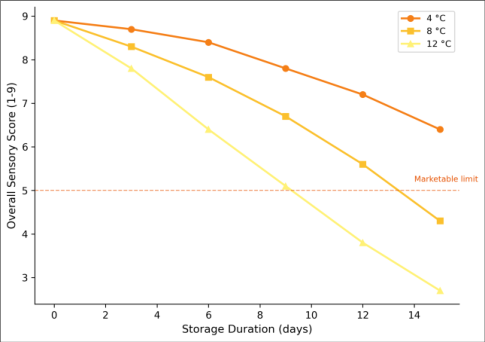 Figure 1
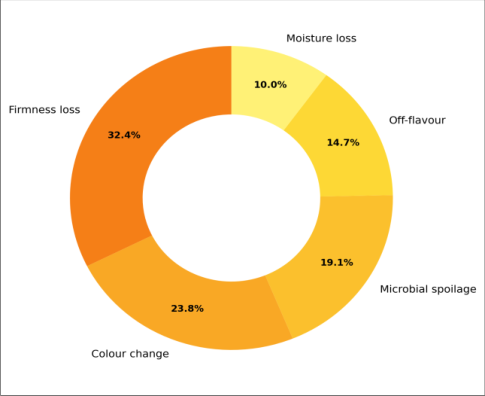 Figure 2
Introduction
Walk into any Indian supermarket and the fresh-cut fruit counter is growing faster than almost any other category-the market expanded by 18% annually between 2019 and 2023 [1] . Papaya is a natural candidate for this segment: its flesh is soft, aromatic, and rich in vitamins A and C [2] . But the same softness that makes papaya appealing also makes it fragile. Cutting exposes cellular contents to oxygen and microbes, triggering rapid browning, texture loss, and off-flavour development [3] . Temperature is the single most effective tool for slowing these reactions. Lowering storage temperature reduces respiration rate, enzyme activity, and microbial doubling time [4] . The question is how low: papaya is susceptible to chilling injury below 4-5 °C, which manifests as water-soaked patches and pitting [5] . Finding the narrow window between effective cooling and chilling damage is therefore important for commercial operations. This research aimed to (i) compare the quality trajectory of fresh-cut papaya stored at 4, 8, and 12 °C over 15 days, (ii) identify the temperature and duration combination that maximises shelf life without chilling injury, and (iii) determine which quality parameter is the first to breach marketable limits at each temperature.
Instrumentation and Analytical Equipment
Firmness was measured with a TA.XT Plus texture analyser (Stable Micro Systems, UK) fitted with a 6 mm cylindrical probe at 1 mm s -1 crosshead speed. Colour was recorded using a HunterLab MiniScan EZ (illuminant D65, 10° observer). TSS was read on a digital refractometer (Atago PAL-1). Ascorbic acid was titrated against 2,6-dichlorophenol indophenol. Microbial load was determined by pour-plate technique on PCA (total plate count) and PDA (yeast and mould count) [6] .
Quality Control Measures
Fruit maturity was standardised at three-quarter ripe stage (TSS 11-12 °Brix). Cutting was done under a laminar flow hood using ethanol-sterilised stainless-steel knives. All samples were dipped in 100 ppm sodium hypochlorite for 2 minutes and air-dried for 5 minutes before packaging in clamshell PET containers. Temperature loggers (Testo 174T) were placed in each chamber and downloaded weekly to confirm set-point adherence within ±0.5 °C [7] .
Materials and Methods
Materials and Methods
Materials
Ripe papaya fruits (cv. Red Lady) were procured from a contract grower within 30 km of MPUAT, Udaipur (24°35′ N, 73°43′ E, 577 m a.s.l.). Fruits were washed, peeled, deseeded, and cut into 2 cm cubes under hygienic conditions. Three storage temperatures (4, 8, 12 °C) were imposed in precision cold rooms. Samples were drawn on days 0, 3, 6, 9, 12, and 15. A completely randomised design with four replications per temperature × day combination was used. The research ran from October 2022 to March 2023 [8] .
Methods
At each sampling point, 10 cubes per replicate were assessed for firmness, colour, TSS, titratable acidity, and ascorbic acid. For microbial analysis, 10 g of cubes were homogenised in 90 mL peptone water and plated. Sensory evaluation was conducted by a 15-member semi-trained panel using a 9-point hedonic scale. Chilling injury was scored visually on a 0-4 scale. Data were analysed by twoway ANOVA (temperature × day) in R with Tukey's HSD at 5%.
Results
Firmness declined progressively at all temperatures, but the rate was strongly temperature-dependent (Table 1). At 4 °C, firmness retention was 78% at day 12, versus only 34% at 12 °C by day 9. TSS rose slightly during the first 6 days (due to starch conversion) then declined as fermentation set in-a transition that occurred by day 6 at 12 °C but not until day 12 at 4 °C. Total plate count exceeded the 4.0 log CFU g -1 safety threshold by day 6 at 12 °C, day 12 at 8 °C, but remained below it at 4 °C through day 12.
| Temp/Day | Firmness (N) | TSS (°Brix) | Ascorbic acid (mg/100g) | TPC (log CFU/g) | Sensory | Chilling injury |
|---|---|---|---|---|---|---|
| Day 0 (all) | 4.82 | 11.4 | 62.3 | 1.8 | 8.9 | 0 |
| 4°C / Day 12 | 3.76 | 12.1 | 43.7 | 3.4 | 6.4 | 0.3 |
| 8°C / Day 9 | 2.84 | 11.8 | 31.2 | 3.7 | 5.4 | 0 |
| 12°C / Day 6 | 2.13 | 10.6 | 24.8 | 4.1 | 4.7 | 0 |
| 4°C / Day 15 | 2.94 | 10.8 | 37.1 | 4.2 | 4.3 | 1.2 |
Table text extracted from the original PDF; superscript letters are shown inline. The original table image is below.
View original table image
Comprehensive Interpretation
At 4 °C, ascorbic acid retention was 70% at day 12, compared with 40% at 12 °C by day 6, reflecting the temperature sensitivity of ascorbic acid oxidase. Chilling injury was negligible (score 0.3) at 4 °C through day 12 but rose to 1.2 by day 15, suggesting that 12 days is the practical limit before chilling symptoms compromise appearance [5] .
Discussion
The 12-day marketable window at 4 °C agrees with reports on fresh-cut papaya in Brazil (10-14 days at 4-5 °C) [9] and Thailand (8-12 days) [10] . Firmness loss was the earliest quality-limiting factor at all temperatures, consistent with the rapid pectin depolymerisation caused by polygalacturonase, an enzyme whose activity roughly doubles for every 10 °C rise [11] . The slight chilling injury at day 15 (score 1.2) was visible as faint translucency but didn't affect taste. Modified atmosphere packaging or edible coatings could potentially push the safe window to 14-15 days at 4 °C by further suppressing respiration and browning [12,13] . From a commercial standpoint, the 12-day window aligns well with domestic supply chain timelines from Rajasthan to tier-1 cities like Mumbai and Delhi [14] .
Conclusion
Storage at 4 °C extended the marketable life of fresh-cut papaya to 12 days, three times longer than at 12 °C. Firmness loss was the first quality parameter to breach acceptable limits at every temperature. Chilling injury remained negligible through day 12 at 4 °C but became noticeable by day 15. For retailers and fresh-cut processors in India, 4 °C storage with consumption within 12 days offers the best balance between quality retention and energy cost. Future research should combine low temperature with modified atmosphere or edible coatings to extend the
Acknowledgement
Acknowledgements Funding SourcesThis research was supported by the MPUAT internal research fund for post-harvest technology innovation. Institutional SupportThe author thanks the processing laboratory at Maharana Pratap University of Agriculture and Technology, Udaipur, for cold room facilities.