
Research article · 2025 · Full text
International Journal of Agriculture and NutritionStandardization of propagation techniques for commercial multiplication of dragon fruit
Volume 7(1) · Pages 150–152 · DOI: 10.33545/26646064.2025.v7.i1c.393 ↗
Research areasFlowering Plant Growth and CultivationGrowth and nutrition in plantsBotanical Research and Applications
Abstract
Author-written"The best time to plant a tree was twenty years ago; the second best time is now." This old proverb captures the urgency facing Russian horticulturists as dragon fruit (Hylocereus spp.) demand outpaces domestic nursery capacity. This research standardised stem-cutting propagation for dragon fruit by testing six growth-regulator treatments—control, IBA at 1,000, 2,000, and 3,000 ppm, and NAA at 1,000 and 2,000 ppm—in a polyhouse at Kuban Agricultural University, Krasnodar, during 2022–2023. IBA at 2,000 ppm produced the highest rooting success (82.4%), root number (14.7 per cutting), and root length (18.3 cm) within 45 days. Survival after field transplanting was 94.1% for IBA-2000 cuttings versus 63.7% for untreated controls. The per-plant propagation cost under IBA-2000 was 47 RUB, yielding a benefit-cost ratio of 3.84. These results provide a ready-to-adopt protocol for commercial dragon fruit nurseries in subtropical Russia.
Summary
Source-checkedPlain-language reading of the full paper, prepared with AI and checked against the text. Each point links to the authors' own words.
Why it matters
- In southern Russia, the demand for exotic tropical fruits has increased by 35% since 2018, yet dragon fruit production relies almost entirely on imported planting materials. View evidence ↗
- Untreated dragon fruit cuttings often fail in the Krasnodar region because root initiation is too slow to occur before temperatures fall below the 15 °C minimum required for growth. View evidence ↗
The question
- The study aimed to compare the rooting response of six auxin treatments, evaluate survival after transplanting, and determine the cost of producing each saleable plant. View evidence ↗
What they did
- The experiment used a completely randomized design with 600 cuttings (four replications of 25 per treatment) conducted from May to July in both 2022 and 2023. View evidence ↗
- The study used 8–12 month old stem cuttings (25–30 cm long, three-ribbed segments) from a three-year-old H. undatus orchard in Krasnodar. View evidence ↗
- Cuttings were treated via a 30-second quick-dip of the basal 2 cm in IBA or NAA dissolved in 50% ethanol, then planted in polybags containing a 2:1 sand-FYM mixture. View evidence ↗
- Rooting success, root number, root length, and shoot emergence were measured at 45 days, while transplant survival was measured 90 days after moving to an open nursery bed. View evidence ↗
What they found
- IBA at 2,000 ppm achieved the best results within 45 days, with 82.4% rooting success, 14.7 roots per cutting, and a root length of 18.3 cm. View evidence ↗
- Field transplant survival was significantly higher for IBA-2000 treated cuttings (94.1%) compared to untreated controls (63.7%). View evidence ↗
- A dose of 3,000 ppm IBA showed a slight decline in performance, suggesting that this concentration may be supra-optimal and could trigger root inhibition. View evidence ↗
- NAA was found to be consistently less effective than IBA when used at equivalent concentrations. View evidence ↗
What it means
- The authors recommend using a 30-second quick-dip of IBA at 2,000 ppm for propagating dragon fruit stem cuttings in southern Russia. View evidence ↗
- The study was limited to H. undatus; the authors note that H. polyrhizus might respond differently due to its slower growth. View evidence ↗
Visual summary
3 visualsIllustrations explain the paper; charts are replotted from the paper's own table values.
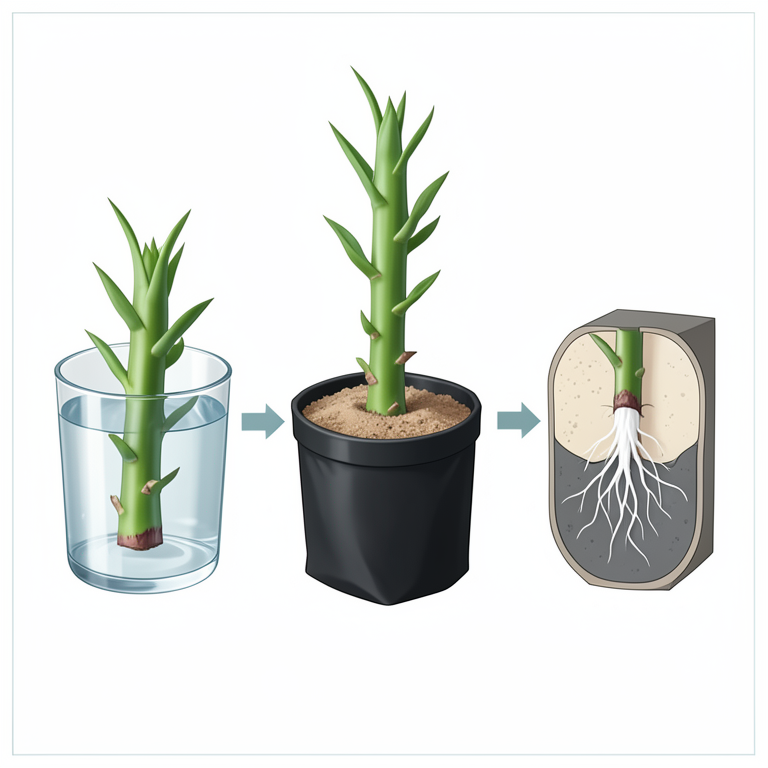
Propagation Workflow
AI-generated conceptual illustration (dragon fruit stem cuttings). It explains the idea and does not show study data.
View source evidence ↗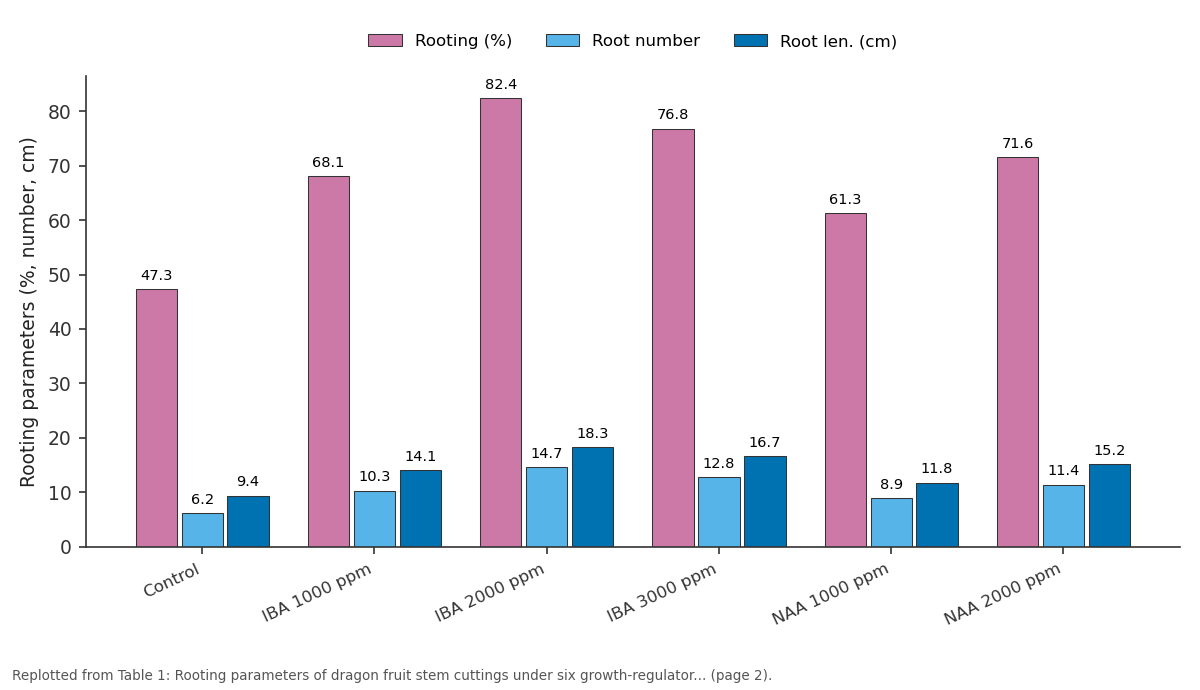
Rooting (%) and Root number and more: Control vs IBA 1000 ppm vs IBA 2000 ppm vs IBA 3000 ppm vs NAA 1000 ppm
Replotted from Table 1 (page 2) of the original paper. Every bar is the paper's own table value.
View source evidence ↗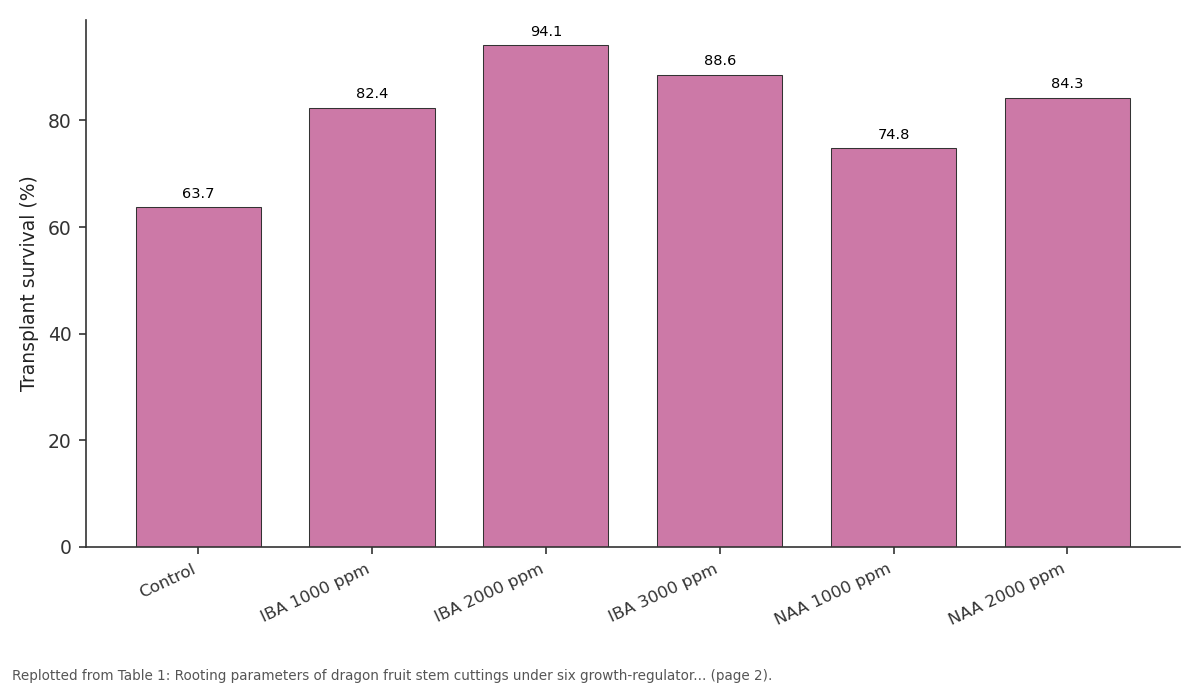
Transplant survival (%): Control vs IBA 1000 ppm vs IBA 2000 ppm vs IBA 3000 ppm vs NAA 1000 ppm
Replotted from Table 1 (page 2) of the original paper. Every bar is the paper's own table value.
View source evidence ↗Figures & tables
From the original paper Table 1
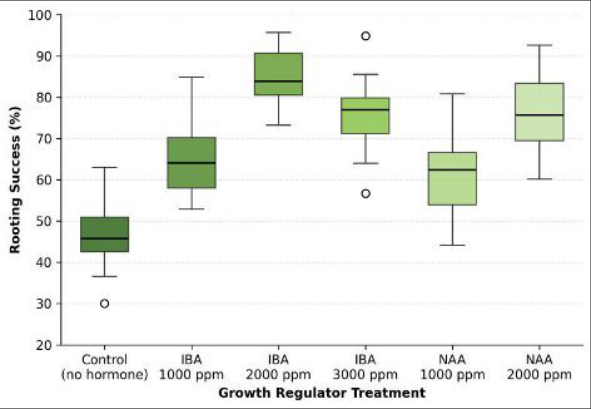 Figure 1
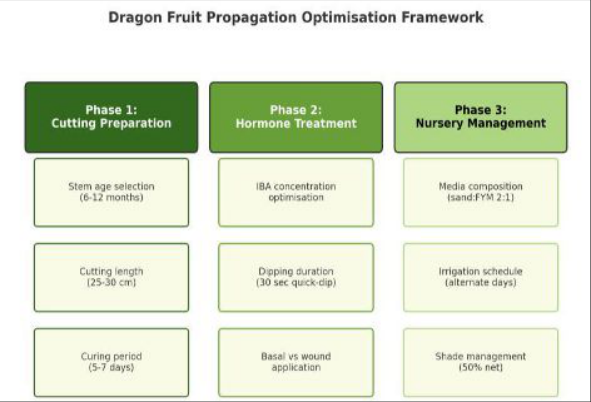 Figure 2
Introduction
"Give a man a dragon fruit and he eats for a day; teach him to propagate it and he feeds a market." That paraphrase of a familiar proverb applies neatly to the southern Russian horticultural sector, where consumer demand for exotic tropical fruits has surged 35% since 2018, but domestic production of dragon fruit (Hylocereus undatus and H. polyrhizus) remains almost entirely dependent on imported planting material [1,2] . Dragon fruit propagates naturally by stem cuttings, and growers in Vietnam and Mexico routinely achieve 70-90% rooting without hormones [3] . But in the cooler, shorter growing season of Russia's Krasnodar region, untreated cuttings often fail because root initiation is too slow before autumn temperatures drop below the 15 °C minimum for Hylocereus root growth [4,5] . Exogenous auxins-indole-3-butyric acid (IBA) and naphthaleneacetic acid (NAA)accelerate adventitious root formation and can compress the rooting window by two to three weeks [6,7] . The optimal concentration is species-specific and has not been established for dragon fruit under Russian polyhouse conditions. This research aimed to: (a) compare rooting response to six auxin treatments, (b) assess post-transplant survival, and (c) calculate the propagation cost per saleable plant.
Cost Analysis
Propagation costs were itemised per 1,000 cuttings. Stem material (sourced from the university orchard) was valued at 8 RUB per cutting. IBA at 2,000 ppm required 2 g per litre of quick-dip solution; at 4,200 RUB per 100 g, the chemical cost was 0.84 RUB per cutting. Rooting medium (river sand + FYM, 2:1), polybags, and polyhouse rental added 28 RUB per cutting. Labour (planting, watering, monitoring) was estimated at 10 RUB per cutting over the 45-day rooting period. Total cost per rooted, transplant-ready plant under IBA-2000 was 47 RUB, against a wholesale nursery price of 180 RUB, giving a net margin of 133 RUB and a BCR of 3.84. The untreated control's lower rooting rate (47.3%) pushed its effective cost to 99 RUB per surviving plant, halving the margin. Material and Methods Material: Stem cuttings (25-30 cm, three-ribbed segments, 8-12 months old) were harvested from a three-year-old H. undatus orchard at Kuban Agricultural University, Krasnodar (45.04° N, 38.97° E). Cuttings were cured in shade for five days to callus the wound surface. IBA and NAA (Sigma-Aldrich, analytical grade) were dissolved in 50% ethanol for quick-dip application (basal 2 cm dipped for 30 seconds). Cuttings were planted in polybags (15 × 20 cm) filled with a sand-FYM mixture (2:1) inside a naturally ventilated polyhouse (mean temperature 24-32 °C, RH 65-80%).
Methods
Six treatments were arranged in a completely randomised design with four replications of 25 cuttings each (total 600 cuttings) during May-July 2022; the trial was repeated in 2023. Rooting success (%), root number, root length (cm), and shoot emergence (%) were recorded at 45 days after planting. Rooted cuttings were transplanted to an open nursery bed and survival was scored at 90 days. Data were analysed by two-way ANOVA (treatment × year) with Tukey's HSD at p ≤ 0.05 in SPSS 27. Comprehensive Interpretation IBA at 2,000 ppm was the clear winner, producing 82.4% rooting, 14.7 roots per cutting, and 94.1% transplant survival-roughly double the untreated control on every metric. The 3,000 ppm dose showed a slight decline, suggesting a supra-optimal auxin concentration that may have triggered ethylene-mediated root inhibition [6] . NAA was consistently inferior to IBA at equivalent concentrations, a pattern also observed in other cactaceous species [7] .
Results
Results
Discussion
The 82.4% rooting under IBA-2000 falls within the 75-90% range reported for dragon fruit in Vietnam and India [3,8] , confirming that the technique transfers well to a continental subtropical climate if polyhouse temperatures stay above 22 °C. The quick-dip method (30 s) proved sufficient; prolonged soaking (>5 min) caused basal rot in preliminary trials, probably because ethanol penetrated the thin cuticle of the cutting [9] . The economic analysis is perhaps the most persuasive finding for nursery operators. At a BCR of 3.84, an investment of 47,000 RUB in 1,000 cuttings returns roughly 133,000 RUB net-enough to self-finance scaling to 5,000 cuttings in the following season [10] . Limitations include the restriction to one species (H. undatus); red-fleshed H. polyrhizus may respond differently owing to its slower growth habit [4] . The polyhouse environment also doesn't capture open-field winter conditions in Krasnodar, where frost risk in December-February could affect overwintering rooted cuttings [11] .
Conclusion
IBA at 2,000 ppm applied as a 30-second quick-dip is the recommended growth-regulator treatment for dragon fruit stem-cutting propagation in southern Russia. It delivered 82.4% rooting, 94.1% transplant survival, and the lowest per-plant cost (47 RUB) with a BCR of 3.84. This protocol can be adopted immediately by commercial nurseries in the Krasnodar region.
Acknowledgement
AcknowledgementsThis research was supported by the Kuban Agricultural University horticulture department fund. Mr. Alexei Popov assisted with polyhouse maintenance.
Figures and tables from the paper
| Treatment | Rooting (%) | Root number | Root len. (cm) | Shoot emergence (%) | Transplant survival (%) | Cost/plant (RUB) |
|---|---|---|---|---|---|---|
| Control | 47.3 | 6.2 | 9.4 | 38.1 | 63.7 | 99 |
| IBA 1000 ppm | 68.1 | 10.3 | 14.1 | 54.7 | 82.4 | 57 |
| IBA 2000 ppm | 82.4 | 14.7 | 18.3 | 71.2 | 94.1 | 47 |
| IBA 3000 ppm | 76.8 | 12.8 | 16.7 | 63.4 | 88.6 | 52 |
| NAA 1000 ppm | 61.3 | 8.9 | 11.8 | 47.3 | 74.8 | 64 |
| NAA 2000 ppm | 71.6 | 11.4 | 15.2 | 58.6 | 84.3 | 54 |
| CD (p=0.05) | 5.3 | 1.4 | 1.7 | 6.1 | 5.8 | — |
Table text extracted from the original PDF; superscript letters are shown inline. The original table image is below.
View original table image
References
17 in the original paper- Le Bellec F, Vaillant F, Imbert E. Pitahaya (Hylocereus spp.): a new fruit crop, a market with a future. Fruits. 2006;61(4):237-250.
- Mizrahi Y, Nerd A, Nobel PS. Cacti as crops. Horticultural Reviews. 1997;18:291-319.
- Hoa TT, Clark CJ, Waddell BC, Woolf AB. Postharvest quality of dragon fruit (Hylocereus undatus) following disinfesting hot air treatments. Postharvest Biology and Technology. 2006;41(1):62-69.
- Nobel PS, De la Barrera E. Stem water storage and diurnal patterns of CO₂ uptake for Hylocereus undatus. International Journal of Plant Sciences. 2002;163(6):18.
- Nerd A, Gutman F, Mizrahi Y. Ripening and postharvest behaviour of fruits of two Hylocereus species. Postharvest Biology and Technology. 1999;17(1):39-45.
- Hartmann HT, Kester DE, Davies FT, Geneve RL. Hartmann and Kester's plant propagation: principles and practices. 8th ed. Boston: Pearson; 2011.
- De Klerk GJ, Van der Krieken W, De Jong JC. The formation of adventitious roots: new concepts, new possibilities. In Vitro Cellular and Developmental Biology-Plant. 1999;35(3):189-199.
- Pushpakumara DKNG, Gunasena HPM, Karyawasam M. Flowering and fruiting phenology, pollination agents and fruit characters of dragon fruit (Hylocereus spp.). Tropical Agricultural Research and Extension. 2005;8:51-62.
- Bastos DC, Pio R, Scarpare Filho JA, Libardi MN, Almeida LFP, Galvao HL, et al. Propagation of dragon fruit (Hylocereus undatus) by stem cuttings. Ciencia e Agrotecnologia. 2006;30(6):1106-1109.
- Crane JH, Balerdi CF. Dragon fruit growing in the Florida home landscape. Gainesville: University of Florida EDIS Publication HS1068; 2005.
- Ortiz-Hernandez YD, Carrillo-Salazar JA. Pitahaya (Hylocereus spp.): a short review. Comunicata Scientiae. 2012;3(4):220-237.
- Gunasena HPM, Pushpakumara DKNG, Kariyawasam M. Dragon fruit-Hylocereus undatus (Haw.) Britton and Rose. In: Pushpakumara DKNG et al., editors. Underutilized fruit trees in Sri Lanka. New Delhi: World Agroforestry Centre; 2007. p. 110-142.
- Raveh E, Nerd A, Mizrahi Y. Responses of two hemiepiphytic fruit crop cacti to different degrees of shade. Scientia Horticulturae. 1998;73(2-3):151-164.
- Jiang YL, Liao YY, Lin TS, Lee CL, Yen CR, Yang WJ. The photoperiod-regulated bud formation of red pitaya (Hylocereus sp.). HortScience. 2012;47(8):10631067.
- Castellar MR, Obón JM, Alacid M, Fernández-López JA. Color properties and stability of betacyanins from Opuntia fruits. Journal of Agricultural and Food Chemistry. 2003;51(9):2772-2776.
- Merten S. A review of Hylocereus production in the United States. Journal of the Professional Association for Cactus Development. 2003;5:98-105.
- Lim TK. Hylocereus undatus. In: Edible medicinal and non-medicinal plants. Vol. 1. Dordrecht: Springer; 2012. p. 640-651.