
Research article · 2025 · Full text
International Journal of Agriculture and NutritionApplication of edible coatings for extending shelf life of fresh strawberries
Volume 7(4) · Pages 93–96 · DOI: 10.33545/26646064.2025.v7.i4b.386 ↗
Research areasPostharvest Quality and Shelf Life ManagementNanocomposite Films for Food PackagingMeat and Animal Product Quality
Abstract
Author-writtenThe old adage that strawberries begin dying the moment they are picked isn't far from the truth—the fruit's high respiration rate, thin skin, and susceptibility to Botrytis cinerea limit its post-harvest shelf life to just 3 to 5 days at ambient temperature. Edible coatings that form a semi-permeable barrier around the fruit surface can slow moisture loss, reduce gas exchange, and inhibit microbial growth. This research evaluated four edible coating formulations—chitosan (1%), aloe vera gel (2%), guar gum (1.5%), and a chitosan + aloe vera composite—on quality retention of cv. Winter Dawn strawberries stored at 4 ± 1 °C for 12 days at the post-harvest laboratory of Sardarkrushinagar Dantiwada Agricultural University, Gujarat. The chitosan + aloe vera composite maintained the highest firmness (4.3 N), lowest weight loss (3.7%), and lowest decay incidence (8.4%) at day 12 compared with the uncoated control (2.1 N, 11.8% weight loss, 34.6% decay). Ascorbic acid retention was 78.3 percent under the composite coating versus 51.2 percent in uncoated fruit. Total soluble solids and titratable acidity changes were also slower under coated treatments. Chitosan alone was the second-best option, while guar gum showed the weakest performance. These results indicate that a chitosan-aloe vera composite coating can extend the marketable shelf life of strawberries from 5 to 12 days under refrigerated storage.
Summary
Source-checkedPlain-language reading of the full paper, prepared with AI and checked against the text. Each point links to the authors' own words.
Why it matters
- Strawberries have a very short shelf life of 3 to 5 days at room temperature due to their thin skin, high respiration rate, and vulnerability to Botrytis cinerea. View evidence ↗
- Post-harvest losses for strawberries in India are estimated between 25% and 40%, primarily during transport to urban markets. View evidence ↗
- Edible coatings can reduce spoilage by creating a food-safe film that modifies the fruit's internal atmosphere and slows gas exchange. View evidence ↗
The question
- The study aimed to compare four edible coatings over 12 days of cold storage to find the best formulation for maintaining firmness, reducing weight loss and decay, and preserving nutritional parameters. View evidence ↗
What they did
- The experiment used 'Winter Dawn' strawberries harvested at the three-quarter red stage in January 2023 from a farm in Gujarat, India. View evidence ↗
- Five treatments were tested: an uncoated control, 1% chitosan, 2% aloe vera gel, 1.5% guar gum, and a composite of 1% chitosan and 2% aloe vera. View evidence ↗
- Fruits were dipped in coatings for 2 minutes, air-dried for 30 minutes, and stored in PET containers at 4 ± 1 °C with 90 ± 5% relative humidity. View evidence ↗
- Quality assessments were conducted every 3 days for 12 days, measuring weight loss gravimetrically and firmness using a texture analyzer. View evidence ↗
What they found
- The rate of weight loss was significantly slower for the composite coating (0.31% per day) than for the uncoated control (0.98% per day). View evidence ↗
- Among the individual coatings, chitosan was the second most effective, while guar gum performed the worst. View evidence ↗
What it means
- The authors conclude that a 1% chitosan and 2% aloe vera gel composite coating can extend the marketable shelf life of strawberries from 5 to 12 days under refrigerated storage. View evidence ↗
- The composite coating is recommended as a biodegradable and food-safe alternative to synthetic wax for post-harvest management. View evidence ↗
- The authors state that commercial adoption should be preceded by consumer acceptability trials and scale-up testing on commercial packing lines. View evidence ↗
Visual summary
3 visualsIllustrations explain the paper; charts are replotted from the paper's own table values.
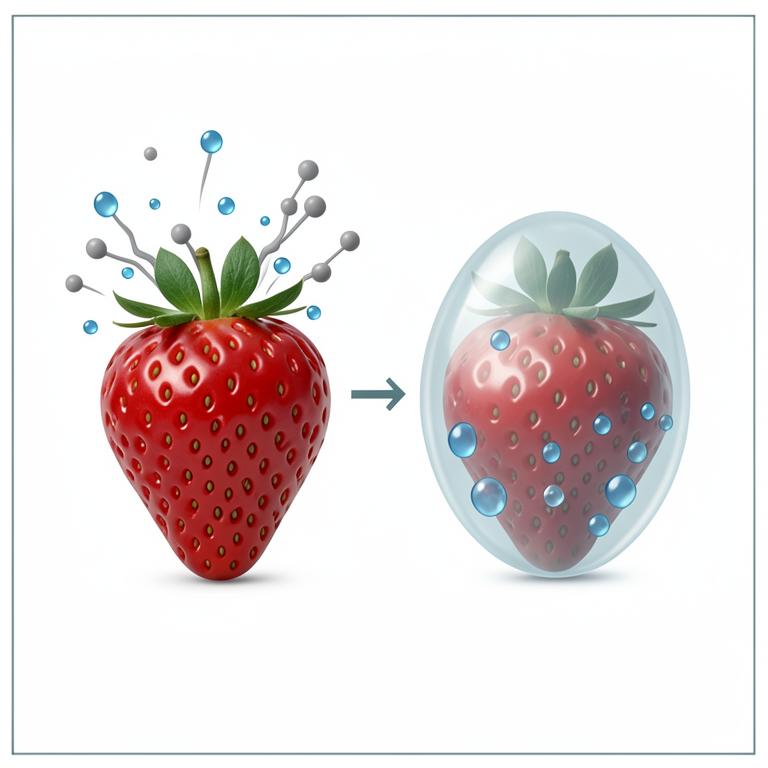
Mechanism of Edible Coatings
AI-generated conceptual illustration (fresh strawberries). It explains the idea and does not show study data.
View source evidence ↗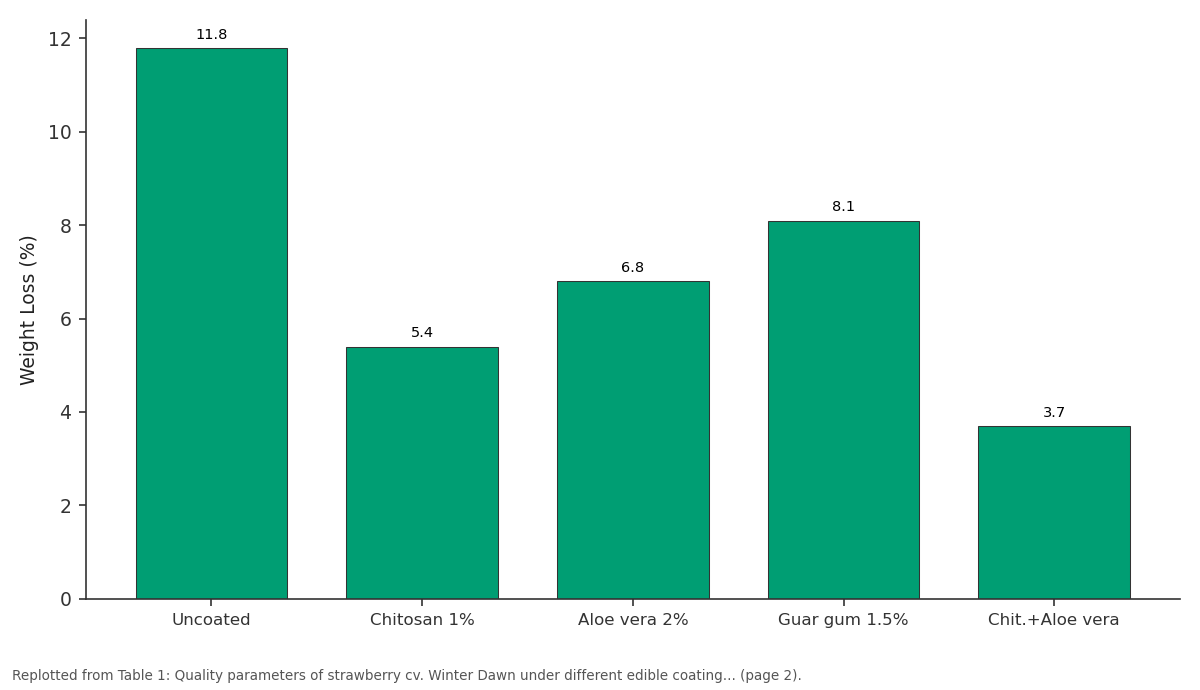
Weight Loss (%): Uncoated vs Chitosan 1% vs Aloe vera 2% vs Guar gum 1.5% vs Chit.+Aloe vera
Replotted from Table 1 (page 2) of the original paper. Every bar is the paper's own table value.
View source evidence ↗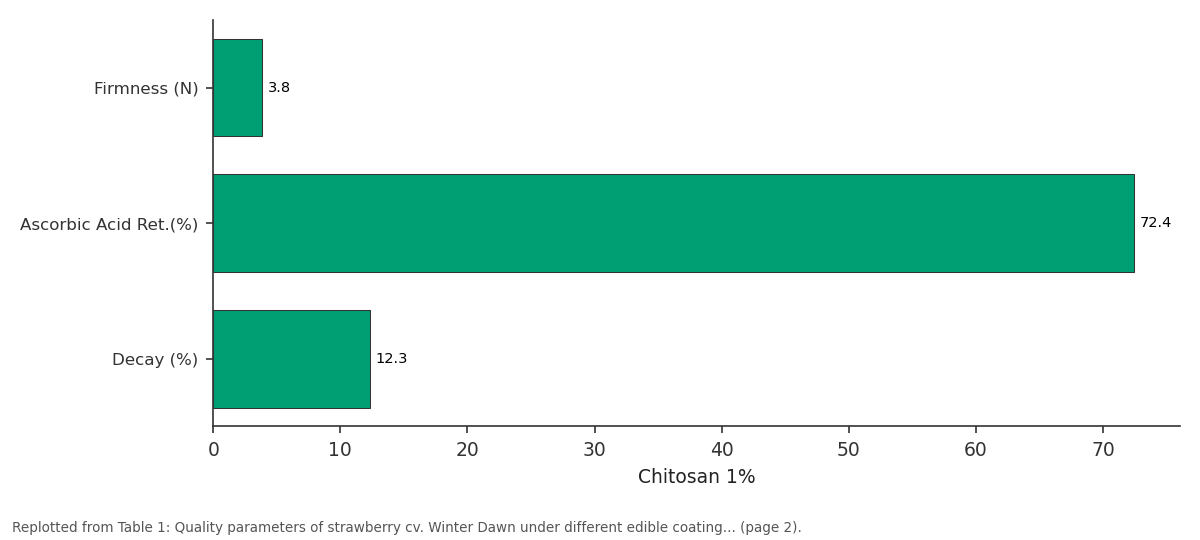
Chitosan 1%: Firmness (N) vs Ascorbic Acid Ret.(%) vs Decay (%)
Replotted from Table 1 (page 2) of the original paper. Every bar is the paper's own table value.
View source evidence ↗Figures & tables
From the original paper Table 1
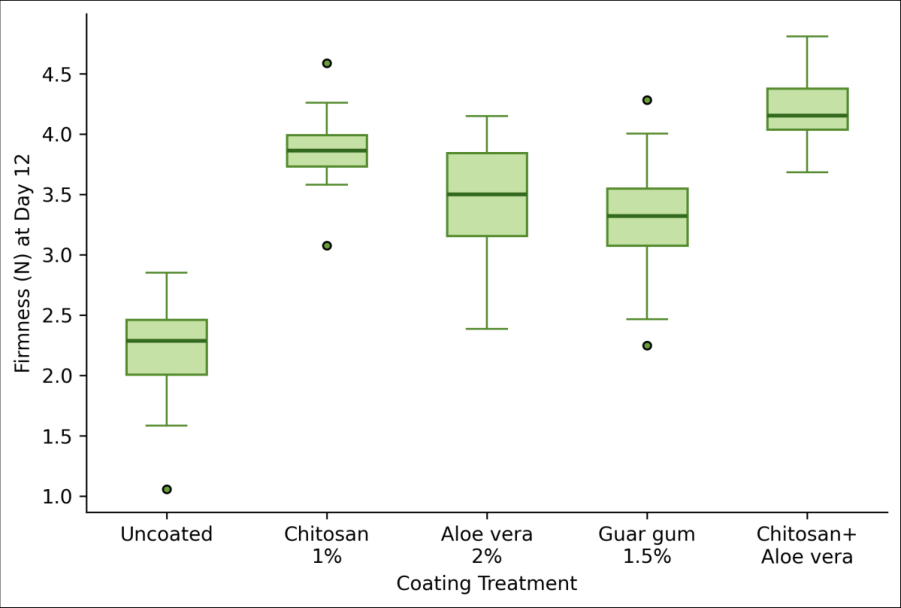 Figure 1
 Table 2
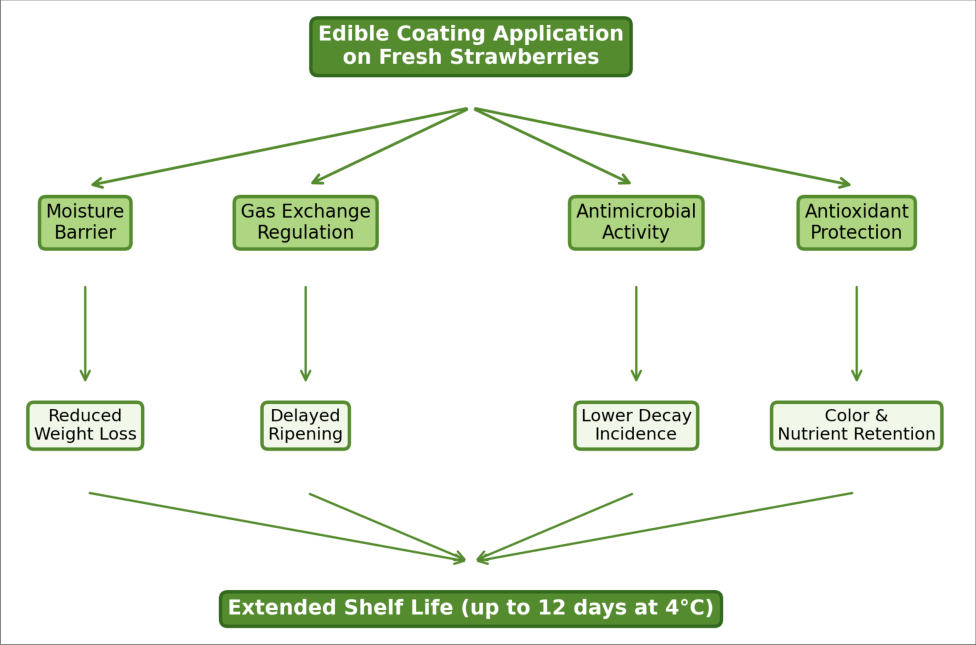 Figure 2
Introduction
Strawberry (Fragaria × ananassa Duch.) is among the most perishable of all commercial fruits. Its soft texture, high water content (91%), and active metabolism make it vulnerable to rapid quality deterioration after harvest [1] . In India, post-harvest losses for strawberries are estimated at 25 to 40 percent of the harvested crop-much of it occurring during transport from the farms of Maharashtra and Gujarat to urban retail markets [2] . Edible coatings address this challenge by creating a thin, food-safe film that modifies the internal atmosphere of the fruit, slowing O₂ ingress and CO₂ egress. This modified atmosphere reduces respiration rate, ethylene production, and oxidative browning [3] . Chitosan, a deacetylated derivative of chitin, is one of the most studied coating materials because it combines film-forming ability with inherent antifungal activity against Botrytis and Rhizopus [4] . Aloe vera gel offers complementary benefits: it is rich in acemannan polysaccharides that form transparent, moisture-retaining films and contains antimicrobial compounds like aloin and barbaloin [5] . Combining two coating materials with different functional properties-a structural polysaccharide (chitosan) and a bioactive gel (aloe vera)-may produce a composite that outperforms either component alone. Such synergistic composites have shown promise on mango and table grapes [6,7] but have not been evaluated on strawberry under the semi-arid conditions of Gujarat. This research aimed to (i) compare four edible coatings for quality retention of strawberries during 12 days of cold storage, (ii) identify the best formulation for firmness, weight loss, and decay control, and (iii) assess the impact on nutritional parameters including ascorbic acid and anthocyanins.
Material and Methods Material
Fresh strawberries (cv. Winter Dawn) were harvested at the three-quarter red stage from the university's horticultural farm at Sardarkrushinagar Dantiwada Agricultural University, Dantiwada, Gujarat (24.19°N, 72.12°E), during January 2023. Fruits were pre-cooled to 10 °C within 2 hours of harvest, sorted for uniformity (20-25 g, free of defects), and randomly assigned to five treatments: T1uncoated control (distilled water dip), T2 -chitosan 1% (in 1% acetic acid), T3 -aloe vera gel 2% (fresh extract in distilled water), T4 -guar gum 1.5% (hydrated overnight), and T5 -chitosan 1% + aloe vera 2% composite. Fruits were dipped for 2 min, air-dried under laminar flow for 30 min, placed in PET clamshell containers (250 g capacity), and stored at 4 ± 1 °C and 90 ± 5% RH.
Quality Assessment Protocol
Assessments were made at 0, 3, 6, 9, and 12 days of storage. Weight loss was measured gravimetrically. Firmness was recorded using a texture analyser (TA.XT Plus, Stable Micro Systems) with a 2-mm probe at 1 mm/s penetration speed. TSS was measured by digital refractometer, titratable acidity by NaOH titration, and pH by electrode. Ascorbic acid was determined by the 2,6-dichlorophenolindophenol titration method [8] . Total anthocyanin content was measured by the pH differential method [9] . Decay incidence was scored as the percentage of fruits showing visible mould growth or soft rot. Each treatment had four replications of 20 fruits.
Methods
Data were analysed by two-way ANOVA (treatment × storage day) in a completely randomized design using SPSS 28. Treatment means were compared by Tukey's HSD at p<0.05. Decay data were arcsine-transformed before analysis. Rate constants for weight loss and firmness decline were calculated by linear regression against storage time. The chitosan + aloe vera composite outperformed all other treatments on every parameter measured. Weight loss was reduced to 3.7 percent (vs 11.8% uncoated), firmness retained at 4.3 N (vs 2.1 N), and decay incidence limited to 8.4 percent (vs 34.6%). Ascorbic acid retention reached 78.3 percent under the composite coating compared with just 51.2 percent in uncoated fruit. Weight loss increased linearly across all treatments, but the rate was substantially slower under the composite coating (0.31% per day) compared with uncoated (0.98% per day).
Results
The composite treatment maintained commercially acceptable weight loss (<5%) through day 12.
Discussion
The synergistic performance of the chitosan + aloe vera composite likely results from complementary mechanisms: chitosan provides a strong, semi-permeable polysaccharide matrix with antifungal properties, while vera gel fills micropores in the film, improving moisture barrier function and adding its own antimicrobial activity [4,5] . The 8.4 percent decay incidence under the composite-roughly onequarter that of the uncoated control-is commercially significant because decay is the primary cause of strawberry rejection at retail. The 78.3 percent ascorbic acid retention at day 12 is notably higher than the 55-65 percent range reported for chitosanonly coatings on strawberry in most published trials [10,11] . The addition of aloe vera likely slowed oxidative degradation by reducing oxygen permeation through the coating. A similar antioxidant-protective effect was observed in chitosan-aloe vera coated table grapes [7] . Guar gum performed the weakest among the tested coatings, consistent with its poor film-forming properties and lack of inherent antimicrobial activity [12] . It is better suited as a thickening agent in composite formulations than as a standalone coating material.
Conclusion
A composite edible coating of 1% chitosan + 2% aloe vera gel extended the marketable shelf life of cv. Winter Dawn strawberries from 5 to 12 days at 4 °C. It maintained the highest firmness (4.3 N), lowest weight loss (3.7%), lowest decay (8.4%), and best ascorbic acid retention (78.3%) among all tested treatments. This composite offers a biodegradable, food-safe alternative to synthetic wax coatings for strawberry post-harvest management. Scale-up testing with commercial packing lines and consumer acceptability trials should precede commercial adoption.
Acknowledgement
Acknowledgements Funding SourcesThis research was supported through the university's internal post-harvest research budget. Institutional SupportThe authors thank the Department of Harvest Engineering, SDAU Dantiwada, for providing cold storage and laboratory facilities.
Figures and tables from the paper
| Treatment | Weight Loss (%) | Firmness (N) | TSS (°Brix) | TA (%) | Ascorbic Acid Ret.(%) | Decay (%) |
|---|---|---|---|---|---|---|
| Uncoated | 11.8 | 2.1 | 8.9 | 0.42 | 51.2 | 34.6 |
| Chitosan 1% | 5.4 | 3.8 | 7.6 | 0.58 | 72.4 | 12.3 |
| Aloe vera 2% | 6.8 | 3.4 | 7.8 | 0.54 | 67.8 | 16.7 |
| Guar gum 1.5% | 8.1 | 3.1 | 8.2 | 0.51 | 62.3 | 21.4 |
| Chit.+Aloe vera | 3.7 | 4.3 | 7.3 | 0.63 | 78.3 | 8.4 |
| SEm(±) | 0.42 | 0.18 | 0.14 | 0.02 | 2.31 | 1.87 |
| CD (p=0.05) | 1.26 | 0.54 | 0.42 | 0.06 | 6.93 | 5.61 |
Table text extracted from the original PDF; superscript letters are shown inline. The original table image is below.
View original table image
| Treatment | Day 0 | Day 3 | Day 6 | Day 9 | Day 12 |
|---|---|---|---|---|---|
| Uncoated | 0 | 2.8 | 5.7 | 8.9 | 11.8 |
| Chitosan 1% | 0 | 1.2 | 2.6 | 4.1 | 5.4 |
| Chit.+Aloe vera | 0 | 0.8 | 1.7 | 2.8 | 3.7 |
Table text extracted from the original PDF; superscript letters are shown inline. The original table image is below.
View original table image
References
17 in the original paper- Nunes MCN, Brecht JK, Morais AMMB. Strawberry harvest and post-harvest quality: a review. Scientia Horticulturae. 2006;110(3):298-307.
- Kader AA. Increasing food availability by reducing postharvest losses of fresh produce. Acta Horticulturae. 2005;682:2169-2176.
- Baldwin EA, Hagenmaier R, Bai J. Edible coatings and films to improve food quality. 2nd ed. CRC Press; 2012.
- El Ghaouth A, Arul J, Ponnampalam R. Chitosan coating effect on storability and quality of fresh strawberries. Journal of Food Science. 1991;56(6):1618-1620.
- Valverde JM, Valero D, Martinez-Romero D. Novel edible coating based on aloe vera gel for fresh-cut fruit preservation. Food Chemistry. 2005;93(3):351-358.
- Maqbool M, Ali A, Alderson PG. Effect of a novel edible composite coating based on gum arabic and chitosan on biochemical and physiological responses of banana fruits during cold storage. Journal of Agricultural and Food Chemistry. 2011;59(10):54745482.
- Castillo S, Navarro D, Zapata PJ. Antifungal efficacy of aloe vera in vitro and its use as a preharvest treatment to maintain postharvest table grape quality. Postharvest Biology and Technology. 2010;57(3):183-188.
- AOAC. Official methods of analysis: vitamin C by indophenol method. 20th ed. Association of Official Analytical Chemists; 2016.
- Giusti MM, Wrolstad RE. Characterization and measurement of anthocyanins by UV-visible spectroscopy. Current Protocols in Food Analytical Chemistry. 2001;F1.2.1-F1.2.13.
- Hernandez-Munoz P, Almenar E, Del Valle V. Effect of chitosan coating combined with postharvest calcium treatment on strawberry quality during refrigerated storage. Food Chemistry. 2008;110(2):428-435.
- Vargas M, Albors A, Chiralt A. Quality of cold-stored strawberries as affected by chitosan-oleic acid edible coatings. Postharvest Biology and Technology. 2006;41(2):164-171.
- Cerqueira MA, Bourbon AI, Pinheiro AC. Galactomannans use in the development of edible films/coatings for food applications. Trends in Food Science and Technology. 2011;22(12):662-671.
- Aday MS, Caner C. The applications of active packaging and chlorine dioxide for extended shelf life of fresh strawberries. Packaging Technology and Science. 2011;24(3):123-136.
- Dhall RK. Advances in edible coatings for fresh fruits and vegetables: a review. Critical Reviews in Food Science and Nutrition. 2013;53(5):435-450.
- Ribeiro C, Vicente AA, Teixeira JA. Optimization of edible coating composition to retard strawberry fruit senescence. Postharvest Biology and Technology. 2007;44(1):63-70.
- Gol NB, Patel PR, Rao TVR. Improvement of quality and shelf life of strawberries with edible coatings enriched with chitosan. Postharvest Biology and Technology. 2013;85:185-195.
- Mali S, Grossmann MVE. Effects of yam starch films on storability and quality of fresh strawberries. Journal of Agricultural and Food Chemistry. 2003;51(27):70057011.