
Research article · 2025 · Full text
International Journal of Agriculture and NutritionResponse of potato to potassium fertilization and growth retardants under short day conditions
Volume 7(4) · Pages 173–176 · DOI: 10.33545/26646064.2025.v7.i4c.432 ↗
Research areasAgricultural Science and FertilizationPotato Plant ResearchPlant Growth and Agriculture Techniques
Abstract
Author-writtenWhile nitrogen receives the bulk of attention in potato nutrition research, potassium quietly governs tuber bulking rate, dry matter partitioning, and post-harvest quality—yet it is often under-applied in tropical short-day production systems. Simultaneously, excessive vine growth under warm, humid conditions diverts assimilates away from tubers, reducing harvest index. This research examined the interactive effects of four potassium levels (0, 75, 150, and 225 kg K₂O ha⁻¹) and three growth retardant treatments (control, chlormequat chloride at 1,500 ppm, and paclobutrazol at 100 ppm) on growth, tuber yield, and quality of potato cultivar Diamant under short-day conditions at Can Tho, Vietnam. The experiment followed a factorial randomized block design with three replications during the winter 2022-23 season. Potassium at 150 kg K₂O ha⁻¹ combined with paclobutrazol produced the highest marketable tuber yield (28.7 t ha⁻¹), 43.6 percent above the zero-K control without retardant. Paclobutrazol reduced plant height by 18.3 percent and increased the tuber-to-shoot dry matter ratio from 2.8 to 4.1. Tuber dry matter content peaked at 21.4 percent under K₁₅₀ + paclobutrazol, whereas tubers from the zero-K control contained only 17.8 percent dry matter. Potassium uptake was 38.7 percent higher when K₁₅₀ was paired with paclobutrazol compared to K₁₅₀ alone, suggesting that retarded vine growth redirects nutrient absorption toward tubers. These results indicate that moderate K fertilization combined with a growth retardant spray at 40 days after planting can markedly improve tuber yield and quality in short-day tropical potato production.
Summary
Source-checkedPlain-language reading of the full paper, prepared with AI and checked against the text. Each point links to the authors' own words.
Why it matters
- Potassium is critical for potato tuber bulking, dry matter partitioning, and post-harvest quality, but it is frequently under-applied in tropical short-day production systems. View evidence ↗
- In warm and humid environments, excessive vine growth can reduce the harvest index by diverting assimilates away from the tubers. View evidence ↗
- Due to growth imbalances, average potato yields in southern Vietnam (18-22 t ha⁻¹) are significantly lower than those in temperate countries (35-45 t ha⁻¹). View evidence ↗
The question
- The study aimed to determine if combining potassium (K) fertilization with foliar growth retardants could improve tuber yield and quality in the Mekong Delta's short-day conditions. View evidence ↗
What they did
- The study was conducted from November to February (winter 2022-23) at Mekong Agricultural University in Can Tho, Vietnam, using the short-day adapted potato cultivar Diamant. View evidence ↗
- Measurements included plant height, stem diameter, leaf area index (LAI), total and marketable tuber yield (>25 g), tuber dry matter, specific gravity, and potassium uptake. View evidence ↗
What they found
- Across all potassium levels, paclobutrazol reduced plant height by 16-19% and the leaf area index (LAI) by 14-21%. View evidence ↗
- The K₁₅₀ + paclobutrazol treatment achieved the highest harvest index (65.8%), with tubers capturing 68.3% of total plant dry matter compared to 52.1% in the zero-K control. View evidence ↗
- Tuber dry matter peaked at 21.4% and reducing sugars were lowest (0.23%) under the K₁₅₀ + paclobutrazol treatment, meeting processing-quality standards. View evidence ↗
What it means
- The authors conclude that the optimal strategy for potato cv. Diamant in Can Tho, Vietnam, is combining 150 kg K₂O ha⁻¹ with a 100 ppm paclobutrazol spray at 40 days after planting. View evidence ↗
- The authors state that further validation across different seasons and potato cultivars is necessary before the findings can be widely extended. View evidence ↗
Visual summary
3 visualsIllustrations explain the paper; charts are replotted from the paper's own table values.
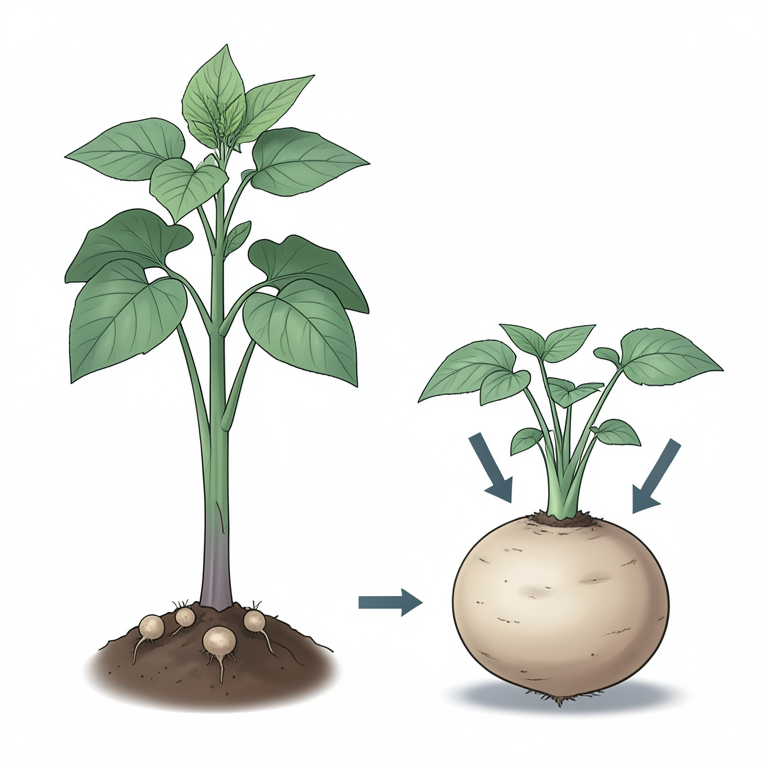
Assimilate and Nutrient Redirection
AI-generated conceptual illustration (potato plants (Solanum tuberosum)). It explains the idea and does not show study data.
View source evidence ↗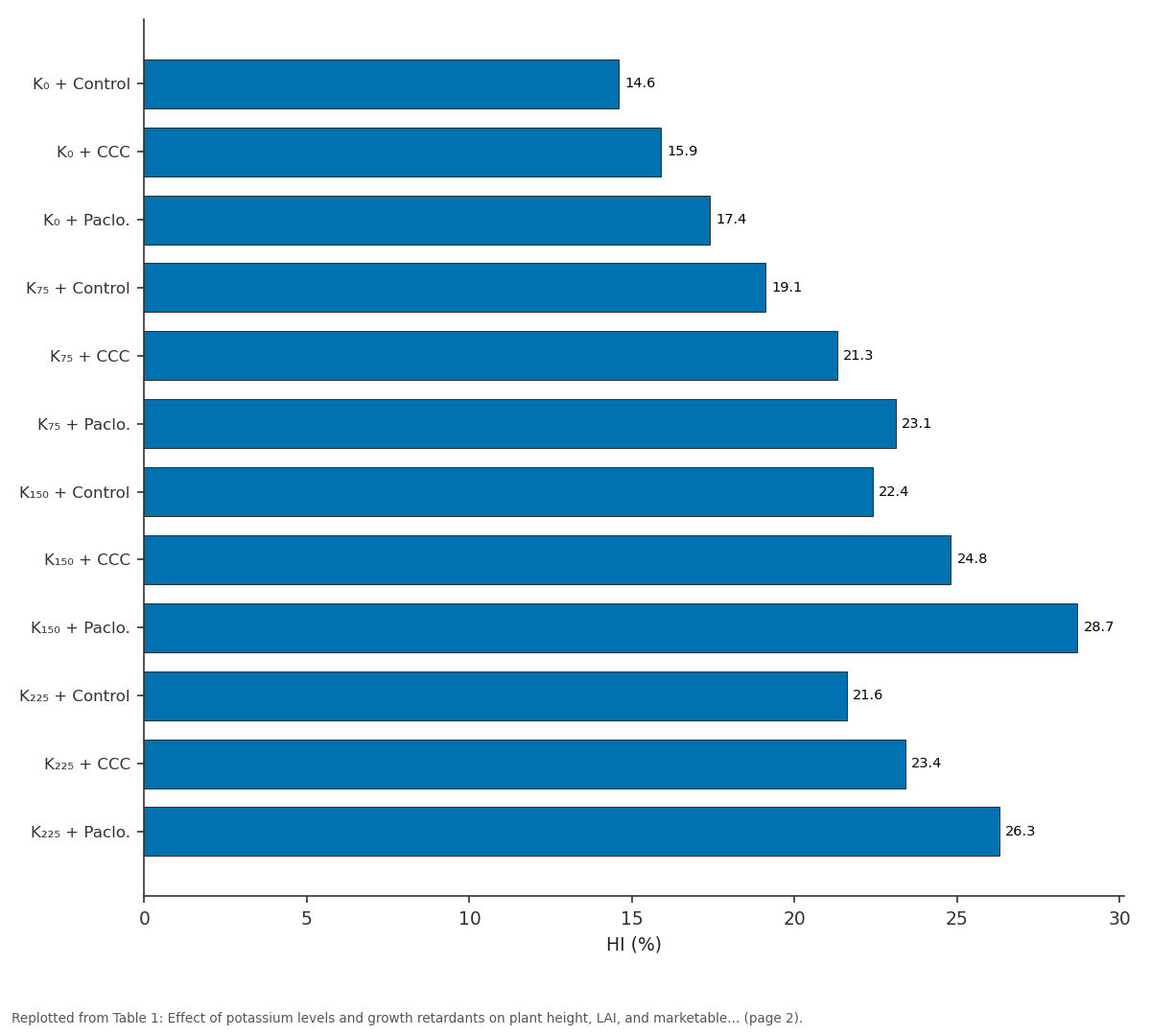
Mkt. Yield (t ha⁻¹): K₀ + Control vs K₀ + CCC vs K₀ + Paclo. vs K₇₅ + Control vs K₇₅ + CCC
Replotted from Table 1 (page 2) of the original paper. Every bar is the paper's own table value.
View source evidence ↗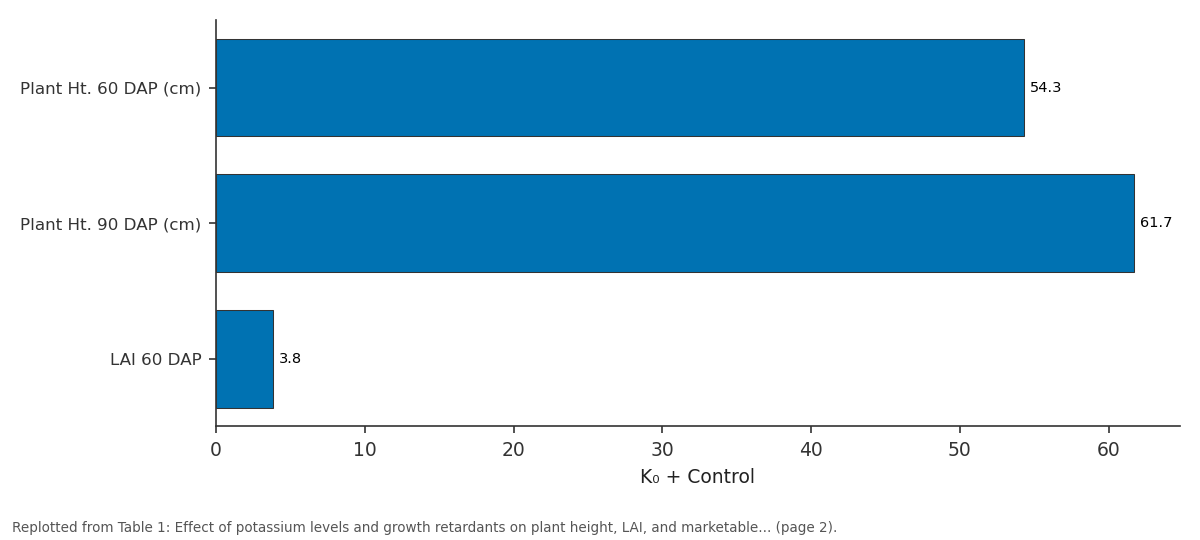
K₀ + Control: Plant Ht. 60 DAP (cm) vs Plant Ht. 90 DAP (cm) vs LAI 60 DAP
Replotted from Table 1 (page 2) of the original paper. Every bar is the paper's own table value.
View source evidence ↗Figures & tables
From the original paper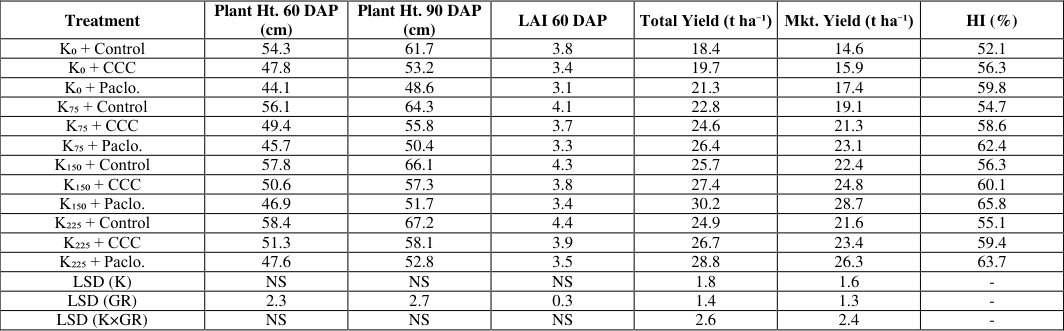 Table 1
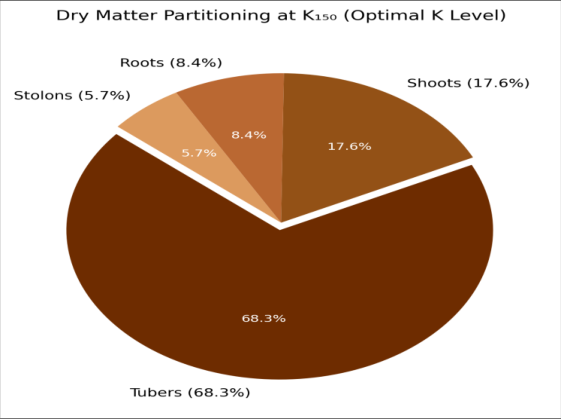 Figure 1
 Table 2
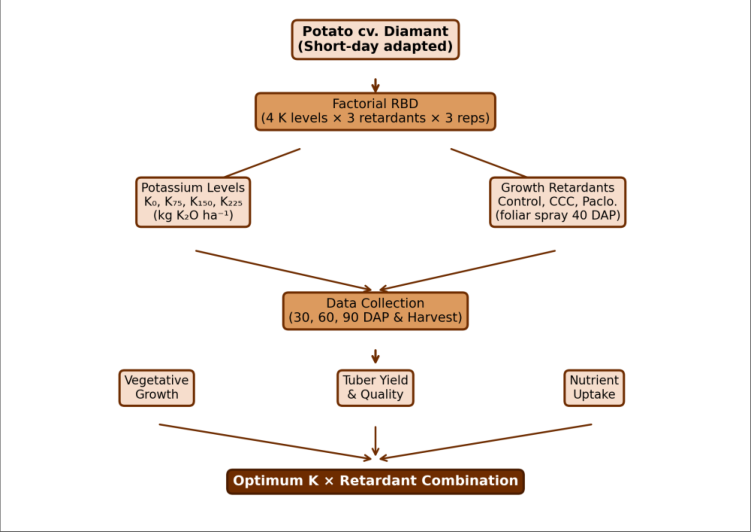 Figure 2
Introduction
Potato growers in the Mekong Delta face a paradox: the warm, humid climate that supports year-round cropping also promotes excessive vegetative growth at the expense of tuber bulking. Under short-day conditions (11-12 h daylength), tuber initiation is triggered relatively early, but the sustained warmth pushes indeterminate shoot growth that competes with tubers for photosynthate [1] . This imbalance explains why average potato yields in southern Vietnam (18-22 t ha⁻¹) lag well behind those in temperate countries (35-45 t ha⁻¹) despite comparable genetic potential [2] . Potassium plays a central role in resolving this conflict. As the most abundant cation in potato tubers, K regulates starch synthesis, phloem loading of sucrose, and osmotic balance during cell expansion [3] . Deficiency slows tuber bulking and lowers specific gravity, while adequate supply improves both yield and cooking quality [4] . However, many Mekong Delta soils are alluvial clays with moderate exchangeable K (0.2-0.4 cmol kg⁻¹), and farmers often underdose K relative to nitrogen, creating an N:K imbalance that favours shoot growth [5] . Growth retardants offer a complementary approach. Compounds like chlormequat chloride (CCC), which inhibits gibberellin biosynthesis at the ent-kaurene stage, and paclobutrazol, which blocks the oxidation of ent-kaurene to ent-kaurenoic acid, suppress internode elongation and redirect assimilates toward sink organs [6] . In temperate potato systems, paclobutrazol has been shown to increase harvest index by 12 to 20 percent, though reports from tropical short-day environments remain scarce [7] . This research tested whether combining K fertilization with foliar growth retardant application could simultaneously address nutrient supply and assimilate partitioning, thereby improving tuber yield and quality under the short-day conditions of the Mekong Delta.
Methods
The experiment used a 4 × 3 factorial arrangement in a randomized block design with three replications. Factor A: K levels (K₀, K₇₅, K₁₅₀, K₂₂₅ kg K₂O ha⁻¹). Factor B: growth retardants (control, CCC at 1,500 ppm, paclobutrazol at 100 ppm). Plot size was 4 m × 3 m with 60 × 25 cm spacing.
Basal N and P were uniform at 120-80 kg ha⁻¹. Observations: plant height, stem diameter, leaf area index (LAI) at 60 and 90 DAP; tuber yield (total and marketable, >25 g), tuber dry matter (oven at 70 °C to constant weight), specific gravity (weight in air / weight in water method), and K uptake by tuber and shoot. Data were analysed using two-way ANOVA in OPSTAT with LSD at p=0.05.
Results
Table At the optimal K₁₅₀ + paclobutrazol combination, tubers captured 68.3 percent of total plant dry matter (Figure 1), compared with only 52.1 percent in the K₀ control. The shift in partitioning toward tubers was driven primarily by reduced shoot biomass under paclobutrazol, rather than increased root or stolon allocation. Tuber dry matter peaked at 21.4 percent under K₁₅₀ + paclobutrazol, meeting the threshold for processing-quality tubers (>20%). Reducing sugars were lowest (0.23%) in the same treatment-desirable for chips and fries where high sugar causes dark browning. K uptake by tubers was 38.7 percent higher when paclobutrazol was combined with K₁₅₀ (114.7 vs 82.7 kg ha⁻¹ under K₁₅₀ alone).
Discussion
The plateau in yield response beyond K₁₅₀ is consistent with findings from subtropical potato systems in Bangladesh and southern China, where maximum tuber yield was achieved at 120-160 kg K₂O ha⁻¹ on alluvial soils with similar exchangeable K status [8,9] . The lack of response at K₂₂₅ likely reflects luxury K consumption-uptake continues to rise (126.3 kg ha⁻¹) without proportional yield benefit, increasing fertilizer cost without return. Paclobutrazol's effect on harvest index (52.1 → 65.8% at K₁₅₀) confirms the mechanism proposed by Tekalign and Hammes [10] : by reducing gibberellin-mediated stem elongation, the retardant limits vegetative sink strength and redirects sucrose flux toward tubers during the bulking phase. CCC produced qualitatively similar effects but with smaller magnitude, possibly because its site of action in the GA pathway is upstream and less potent than paclobutrazol's at the doses tested [6] . The improvement in tuber dry matter and specific gravity under K₁₅₀ + paclobutrazol has practical implications for the Vietnamese processing industry. Potatoes with ≥20 percent dry matter and ≤0.25 percent reducing sugars meet the raw material specifications of major chip manufacturers in the Mekong region [11] . Achieving these quality thresholds under short-day tropical conditions-where high night temperatures normally depress starch accumulation-is a tangible agronomic gain.
Conclusion
This research showed that combining potassium fertilization at 150 kg K₂O ha⁻¹ with a single foliar spray of paclobutrazol at 100 ppm (40 DAP) produced the best tuber yield and quality outcomes for potato cv.
Figures and tables from the paper
| Treatment | Plant Ht. 60 DAP (cm) | Plant Ht. 90 DAP (cm) | LAI 60 DAP | Total Yield (t ha⁻¹) | Mkt. Yield (t ha⁻¹) | HI (%) |
|---|---|---|---|---|---|---|
| K₀ + Control | 54.3 | 61.7 | 3.8 | 18.4 | 14.6 | 52.1 |
| K₀ + CCC | 47.8 | 53.2 | 3.4 | 19.7 | 15.9 | 56.3 |
| K₀ + Paclo. | 44.1 | 48.6 | 3.1 | 21.3 | 17.4 | 59.8 |
| K₇₅ + Control | 56.1 | 64.3 | 4.1 | 22.8 | 19.1 | 54.7 |
| K₇₅ + CCC | 49.4 | 55.8 | 3.7 | 24.6 | 21.3 | 58.6 |
| K₇₅ + Paclo. | 45.7 | 50.4 | 3.3 | 26.4 | 23.1 | 62.4 |
| K₁₅₀ + Control | 57.8 | 66.1 | 4.3 | 25.7 | 22.4 | 56.3 |
| K₁₅₀ + CCC | 50.6 | 57.3 | 3.8 | 27.4 | 24.8 | 60.1 |
| K₁₅₀ + Paclo. | 46.9 | 51.7 | 3.4 | 30.2 | 28.7 | 65.8 |
| K₂₂₅ + Control | 58.4 | 67.2 | 4.4 | 24.9 | 21.6 | 55.1 |
| K₂₂₅ + CCC | 51.3 | 58.1 | 3.9 | 26.7 | 23.4 | 59.4 |
| K₂₂₅ + Paclo. | 47.6 | 52.8 | 3.5 | 28.8 | 26.3 | 63.7 |
| LSD (K) | NS | NS | NS | 1.8 | 1.6 | - |
| LSD (GR) | 2.3 | 2.7 | 0.3 | 1.4 | 1.3 | - |
| LSD (K×GR) | NS | NS | NS | 2.6 | 2.4 | - |
Table text extracted from the original PDF; superscript letters are shown inline. The original table image is below.
View original table image
| Treatment | Dry Matter (%) | Specific Gravity | Reducing Sugars (%) | K Uptake Tuber (kg ha⁻¹) |
|---|---|---|---|---|
| K₀ + Control | 17.8 | 1.068 | 0.34 | 48.3 |
| K₇₅ + Paclo. | 20.1 | 1.078 | 0.27 | 81.6 |
| K₁₅₀ + Paclo. | 21.4 | 1.084 | 0.23 | 114.7 |
| K₂₂₅ + Paclo. | 20.8 | 1.081 | 0.26 | 126.3 |
| K₁₅₀ + Control | 19.6 | 1.074 | 0.29 | 82.7 |
| K₁₅₀ + CCC | 20.3 | 1.079 | 0.25 | 96.4 |
| LSD (p=0.05) | 0.9 | 0.004 | 0.03 | 8.7 |
Table text extracted from the original PDF; superscript letters are shown inline. The original table image is below.
View original table image
References
20 in the original paper- Ewing EE, Struik PC. Tuber formation in potato: Induction, initiation, and growth. Horticultural Reviews. 1992;14:89-198.
- Haverkort AJ, Koesveld MJ, Schepers HTAM. Potato production in Vietnam: Status and constraints. Potato Research. 2018;61(3):227-242.
- Zörb C, Senbayram M, Peiter E. Potassium in agriculture: Status and perspectives. Journal of Plant Physiology. 2014;171(9):656-669.
- Kavvadias V, Paschalidis C, Akrivos G. Effect of potassium on potato tuber yield and quality. Journal of Plant Nutrition. 2012;35(12):1882-1895.
- Tri LQ, Van NM, Hanh NT. Soil fertility status and fertilizer management in the Mekong Delta. Vietnamese Journal of Agricultural Sciences. 2020;18(4):312-321.
- Rademacher W. Growth retardants: Effects on gibberellin biosynthesis and other metabolic pathways. Annual Review of Plant Physiology and Plant Molecular Biology. 2000;51:501-531.
- Tekalign T, Hammes PS. Growth and productivity of potato as influenced by cultivar and reproductive growth: Paclobutrazol as a growth retardant. Scientia Horticulturae. 2005;105(4):461-469.
- Islam MS, Hossain MF, Karim MA. Potassium requirement of potato in floodplain soils of Bangladesh. Bangladesh Journal of Agricultural Research. 2017;42(3):417-425.
- Zhang HP, Wang Z, Liu SJ. Potassium effects on potato tuber yield and quality in southern China. Plant Production Science. 2019;22(2):213-221.
- Tekalign T, Hammes PS. Growth and biomass production in potato plants as influenced by paclobutrazol. New Zealand Journal of Crop and Horticultural Science. 2005;33(3):259-269.
- Hoang TTH, Vu BN, Tran DM. Raw material quality specifications for potato chip processing in Vietnam. Journal of Food Science and Technology Vietnam. 2021;15(2):89-96.
- Singh JP, Trehan SP. Balanced fertilization to increase the yield of potato. Fertiliser News. 1998;43(7):33-37.
- Kumar P, Pandey SK, Singh BP. Effect of potassium on processing quality attributes of potato tubers. Potato Journal. 2007;34(1-2):108-114.
- Struik PC, Wiersema SG. Seed potato technology. Wageningen Academic Publishers; 1999. 1st ed.
- Patel CK, Patel PT, Chaudhari SM. Growth regulation in potato using paclobutrazol and mepiquat chloride. Indian Journal of Horticulture. 2012;69(4):558-562.
- Kolbe H, Stephan-Beckmann S. Development, growth and chemical composition of the potato crop: Potassium and dry matter. Potato Research. 1997;40(4):411-431.
- Pham VH, Nguyen TL. Winter potato production in the Mekong Delta: Opportunities and challenges. Acta Horticulturae. 2019;1251:143-150.
- Sharma RC, Trehan SP. Potassium nutrition of potato in India. Journal of the Indian Potato Association. 2005;32(3-4):131-138.
- Fletcher RA, Gilley A, Sankhla N. Triazoles as plant growth regulators and stress protectants. Horticultural Reviews. 2000;24:55-138.
- Bansal SK, Trehan SP. Effect of potassium on yield and processing quality of potato varieties. Better Crops International. 2011;19(S):40-44.