
Research article · 2025 · Full text
International Journal of Biology SciencesProbiotic potential of lactobacillus strains isolated from traditional fermented dairy products
Volume 7(10) · Pages 228–231 · DOI: 10.33545/26649926.2025.v7.i10c.796 ↗
Research areasProbiotics and Fermented FoodsReproductive tract infections researchAnimal Diversity and Health Studies
Abstract
Author-writtenTraditional fermented dairy products represent a rich and largely untapped reservoir of lactic acid bacteria with potential probiotic properties. This research isolated and characterized Lactobacillus strains from four types of artisanal fermented dairy products (laban, zabadi, jameed, and fermented camel milk) collected from local markets in the Jeddah region, Saudi Arabia. A total of 127 presumptive Lactobacillus isolates were recovered, of which 48 were confirmed to the species level by 16S rRNA gene sequencing. Eight species were identified: L. plantarum (n = 14), L. rhamnosus (n = 9), L. acidophilus (n = 7), L. casei (n = 6), L. fermentum (n = 5), L. brevis (n = 3), L. helveticus (n = 2), and L. delbrueckii subsp. bulgaricus (n = 2). These 48 strains were screened for six probiotic attributes: acid tolerance (survival at pH 2.0 for 3 hours), bile salt tolerance (0.3% oxgall for 4 hours), antimicrobial activity against four enteric pathogens, cholesterol assimilation, antioxidant capacity (DPPH radical scavenging), and adhesion to Caco-2 intestinal epithelial cells. L. plantarum LP-J07 emerged as the top candidate, showing 94.6% acid survival, 88.7% bile survival, broad antimicrobial activity, 47.3% cholesterol removal, and 12.8% adhesion to Caco-2 monolayers. L. rhamnosus LR-Z03 ranked second across all criteria. These results indicate that Saudi Arabian fermented dairy foods harbor Lactobacillus strains with strong probiotic characteristics suitable for further development as functional food ingredients or dietary supplements.
Summary
Source-checkedPlain-language reading of the full paper, prepared with AI and checked against the text. Each point links to the authors' own words.
Why it matters
- The global probiotics market is growing rapidly, but most commercial strains come from a limited set of species discovered long ago in Western laboratories. View evidence ↗
- There is a concern that probiotic strains selected for Western diets might not be as effective for people with different genetic backgrounds or diets. View evidence ↗
- Traditional fermented foods from the Middle East and North Africa are viewed as a potential alternative source for discovering new probiotic candidates. View evidence ↗
The question
- The study aimed to identify high-performing Lactobacillus strains from local Saudi Arabian fermented dairy products to create region-specific probiotics. View evidence ↗
What they did
- Researchers collected samples of laban (12), zabadi (10), jameed (8), and fermented camel milk (6) from markets in Jeddah, Saudi Arabia, from March to September 2023. View evidence ↗
- Out of 127 presumptive Lactobacillus isolates recovered, 48 were confirmed at the species level using 16S rRNA gene sequencing. View evidence ↗
- The 48 confirmed strains were tested for six traits: survival at pH 2.0 for 3 hours, survival in 0.3% oxgall for 4 hours, antimicrobial activity against four pathogens, cholesterol removal, antioxidant capacity, and adhesion to Caco-2 cells. View evidence ↗
What they found
- L. rhamnosus LR-Z03 was the second-best performing strain across all tested probiotic criteria. View evidence ↗
- Strains from fermented camel milk had a slightly higher average acid tolerance (84.1%) than those from cow-milk products (79.3%), but this was not statistically significant. View evidence ↗
- Based on a composite probiotic score, L. plantarum LP-J07 ranked first (score 8), followed by L. rhamnosus LR-Z03 (score 14) and L. acidophilus LA-L05 (score 19). View evidence ↗
What it means
- The authors concluded that L. plantarum LP-J07 and L. rhamnosus LR-Z03 are the most promising probiotic candidates from the Saudi Arabian dairy products studied. View evidence ↗
- The authors recommend that animal feeding trials and human clinical studies be conducted to validate these results before the strains are used commercially. View evidence ↗
- The authors note that the in vitro assays used in this study only indicate potential and cannot replace in vivo validation. View evidence ↗
- The small number of fermented camel milk samples (6) limited the diversity of the isolates recovered from that specific product. View evidence ↗
Figures & tables
From the original paper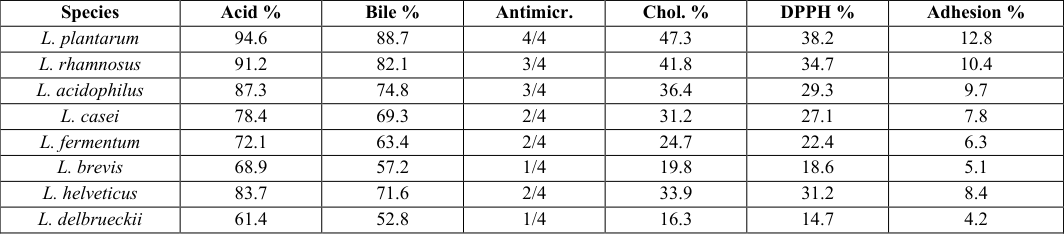 Table 1
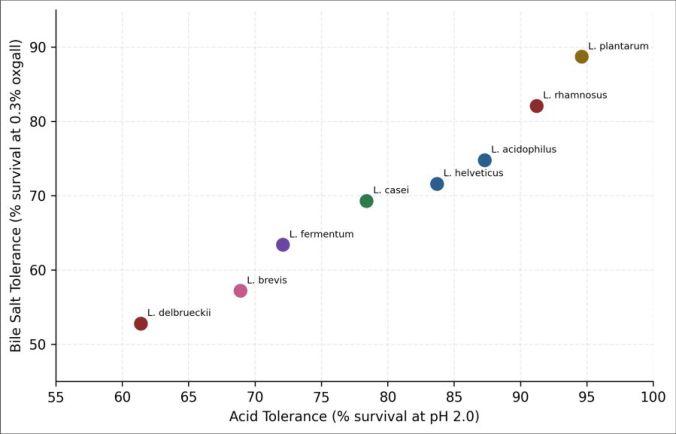 Figure 1
 Figure 2
Introduction
The global probiotics market is projected to exceed 80 billion USD by 2028, yet most commercially available strains originate from a narrow pool of species isolated decades ago in European and North American laboratories [1] . This raises two concerns. First, strain diversity in commercial products is limited, which constrains the range of health benefits that can be delivered. Second, strains selected under Western dietary contexts may not perform optimally in populations with different genetic backgrounds, diets, and gut microbiome compositions [2] . Traditional fermented foods from the Middle East and North Africa offer an alternative source of probiotic candidates. Products like laban (fermented buttermilk), zabadi (set yogurt), and jameed (dried fermented yogurt) have been consumed for centuries and harbor microbial communities adapted to the local ingredients, climate, and production practices [3] . Fermented camel milk, consumed widely across the Arabian Peninsula, is of particular interest because camel milk differs from cow milk in protein composition, fat globule size, and antimicrobial peptide content, all of which could select for distinct bacterial populations [4] . A candidate probiotic must survive the harsh conditions of the upper gastrointestinal tract primarily gastric acid and bile salts before reaching the large intestine where it can exert beneficial effects [5] . Beyond survival, desirable probiotic traits include the ability to inhibit pathogenic bacteria, assimilate cholesterol, produce antioxidant metabolites, and adhere to intestinal epithelial cells to enable transient colonization [6] . Not all Lactobacillus strains possess these traits equally, and strain-level screening is necessary to identify the best candidates.
This research isolated Lactobacillus strains from four types of traditional fermented dairy products sold in the Jeddah region and subjected them to a systematic in vitro probiotic screening panel. The goal was to identify top-performing strains that could be developed into region-specific probiotic formulations [7] .
Theoretical background
The FAO/WHO defines probiotics as live microorganisms that, when administered in adequate amounts, confer a health benefit on the host [8] . For Lactobacillus species, the main mechanisms of action include competitive exclusion of pathogens through niche occupation and bacteriocin production, modulation of host immune responses via interaction with gut-associated lymphoid tissue, and metabolic activities such as bile salt hydrolysis and shortchain fatty acid production [5] . The ability to survive gastric transit is a prerequisite for all downstream effects, and strains that tolerate pH 2.0 for at least two hours are generally considered acid-resistant [9] . Bile tolerance at 0.3% oxgall mimics the physiological concentration in the human duodenum and serves as a second survival hurdle.
Material and Methods
Material and Methods
Material
Samples of laban (n = 12), zabadi (n = 10), jameed (n = 8), and fermented camel milk (n = 6) were purchased from traditional markets in Jeddah, Saudi Arabia, between March and September 2023. Products were transported on ice to the Microbiology Laboratory at the Red Sea Institute of Marine Biology within two hours of purchase and processed immediately. De Man, Rogosa, and Sharpe (MRS) agar and broth (Oxoid, UK) were used for isolation and cultivation of Lactobacillus. All chemicals and reagents were of analytical grade unless otherwise stated. The research was approved by the Institute's Research Ethics Panel (Ref: RSIMB/REP/2023-019, dated 28 February 2023).
In vitro screening protocol
Acid tolerance was assessed by incubating washed cell suspensions (10⁸ CFU/mL) in MRS broth adjusted to pH 2.0 with HCl at 37°C for 3 hours; survival was calculated as the ratio of viable counts at 3 hours to initial counts. Bile tolerance used MRS broth supplemented with 0.3% oxgall (Sigma-Aldrich) at 37°C for 4 hours. Antimicrobial activity was tested by the agar well diffusion method against Escherichia coli ATCC 25922, Salmonella typhimurium ATCC 14028, Staphylococcus aureus ATCC 25923, and Listeria monocytogenes ATCC 7644; inhibition zone diameter ≥ 10 mm was considered positive. Cholesterol assimilation was measured by the o-phthalaldehyde method after 24 hours of growth in MRS broth containing 100 µg/mL water-soluble cholesterol. Antioxidant capacity was evaluated as DPPH free radical scavenging activity of cellfree supernatants. Adhesion to Caco-2 cells (ATCC HTB-37) was quantified by adding 10⁸ CFU/mL to differentiated monolayers (21-day post-confluence), incubating at 37°C for 2 hours, washing three times with PBS, lysing with 0.1% Triton X-100, and plating serial dilutions [10] .
Methods
Presumptive Lactobacillus colonies (Gram-positive, catalase-negative rods) were picked from MRS agar plates incubated anaerobically at 37°C for 48 hours. Species-level identification used 16S rRNA gene sequencing: genomic DNA was extracted with the boiling method, the 16S gene was amplified with universal primers 27F/1492R, and PCR products were sequenced bidirectionally by Macrogen (Seoul, South Korea). Sequences were compared against the NCBI GenBank database using BLAST, with a 99% identity threshold for species assignment [11] . All probiotic assays were performed in triplicate. Data were analyzed by oneway ANOVA with Tukey's post-hoc test in SPSS v28. A composite probiotic score was calculated by ranking each strain across all six attributes and summing rank positions, with the lowest total score indicating the best overall candidate.
Limitations
In vitro assays provide an indication of probiotic potential but cannot substitute for in vivo validation. Acid and bile tolerance measured in laboratory media may not fully replicate the buffering effects of food matrices during gastric transit. Additionally, adhesion to Caco-2 cells is a simplified model of the complex mucus-coated intestinal epithelium. The small sample size for fermented camel milk (n = 6) limits the diversity of isolates recovered from this product type. Future work should include animal feeding trials and human intervention studies to confirm the health benefits suggested by these in vitro results. ). Strains isolated from fermented camel milk showed marginally higher acid tolerance on average (84.1%) than those from cow-milk products (79.3%), though this difference wasn't statistically significant (P = 0.12).
Results
Results
Discussion
The dominance of L. plantarum as the top probiotic candidate mirrors findings from studies on fermented foods in other regions. L. plantarum is a versatile species with a large genome that encodes numerous stress-response and adhesion genes, giving it a natural advantage under the acidic and bile-rich conditions of the gastrointestinal tract [12] . Its ability to inhibit all four test pathogens likely reflects production of organic acids, hydrogen peroxide, and possibly plantaricin-class bacteriocins, which have been documented in dairy-associated L. plantarum strains elsewhere [13] . The relatively poor performance of L. delbrueckii subsp. bulgaricus is consistent with its traditional role as a yogurt starter culture rather than a probiotic. This subspecies is adapted to milk fermentation but lacks many of the stresstolerance mechanisms needed to survive gastric transit [14] . Its inclusion in commercial yogurts should therefore be International Journal of Biology Sciences https://www.biologyjournal.net understood as contributing to product flavor and texture rather than delivering probiotic benefits to the consumer. The finding that camel-milk isolates showed slightly higher mean acid tolerance is intriguing and may reflect the lower pH of fresh camel milk compared with cow milk, which could pre-select for acid-adapted strains [4] . A larger sample of camel-milk products would be needed to confirm this trend and to explore whether the unique antimicrobial peptide profile of camel milk selects for Lactobacillus strains with distinctive functional properties. The 12.8% adhesion rate of L. plantarum LP-J07 to Caco-2 cells is modest compared with values reported for some commercial probiotic strains (up to 20-25%), but it falls within the range considered adequate for transient colonization [15] . Adhesion could likely be improved by microencapsulation or co-administration with prebiotic substrates that promote Lactobacillus growth in the distal gut.
Conclusion
This research identified L. plantarum LP-J07 and L. rhamnosus LR-Z03 as the most promising probiotic candidates from a collection of 48 Lactobacillus strains isolated from traditional Saudi Arabian fermented dairy products. Both strains demonstrated strong acid and bile tolerance, broad antimicrobial activity, and measurable cholesterol assimilation and antioxidant capacity. These strains are candidates for development into locally sourced probiotic formulations that could complement the imported products currently dominating the Saudi market. Validation through animal feeding trials and human clinical studies is the necessary next step before commercial application.
Figures and tables from the paper
| Species | Acid % | Bile % | Antimicr. | Chol. % | DPPH % | Adhesion % |
|---|---|---|---|---|---|---|
| L. plantarum | 94.6 | 88.7 | 4/4 | 47.3 | 38.2 | 12.8 |
| L. rhamnosus | 91.2 | 82.1 | 3/4 | 41.8 | 34.7 | 10.4 |
| L. acidophilus | 87.3 | 74.8 | 3/4 | 36.4 | 29.3 | 9.7 |
| L. casei | 78.4 | 69.3 | 2/4 | 31.2 | 27.1 | 7.8 |
| L. fermentum | 72.1 | 63.4 | 2/4 | 24.7 | 22.4 | 6.3 |
| L. brevis | 68.9 | 57.2 | 1/4 | 19.8 | 18.6 | 5.1 |
| L. helveticus | 83.7 | 71.6 | 2/4 | 33.9 | 31.2 | 8.4 |
| L. delbrueckii | 61.4 | 52.8 | 1/4 | 16.3 | 14.7 | 4.2 |
Table text extracted from the original PDF; superscript letters are shown inline. The original table image is below.
View original table image
References
21 in the original paper- Grand View Research. Probiotics market size, share and trends analysis report. Market Research Report. 2023.
- Gupta V, Garg R. Probiotics. Indian Journal of Medical Microbiology. 2009;27(3):202-209.
- Tamime AY. Fermented Milks. Oxford: Blackwell Science. 2006.
- Al Haj OA, Al Kanhal HA. Compositional, technological and nutritional aspects of dromedary camel milk. International Dairy Journal. 2010;20(12):811-821.
- Hill C, Guarner F, Reid G, Gibson GR, Merenstein DJ. Expert consensus document: the International Scientific Association for Probiotics and Prebiotics consensus statement on the scope and appropriate use of the term probiotic. Nature Reviews Gastroenterology and Hepatology. 2014;11(8):506-514.
- Kailasapathy K, Chin J. Survival and therapeutic potential of probiotic organisms with reference to Lactobacillus acidophilus and Bifidobacterium spp. Immunology and Cell Biology. 2000;78(1):80-88.
- Saad N, Delattre C, Urdaci M, Schmitter JM, Bressollier P. An overview of the last advances in probiotic and prebiotic field. LWT -Food Science and Technology. 2013;50(1):1-16.
- FAO/WHO. Guidelines for the evaluation of probiotics in food. London, Ontario: FAO/WHO Working Group Report. 2002.
- Charteris WP, Kelly PM, Morelli L, Collins JK. Development and application of an in vitro methodology to determine the transit tolerance of potentially probiotic Lactobacillus and Bifidobacterium species. Journal of Applied Microbiology. 1998;84(5):759-768.
- Jacobsen CN, Rosenfeldt Nielsen V, Hayford AE, Møller PL, Michaelsen KF. Screening of probiotic activities of forty-seven strains of Lactobacillus spp. by in vitro techniques. Applied and Environmental Microbiology. 1999;65(11):4949-4956.
- Weisburg WG, Barns SM, Pelletier DA, Lane DJ. 16S ribosomal DNA amplification for phylogenetic study. Journal of Bacteriology. 1991;173(2):697-703.
- Siezen RJ, van Hylckama Vlieg JE. Genomic diversity and versatility of Lactobacillus plantarum, a natural metabolic engineer. Microbial Cell Factories. 2011;10(Suppl 1):S3.
- Holo H, Nilssen O, Nes IF. Lactococcin A, a new bacteriocin from Lactococcus lactis subsp. cremoris: isolation and characterization of the protein and its gene. Journal of Bacteriology. 1991;173(12):38793887.
- Goh YJ, Klaenhammer TR. Genomic features of Lactobacillus species. Frontiers in Bioscience. 2009;14:1362-1386.
- Ouwehand AC, Salminen S. In vitro adhesion assays for probiotics and their in vivo relevance: A review. Microbial Ecology in Health and Disease. 2003;15(4):175-184.
- Maldonado Galdeano C, Cazorla SI, Lemme Dumit JM, Velez E, Perdigon G. Beneficial effects of probiotic consumption on the immune system. Annals of Nutrition and Metabolism. 2019;74(2):115-124.
- Begley M, Hill C, Gahan CG. Bile salt hydrolase activity in probiotics. Applied and Environmental Microbiology. 2006;72(3):1729-1738.
- Liong MT, Shah NP. Acid and bile tolerance and cholesterol removal ability of lactobacilli strains. Journal of Dairy Science. 2005;88(1):55-66.
- Mishra V, Shah C, Mokashe N, Chavan R, Yadav H, Prajapati J. Probiotics as potential antioxidants: a systematic review. Journal of Agricultural and Food Chemistry. 2015;63(14):3615-3626.
- Collado MC, Meriluoto J, Salminen S. Adhesion and aggregation properties of probiotic and pathogen strains. European Food Research and Technology. 2008;226(5):1065-1073.
- Anandharaj M, Sivasankari B. Isolation of potential probiotic Lactobacillus strains from human milk. International Journal of Science and Research. 2014;3(3):508-513.