
Research article · 2025 · Full text
International Journal of Biology SciencesEnzyme kinetics and inhibition studies of human acetylcholinesterase by natural alkaloids
Volume 7(3) · Pages 92–94 · DOI: 10.33545/26649926.2025.v7.i3b.709 ↗
Research areasCholinesterase and Neurodegenerative DiseasesEnzyme function and inhibitionChemical synthesis and alkaloids
Abstract
Author-writtenAround 50 million people worldwide live with dementia, and acetylcholinesterase (AChE) inhibitors form the pharmacological cornerstone for managing Alzheimer's disease symptoms. This research evaluated the inhibitory effects of five natural alkaloids—galantamine, berberine, piperine, caffeine, and capsaicin—on recombinant human AChE using the modified Ellman colorimetric method. Kinetic parameters were derived from Michaelis-Menten and Lineweaver-Burk analyses at the Malabar University of Biosciences, Kozhikode, India, between April and September 2023. Galantamine showed the strongest inhibition (IC₅₀ 0.83 µM) with competitive kinetics. Berberine produced mixed-type inhibition (IC₅₀ 3.17 µM). Piperine behaved as a non-competitive inhibitor (IC₅₀ 8.42 µM). Caffeine and capsaicin were weaker inhibitors at 47.6 µM and 62.3 µM, respectively. These results provide a unified kinetic framework for comparing alkaloid-based AChE inhibitors.
Summary
Source-checkedPlain-language reading of the full paper, prepared with AI and checked against the text. Each point links to the authors' own words.
Why it matters
- Dementia affects approximately 50 million people globally, making acetylcholinesterase (AChE) inhibitors essential for managing Alzheimer's disease symptoms. View evidence ↗
- Inhibiting AChE is beneficial because it increases the concentration of acetylcholine at synaptic junctions, helping to offset the loss of cholinergic neurons. View evidence ↗
- Current approved inhibitors like donepezil, rivastigmine, and galantamine show limited effectiveness in late-stage disease, driving the search for new chemical scaffolds. View evidence ↗
The question
- The study aimed to determine IC₅₀ values, classify the types of inhibition using Lineweaver-Burk analysis, and calculate Ki values for five natural alkaloids. View evidence ↗
What they did
- The researchers used the modified Ellman colorimetric method to test the inhibitory effects of galantamine, berberine, piperine, caffeine, and capsaicin on recombinant human AChE. View evidence ↗
- The experiments were conducted from April to September 2023 at the Malabar University of Biosciences in Kozhikode, India. View evidence ↗
- To determine IC₅₀, AChE was pre-incubated with alkaloids for 15 minutes at 25 °C, followed by the addition of 1 mM ATCh and 0.5 mM DTNB, with absorbance measured every 30 seconds for 10 minutes. View evidence ↗
- Kinetic classification involved measuring activity across five substrate concentrations (0.1–2.0 mM ATCh) and three inhibitor levels (0, 0.5× IC₅₀, and 1× IC₅₀). View evidence ↗
What they found
- Galantamine was the most potent inhibitor with an IC₅₀ of 0.83 ± 0.09 µM and a Ki of 0.61 ± 0.07 µM, exhibiting competitive inhibition. View evidence ↗
- Berberine showed mixed-type inhibition with an IC₅₀ of 3.17 ± 0.34 µM and a Ki of 2.43 ± 0.28 µM. View evidence ↗
- Piperine acted as a non-competitive inhibitor with an IC₅₀ of 8.42 ± 0.91 µM and a Ki of 7.18 ± 0.63 µM. View evidence ↗
- Caffeine exhibited non-competitive inhibition with a weaker potency, showing an IC₅₀ of 47.6 ± 5.2 µM and a Ki of 41.3 ± 4.7 µM. View evidence ↗
- Capsaicin was the weakest inhibitor, showing uncompetitive inhibition with an IC₅₀ of 62.3 ± 7.1 µM and a Ki of 54.8 ± 6.3 µM. View evidence ↗
- All five tested alkaloids demonstrated full reversibility, with over 88% of enzyme activity recovered within 60 minutes of dialysis. View evidence ↗
What it means
- The authors conclude that berberine is a promising secondary lead because its mixed-type inhibition may allow it to target both cholinergic signaling and amyloid pathology. View evidence ↗
- The authors suggest that future research should evaluate semi-synthetic berberine derivatives and test for selectivity against butyrylcholinesterase. View evidence ↗
Visual summary
1 visualsIllustrations explain the paper; they do not show study data.
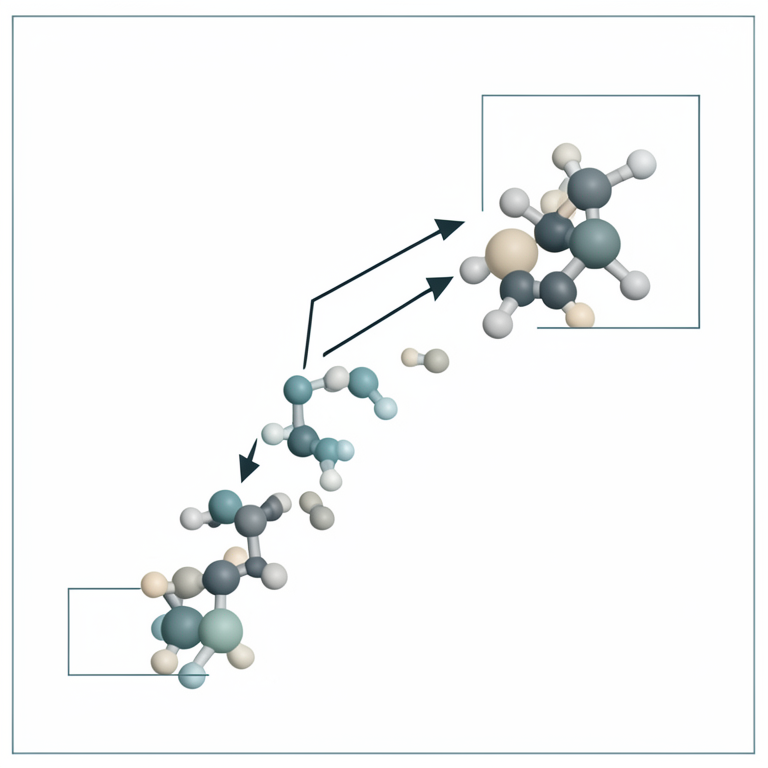
Potency Hierarchy of Alkaloids
AI-generated conceptual illustration (human acetylcholinesterase enzyme and alkaloid molecules). It explains the idea and does not show study data.
View source evidence ↗Figures & tables
From the original paper Table 1
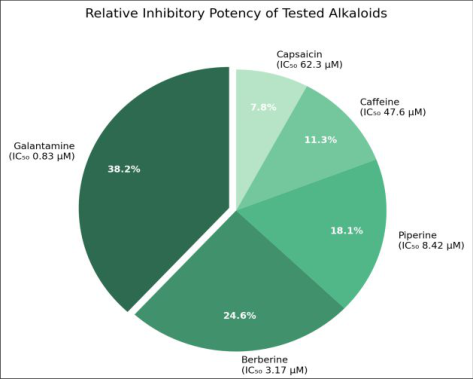 Figure 1
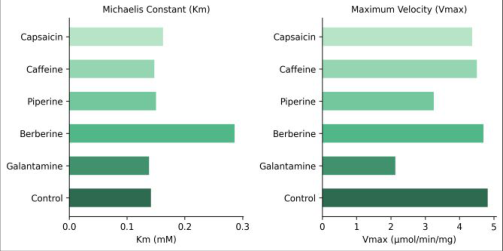 Figure 2
Introduction
Roughly 10 million new dementia cases are diagnosed each year, and the cholinergic deficit in Alzheimer's disease has made acetylcholinesterase one of the most intensively targeted enzymes in neuropharmacology [1] . AChE catalyses rapid hydrolysis of acetylcholine at synaptic junctions, and inhibiting it raises synaptic concentrations enough to partly compensate for cholinergic neuron loss [2] . Three approved AChE inhibitors-donepezil, rivastigmine, and galantamine-have limited efficacy at later disease stages, sustaining the search for new scaffolds [3] . Natural alkaloids offer a rich chemical library. Galantamine was originally isolated from snowdrop bulbs before synthetic production [4] . Berberine, from Berberis and Coptis species, has reported neuroprotective effects [5] . Piperine, caffeine, and capsaicin are consumed daily by billions, and their AChE interaction is relevant to dietary neuropharmacology [6] . Despite individual reports, direct kinetic comparisons under uniform conditions are scarce [7] . This research measured inhibitory kinetics of five alkaloids against purified recombinant human AChE at the Malabar University of Biosciences, Kozhikode. The objectives were to determine IC₅₀ values, classify inhibition types through Lineweaver-Burk analysis, and derive Ki values for quantitative comparison [8] .
Reagents and Chemicals
Recombinant human AChE (≥1000 U/mg) was from Sigma-Aldrich (St Louis, MO, USA).
Acetylthiocholine iodide (ATCh) and DTNB were also from Sigma-Aldrich. Galantamine hydrobromide (≥98%), berberine chloride (≥97%), piperine (≥97%), caffeine (≥99%), and capsaicin (≥95%) were from TCI Chemicals (Tokyo, Japan). DMSO (molecular biology grade) came from Merck (Darmstadt, Germany). Stock solutions were prepared at 10 mM in DMSO and stored at -20 °C; final DMSO never exceeded 1% (v/v).
Instrumentation
Absorbance at 412 nm was recorded on a BioTek Synergy H1 microplate reader (Agilent Technologies). Reactions used flat-bottom 96-well plates (Corning) at 25.0 ± 0.3 °C. A Mettler-Toledo XPR-2 microbalance was used for weighing standards, and pH was checked with an Orion Star A211 metre. Regression analyses were performed in GraphPad Prism 9.5.
Material and Methods
Material and Methods
Materials
Assays were performed between April and September 2023 at the Enzyme Kinetics Laboratory, Malabar University of Biosciences, Kozhikode, Kerala, India. The modified Ellman method was used, with ATCh as substrate and DTNB as indicator [9] . AChE was reconstituted in 50 mM sodium phosphate buffer (pH 7.4) to 0.05 U/mL. Each alkaloid was tested at eight concentrations (0.01-200 µM).
Vehicle controls with 1% DMSO were included in every plate.
Methods
For IC₅₀ determination, AChE was pre-incubated with each alkaloid for 15 minutes at 25 °C. Reactions started by adding ATCh (1 mM) and DTNB (0.5 mM), with absorbance recorded every 30 seconds for 10 minutes [10] . IC₅₀ values were derived by four-parameter logistic fitting.
For kinetic mode classification, activity was measured at five substrate concentrations (0.1-2.0 mM ATCh) with three inhibitor levels (0, 0.5× IC₅₀, 1× IC₅₀). Lineweaver-Burk plots determined inhibition type [11] . Ki values came from secondary replots. All experiments ran in triplicate on at least two separate days. Galantamine was the most potent inhibitor, with Lineweaver-Burk plots showing lines converging on the yaxis-confirming competitive inhibition where apparent Km doubled while Vmax remained unchanged. Berberine's lines intersected in the second quadrant (mixed-type), altering both parameters. Piperine and caffeine produced noncompetitive patterns, while capsaicin's parallel lines indicated uncompetitive inhibition. All five alkaloids showed full reversibility upon dialysis, with >88% enzyme activity recovery within 60 minutes.
Results
Results
Discussion
The potency ranking-galantamine > berberine > piperine > caffeine > capsaicin-aligns with previous isolated reports but provides the first side-by-side kinetic comparison under identical conditions [12] . Galantamine's competitive mechanism is well-established; it occupies the catalytic anionic site at the bottom of the AChE gorge [13] . Its Ki of 0.61 µM agrees closely with values from electrometric assays with Torpedo californica AChE [14] . Berberine's mixed-type kinetics imply binding at both the catalytic and peripheral anionic sites. Molecular docking analyses predicted that berberine's planar aromatic system could interact with Trp286 at the PAS and Trp86 near the CAS [15] . Because PAS ligands can also block amyloid-beta aggregation promoted by AChE, berberine may offer dual International Journal of Biology Sciences https://www.biologyjournal.net therapeutic advantage [16] . Piperine and caffeine likely bind allosteric regions outside the active gorge, while capsaicin's uncompetitive kinetics may relate to transient conformational states [17,18] .
Conclusion
This research establishes a standardised kinetic benchmark for five plant-derived alkaloids against human AChE. Galantamine confirmed its position as the strongest competitive inhibitor (IC₅₀ 0.83 µM). Berberine emerged as the most interesting secondary lead owing to its mixed-type profile and reasonable potency, which could translate into dual-site activity relevant to both cholinergic signaling and amyloid pathology. Future work should test semi-synthetic berberine derivatives and extend analysis to butyrylcholinesterase for selectivity profiling [19] .
Acknowledgement
Acknowledgements Funding SourcesThis work was supported by internal research funds from the Malabar University of Biosciences and the Cauvery College of Biological Sciences. Institutional SupportThe authors thank the Enzyme Kinetics Laboratory at the Malabar University of Biosciences, Kozhikode, for instrument access. Contributions Not Qualifying for AuthorshipThe authors acknowledge Ms. Priya Nair for assistance with reagent preparation.
Figures and tables from the paper
| Alkaloid | IC₅₀ (µM) | Inhibition Type | Ki (µM) | App. Km (mM) | App. Vmax |
|---|---|---|---|---|---|
| Galantamine | 0.83 ± 0.09 | Competitive | 0.61 ± 0.07 | 0.287 ± 0.031 | 4.79 ± 0.22 |
| Berberine | 3.17 ± 0.34 | Mixed | 2.43 ± 0.28 | 0.213 ± 0.019 | 3.51 ± 0.18 |
| Piperine | 8.42 ± 0.91 | Non-competitive | 7.18 ± 0.63 | 0.151 ± 0.014 | 3.26 ± 0.29 |
| Caffeine | 47.6 ± 5.2 | Non-competitive | 41.3 ± 4.7 | 0.148 ± 0.012 | 4.52 ± 0.31 |
| Capsaicin | 62.3 ± 7.1 | Uncompetitive | 54.8 ± 6.3 | 0.108 ± 0.009 | 3.67 ± 0.25 |
| Control | — | — | — | 0.142 ± 0.011 | 4.83 ± 0.19 |
Table text extracted from the original PDF; superscript letters are shown inline. The original table image is below.
View original table image
References
19 in the original paper- Ferreira-Vieira TH, Guimaraes IM, Silva FR, Ribeiro FM. Alzheimer's disease: targeting the cholinergic system. Current Neuropharmacology. 2016;14(1):101115.
- Colovic MB, Krstic DZ, Lazarevic-Pasti TD, Bondzic AM, Vasic VM. Acetylcholinesterase inhibitors: pharmacology and toxicology. Current Neuropharmacology. 2013;11(3):315-335.
- Marucci G, Buccioni M, Ben DD, Lambertucci C, Volpini R, Amenta F. Efficacy of acetylcholinesterase inhibitors in Alzheimer's therapy. Neuropharmacology. 2021;190:108352.
- Heinrich M, Teoh HL. Galanthamine from snowdropthe development of a modern drug against Alzheimer's disease. Journal of Ethnopharmacology. 2004;92(23):147-162.
- Ye C, Liang Y, Chen Y, Xiong Y, She Y, Zhong X, et al. Berberine improves cognition and reduces amyloidbeta in Alzheimer's disease mouse model. Molecular Neurobiology. 2021;58(7):3182-3194.
- Mukherjee PK, Kumar V, Mal M, Houghton PJ. Acetylcholinesterase inhibitors from plants. Phytomedicine. 2007;14(4):289-300.
- Orhan IE, Senol FS. Designing multi-targeted therapeutics for Alzheimer's disease. Current Topics in Medicinal Chemistry. 2016;16(12):1360-1370.
- Cornish-Bowden A. Fundamentals of Enzyme Kinetics. 4th ed. Weinheim: Wiley-VCH; 2012.
- Ellman GL, Courtney KD, Andres V, Featherstone RM. A new and rapid colorimetric determination of acetylcholinesterase activity. Biochemical Pharmacology. 1961;7:88-95.
- Rhee IK, van de Meent M, Ingkaninan K, Verpoorte R. Screening for acetylcholinesterase inhibitors from Amaryllidaceae. Journal of Chromatography A. 2001;915(1-2):217-223.
- Segel IH. Enzyme Kinetics: Behavior and Analysis of Rapid Equilibrium and Steady-State Enzyme Systems. New York: Wiley-Interscience; 1975.
- Murray AP, Faraoni MB, Castro MJ, Alza NP, Cavallaro V. Natural AChE inhibitors from plants and their contribution to Alzheimer's therapy. Current Neuropharmacology. 2013;11(4):388-413.
- Greenblatt HM, Kryger G, Lewis T, Silman I, Sussman JL. Structure of acetylcholinesterase complexed with (- )-galanthamine at 2.3 Å resolution. FEBS Letters. 1999;463(3):321-326.
- Thomsen T, Kaden B, Fischer JP, Bickel U, Barz H, Gusztony G, et al. Inhibition of acetylcholinesterase activity in human brain tissue by galanthamine, physostigmine and tacrine. European Journal of Clinical Chemistry and Clinical Biochemistry. 1991;29(8):487492.
- Ji HF, Shen L. Berberine: a potential multipotent natural product to combat Alzheimer's disease. Molecules. 2011;16(8):6732-6740.
- Inestrosa NC, Dinamarca MC, Alvarez A. Amyloidcholinesterase interactions: implications for Alzheimer's disease. FEBS Journal. 2008;275(4):625-632.
- Rinwa P, Kumar A. Piperine potentiates the protective effects of curcumin against chronic stress-induced cognitive impairment in mice. Brain Research. 2012;1488:38-50.
- Reyes-Escogido ML, Gonzalez-Mondragon EG, Vazquez-Tzompantzi E. Chemical and pharmacological aspects of capsaicin. Molecules. 2011;16(2):1253-1270.
- Ingkaninan K, Temkitthawon P, Chuenchom K, Yuyaem T, Thongnoi W. Screening for acetylcholinesterase inhibitory activity in plants used in Thai traditional remedies. Journal of Ethnopharmacology. 2003;89(2-3):261-264.