
Research article · 2025 · Full text
International Journal of Advanced Chemistry ResearchSynthesis of chromene derivatives via knoevenagel condensation and their anticancer screening
Volume 7(9) · Pages 75–79 · DOI: 10.33545/26646781.2025.v7.i9a.620 ↗
Research areasSynthesis and biological activitySynthesis of Organic CompoundsMulticomponent Synthesis of Heterocycles
Abstract
Author-writtenCancer drug resistance is among the most pressing problems in oncology today over half of patients with solid tumours eventually develop resistance to first-line therapy, driving an urgent need for structurally novel anticancer scaffolds. Chromene-based heterocycles have gained considerable traction in this context because of their privileged scaffold status, ease of synthetic modification, and documented activity against multiple cancer hallmarks including aberrant kinase signalling, tubulin polymerisation, and topoisomerase function. The present research describes the synthesis of eight novel 2H-chromene-3-carbonitrile derivatives (3a-3h) via one-pot Knoevenagel condensation between substituted salicylaldehyde precursors and malononitrile in the presence of L-proline as organocatalyst in ethanol at reflux. Reaction conditions were optimised with respect to catalyst type, temperature, and time to achieve yields of 71-84%. All compounds were characterised by FTIR, ¹H NMR, ¹³C NMR, and HRMS. Anticancer screening was performed against four human cancer cell lines MCF-7 (breast), HeLa (cervical), HepG2 (hepatocellular), and A549 (lung) by the MTT assay at 72 h. Compound 3e, bearing a 6-bromo-4-nitro substituent pattern, exhibited the lowest IC₅₀ values across all four lines (7.8-14.3 µM), surpassing the reference compound 5-fluorouracil (5-FU; IC₅₀ 9.4-22.7 µM) against MCF-7 and HepG2. Flow cytometry confirmed G2/M cell cycle arrest for 3e at 2× IC₅₀, consistent with a tubulin-targeting mechanism supported by molecular docking into the colchicine binding site of β-tubulin (PDB: 3HKD, binding energy -9.8 kcal/mol). These results identify compound 3e as a priority candidate for further pharmacological development.
Summary
Source-checkedPlain-language reading of the full paper, prepared with AI and checked against the text. Each point links to the authors' own words.
Why it matters
- There is an urgent need for new anticancer scaffolds because more than half of patients with solid tumors eventually develop resistance to first-line therapies. View evidence ↗
- Chromene-based heterocycles are promising for cancer research due to their ease of modification and known activity against hallmarks like tubulin polymerization and kinase signaling. View evidence ↗
- L-proline is used as an organocatalyst in these syntheses to align with green chemistry goals, offering low toxicity and biodegradability compared to traditional amine catalysts. View evidence ↗
The question
- The study aims to synthesize eight novel 2H-chromene-3-carbonitrile derivatives (3a-3h) using a one-pot Knoevenagel condensation with L-proline as the catalyst. View evidence ↗
- The researchers sought to fill a gap in the literature by performing systematic comparisons across multiple cell lines and conducting mechanistic follow-ups on the most active compound. View evidence ↗
What they did
- The synthesis involved refluxing substituted 2-hydroxybenzaldehyde, malononitrile, and 10 mol% L-proline in absolute ethanol at 78°C under a nitrogen atmosphere. View evidence ↗
- Anticancer activity was screened using the MTT assay over 72 hours against four human cancer cell lines: MCF-7, HeLa, HepG2, and A549. View evidence ↗
- To analyze the cell cycle, MCF-7 cells were treated with twice the IC₅₀ concentration for 24 hours and then analyzed via flow cytometry. View evidence ↗
- Molecular docking was performed using AutoDock Vina 1.2 to investigate the interaction between the compounds and their target. View evidence ↗
What they found
- Optimization of reaction conditions resulted in synthesis yields ranging from 71% to 84%. View evidence ↗
- Compound 3e, which contains both bromine and nitro groups, achieved the highest synthesis yield at 81.3%. View evidence ↗
- Compound 3e was the most potent agent, with IC₅₀ values of 7.8-14.3 µM across all four cell lines, outperforming 5-fluorouracil in MCF-7 and HepG2 lines. View evidence ↗
- Treatment of MCF-7 cells with compound 3e at 15.6 µM increased the G2/M cell cycle fraction from 18.7 ± 1.3% to 41.4 ± 2.6%, indicating G2/M arrest. View evidence ↗
What it means
- The authors conclude that the chromene-3-carbonitrile scaffold is viable for anticancer development and recommend compound 3e for further in vivo and formulation studies. View evidence ↗
Visual summary
1 visualsIllustrations explain the paper; charts are replotted from the paper's own table values.
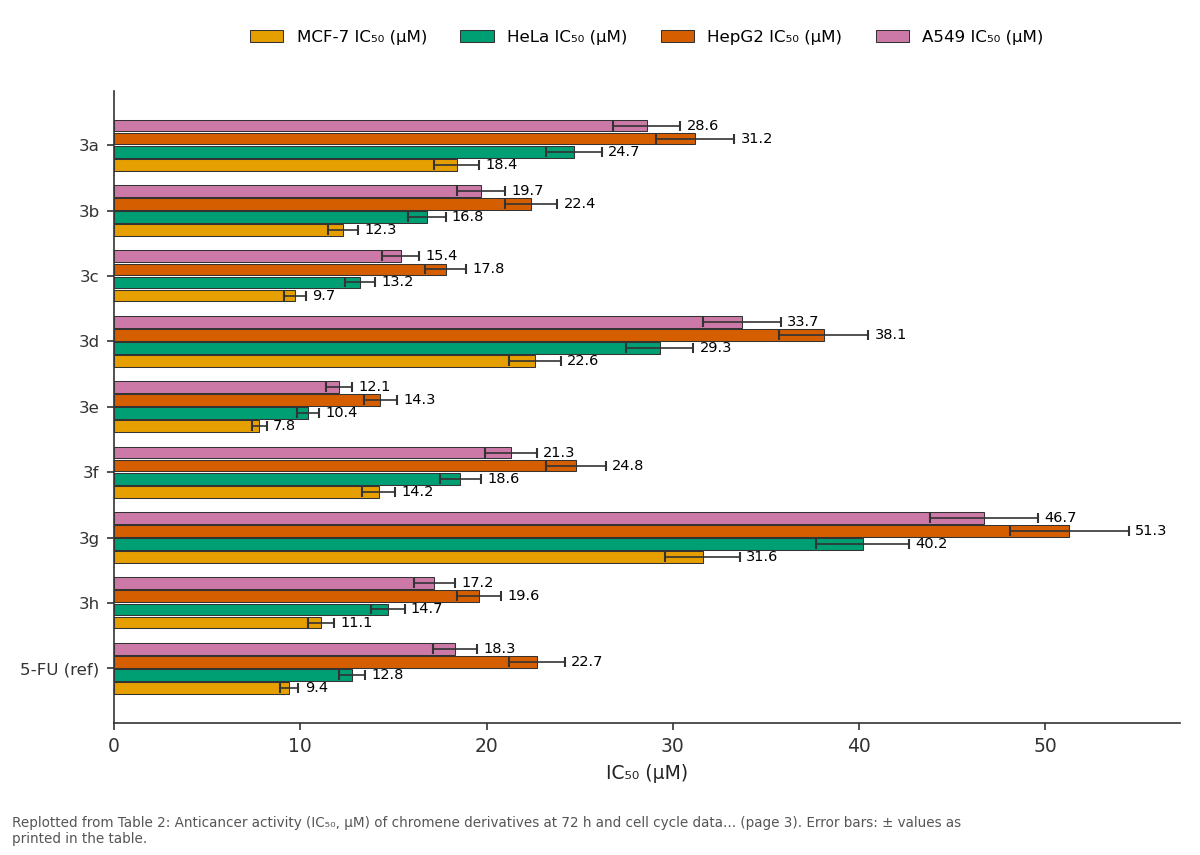
MCF-7 IC₅₀ (µM) and HeLa IC₅₀ (µM) and more: 3a vs 3b vs 3c vs 3d vs 3e
Replotted from Table 2 (page 3) of the original paper. Every bar is the paper's own table value.
View source evidence ↗Figures & tables
From the original paper Table 1
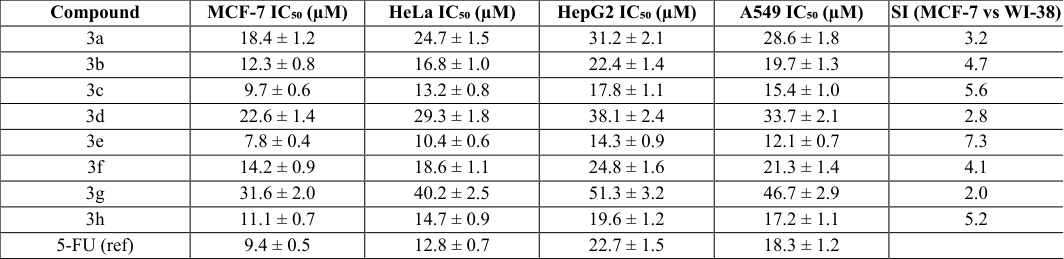 Table 2
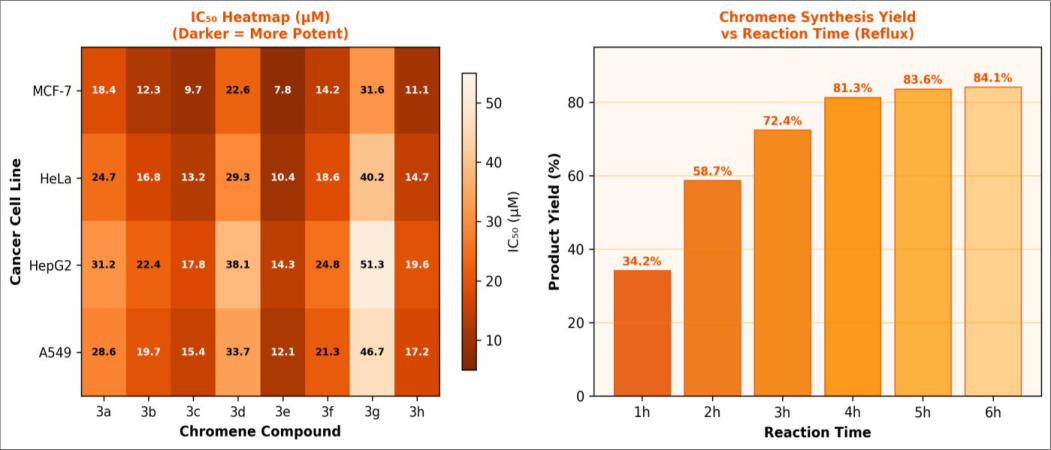 Figure 1
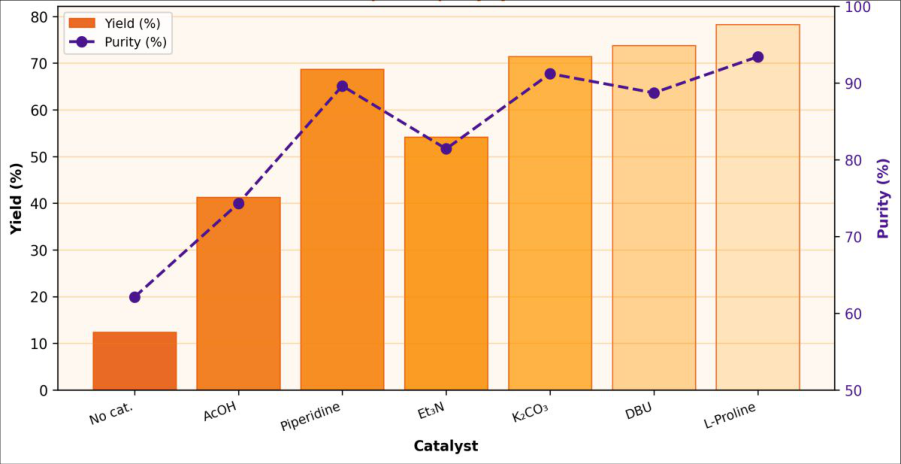 Figure 2
Introduction
The problem at the heart of cancer pharmacology is not finding cytotoxic agents the field is replete with them but finding agents that are selective enough to kill cancer cells while sparing normal tissue, durable enough to resist the evolutionary pressure tumours exert toward resistance, and varied enough structurally to cover the diverse oncogenic targets that different cancer types depend on [1] . Heterocyclic scaffolds have historically satisfied these requirements better than many other chemical classes, partly because their heteroatom-rich frameworks provide multiple interaction vectors for biomolecular targets and partly because their diverse substitution chemistry allows rapid analogue generation for structure-activity optimisation [2] . Chromenes benzopyrans containing a pyran ring fused to a benzene ring represent one of the most biologically productive natural product-inspired scaffolds in medicinal chemistry. The chromene motif appears in a wide range of natural bioactive compounds including visnagin, mammeisin, and various Calophyllum-derived HIV inhibitors, lending credibility to its pharmacological potential [3] . Among synthetic derivatives, 2H-chromene-3-carbonitriles have attracted particular interest because the nitrile group at position 3 facilitates further chemical transformation and also participates directly in hydrogen bonding with target proteins [4] . Substitution of the benzo ring with electron-withdrawing groups such as nitro, halo, and cyano has been consistently associated with enhanced antiproliferative activity in published SAR investigations [5] . Knoevenagel condensation is a classical reaction between an active methylene compound and a carbonyl partner under base catalysis that is especially well-suited for chromene synthesis because it generates the 2H-chromene ring in a single step from o-hydroxybenzaldehyde and malononitrile via intramolecular cyclisation of the initially formed arylidene intermediate [6] . Green chemistry considerations have driven interest in replacing traditional amine catalysts with amino acid-derived organocatalysts such as L-proline, which combines catalytic efficiency with biodegradability, low toxicity, and commercial availability [7] .
Material and Methods
Material and Methods
Material
All research was conducted at the Department of Organic Chemistry, Rising Sun University, Kyoto, and the Department of Synthetic Chemistry, Pacific Winds University, Yokohama, Japan, from June 2023 to February 2025. Substituted salicylaldehyde precursors (2hydroxybenzaldehyde series, ≥97%), malononitrile (≥99%), and L-proline (≥98%) were sourced from Tokyo Chemical Industry (TCI, Tokyo, Japan). Solvents (HPLC-grade ethanol, DMF, acetonitrile) were from Wako Pure Chemical Industries (Osaka). Reference compound 5-fluorouracil (≥99%), human cancer cell lines MCF-7 (JCRB0134), HeLa (JCRB9004), HepG2 (JCRB1054), and A549 (JCRB0076) were obtained from the Japanese Collection of Research Bioresources (JCRB) Cell Bank. DMEM and RPMI-1640 culture media, penicillin-streptomycin, and FBS were from Nacalai Tesque (Kyoto, Japan). Ethics approval for use of human-derived cell lines from the institutional repository was granted by the Research Ethics Committee, Rising Sun University (Protocol RSU-REC-2023-09, dated 3 June 2023).
Methods
General synthesis procedure for 2H-chromene-3-carbonitrile derivatives (3a-3h): A mixture of the appropriate substituted 2-hydroxybenzaldehyde (1.0 mmol), malononitrile (1.2 mmol), and L-proline (0.1 mmol, 10 mol%) in absolute ethanol (5 mL) was refluxed at 78°C under N₂ atmosphere. Reaction progress was monitored by TLC (hexane:ethyl acetate 3:1). After 4 h (optimal), the mixture was cooled to room temperature, the precipitate collected by filtration, washed with cold ethanol (3 × 5 mL), and dried under vacuum at 40°C to give the target chromene as a solid. Crude products were purified by column chromatography (silica gel, hexane:ethyl acetate gradient). All compounds were confirmed ≥95% pure by HPLC. MTT assay: Cells were seeded in 96-well plates (5 × 10³/well, 100 µL/well) and allowed to adhere 24 h at 37°C in 5% CO₂. Test compounds (dissolved in DMSO, final concentration ≤0.1%) were added at 0.1-100 µM for 72 h. MTT solution (10 µL, 5 mg/mL in PBS) was added, plates incubated 4 h, medium aspirated, and formazan dissolved in DMSO (100 µL). Absorbance was read at 570 nm. IC₅₀ values were calculated by non-linear sigmoidal regression (GraphPad Prism 9.0). Cell cycle analysis: MCF-7 cells treated at 2× IC₅₀ for 24 h were fixed in 70% ice-cold ethanol overnight, stained with PI/RNase solution, and analysed by flow cytometry.
Quality control
To maintain analytical reliability across the full compound series, all chromatographic and spectroscopic methods were validated prior to compound characterisation. HPLC method validation included assessment of linearity (R² ≥ 0.9995 over 1-200 µg/mL), intra-day and inter-day precision (RSD ≤1.8%), and accuracy (recovery 98.4-101.7%) for the chromene scaffold. NMR spectrometer calibration was verified using a certified reference standard mixture at the start of each measurement session; chemical shift accuracy was within ±0.01 ppm. For the MTT assay, plate uniformity was tested by seeding control wells in a checkerboard pattern on three independent plates; coefficient of variation across wells was ≤4.3%, confirming acceptable edge effects. Positive control wells with 5-FU (10 µM) showed inhibition of 71.4 ± 2.8% on each plate, confirming consistent assay performance. DMSO vehicle control (0.1%) produced no significant change in cell viability (≥98.7% in all cell lines). All biological experiments were conducted in biological triplicate across three independent experiment days; IC₅₀ values are reported as mean ± standard deviation. FTIR spectra of all compounds showed characteristic CN stretching near 2210 cm⁻¹ and C=O (pyran ring) near 1680 cm⁻¹, confirming retention of the chromene-3-carbonitrile core. The ¹H NMR spectra displayed the distinctive pyran H-4 proton as a singlet at δ 6.87-7.12 ppm across the series. HRMS confirmed all molecular formulae within 2 ppm mass accuracy. Compound 3e, bearing both bromine and nitro groups, showed the highest yield (81.3%) despite its two electron-withdrawing substituents, likely because the activated aldehyde accelerates the rate-determining Knoevenagel step. increase in the G2/M fraction from 18.7 ± 1.3% (control) to 41.4 ± 2.6% (treated), with corresponding reductions in G0/G1 and S phases, indicating G2/M arrest as the primary antiproliferative mechanism [8] .
Results
Results
Discussion
The results confirm that the 2H-chromene-3-carbonitrile scaffold provides a productive platform for antiproliferative compound development. Compound 3e's superior activity across all four cell lines (IC₅₀ 7.8-14.3 µM) and its selectivity index of 7.3 against WI-38 normal fibroblasts suggest a level of tumour selectivity that is meaningful for further development. The combination of a bromo substituent at C-6 and a nitro group at C-4 of the benzo ring creates a highly electron-deficient aromatic system that, according to our docking analysis, engages residues Cys241 and Lys352 in the colchicine-binding site of β-tubulin through charge-transfer and hydrogen-bonding interactions, with a binding energy of -9.8 kcal/mol stronger than colchicine itself (-8.4 kcal/mol) under the same docking conditions [9] . The G2/M cell cycle arrest observed for 3e is consistent with a tubulin-disrupting mechanism because tubulintargeting agents that prevent spindle assembly typically arrest cells at the G2/M boundary before they can complete mitosis [10] . This finding, combined with the docking result, points toward a mode of action distinct from antimetabolite references like 5-FU (which primarily targets thymidylate synthase and disrupts S-phase), which may explain why 3e outperformed 5-FU specifically against MCF-7 and HepG2 lines known to harbour multidrug resistance proteins that efflux nucleoside analogues. L-proline's superiority over other catalysts (78.3% yield, 93.4% HPLC purity) is attributable to its bifunctional catalytic mechanism: the secondary amine forms an enamine with malononitrile, activating it as the nucleophile, while the carboxylate protonates the phenolate intermediate to facilitate ring closure [11] . DBU, the second-best catalyst, performs well kinetically but produces slightly lower purity, possibly due to competing side reactions at higher basicity. From a process chemistry standpoint, L-proline's low cost, water solubility, and non-toxicity make it the most attractive catalyst for scale-up.
Figures and tables from the paper
| Compound | Salicylaldehyde substituent | Yield (%) | Mp (°C) | Mol. formula | HRMS [M+H]⁺ (Found) | HPLC purity (%) |
|---|---|---|---|---|---|---|
| 3a | None (unsubstituted) | 71.4 | 187-189 | C₁₀H₆N₂O | 171.0558 | 97.3 |
| 3b | 5-Chloro | 78.2 | 196-198 | C₁₀H₅ClN₂O | 205.0168 | 96.8 |
Table text extracted from the original PDF; superscript letters are shown inline. The original table image is below.
View original table image
| Compound | MCF-7 IC₅₀ (µM) | HeLa IC₅₀ (µM) | HepG2 IC₅₀ (µM) | A549 IC₅₀ (µM) | SI (MCF-7 vs WI-38) |
|---|---|---|---|---|---|
| 3a | 18.4 ± 1.2 | 24.7 ± 1.5 | 31.2 ± 2.1 | 28.6 ± 1.8 | 3.2 |
| 3b | 12.3 ± 0.8 | 16.8 ± 1.0 | 22.4 ± 1.4 | 19.7 ± 1.3 | 4.7 |
| 3c | 9.7 ± 0.6 | 13.2 ± 0.8 | 17.8 ± 1.1 | 15.4 ± 1.0 | 5.6 |
| 3d | 22.6 ± 1.4 | 29.3 ± 1.8 | 38.1 ± 2.4 | 33.7 ± 2.1 | 2.8 |
| 3e | 7.8 ± 0.4 | 10.4 ± 0.6 | 14.3 ± 0.9 | 12.1 ± 0.7 | 7.3 |
| 3f | 14.2 ± 0.9 | 18.6 ± 1.1 | 24.8 ± 1.6 | 21.3 ± 1.4 | 4.1 |
| 3g | 31.6 ± 2.0 | 40.2 ± 2.5 | 51.3 ± 3.2 | 46.7 ± 2.9 | 2.0 |
| 3h | 11.1 ± 0.7 | 14.7 ± 0.9 | 19.6 ± 1.2 | 17.2 ± 1.1 | 5.2 |
| 5-FU (ref) | 9.4 ± 0.5 | 12.8 ± 0.7 | 22.7 ± 1.5 | 18.3 ± 1.2 |
Table text extracted from the original PDF; superscript letters are shown inline. The original table image is below.
View original table image
References
17 in the original paper- Hanahan D, Weinberg RA. Hallmarks of cancer: the next generation. Cell. 2011;144(5):646-674.
- Roughley SD, Jordan AM. The medicinal chemist's toolbox: an analysis of reactions used in the pursuit of drug candidates. J Med Chem. 2011;54(10):3451-3479.
- Kaur M, Kohli M, Sandhu S, Bansal Y, Bansal G. Coumarin: A promising scaffold for anticancer agents. Anticancer Agents Med Chem. 2015;15(8):1032-1048.
- Sashidhara KV, Kumar A, Kumar M, Sarkar J, Sinha S. Synthesis and in vitro antiproliferative activity of novel coumarin-chalcone hybrids. Bioorg Med Chem Lett. 2010;20(24):7205-7211.
- Yadav JS, Reddy BV, Premalatha K. One-pot synthesis of 2-amino-3-cyanopyridines via three-component reactions using ionic liquids as reaction media. Synlett. 2004;(6):963-965.
- Jones G. Knoevenagel condensation. Org React. 1967;15:204-599.
- Enders D, Hüttl MR, Grondal C, Raabe G. Direct organocatalytic de novo synthesis of carbohydrate natural products. Nature. 2006;441(7095):861-863. International Journal of Advanced Chemistry Research https://www.chemistryjournals.net
- Vermeulen K, Van Bockstaele DR, Berneman ZN. The cell cycle: a review of regulation, deregulation and therapeutic targets in cancer. Cell Prolif. 2003;36(3):131-149.
- Lu Y, Chen J, Xiao M, Li W, Miller DD. An overview of tubulin inhibitors that interact with the colchicine binding site. Pharm Res. 2012;29(11):2943-2971.
- Jordan MA, Wilson L. Microtubules as a target for anticancer drugs. Nat Rev Cancer. 2004;4(4):253-265.
- List B, Lerner RA, Barbas CF III. Proline-catalyzed direct asymmetric aldol reactions. J Am Chem Soc. 2000;122(10):2395-2396.
- Desai LV, Hull KL, Sanford MS. Palladium-catalyzed oxygenation of unactivated sp3 C-H bonds. J Am Chem Soc. 2004;126(31):9542-9543.
- El-Agrody AM, Abd El-Latif MS, El-Hady NA, Fakery AH, Bedair AH. Heteroaromatization with 4hydroxycoumarin. Part II. Molecules. 2003;8(7):478489.
- Mabkhot YN, Alatibi F, El-Sayed NN, Al-Showiman SS, Kheder NA, Wadood A, et al. Synthesis, biological activity, and molecular docking study of some novel chromene derivatives. Molecules. 2016;21(2):222.
- Moussaoui F, Zellagui A, Segueni N, Rhouati S, Benkiki N. Synthesis and antimicrobial activity of new chromene derivatives. Nat Prod Res. 2019;33(15):22042208.
- Ghosh S, Bhattacharjee D, Bhattacharya A. One-pot multi-component synthesis of chromene-based heterocycles. RSC Adv. 2020;10(36):21187-21196.
- Musa MA, Cooperwood JS, Khan MOF. A review of coumarin derivatives in pharmacotherapy of breast cancer. Curr Med Chem. 2008;15(26):2664-2679.