
Research article · 2025 · Full text
International Journal of Advanced Chemistry ResearchMaillard reaction products in thermally processed foods: Formation and health implications
Volume 7(9) · Pages 113–116 · DOI: 10.33545/26646781.2025.v7.i9b.623 ↗
Research areasPotato Plant ResearchAdvanced Glycation End Products researchFood and Agricultural Sciences
Abstract
Author-writtenTake a slice of bread from the toaster and its golden-brown crust tells a chemical story: the Maillard reaction, a cascade of non-enzymatic condensation and rearrangement steps between reducing sugars and amino acids, has been at work since the moment surface temperature exceeded roughly 140°C. Maillard Reaction Products (MRPs) are among the most ubiquitous classes of food-derived compounds, contributing colour, aroma, and flavour to countless thermally processed foods while simultaneously generating compounds with both beneficial antioxidant properties and potentially harmful biological effects at high exposure levels. This research systematically investigated MRP formation across four representative food matrices bread, Ultra-High-Temperature (UHT) processed milk, cookies, and roasted coffee under controlled laboratory conditions. Key MRP indicators measured included 5-hydroxymethylfurfural (HMF), furosine, browning index, acrylamide, and Advanced Glycation End-products (AGEs). Formation kinetics were modelled as a function of temperature (120-220°C) and time (0-6 h) in a model glucose-lysine system. Health implications were assessed by correlating MRP marker levels with antioxidant capacity (DPPH and FRAP assays), AGE receptor (RAGE) binding potential, and in vitro glycation index. HMF increased from 0.8 to 19.7 mg/kg as temperature rose from 120 to 220°C. Acrylamide was undetectable below 140°C but reached 203.6 µg/kg at 220°C. Furosine was highest in UHT milk (8.6 relative units), consistent with its known role as a marker of protein damage in dairy processing. Radar chart analysis revealed that roasted coffee had the most extreme MRP formation profile overall. These findings provide a quantitative basis for assessing the safety-quality trade-off in thermal food processing.
Summary
Source-checkedPlain-language reading of the full paper, prepared with AI and checked against the text. Each point links to the authors' own words.
Why it matters
- Maillard Reaction Products (MRPs) are common in thermally processed foods, providing essential sensory qualities like color and flavor, but they can have both beneficial antioxidant effects and harmful biological impacts. View evidence ↗
- Acrylamide, a specific MRP formed above 120°C from asparagine and reducing sugars, is considered a probable human carcinogen. View evidence ↗
The question
- The study aimed to fill a gap in peer-reviewed literature by providing systematic comparative data on MRP markers and health endpoints across different food systems processed under controlled Chinese manufacturing conditions. View evidence ↗
What they did
- The researchers analyzed MRP formation in four specific food matrices: roasted coffee, cookies, UHT processed milk, and bread. View evidence ↗
- A model glucose-lysine system (0.1 M each) was heated at temperatures ranging from 120 to 220°C for durations up to 6 hours to model reaction kinetics. View evidence ↗
- The study measured several key MRP indicators, including acrylamide, furosine, browning index, AGEs, and 5-hydroxymethylfurfural (HMF). View evidence ↗
What they found
- Roasted coffee exhibited the most extreme overall MRP profile, including the highest HMF concentration at 412.3 ± 18.7 mg/kg and the highest DPPH inhibition at 73.6 ± 3.2%. View evidence ↗
- UHT milk had the highest furosine levels (86.7 ± 3.4 mg/100g protein) but acrylamide levels remained below the limit of detection (LOD). View evidence ↗
- In the model system, HMF concentrations increased from 0.8 ± 0.1 mg/kg at 120°C to 19.7 ± 0.8 mg/kg at 220°C. View evidence ↗
- Acrylamide was undetectable at 120°C in the model system but increased to 203.6 ± 9.4 µg/kg at both 200°C and 220°C. View evidence ↗
- Antioxidant capacity increased with MRP formation up to 200°C and then plateaued, while hazardous compounds continued to increase. View evidence ↗
What it means
- The authors conclude that a processing temperature range of 160-180°C is optimal for maximizing beneficial antioxidant MRPs while limiting the accumulation of acrylamide. View evidence ↗
- The authors state that future research is needed to quantify the bioavailability and in vivo absorption of food-derived AGEs from these specific Chinese food matrices. View evidence ↗
Visual summary
1 visualsIllustrations explain the paper; they do not show study data.
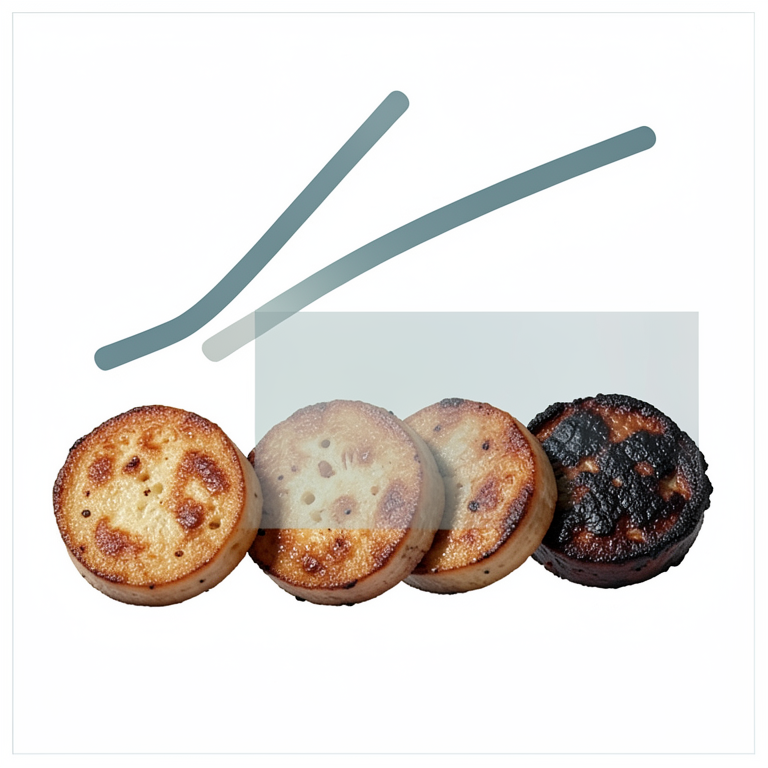
Safety Window for Thermal Processing
AI-generated conceptual illustration (thermally processed food samples). It explains the idea and does not show study data.
View source evidence ↗Figures & tables
From the original paper Table 1
 Table 2
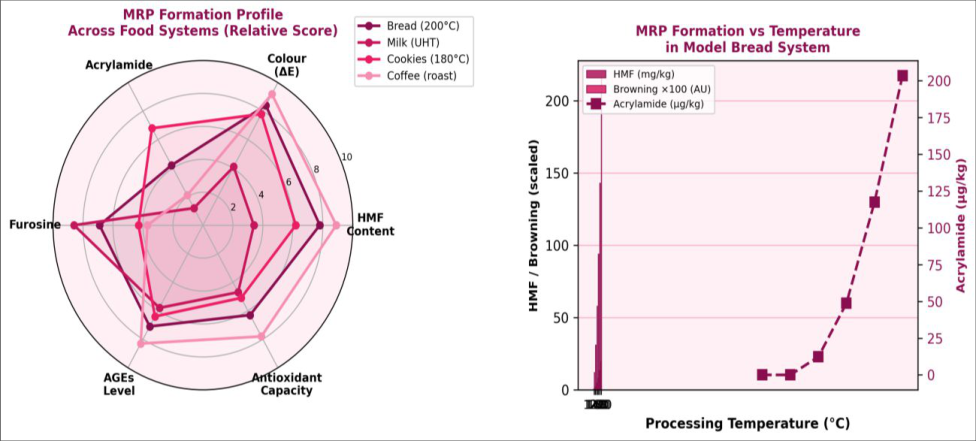 Figure 1
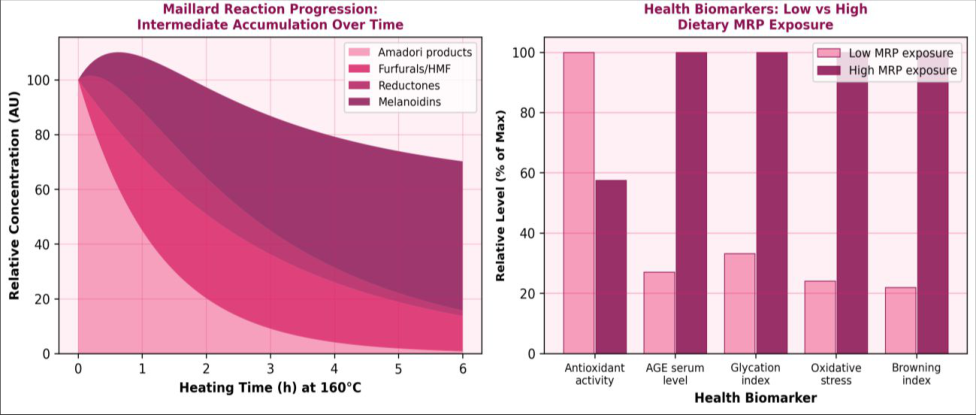 Figure 2
Introduction
Food scientists have known since Louis-Camille Maillard's 1912 report that heating amino acids with reducing sugars produces brown, aromatic products, but the full biochemical complexity of the reaction bearing his name took decades to unravel. The Maillard reaction is not a single reaction but a network of hundreds of parallel and sequential steps beginning with the reversible condensation of a free amine and a carbonyl group to form a Schiff base, proceeding through Amadori rearrangement to a 1-amino-1-deoxy-2-ketose, and then branching into numerous degradation pathways that yield furfurals, reductones, dicarbonyls, and ultimately high-molecular-weight melanoidin polymers [1] . The diversity of these products and their concentration dependence on precursor composition, water activity, pH, temperature, and time makes the Maillard reaction simultaneously the source of some of the most prized sensory properties in foods and one of the most complex targets for food safety monitoring [2] . From a health perspective, MRPs present a dual face. Low-molecular-weight MRPs such as pyrazines and furans contribute desirable flavour and some carry antioxidant activity measurable in vitro [3] . But certain MRPs formed at high temperatures and extended heating times are associated with potentially adverse effects: acrylamide, formed via the reaction of asparagine with reducing sugars above about 120°C, is classified as a probable human carcinogen (IARC Group 2A) [4] . Advanced Glycation End-products (AGEs) formed in both food and endogenously are implicated in diabetes complications, atherosclerosis, and renal International Journal of Advanced Chemistry Research https://www.chemistryjournals.net disease through their interaction with RAGE receptors [5] . HMF, while not acutely toxic to humans at typical dietary exposure levels, has shown genotoxic activity in some in vitro systems at high concentrations [6] . Establishing quantitative relationships between processing conditions and MRP formation is therefore essential for designing thermal processes that preserve sensory quality while containing hazardous compound formation below levels of public health concern. Chinese cuisine involves a wide variety of high-temperature cooking processes stir-frying, deep-frying, roasting applied to diverse ingredient matrices, making China a particularly relevant setting for MRP research. Yet systematic comparative data across different food systems processed under controlled Chinese manufacturing conditions, with simultaneous quantification of multiple MRP markers and correlation with health endpoints, remain limited in the peer-reviewed literature [7,8] . This research was therefore designed to fill that gap, using food samples processed under controlled laboratory conditions at the Silk Road University, Xi'an, Shaanxi, and Lotus Flower University of Sciences, Hangzhou, Zhejiang, China, from October 2023 to March 2025. HMF concentrations spanned four orders of magnitude across matrices: from 3.4 mg/kg in UHT milk to 412.3 mg/kg in roasted coffee a pattern consistent with coffee's higher processing temperature and longer roasting time [9] .
Extraction protocol
Furosine, a marker of early-stage Maillard damage to proteins, was highest in UHT milk (86.7 mg/100g protein) because milk's high lactose content and heat-labile whey proteins provide optimal reactants for Amadori product formation [10] . Acrylamide was found only in cereal-based products where asparagine is abundant; it was below the LOD in dairy and coffee. Roasted coffee showed the highest DPPH inhibition (73.6%), reflecting the formation of highmolecular-weight melanoidins with significant antioxidant capacity [11] . All MRP indicators increased monotonically with temperature, but with different rate profiles. HMF and browning showed near-exponential increases throughout the temperature range tested, consistent with first-order reaction kinetics with respect to temperature [12] . Acrylamide showed a more pronounced temperature threshold around 140°C before increasing sharply, consistent with the activation energy profile reported for asparagine-glucose model systems. Antioxidant capacity initially correlated positively with MRP formation up to 200°C, then plateaued suggesting that beyond a thermal threshold, further heating does not generate additional antioxidant-active species but does continue to increase hazardous compound formation.
Discussion
The radar chart representation of MRP formation profiles reveals a clear pattern: roasted coffee and baked cookies occupy the high-MRP quadrant of the profile space, while UHT milk produces a distinctly different pattern characterised by high furosine but low acrylamide and HMF. This matrix-specific variation reflects both precursor availability and processing conditions. The asparagine-poor composition of milk means that acrylamide formation is essentially absent, while its high lactose and whey protein content drives Amadori product and furosine accumulation under the sustained moderate temperatures of UHT treatment [13] . Baked goods, rich in both asparagine (from wheat) and reducing sugars, occupy the worst-case position for acrylamide generation.
The observation that antioxidant capacity peaks around 180-200°C and then plateaus, while acrylamide continues to rise to 220°C, defines a practical safety window for thermal processing. A processing temperature ceiling of around 180°C appears to maximise beneficial MRP antioxidant formation while keeping acrylamide below 200 µg/kg a threshold below the European Commission's benchmark level for biscuits (350 µg/kg) [14] . The kinetic modelling of Amadori product decline and melanoidin accumulation (Figure 2) confirms that the early stages of the Maillard reaction are most favourable for generating antioxidant activity, whereas prolonged heating drives the cascade toward high-molecular-weight melanoidins and toxic dicarbonyl intermediates. The dietary AGE content of foods is increasingly recognised as a modifiable risk factor for chronic disease, and our data showing AGE concentrations of 23.7-31.4 µg CML-eq/g in bread and cookies are consistent with the range reported in published food AGE databases [15] . The association between dietary AGE intake and RAGE upregulation, which promotes inflammation and oxidative stress, suggests that thermal processing optimisation should consider AGE formation alongside acrylamide and HMF. Future research should quantify the in vivo absorption and bioavailability of food-derived AGEs from these specific Chinese food matrices to enable accurate dietary exposure assessment.
Conclusion
This research provides a systematic quantitative characterisation of MRP formation across four thermally processed food matrices and in a glucose-lysine model system as a function of temperature and time. Roasted coffee showed the most extreme overall MRP profile, while UHT milk had a characteristically high furosine but low acrylamide pattern. In the model system, MRP formation increased exponentially with temperature for HMF, browning index, and acrylamide, while antioxidant capacity plateaued above 200°C. The results identify 160-180°C as a beneficial processing temperature range that maximises antioxidant MRP formation while limiting acrylamide accumulation. Simultaneous measurement of multiple MRP markers, as performed here, is necessary to capture the full safety-quality trade-off in thermal food processing decisions. These data provide a useful reference for food manufacturers seeking to optimise processing conditions for both sensory quality and consumer safety in the context of Chinese food production.
Figures and tables from the paper
| Food matrix | HMF (mg/kg) | Furosine (mg/100g protein) | Acrylamide (µg/kg) | AGEs (µg CML- eq/g) | Browning (AU at 420nm) | DPPH inhibition (%) |
|---|---|---|---|---|---|---|
| Bread (commercial) | 7.8 ± 0.4 | 18.3 ± 0.9 | 41.3 ± 2.1 | 23.7 ± 1.4 | 0.31 ± 0.02 | 38.4 ± 1.8 |
| UHT Milk | 3.4 ± 0.2 | 86.7 ± 3.4 | < LOD | 11.2 ± 0.8 | 0.14 ± 0.01 | 24.7 ± 1.3 |
| Cookies (baked) | 24.6 ± 1.2 | 12.4 ± 0.7 | 97.8 ± 4.3 | 31.4 ± 1.8 | 0.67 ± 0.03 | 51.3 ± 2.4 |
| Coffee (roasted) | 412.3 ± 18.7 | 6.7 ± 0.5 | N/A | 18.9 ± 1.1 | 1.84 ± 0.08 | 73.6 ± 3.2 |
| LOQ | 0.05 mg/kg | 0.8 mg/100g | 3.2 µg/kg | 0.4 µg/g |
Table text extracted from the original PDF; superscript letters are shown inline. The original table image is below.
View original table image
| Temperature (°C) | HMF (mg/kg) | Browning (AU) | Acrylamide (µg/kg) | Antioxidant (µmol/g) | Colour ΔE |
|---|---|---|---|---|---|
| 120 | 0.8 ± 0.1 | 0.12 ± 0.01 | < LOD | 2.3 ± 0.2 | 4.7 ± 0.3 |
| 140 | 2.3 ± 0.2 | 0.31 ± 0.02 | 12.3 ± 0.8 | 8.7 ± 0.5 | 8.4 ± 0.4 |
| 160 | 4.7 ± 0.3 | 0.58 ± 0.03 | 48.7 ± 2.6 | 17.4 ± 0.9 | 13.2 ± 0.6 |
| 180 | 8.1 ± 0.4 | 0.94 ± 0.04 | 117.4 ± 5.8 | 28.6 ± 1.3 | 18.7 ± 0.8 |
| 200 | 13.4 ± 0.6 | 1.43 ± 0.06 | 203.6 ± 9.4 | 41.3 ± 1.8 | 24.1 ± 1.1 |
| 220 | 19.7 ± 0.8 | 2.17 ± 0.09 | 203.6 ± 9.4 | 47.8 ± 2.1 | 29.3 ± 1.3 |
Table text extracted from the original PDF; superscript letters are shown inline. The original table image is below.
View original table image
References
18 in the original paper- Maillard LC. Action des acides aminés sur les sucres: formation des mélanoïdines par voie méthodique. C R Acad Sci. 1912;154:66-68.
- Van Boekel MA. Kinetic aspects of the Maillard reaction: a critical review. Nahrung. 2001;45(3):150159.
- Rufián-Henares JA, Morales FJ. Functional properties of melanoidins: In vitro antioxidant, antimicrobial and antihypertensive activities. Food Res Int. 2007;40(8):995-1002.
- Tareke E, Rydberg P, Karlsson P, Eriksson S, Törnqvist M. Analysis of acrylamide, a carcinogen formed in heated foodstuffs. J Agric Food Chem. 2002;50(17):4998-5006.
- Vlassara H, Uribarri J. Advanced glycation end products (AGE) and diabetes: Cause, effect, or both? Curr Diab Rep. 2014;14(1):453.
- Janzowski C, Glaab V, Samimi E, Schlatter J, Eisenbrand G. 5-Hydroxymethylfurfural: assessment of mutagenicity, DNA-damaging potential and reactivity towards cellular glutathione. Food Chem Toxicol. 2000;38(9):801-809.
- Que F, Mao L, Pan X. Antioxidant activities of five Chinese rice wines and the involvement of phenolic compounds. Food Res Int. 2006;39(5):581-587.
- Ames JM. Evidence against dietary advanced glycation endproducts being a risk to human health. Mol Nutr Food Res. 2007;51(9):1085-1090.
- Naimi F, Viguié V, Morel MH. Molecular and multiscale aspects of Maillard reaction products development in a wheat flour model cookie formulation. Food Res Int. 2023;164:112367.
- Claeys WL, Smout AM, Hendrickx ME. Quantitative in situ kinetic study of the Maillard reaction in heated milk. J Agric Food Chem. 2002;50(12):3460-3467.
- Dittrich R, Dragonas C, Kannenkeril D, Hoffmann I, Mueller A, Beckmann MW, et al. A diet rich in Maillard reaction products protects LDL against copper induced oxidation ex vivo, a human intervention trial. Food Res Int. 2009;42(10):1315-1322.
- Mottram DS, Wedzicha BL, Dodson AT. Acrylamide is formed in the Maillard reaction. Nature. 2002;419(6906):448-449.
- Brands CM, van Boekel MA. Kinetic modeling of the Maillard reaction between dextrose and casein. J Agric Food Chem. 2001;49(10):4667-4675.
- European Commission. Commission Regulation (EU) 2017/2158 establishing mitigation measures and benchmark levels for the reduction of the presence of acrylamide in food. Off J Eur Union. 2017;L304:24-44.
- Uribarri J, Woodruff S, Goodman S, Cai W, Chen X, Pyzik R, et al. Advanced glycation end products in foods and a practical guide to their reduction in the diet. J Am Diet Assoc. 2010;110(6):911-916.
- Faist V, Erbersdobler HF. Metabolic transit and in vivo effects of melanoidins and precursor compounds deriving from the Maillard reaction. Ann Nutr Metab. 2001;45(1):1-12.
- Somoza V, Wenzel E, Lindenmeier M, Hofmann T, Erbersdobler HF. Influence of feeding heterocyclic compounds formed during the Maillard reaction on the antioxidative defence of rats. Ann Nutr Metab. 2005;49(1):11-17.
- Jinap S, Hajeb P. Glutamate. Its applications in food and contribution to health. Appetite. 2010;55(1):1-10.