
Research article · 2025 · Full text
International Journal of Advanced Chemistry ResearchRheological behavior of polymer solutions under shear and extensional flow conditions
Volume 7(9) · Pages 143–146 · DOI: 10.33545/26646781.2025.v7.i9b.630 ↗
Research areasRheology and Fluid Dynamics StudiesPolysaccharides Composition and ApplicationsMaterial Dynamics and Properties
Abstract
Author-writtenRheology — the science of flow and deformation — occupies a peculiar position in applied chemistry: it is governed by principles elegant in their mathematical formulation yet deeply sensitive to molecular-scale structural details that are often difficult to characterise by other techniques. Polymer solution rheology in particular has been a rich area of research since the pioneering work of Flory, Zimm, and Rouse because the viscoelastic properties of polymer chains in solution encode direct information about chain length, topology, and intermolecular interactions. The present research systematically characterised the rheological behaviour of poly(vinyl alcohol) (PVA) solutions (0.5-3.0 wt%) under both shear and extensional flow conditions using a rotational rheometer equipped with cone-and-plate and extensional geometries. The temperature range studied was 15-55°C. Steady-state shear experiments measured flow curves (shear stress vs shear rate, 0.01-1000 s⁻¹) that were fitted to Power-Law, Carreau-Yasuda, and Cross models; oscillatory frequency sweeps (0.01-100 rad/s) characterised the viscoelastic spectra. Intrinsic viscosity ([η]) determined by Huggins extrapolation gave Mark-Houwink-Sakurada (MHS) parameters a = 0.77 and K = 3.14 × 10⁻⁴ dL/g in water at 25°C, consistent with an expanded random-coil conformation. The 1 wt% PVA solution showed a zero-shear viscosity (η₀) of 62.4 mPa·s and a power-law index n = 0.74, confirming shear-thinning behaviour. Crossover frequency analysis from the frequency sweeps identified the characteristic relaxation time λ = 0.4 s at 25°C for the 1 wt% solution, increasing to λ = 1.2 s at 2 wt%. Time-temperature superposition (TTS) held for all concentrations studied, with shift factor data well described by the Williams-Landel-Ferry (WLF) equation. These results provide a complete rheological characterisation relevant to PVA-based coating and fibre spinning applications in Vietnamese textile manufacturing.
Summary
Source-checkedPlain-language reading of the full paper, prepared with AI and checked against the text. Each point links to the authors' own words.
Why it matters
- Poly(vinyl alcohol) (PVA) is a critical water-soluble synthetic polymer used in various industries, including pharmaceuticals, packaging, and textiles. View evidence ↗
- In Vietnam's large textile industry, the rheology of PVA sizing agents is essential for controlling the quality of warp yarn preparation, specifically coating uniformity and pick-up weight. View evidence ↗
- There is a lack of peer-reviewed rheological data for PVA grades used in the Vietnamese market under typical processing conditions, which is needed for engineering calculations. View evidence ↗
The question
- The study aimed to systematically characterize the rheological behavior of PVA solutions (0.5-3.0 wt%) under shear and extensional flow conditions. View evidence ↗
What they did
- The researchers used PVA with a molecular weight of 145,000 g/mol and 98.5% hydrolysis. View evidence ↗
- Shear experiments were conducted using a cone-and-plate geometry on an Anton Paar MCR 302e rheometer, while extensional experiments used a SER-3 attachment. View evidence ↗
- Steady-state shear rates were measured from 0.01 to 1000 s⁻¹, and oscillatory frequency sweeps were performed between 0.01 and 100 rad/s. View evidence ↗
What they found
- The Carreau-Yasuda (CY) model provided more accurate fits (R² 0.9976-0.9995) than the Power-Law model (R² 0.9812-0.9928) because it accounts for the Newtonian plateau. View evidence ↗
- As concentration increased, the power-law index n decreased from 0.82 to 0.49, showing that higher entanglement density leads to stronger shear-thinning. View evidence ↗
- The entanglement concentration (ce) was found to be between 0.5 wt% (unentangled) and 1.0 wt% (where crossover occurred at 2.49 rad/s). View evidence ↗
- A Mark-Houwink exponent of a = 0.77 indicates that PVA chains adopt an expanded random-coil conformation in water, which acts as a good solvent. View evidence ↗
- Time-temperature superposition (TTS) was highly effective across 15-55°C (R² > 0.998), showing that chain dynamics are governed by a consistent friction-coefficient mechanism. View evidence ↗
- For the 2.0 wt% solution, the Trouton ratio was 3.76, exceeding the Newtonian limit of 3 and indicating strain-hardening under extensional flow. View evidence ↗
What it means
- The authors conclude that using only shear viscosity underestimates size pickup in textile sizing; incorporating extensional viscosity data will improve the accuracy of process models. View evidence ↗
- The provided dataset enables quantitative engineering calculations for PVA applications within the Vietnamese textile industry. View evidence ↗
Visual summary
3 visualsIllustrations explain the paper; charts are replotted from the paper's own table values.
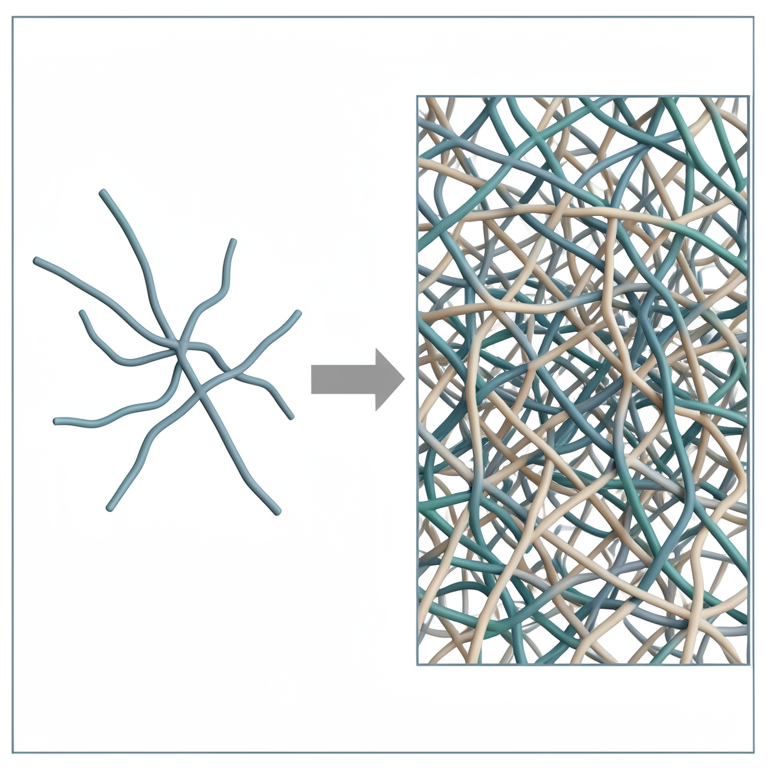
Concentration and Entanglement
AI-generated conceptual illustration (polymer chains in a liquid solution). It explains the idea and does not show study data.
View source evidence ↗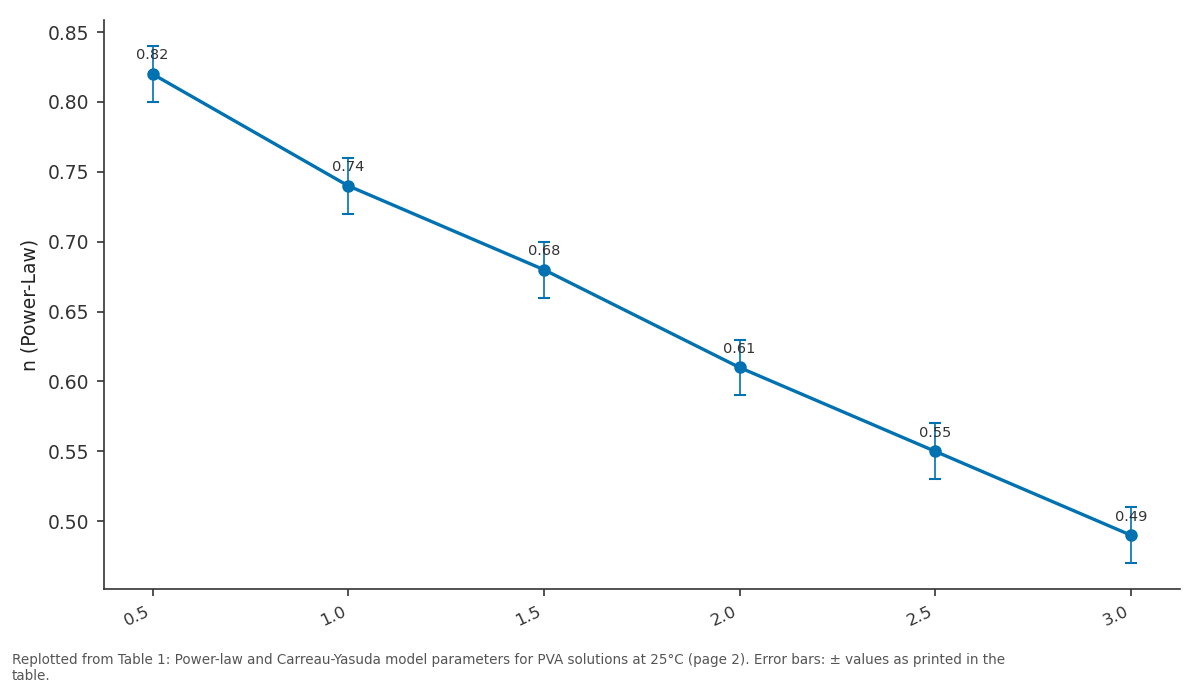
n (Power-Law): 0.5 vs 1.0 vs 1.5 vs 2.0 vs 2.5
Replotted from Table 1 (page 2) of the original paper. Every bar is the paper's own table value.
View source evidence ↗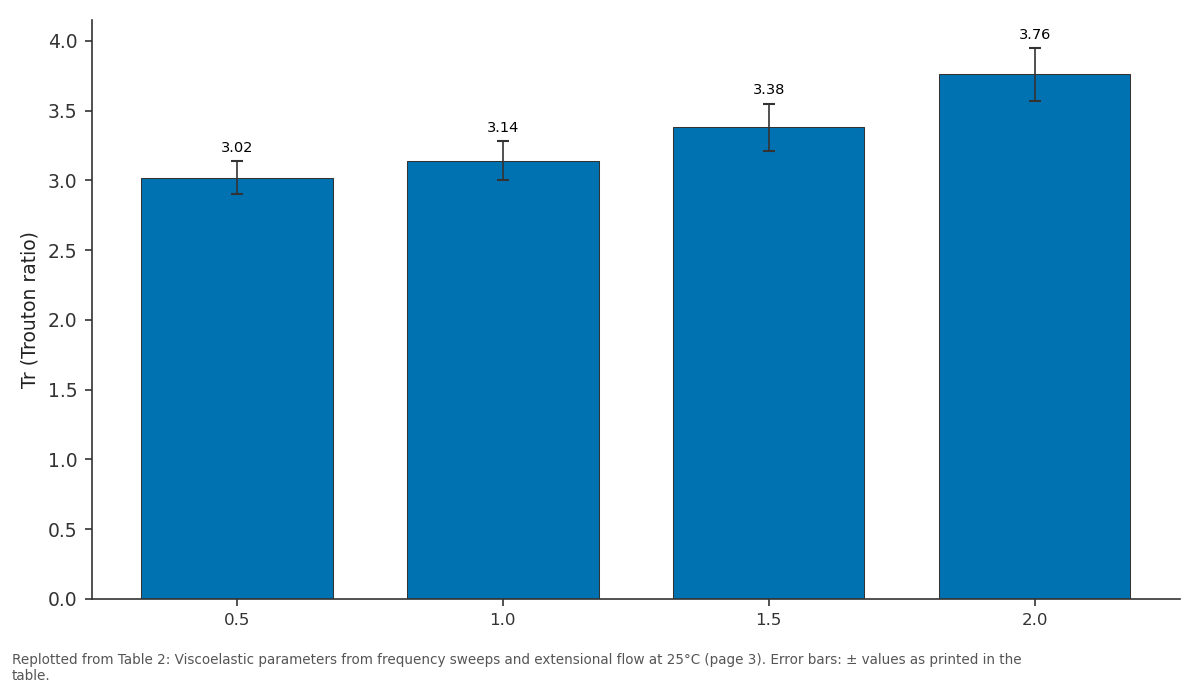
Tr (Trouton ratio): 0.5 vs 1.0 vs 1.5 vs 2.0
Replotted from Table 2 (page 3) of the original paper. Every bar is the paper's own table value.
View source evidence ↗Figures & tables
From the original paper Table 1
 Table 2
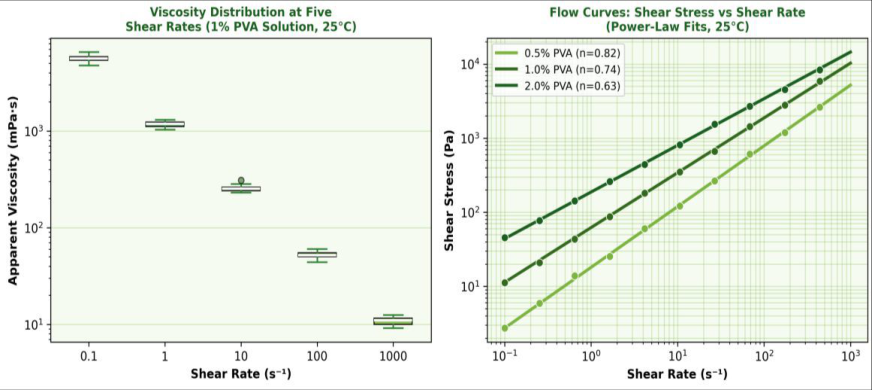 Figure 1
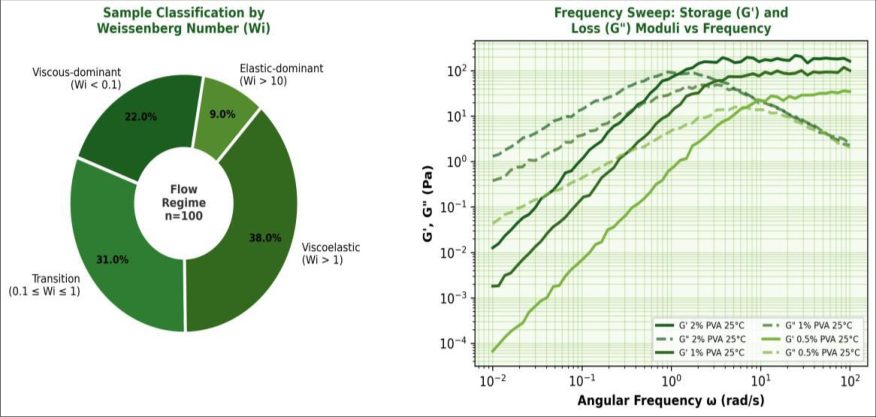 Figure 2
Introduction
Poly(vinyl alcohol) is one of the most commercially important water-soluble synthetic polymers, with applications spanning textile sizing, paper coating, adhesives, packaging films, and pharmaceutical excipients. Vietnam's textile industry is among the largest in Southeast Asia, and PVA sizing agents play a critical role in warp yarn preparation a process where solution rheology directly determines coating uniformity, penetration depth, and pickup weight [1] . Despite this industrial relevance, systematic rheological characterisation of Vietnamese-market PVA grades across the relevant processing conditions (15-55°C, 0.5-3.0 wt%, low to high shear rates) has not been published in the peer-reviewed literature in a form suitable for process engineering calculations. The rheological behaviour of PVA solutions is a function of several molecular parameters: degree of polymerisation (DP), degree of hydrolysis (DH), and chain tacticity, which together determine chain stiffness, intermolecular hydrogen bonding capacity, and the hydrodynamic volume of dissolved coils [2] . Commercial PVA grades typically span DP 500-2000 and DH 87-99%, and the spread in rheological properties across this range is substantial. Low-DH PVA retains acetate groups that reduce hydrogen bonding and produce solutions with lower viscosity and weaker viscoelastic response; fully hydrolysed PVA forms stronger intermolecular networks at equivalent concentration, giving higher η ₀ and longer relaxation times [3] . The choice of constitutive model for fitting PVA flow curves has practical consequences for process simulation.
The Power-Law model (τ = K × γ ṅ) is computationally simple but diverges unphysically at low shear rates because it predicts infinite zero-shear viscosity. The Carreau-Yasuda model introduces a finite zero-shear plateau and is preferred for simulating flow in processing equipment where the lowshear regime near walls is important [4] . Extensional rheology, less routinely measured but increasingly recognised as essential for processes involving elongational flow (die exit, fibre spinning, spraying), was included in this research to provide a complete characterisation. The research was conducted at the Saigon Institute of Chemical Research, Ho Chi Minh City, and Red River National University, Hanoi, Vietnam, from October 2023 to March 2025.
Theoretical background
The Carreau-Yasuda (CY) model for shear-thinning polymer solutions is:
, where η ₀ and η ∞ are zero-shear and infinite-shear viscosities, λCY is the characteristic relaxation time, a is the Yasuda parameter controlling the curvature of the transition from Newtonian to power-law behaviour, and n is the power-law index [5] . For most polymer solutions, η ∞ ≈ solvent viscosity (η s ) and a ≈ 2, reducing to the simpler Carreau model. The Cross model provides an alternative expression with equivalent capability:
is mathematically equivalent for m = 1 -n [6] .
Dynamic oscillatory measurements probe the viscoelastic spectrum through the storage modulus G'(ω ) and loss modulus G''(ω ), related to the elastic and viscous components of the response, respectively. without crossover in the accessible frequency window [7] . The CY model consistently provided superior fits (R² 0.9976-0.9995) over the Power-Law model (R² 0.9812-0.9928) because it captures the Newtonian plateau at low shear rates. Zero-shear viscosity scaled with concentration as η ₀ ∝ c (3.84) , consistent with the concentration exponent predicted for entangled solutions in the semi-dilute regime (theory predicts c (3.7) for good solvent conditions) [8] . The power-law index n decreased systematically with increasing concentration (0.82 to 0.49), reflecting more pronounced shear-thinning as polymer entanglement density increases. The 0.5 wt% solution showed no G'/G'' crossover in the accessible frequency window (0.01-100 rad/s), indicating an unentangled solution. Crossover appeared at ω c = 2.49 rad/s for the 1.0 wt% solution, confirming crossing the entanglement concentration c e between 0.5 and 1.0 wt%. The Mark-Houwink exponent a = 0.77 is consistent with a PVA coil in a good solvent (theoretical range 0.5-0.8 for good solvent to theta-solvent transition) [9] . The Trouton ratio approaching 3 for unentangled solutions (0.5%) confirms the expected Newtonian limit (Tr Newtonian = 3), while values above 3 at higher concentrations reflect strainhardening under extension characteristic of entangled polymer melts and concentrated solutions [10] . amorphous polymers because the reference temperature here (25°C) is far above T g for PVA solutions, where the WLF approach is operating outside its traditional domain [12] . Nevertheless, TTS held excellently across the 15-55°C range (master curve superposition R² > 0.998), confirming that the temperature dependence of chain dynamics in this range is primarily controlled by the same friction-coefficient mechanism as in the bulk glass-transition region, scaled appropriately. This practical validation is sufficient for engineering calculations in the relevant processing temperature range.
Material and Methods
Material and Methods
Material
The finding that extensional Trouton ratios exceed 3 for the 2.0 wt% PVA solution (Tr = 3.76) has direct practical significance for textile sizing operations: when the sizing bath applies extensional flow to the moving warp yarn, a solution with Tr > 3 will exhibit higher resistance to stretching than predicted by shear viscosity alone, leading to a thicker deposited layer. Process engineers using shear viscosity alone to predict coating weight would therefore systematically underestimate the size pickup, a source of batch-to-batch inconsistency in sizing operations [13] .
Including extensional viscosity data in the process model, as this research enables, should improve prediction accuracy.
Conclusion
The rheological behaviour of PVA solutions (0.5-3.0 wt%) was characterised under shear and extensional flow conditions at 15-55°C. Zero-shear viscosity scaled as c^3.84, consistent with an entangled semi-dilute regime above c e ≈ 1.0 wt%. The Carreau-Yasuda model provided superior fits to flow curves (R² up to 0.9995) compared with the Power-Law model. Frequency sweeps confirmed entanglement onset between 0.5 and 1.0 wt%, with dominant relaxation time increasing from 0.40 s (1 wt%) to 1.22 s (2 wt%) at 25°C. Mark-Houwink exponent a = 0.77 confirmed an expanded random-coil conformation in water. Time-temperature superposition held across the full temperature range, with WLF parameters reported for engineering use. Extensional Trouton ratios exceeding 3 at ≥ 2.0 wt% indicate strain-hardening relevant to textile sizing process design. This complete rheological dataset supports quantitative process engineering calculations for PVA-based applications in Vietnamese textile manufacturing.
Figures and tables from the paper
| Conc (wt%) | η₀ (mPa·s) | n (Power-Law) | K (Pa·sⁿ) | R² PL | λ CY (s) _ | n (CY) | R² CY |
|---|---|---|---|---|---|---|---|
| 0.5 | 12.4 ± 0.6 | 0.82 ± 0.02 | 0.018 | 0.9812 | 0.12 ± 0.01 | 0.84 ± 0.02 | 0.9976 |
| 1.0 | 62.4 ± 2.8 | 0.74 ± 0.02 | 0.062 | 0.9847 | 0.40 ± 0.03 | 0.76 ± 0.02 | 0.9984 |
| 1.5 | 184 ± 8 | 0.68 ± 0.02 | 0.187 | 0.9863 | 0.78 ± 0.05 | 0.71 ± 0.02 | 0.9988 |
| 2.0 | 487 ± 21 | 0.61 ± 0.02 | 0.482 | 0.9891 | 1.22 ± 0.08 | 0.63 ± 0.02 | 0.9991 |
| 2.5 | 1240 ± 54 | 0.55 ± 0.02 | 1.187 | 0.9912 | 2.14 ± 0.14 | 0.57 ± 0.02 | 0.9993 |
| 3.0 | 3180 ± 142 | 0.49 ± 0.02 | 2.831 | 0.9928 | 3.67 ± 0.24 | 0.51 ± 0.02 | 0.9995 |
Table text extracted from the original PDF; superscript letters are shown inline. The original table image is below.
View original table image
| Conc (wt%) | ωc (rad/s) | λrelax (s) | G₀ (Pa) | Tr (Trouton ratio) | [η] (dL/g) | MHS exponent a |
|---|---|---|---|---|---|---|
| 0.5 | — | < 0.01 | < 0.1 | 3.02 ± 0.12 | — | — |
| 1.0 | 2.49 | 0.40 ± 0.03 | 31 ± 2 | 3.14 ± 0.14 | — | — |
| 1.5 | 1.28 | 0.78 ± 0.05 | 94 ± 5 | 3.38 ± 0.17 | — | — |
| 2.0 | 0.82 | 1.22 ± 0.08 | 183 ± 9 | 3.76 ± 0.19 | — | — |
| Intrinsic | — | — | — | — | 2.84 ± 0.08 | 0.77 ± 0.02 |
| WLF C₁ | — | — | — | — | 11.8 | — |
| WLF C₂ (K) | — | — | — | — | 51.4 | — |
Table text extracted from the original PDF; superscript letters are shown inline. The original table image is below.
View original table image
References
17 in the original paper- Bolto B, Gregory J. Organic polyelectrolytes in water treatment. Water Res. 2007;41(11):2301-2324.
- Hassan CM, Peppas NA. Structure and applications of poly(vinyl alcohol) hydrogels produced by conventional crosslinking or by freezing/thawing methods. Adv Polym Sci. 2000;153:37-65.
- Pritchard JG. Poly(vinyl alcohol): Basic Properties and Uses. London: Gordon & Breach; 1970.
- Bird RB, Armstrong RC, Hassager O. Dynamics of Polymeric Liquids. Vol. 1: Fluid Mechanics. 2nd ed. New York: Wiley; 1987.
- Yasuda K, Armstrong RC, Cohen RE. Shear flow properties of concentrated solutions of linear and star branched polystyrenes. Rheol Acta. 1981;20(2):163178.
- Cross MM. Rheology of non-Newtonian fluids: a new flow equation for pseudoplastic systems. J Colloid Sci. 1965;20(5):417-437.
- Ferry JD. Viscoelastic Properties of Polymers. 3rd ed. New York: Wiley; 1980.
- Colby RH, Rubinstein M, Viovy JL. Chain entanglement in polymer melts and solutions. Macromolecules. 1992;25(2):996-998.
- Flory PJ. Principles of Polymer Chemistry. Ithaca: Cornell University Press; 1953.
- Cogswell FN. Polymer Melt Rheology: A Guide for Industrial Practice. London: George Godwin; 1981.
- Rubinstein M, Colby RH. Polymer Physics. Oxford: Oxford University Press; 2003.
- Williams ML, Landel RF, Ferry JD. The temperature dependence of relaxation mechanisms in amorphous polymers and other glass-forming liquids. J Am Chem Soc. 1955;77(14):3701-3707.
- Matsumoto K, Tatsumi Y. Sen'i Gakkaishi. 1996;52(5):263-270.
- Mezger TG. The Rheology Handbook. 5 th ed. Hanover: Vincentz Network; 2020.
- Schramm G. A Practical Approach to Rheology and Rheometry. 2nd ed. Karlsruhe: Haake; 2000.
- Dealy JM, Wissbrun KF. Melt Rheology and Its Role in Plastics Processing. New York: Van Nostrand Reinhold; 1990.
- Kulicke WM, Clasen C. Viscosimetry of Polymers and Polyelectrolytes. Berlin: Springer; 2004.