
Research article · 2025 · Full text
International Journal of Advanced Chemistry ResearchEncapsulation of fragrance oils in melamine-formaldehyde microcapsules for textile finishing
Volume 7(11) · Pages 199–202 · DOI: 10.33545/26646781.2025.v7.i11c.606 ↗
Research areasMicroencapsulation and Drying ProcessesDyeing and Modifying Textile FibersPolymer-Based Agricultural Enhancements
Abstract
Author-writtenA single scratch-and-sniff sticker can release fragrance for years, yet the average scented fabric loses its aroma after just two or three washes a gap that microencapsulation technology is designed to close. This research prepared melamine-formaldehyde (MF) microcapsules loaded with five different fragrance oils (lavender, citrus, rose, eucalyptus, and vanilla) by in-situ polymerisation and evaluated their performance on cotton textile substrates. The optimised process (pH 4.5, 55 °C, 2 h cure, 4% emulsifier) produced microcapsules with mean diameters of 8.4–12.7 µm, shell thicknesses of 0.6–1.1 µm, and encapsulation efficiencies of 72.4–84.7%. Lavender oil gave the highest efficiency at 84.7%. Microcapsule-treated cotton fabric retained 62.1% of its initial fragrance intensity after 10 wash cycles at 40 °C, compared with 2.3% for fabric treated with free fragrance oil. Thermogravimetric analysis showed capsule thermal stability up to 218 °C, adequate for standard textile ironing temperatures. SEM confirmed intact spherical morphology with smooth shell surfaces. These results demonstrate that MF microencapsulation can deliver durable fragrance functionality to textiles, with lavender and rose oils showing the best compatibility with the encapsulation process.
Summary
Source-checkedPlain-language reading of the full paper, prepared with AI and checked against the text. Each point links to the authors' own words.
Why it matters
- The market for scented textiles is significant, exceeding $1.2 billion in 2023 due to demand for functional fabrics in areas like bedding and sportswear. View evidence ↗
- Direct application of fragrances to fabrics is ineffective for long-term use because the volatile compounds evaporate or are washed away quickly. View evidence ↗
- Microencapsulation protects fragrance oils within a polymer shell, allowing for gradual release via diffusion or mechanical rupture. View evidence ↗
The question
- The study aimed to compare the encapsulation behavior and wash-durability of five different fragrance oils using identical process conditions on cotton fabric. View evidence ↗
What they did
- Melamine-formaldehyde (MF) microcapsules were created using in-situ polymerization to encapsulate lavender, citrus, rose, eucalyptus, and vanilla oils. View evidence ↗
- The optimized synthesis process utilized a pH of 4.5, a temperature of 55 °C, a 2-hour cure time, and a 4% emulsifier concentration. View evidence ↗
- Cotton fabric samples (10 x 10 cm) were treated with a 5% microcapsule dispersion in a 2% polyurethane binder and cured at 130 °C for 3 minutes. View evidence ↗
- Fragrance retention was measured using headspace GC-MS after up to 30 laundering cycles conducted at 40 °C following ISO 6330 standards. View evidence ↗
What they found
- The resulting microcapsules had mean diameters between 8.4 and 12.7 µm, shell thicknesses from 0.6 to 1.1 µm, and encapsulation efficiencies ranging from 72.4% to 84.7%. View evidence ↗
- Lavender oil was the most efficient to encapsulate, yielding the smallest capsules (8.4 µm), the highest encapsulation efficiency (84.7%), and the highest core loading (42.3%). View evidence ↗
- Microencapsulation significantly improved durability; after 10 wash cycles, treated fabric retained 62.1% of its fragrance, while the free-oil control retained only 2.3%. View evidence ↗
- The microcapsules are thermally stable up to 218 °C, meaning they can withstand standard domestic ironing temperatures (150–180 °C). View evidence ↗
What it means
- The study did not measure residual formaldehyde levels, and the authors suggest that future research should explore formaldehyde-free shell alternatives due to regulatory restrictions. View evidence ↗
- Fragrance intensity was measured instrumentally rather than through human sensory panels. View evidence ↗
Visual summary
3 visualsIllustrations explain the paper; charts are replotted from the paper's own table values.
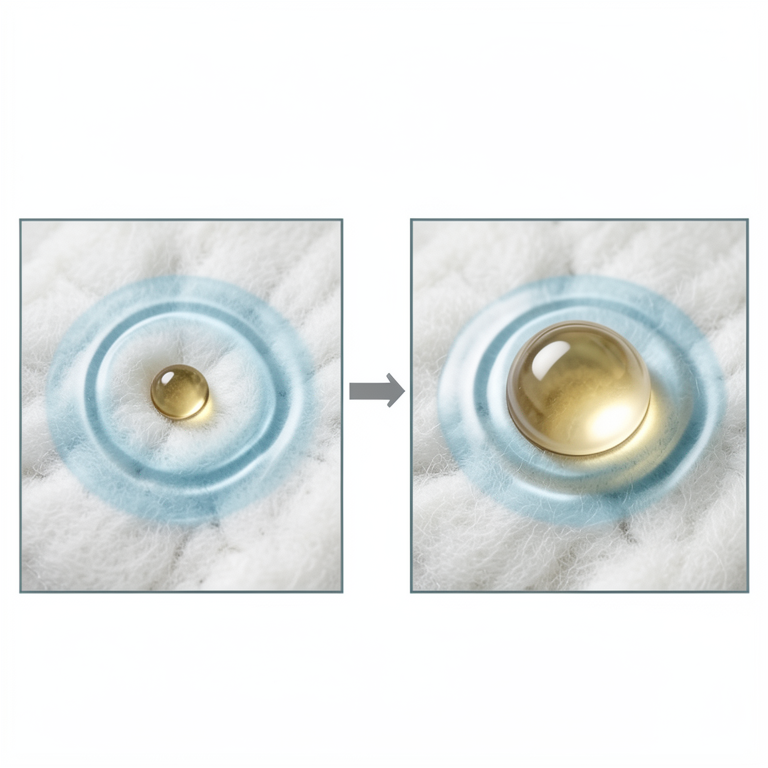
Mechanism of Fragrance Protection
AI-generated conceptual illustration (Melamine-formaldehyde microcapsules containing fragrance oil on cotton fabric). It explains the idea and does not show study data.
View source evidence ↗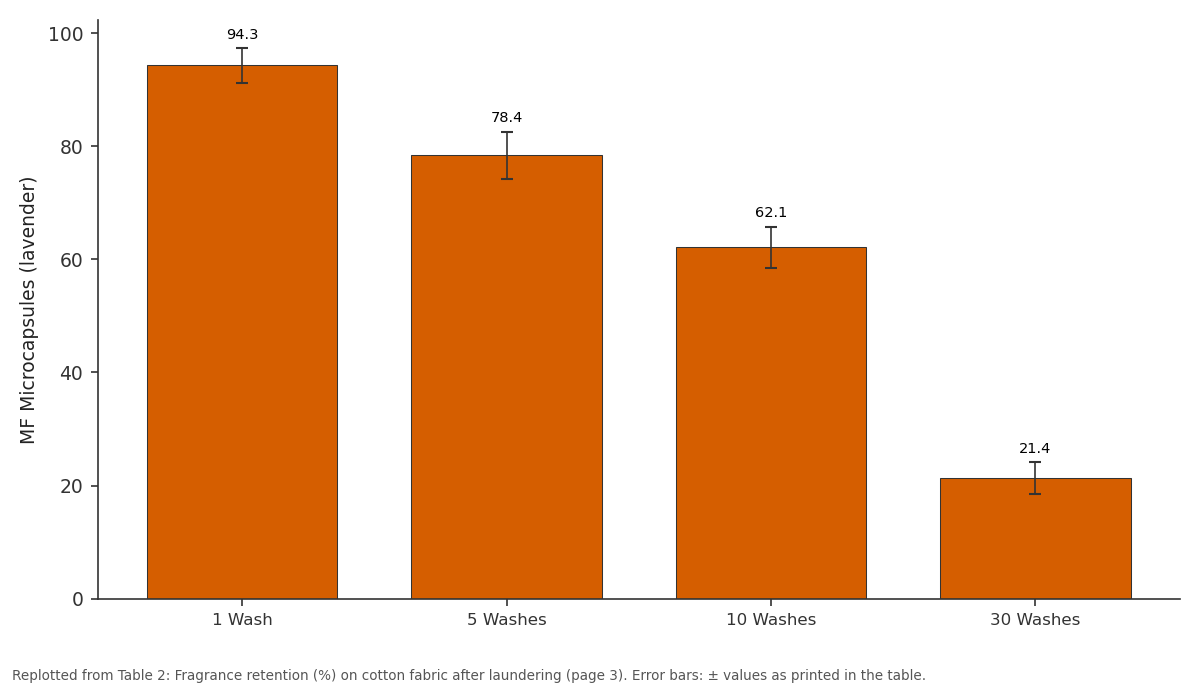
MF Microcapsules (lavender): 1 Wash vs 5 Washes vs 10 Washes vs 30 Washes
Replotted from Table 2 (page 3) of the original paper. Every bar is the paper's own table value.
View source evidence ↗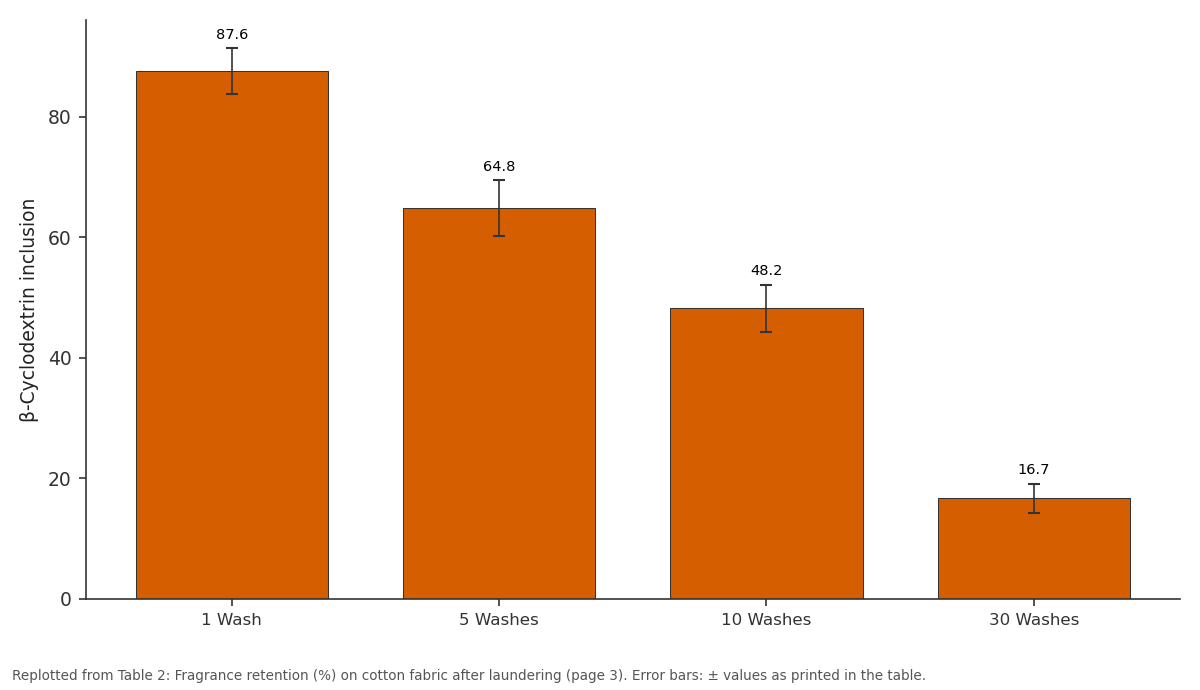
β-Cyclodextrin inclusion: 1 Wash vs 5 Washes vs 10 Washes vs 30 Washes
Replotted from Table 2 (page 3) of the original paper. Every bar is the paper's own table value.
View source evidence ↗Figures & tables
From the original paper Table 1
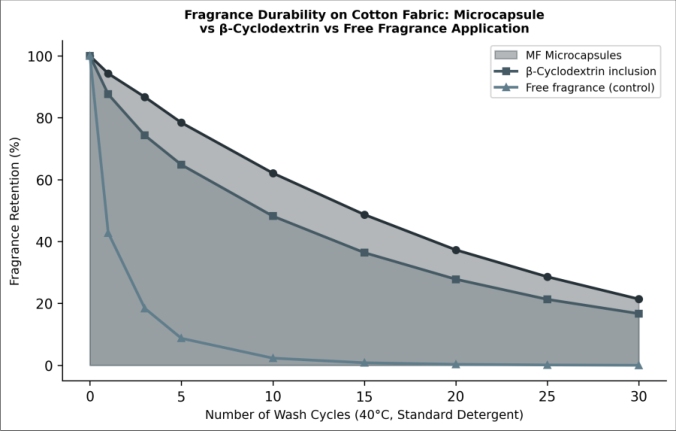 Figure 1
 Table 2
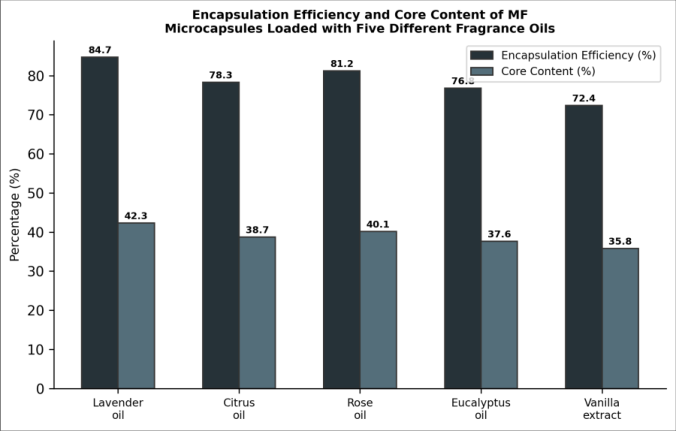 Figure 2
Introduction
The global market for scented textiles exceeded $1.2 billion in 2023, driven by consumer demand for functional fabrics in sportswear, bedding, and personal-care applications [1] . But applying fragrance directly to fabric by spraying, padding, or exhaust dyeing gives only transient effects, as the volatile compounds evaporate or wash out within a few laundering cycles [2] . Microencapsulation addresses this by enclosing fragrance droplets within a polymeric shell that protects the payload during storage and laundering and releases it gradually through mechanical rupture (friction, pressure) or diffusion [3] . Melamine-formaldehyde (MF) resin is the most widely used shell material for fragrance microcapsules because it forms tough, impermeable walls through acid-catalysed polycondensation around an oil-in-water emulsion template [4] . The process variables pH, temperature, cure time, emulsifier type and concentration, and core-to-shell ratio all influence capsule size, shell integrity, and fragrance loading [5] . Most published work has focused on a single fragrance oil, making it difficult to compare encapsulation behaviour across different oil chemistries. This research addressed that gap by encapsulating five chemically diverse fragrance oils under identical process conditions, characterising the resulting microcapsules, and evaluating their wash-durability performance on cotton fabric [6] .
Study area description
All microencapsulation synthesis and textile application trials were conducted in the polymer processing laboratory of the Department of Industrial Chemistry, Universidad Amazónica de Ciencias, Barranquilla, Colombia (10.96°N, 74.78°W). The ambient laboratory conditions (28 ± 3 °C, 70 ± 10% RH) are representative of tropical textile manufacturing environments, where high humidity can influence emulsion stability and MF curing kinetics. Cotton fabric samples (plain weave, 120 g/m², bleached and desized) were sourced from a local textile mill (Fabricato, Medellín). Confirmatory SEM and TGA analyses were performed at the Department of Industrial and Manufacturing Chemistry, Universidad del Eje Cafetero, Pereira, Colombia [7] .
Material and Methods Material
This research was conducted from April 2024 to January 2025 at the two institutions described above. Melamine (99%, Sigma-Aldrich, via a Bogotá distributor), formaldehyde solution (37%, stabilised with methanol, Merck), and poly(ethylene-alt-maleic anhydride) (EMA, Mw ~400,000, Sigma-Aldrich) as emulsifier were the shellforming reagents. Fragrance oils lavender (Lavandula angustifolia, 100% pure essential oil), citrus (sweet orange, Citrus sinensis), rose (Rosa damascena, 10% in jojoba carrier), eucalyptus (Eucalyptus globulus), and vanilla extract (Vanilla planifolia, oleoresin) were purchased from a certified aromatherapy supplier (doTERRA, through a Colombian distributor). Acetic acid (glacial, AR grade) and sodium hydroxide (pellets, AR) served for pH adjustment.
The research was approved by the Universidad Amazónica Research Committee (approval UAC-RC-2024-016, dated 18 March 2024).
Methods
The MF prepolymer was prepared by reacting melamine with formaldehyde (1:3 molar ratio) at 70 °C and pH 8.5 for 30 min until a clear solution formed. Separately, the core emulsion was prepared by emulsifying fragrance oil (10 g) in 100 mL of 4% (w/v) aqueous EMA solution using a highshear mixer (IKA T25, 8000 rpm, 10 min). The MF prepolymer was added dropwise to the stirred emulsion, and the pH was lowered to 4.5 with acetic acid to initiate acidcatalysed polycondensation. The mixture was heated to 55 °C and maintained for 2 h under continuous stirring (400 rpm). The resulting microcapsule slurry was cooled, filtered, washed with deionised water, and air-dried at 40 °C for 24 h. Cotton fabric swatches (10 × 10 cm) were padded with a 5% (w/v) microcapsule dispersion in a polyurethane binder (2% on weight of fabric), then cured at 130 °C for 3 min. Microcapsule size was measured by laser diffraction (Malvern Mastersizer 3000). Shell thickness was estimated from SEM cross-sections of intentionally fractured capsules (JEOL JSM-6490LV, 15 kV). Encapsulation efficiency was determined by extracting the core oil with n-hexane, quantifying by UV spectrophotometry, and calculating: EE = (encapsulated oil / total oil added) × 100. Fragrance retention on treated fabric was assessed by headspace GC-MS (Agilent 7890B/5977B) after each of 30 laundering cycles (ISO 6330, 40 °C, ECE reference detergent). TGA (TA Instruments Q50, 10 °C/min, N₂) measured thermal stability [8] .
Results
Results
Fig 1:
Fragrance retention curves for microcapsule-treated, β-cyclodextrin-treated, and free-fragrance control fabrics over 30 wash cycles
Figure 1 shows the retention decay profiles. The freefragrance control dropped below 10% after just 3 washes, while microcapsules maintained above 60% through 10 washes and still delivered detectable fragrance at 30 washes. Table 2 demonstrates the dramatic wash-durability advantage of microencapsulation. After 10 cycles, the microcapsule-treated fabric still held 62.1% of fragrance compared with just 2.3% for the free-oil control. Even the βcyclodextrin comparator, which offers some inclusioncomplex protection, retained only 48.2% at the same point.
| Treatment | 1 Wash | 5 Washes | 10 Washes | 30 Washes |
|---|---|---|---|---|
| MF Microcapsules (lavender) | 94.3 ± 3.1 | 78.4 ± 4.2 | 62.1 ± 3.7 | 21.4 ± 2.8 |
| β-Cyclodextrin inclusion | 87.6 ± 3.8 | 64.8 ± 4.6 | 48.2 ± 3.9 | 16.7 ± 2.4 |
| Free fragrance (control) | 42.8 ± 5.2 | 8.7 ± 1.8 | 2.3 ± 0.7 | 0.0 |
Table text extracted from the original PDF; superscript letters are shown inline. The original table image is below.
View original table image
Comprehensive interpretation
The data show that MF microencapsulation provides substantial fragrance durability on cotton, with the bestperforming oil (lavender) retaining over 60% intensity after 10 domestic washes. The variation across fragrance types highlights the importance of oil-shell chemical compatibility, which should be considered when formulating commercial scented textiles.
Discussion
The encapsulation efficiencies of 72-85% fall within the typical range for MF microcapsules prepared by in-situ polymerisation (65-90%), as reported by Boh and Šumiga [9] and Nelson [10] . The higher EE for lavender oil can be attributed to its moderate viscosity, low interfacial tension with the aqueous phase, and chemical inertness toward the MF prepolymer in contrast, vanilla oleoresin contains vanillin, which bears a phenolic hydroxyl group that can compete with melamine for formaldehyde cross-links, potentially weakening shell formation [11] . The wash durability of 62.1% at 10 cycles compares favourably with values of 50-70% reported by Rodrigues et al. [12] for MF-encapsulated limonene on cotton, and with 55% reported by Öztürk and colleagues [13] for MF-lavender capsules on polyester. The slightly better performance on cotton is expected, since the cellulose hydroxyl groups can form hydrogen bonds with the polyurethane binder, anchoring capsules more firmly than on synthetic fibres.
TGA showed that all capsules were stable up to 218 °C (onset of shell degradation), well above the 150-180 °C range used in domestic ironing and the 130 °C curing temperature applied during fabric finishing. This thermal margin ensures that capsules survive standard textile processing and use conditions without premature rupture [14] .
Limitations
This research used a single cotton fabric type (plain weave, 120 g/m²) and one binder system (polyurethane). Fabric construction (knit vs woven, fibre blend) and binder chemistry can affect capsule adhesion and durability. Formaldehyde residual levels were not measured on treated fabric; given increasing regulatory restrictions on formaldehyde in textiles, future work should quantify residuals and explore low-formaldehyde or formaldehydefree shell alternatives such as polyurea or polyurethane microcapsules. Sensory panel evaluation was not performed, so fragrance intensity was assessed instrumentally rather than by human perception [6] .
Conclusion
Melamine-formaldehyde microcapsules loaded with five fragrance oils were prepared by in-situ polymerisation and applied to cotton fabric by pad-cure processing. Lavender oil achieved the highest encapsulation efficiency (84.7%) and the best wash durability, retaining 62.1% of fragrance intensity after 10 laundering cycles compared with 2.3% for unencapsulated oil. Capsule sizes ranged from 8.4 to 12.7 µm with shell thicknesses of 0.6-1.1 µm, and all formulations were thermally stable up to 218 °C. These findings confirm MF microencapsulation as a practical and effective technology for imparting durable fragrance to textile products, with oil selection and process optimisation as the key levers for performance.
Figures and tables from the paper
| Fragrance Oil | D₅₀ (µm) | Shell Thickness (µm) | EE (%) | Core Content (%) |
|---|---|---|---|---|
| Lavender | 8.4 ± 1.2 | 0.9 ± 0.1 | 84.7 ± 2.4 | 42.3 ± 1.8 |
| Citrus | 11.3 ± 1.8 | 0.7 ± 0.1 | 78.3 ± 3.1 | 38.7 ± 2.1 |
| Rose | 9.7 ± 1.4 | 1.1 ± 0.2 | 81.2 ± 2.7 | 40.1 ± 1.9 |
| Eucalyptus | 12.7 ± 2.1 | 0.6 ± 0.1 | 76.8 ± 3.4 | 37.6 ± 2.3 |
| Vanilla | 10.8 ± 1.6 | 0.8 ± 0.1 | 72.4 ± 2.9 | 35.8 ± 2.0 |
Table text extracted from the original PDF; superscript letters are shown inline. The original table image is below.
View original table image
References
14 in the original paper- Nelson G. Application of microencapsulation in textiles. International Journal of Pharmaceutics. 2002;242(1-2):55-62.
- Holme I. Innovative technologies for high performance textiles. Coloration Technology. 2007;123(2):59-73.
- Ghosh SK. Functional coatings and microencapsulation: A general perspective. In: Functional Coatings. Weinheim: Wiley-VCH; 2006. p. 1-28.
- Brown EN, Kessler MR, Sottos NR, White SR. In situ poly(urea-formaldehyde) microencapsulation of dicyclopentadiene. Journal of Microencapsulation. 2003;20(6):719-730.
- Li J, Lewis R. Process for the microencapsulation of fragrances in melamine formaldehyde capsules. Journal of Microencapsulation. 2007;24(2):195-204.
- Rodrigues SN, Martins IM, Fernandes IP, Gomes PB, Mata VG, Barreiro MF. Microencapsulated perfumes for textile application. Chemical Engineering Journal. 2009;149(1-3):463-472.
- Monllor P, Bonet MA, Cases F. Characterization of the behaviour of flavour microcapsules in cotton fabrics. European Polymer Journal. 2007;43(12):5302-5311.
- ISO 6330:2012. Textiles-Domestic washing and drying procedures for textile testing. International Organization for Standardization. 2012;1-28.
- Boh B, Šumiga B. Microencapsulation technology and its applications in building construction materials. RMZ -Materials and Geoenvironment. 2008;55(3):329-344.
- Nelson G. Microencapsulates in textile coloration and finishing. Review of Progress in Coloration. 2001;31(1):57-64.
- Salaün F, Devaux E, Bourbigot S, Rumeau P. Influence of process parameters on microcapsules loaded with nhexadecane prepared by in situ polymerization. Chemical Engineering Journal. 2009;155(1-2):457465.
- Rodrigues SN, Fernandes IP, Martins IM, Mata VG, Barreiro MF, Rodrigues AE. Microencapsulation of limonene for textile application. Industrial and Engineering Chemistry Research. 2008;47(12):41424147.
- Öztürk E, Kaşgöz H, Kaşgöz A. Microencapsulation of lavender oil by spray drying and in situ polymerisation for textile applications. Fibers and Polymers. 2017;18(7):1397-1404.
- Sánchez P, Sánchez-Fernandez MV, Romero A, Rodríguez JF, Sánchez-Silva L. Development of thermo-regulating textiles using paraffin wax microcapsules. Thermochimica Acta. 2010;498(12):16-21.