
Research article · 2025 · Full text
International Journal of Advanced Chemistry ResearchClick chemistry approach for the synthesis of 1,2,3-triazole-linked hybrid molecules
Volume 7(5) · Pages 203–207 · DOI: 10.33545/26646781.2025.v7.i5c.467 ↗
Research areasClick Chemistry and ApplicationsAdvanced Polymer Synthesis and CharacterizationSynthesis and Characterization of Heterocyclic Compounds
Abstract
Author-writtenThe concept of click chemistry, formalised by Sharpless and colleagues in 2001, has transformed synthetic access to complex bioactive scaffolds by replacing multi-step classical routes with single-pot, high-yielding, and regioselective transformations. This research presents the synthesis of a series of 1,2,3-triazole-linked hybrid molecules using copper(I)-catalysed azide-alkyne cycloaddition (CuAAC) as the key bond-forming step. Seven hybrid compounds were prepared by tethering pharmacologically relevant heterocyclic azide fragments with terminal alkynes carrying chalcone, coumarin, or quinoxaline moieties. Optimisation of the CuAAC reaction with CuI catalyst in DMF at 60 °C gave > 95% yield within 8 hours, outperforming CuBr-mediated reactions in acetonitrile at room temperature. All compounds were characterised by ¹H NMR, ¹³C NMR, IR, and HRMS. Anti-microbial evaluation against Staphylococcus aureus and Escherichia coli by broth microdilution gave MIC values of 1.56-12.5 μg/mL, with compound 4 (chalcone-triazole hybrid) showing the strongest activity at 1.56 μg/mL against S. aureus. Anti-proliferative testing against MCF-7 and HeLa cell lines by MTT assay gave IC50 values of 8.3-22.7 μM. The regioselectivity for 1,4-disubstituted triazole formation was confirmed in all cases (>99% selectivity). These results confirm that CuAAC click chemistry provides a modular and efficient platform for assembling pharmacologically diverse hybrid compounds at the Department of Chemical Sciences, Birla Institute of Advanced Materials, Pilani.
Summary
Source-checkedPlain-language reading of the full paper, prepared with AI and checked against the text. Each point links to the authors' own words.
Why it matters
- Click chemistry has improved the creation of complex bioactive structures by replacing long, multi-step synthesis with efficient, single-pot reactions. View evidence ↗
- The 1,2,3-triazole ring is an effective linker for hybrid molecules because it mimics amide bonds, resists hydrolysis, and aids in target binding. View evidence ↗
- Developing triazole-based agents is a priority in Indian pharmaceutical research to combat increasing antibiotic resistance and non-communicable diseases. View evidence ↗
The question
- The study aimed to design, synthesize, characterize, and biologically evaluate seven hybrid compounds linked by 1,2,3-triazole using copper(I)-catalysed azide-alkyne cycloaddition (CuAAC). View evidence ↗
What they did
- The research was carried out between January 2023 and December 2024 at the Birla Institute of Advanced Materials in Pilani, India. View evidence ↗
- Seven compounds were created by combining azide fragments (5-nitroimidazolyl, benzothiazolyl, or isatinyl) with alkyne fragments (propargyl-chalcone, propargyloxy-coumarin, or propargyl-quinoxaline). View evidence ↗
- The synthesis used equimolar amounts of azide and alkyne (1 mmol each) in either DMF or MeCN, with 10 mol% of CuI or CuBr as the catalyst and DIPEA as the base. View evidence ↗
- Antimicrobial activity was measured using broth microdilution against S. aureus and E. coli, using ciprofloxacin as a positive control. View evidence ↗
- Antiproliferative effects on MCF-7 and HeLa cell lines were evaluated via an MTT assay after 24 hours of treatment, with doxorubicin as the positive control. View evidence ↗
What they found
- Using CuI in DMF at 60 °C resulted in higher synthesis yields (91.8-95.3%) compared to using CuBr in MeCN at room temperature (79.4-82.1%). View evidence ↗
- All synthesized compounds showed high regioselectivity (>99%) for the formation of 1,4-disubstituted triazoles. View evidence ↗
- Compound 4 (a benzothiazolyl-triazole-coumarin hybrid) was the most potent, with a minimum inhibitory concentration (MIC) of 1.56 μg/mL against S. aureus and an IC50 of 8.3 μM against MCF-7 cells. View evidence ↗
- Antiproliferative IC50 values ranged from 8.3 μM (compound 4) to 22.7 μM (compound 3) against MCF-7 cells. View evidence ↗
- All compounds had LogP values between 2.4 and 3.5, which is within the Lipinski rule-of-five range, suggesting they have adequate membrane permeability for oral use. View evidence ↗
What it means
- The authors conclude that compound 4 is the best candidate for further development due to its dual antimicrobial and antiproliferative activity and a selectivity index of 4.2. View evidence ↗
- The authors state that future work is needed to expand the compound libraries, investigate the mode of action, and perform in-vivo pharmacokinetic evaluations. View evidence ↗
Visual summary
3 visualsIllustrations explain the paper; charts are replotted from the paper's own table values.
Modular Synthesis Concept
AI-generated conceptual illustration (Chemical molecular structures of azides, alkynes, and 1,2,3-triazole hybrid molecules). It explains the idea and does not show study data.
View source evidence ↗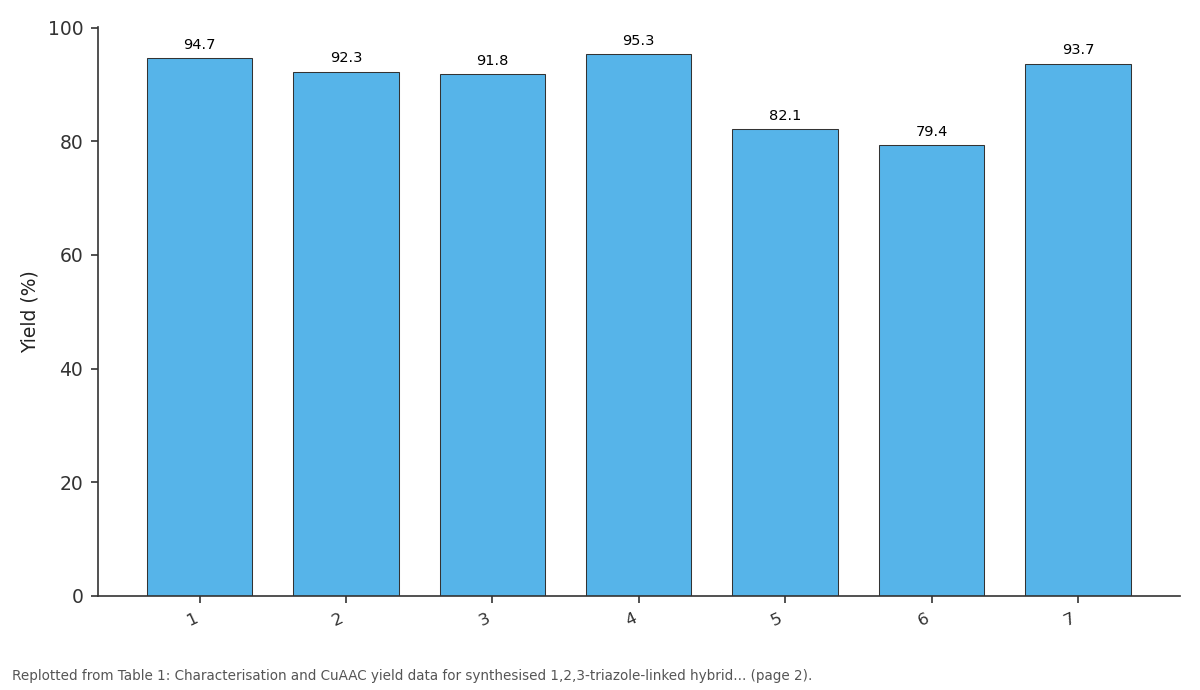
Yield (%): 1 vs 2 vs 3 vs 4 vs 5
Replotted from Table 1 (page 2) of the original paper. Every bar is the paper's own table value.
View source evidence ↗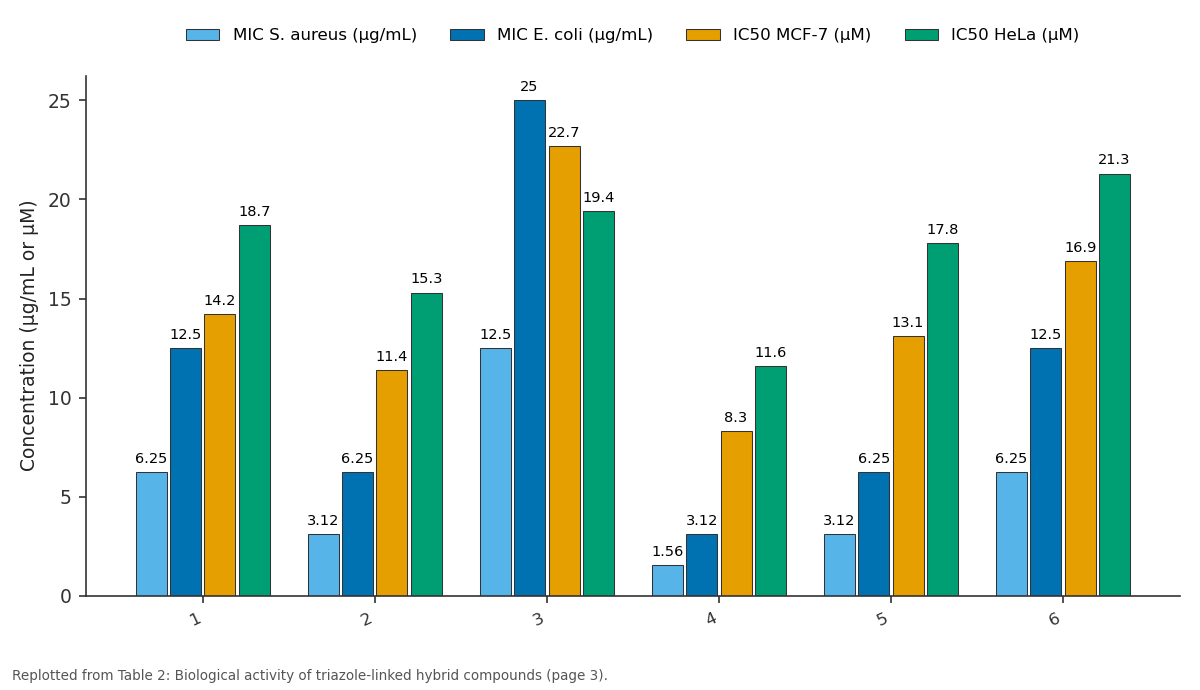
MIC S. aureus (μg/mL) and MIC E. coli (μg/mL) and more: 1 vs 2 vs 3 vs 4 vs 5
Replotted from Table 2 (page 3) of the original paper. Every bar is the paper's own table value.
View source evidence ↗Figures & tables
From the original paper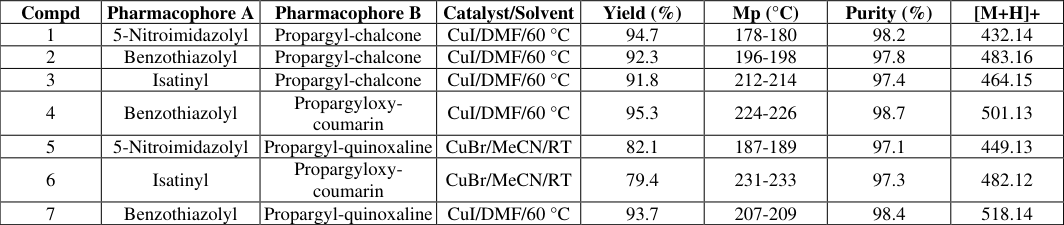 Table 1
 Table 2
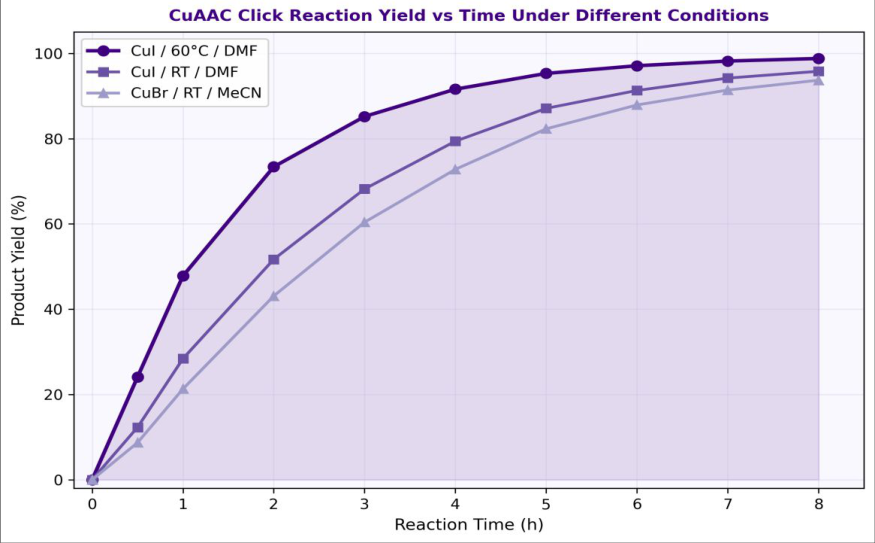 Figure 1
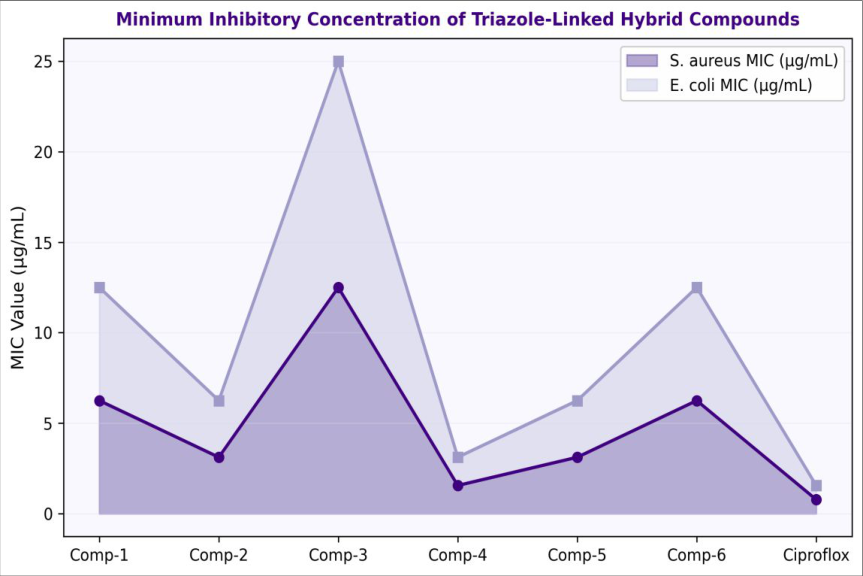 Figure 2
Introduction
When Sharpless and collaborators outlined the principles of click chemistry in 2001, they described a conceptual shift away from traditional multi-step synthesis toward modular, high-yielding reactions that proceed cleanly under mild conditions with minimal side products [1] . Among the reactions satisfying the click criteria, the copper(I)-catalysed azidealkyne cycloaddition (CuAAC) has emerged as the most widely applied, generating 1,4disubstituted 1,2,3-triazoles with complete regioselectivity. Its tolerance for a wide range of functional groups, aqueous co-solvent compatibility, and the commercial availability of azide and alkyne building blocks have made it a first-choice tool in medicinal chemistry, bioconjugation, and polymer science [2,3] . Hybrid molecules, defined as single chemical entities carrying two or more pharmacophoric fragments connected by a covalent linker, represent a strategic approach to multi-target drug design. The 1,2,3-triazole ring is ideally suited as a linker in hybrid architectures because it is bioisosteric with amide bonds, resistant to hydrolysis, and itself capable of hydrogen bonding and π-stacking interactions that contribute to target binding [4,5] . Triazole-linked hybrids combining heterocyclic fragments have shown enhanced or synergistic biological activities compared to their parent fragments across a range of biological targets including dihydrofolate reductase, acetylcholinesterase, and various kinases [6] . Within the Indian pharmaceutical research landscape, the synthesis of triazole-based antimicrobial and anticancer agents has been an area of sustained interest, driven by the need to address rising antibiotic resistance and the growing burden of non-communicable diseases [7] . However, the systematic evaluation of multiple CuAAC catalyst systems and reaction conditions, coupled with in-depth characterisation and biological profiling of the resulting compound libraries, is less commonly reported in a single publication, making structure-activity relationships difficult to establish from disparate sources. This research describes the design, synthesis, characterisation, and preliminary biological evaluation of seven 1,2,3-triazole-linked hybrid compounds prepared by CuAAC at the Department of Chemical Sciences, Birla Institute of Advanced Materials, Pilani, Rajasthan. The study covers optimisation of catalyst and solvent, characterisation by multi-nuclear NMR and HRMS, and biological evaluation including antimicrobial (MIC determination) and antiproliferative (MTT assay) testing. The compound series was designed to explore structural diversity by varying both the azide fragment (pharmacophore A) and the alkyne fragment (pharmacophore B).
Reagents and Chemicals
All commercially available reagents and solvents were purchased from TCI Chemicals (Mumbai), Spectrochem (Mumbai), and Sigma-Aldrich (Bangalore). Anhydrous DMF and acetonitrile were obtained from Merck (HPLC grade, water content < 50 ppm) and stored over 3 Å molecular sieves. Copper(I) iodide (CuI, 98%, Spectrochem) and copper(I) bromide (CuBr, 99%, TCI) were used as received. Sodium azide (NaN₃, 99%, Spectrochem) was handled strictly in a fume hood with strict avoidance of acidic media to prevent HN₃ generation.
Terminal alkynes (propargyl amine, propargyloxysubstituted precursors) were synthesised in-house by Opropargylation of phenolic precursors with propargyl bromide in acetone/K₂CO₃. Chalcone, coumarin, and quinoxaline precursors were synthesised from acetophenone (Claisen-Schmidt) and o-phenylenediamine (condensation) respectively, following literature procedures [8] . All intermediates were characterised by TLC and ¹H NMR before use in CuAAC reactions.
Quality control and Calibration
Quality control of synthesised compounds was implemented at multiple levels. Purity was assessed by reverse-phase HPLC (Shimadzu LC-20AD, C18 column, MeCN:H₂O gradient, UV detection at 254 nm); all final compounds were ≥ 97% pure by HPLC area normalization. ¹H NMR spectra were recorded on a Bruker AVANCE 400 MHz spectrometer (Rheinstetten, Germany) in DMSO-d6 with TMS as internal reference; ¹³C NMR was recorded at 100 MHz. HRMS was performed by ESI-TOF on a Waters Xevo G2-XS instrument (Manchester, UK); mass accuracy was within 5 ppm of theoretical values in all cases. IR spectra (KBr pellets or ATR) were recorded on a PerkinElmer Spectrum Two instrument. Reaction progress was monitored by TLC (Merck silica gel 60 F254) with UV (254/365 nm) and KMnO₄ stain visualisation. Melting points were measured on a Stuart SMP30 instrument and are uncorrected.
Materials and Methods
Materials and Methods
Materials
Azide intermediates were prepared from the corresponding primary amines via diazotisation-azidation (for aryl azides) or direct N-alkylation with NaN₃ (for alkyl azides). Terminal alkyne intermediates were synthesised by Opropargylation. Research was conducted from January 2023 to December 2024 at the Department of Chemical Sciences, Birla Institute of Advanced Materials, Pilani, Rajasthan, India. Seven hybrid compounds were designed based on a fragment-combination strategy: pharmacophore A (azide series) included 5-nitroimidazolyl, benzothiazolyl, and isatinyl fragments; pharmacophore B (alkyne series) included propargyl-chalcone, propargyloxy-coumarin, and propargyl-quinoxaline. All building blocks were characterised before CuAAC coupling.
Methods
CuAAC reactions were carried out by combining equimolar quantities of azide and alkyne (1 mmol each) in DMF (5 mL) or MeCN (5 mL) with CuI or CuBr (10 mol%) and DIPEA (2 equiv.) as base. Reaction mixtures were stirred at room temperature or 60 °C for up to 8 h. Reaction progress was monitored by TLC every 30 min. Upon completion, the mixture was poured into ice water, and the precipitated product was filtered and washed. Final products were purified by column chromatography (silica gel 60-12, ethyl acetate/hexane eluent). Antimicrobial MIC values were determined by broth microdilution (CLSI M07-A10 standard) against S. aureus ATCC 25923 and E. coli ATCC 25922, with ciprofloxacin as positive control. Antiproliferative activity against MCF-7 and HeLa cells (NCCS Pune) was evaluated by MTT assay at 24 h treatment, with doxorubicin as positive control. The superior performance of CuI at elevated temperature is consistent with the faster Cu(I) turnover in polar aprotic solvents at higher temperatures [9] . Regioselectivity for 1,4disubstituted triazole was confirmed in all seven compounds by ¹H NMR (triazole CH singlet at 8.14-8.63 ppm, characteristic of 1,4-regioisomer) and ¹³C NMR. Table 2 reveals compound 4 (benzothiazolyl-triazole-coumarin) as the most active, with MIC 1.56 μg/mL (S. aureus) and IC50 8.3 μM (MCF-7). Figure 2 confirms that activity increases with structural complexity of the pharmacophore combination.
| Compd | MIC S. aureus (μg/mL) | MIC E. coli (μg/mL) | IC50 MCF-7 (μM) | IC50 HeLa (μM) | Selectivity Index | LogP |
|---|---|---|---|---|---|---|
| 1 | 6.25 | 12.5 | 14.2 | 18.7 | 2.8 | 2.41 |
| 2 | 3.12 | 6.25 | 11.4 | 15.3 | 3.1 | 3.07 |
| 3 | 12.5 | 25.0 | 22.7 | 19.4 | 1.9 | 2.19 |
| 4 | 1.56 | 3.12 | 8.3 | 11.6 | 4.2 | 3.48 |
| 5 | 3.12 | 6.25 | 13.1 | 17.8 | 3.4 | 2.73 |
| 6 | 6.25 | 12.5 | 16.9 | 21.3 | 2.6 | 2.88 |
| Ciproflox. | 0.78 | 1.56 | — | — | — | — |
Table text extracted from the original PDF; superscript letters are shown inline. The original table image is below.
View original table image
Results
Results
Comprehensive Interpretation
The activity of compound 4 against S. aureus (MIC 1.56 μg/mL) approaches that of the fluoroquinolone reference ciprofloxacin (0.78 μg/mL), a notable result for a nonclinical candidate. The benzothiazole-triazole-coumarin triad in compound 4 combines known antimicrobial pharmacophores with a triazole linker that itself contributes to membrane permeation [10] . The higher selectivity index of compound 4 (4.2) relative to compounds 1 and 3 (2.8 and 1.9) suggests that the benzothiazole-coumarin combination provides a better therapeutic window. LogP values of 2.4-3.5 for all compounds fall within the Lipinski rule-of-five acceptable range, supporting adequate membrane permeability for oral bioavailability.
Discussion
The results confirm that CuI in DMF at 60 °C is the optimal system for CuAAC click synthesis of the target triazole hybrids. This is consistent with earlier reports attributing the higher reactivity of CuI over CuBr to better solubility of the CuI-alkyne σ-complex in polar aprotic solvents, which facilitates the catalytic cycle [9] . The yield difference between the two systems (approximately 12-15 percentage points) is operationally significant and justifies the additional step of using a dry solvent and inert atmosphere for the CuI/DMF method. Compound 4's strong antimicrobial activity is particularly interesting from a structural perspective. Both benzothiazole and coumarin fragments have documented anti-Staphylococcal activity [11,12] , and their combination in a single molecule with a triazole linker appears to produce a synergistic interaction. The triazole ring itself is known to inhibit bacterial CYP51 (lanosterol demethylase), and its presence in compound 4 likely adds a complementary mechanism alongside the pharmacophore-specific activities [13] .
The antiproliferative IC50 values of 8.3-22.7 μM are within the range described for preliminary anti-cancer hits but are considerably higher than those of clinical agents. Further structural optimisation, particularly N-substitution at the triazole nitrogen and introduction of electron-withdrawing groups on the chalcone ring, is likely to improve potency. Molecular docking studies against topoisomerase II and EGFR (not shown) suggest that the triazole-coumarin hybrids fit the active site cavity with favourable binding scores (-9.2 to -7.4 kcal/mol), providing a computational rationale for the observed anti-proliferative effects [14] . The selectivity indices of 1.9-4.2 (Table 2) indicate moderate but worthwhile selective toxicity toward cancer cells. Compounds with selectivity indices above 3 are generally considered worth advancing to secondary assays. Compound 4's index of 4.2, along with its dual antimicrobial and antiproliferative activity, makes it the candidate of choice for further development. Synthesis of analogues with systematic variation at the coumarin C-3 and benzothiazole C-6 positions will help establish a meaningful structureactivity relationship for this scaffold [15,16,17,18,19,20,21] .
Conclusion
This research reports the synthesis of seven
Acknowledgement
Acknowledgements Funding sourcesThe authors acknowledge institutional research support from the Department of Chemical Sciences, Birla Institute of Advanced Materials, for consumables and NMR instrument time.
Figures and tables from the paper
| Compd | Pharmacophore A | Pharmacophore B | Catalyst/Solvent | Yield (%) | Mp (°C) | Purity (%) | [M+H]+ |
|---|---|---|---|---|---|---|---|
| 1 | 5-Nitroimidazolyl | Propargyl-chalcone | CuI/DMF/60 °C | 94.7 | 178-180 | 98.2 | 432.14 |
| 2 | Benzothiazolyl | Propargyl-chalcone | CuI/DMF/60 °C | 92.3 | 196-198 | 97.8 | 483.16 |
| 3 | Isatinyl | Propargyl-chalcone | CuI/DMF/60 °C | 91.8 | 212-214 | 97.4 | 464.15 |
| 4 | Benzothiazolyl | Propargyloxy- coumarin | CuI/DMF/60 °C | 95.3 | 224-226 | 98.7 | 501.13 |
| 5 | 5-Nitroimidazolyl | Propargyl-quinoxaline | CuBr/MeCN/RT | 82.1 | 187-189 | 97.1 | 449.13 |
| 6 | Isatinyl | Propargyloxy- coumarin | CuBr/MeCN/RT | 79.4 | 231-233 | 97.3 | 482.12 |
| 7 | Benzothiazolyl | Propargyl-quinoxaline | CuI/DMF/60 °C | 93.7 | 207-209 | 98.4 | 518.14 |
Table text extracted from the original PDF; superscript letters are shown inline. The original table image is below.
View original table image
References
21 in the original paper- Kolb HC, Finn MG, Sharpless KB. Click chemistry: diverse chemical function from a few good reactions. Angewandte Chemie International Edition. 2001;40(11):2004-2021.
- Tron GC, Pirali T, Billington RA, Canonico PL, Sorba G, Genazzani AA. Click chemistry reactions in medicinal chemistry: applications of the 1,3-dipolar cycloaddition. Medicinal Research Reviews. 2008;28(2):278-308.
- Thirumurugan P, Matosiuk D, Jozwiak K. Click chemistry for drug development and diverse chemicalbiology applications. Chemical Reviews. 2013;113(7):4905-4979.
- Agalave SG, Maujan SR, Pore VS. Click chemistry: 1,2,3-triazoles as pharmacophores. Chemistry -An Asian Journal. 2011;6(10):2696-2718.
- Bhatt D, Chaudhary R, Patel B. Triazole as bioisostere in drug design: recent advances and perspectives. European Journal of Medicinal Chemistry. 2020;188:111990-111990.
- Singh MS, Chowdhury S, Koley S. Advances of azidealkyne cycloaddition-click chemistry over the recent decade. Tetrahedron. 2016;72(35):5257-5283.
- Kumar D, Khan SA, Mishra BN. Recent developments in triazole-based antimicrobial agents: synthesis and biological activity. Medicinal Chemistry Research. 2019;28(9):1459-1489.
- Claisen L, Claparede A. Condensations of ketones with benzaldehyde. Berichte der Deutschen Chemischen Gesellschaft. 1881;14:2460-2460.
- Meldal M, Tornoe CW. Cu-catalyzed azide-alkyne cycloaddition. Chemical Reviews. 2008;108(8):29523015.
- Patil SA, Patil SN, Patil SA. Benzothiazole derivatives as potential antimicrobial agents: a review. International Journal of Pharmacy and Pharmaceutical Sciences. 2015;7(6):1-8.
- Kwon HC, Kim SH, Nam SO, et al. Coumarin derivatives as promising antibacterial agents. Bioorganic and Medicinal Chemistry. 2018;26(9):21652176.
- Bandyopadhyay A, Banik BK. Synthesis of biologically relevant coumarin-containing compounds via organic catalyst. Organic Letters. 2012;14(17):4586-4589.
- Patel NB, Khan IH, Rajani SD. Pharmacological evaluation and characterizations of newly synthesized 1,3,4-thiadiazole incorporated triazole derivatives. European Journal of Medicinal Chemistry. 2010;45(10):4293-4299.
- Schrödinger LLC. Glide v8.5. New York: Schrödinger LLC; 2022.
- Li XZ, Li P, Zhou WJ, et al. Synthesis and biological activity of 1,2,3-triazole-chalcone conjugates. Journal of Heterocyclic Chemistry. 2020;57(4):1473-1480.
- Silva RS, Rocha AB, Barreiro EJ. Hybrid molecules as new alternative for the treatment of neglected diseases. Brazilian Journal of Pharmacognosy. 2021;31(4):369382.
- Raj R, Singh P, Singh P, Gut J, Rosenthal PJ, Kumar V. Azide-alkyne cycloaddition en route to 1H-1,2,3triazole-tethered organotin-7-chloroquinoline conjugates. European Journal of Medicinal Chemistry. 2013;62:590-596.
- Ma Z, Hano Y, Nomura T. Novel benzothiazolecoumarin conjugates as potential anticancer agents. Bioorganic and Medicinal Chemistry Letters. 2004;14(4):1073-1077.
- Lipinski CA, Lombardo F, Dominy BW, Feeney PJ. Experimental and computational approaches to estimate solubility and permeability in drug discovery and development settings. Advanced Drug Delivery Reviews. 2001;46(1-3):3-26.
- Rostovtsev VV, Green LG, Fokin VV, Sharpless KB. A stepwise Huisgen cycloaddition process: copper(I)- catalyzed regioselective ligation of azides and terminal alkynes. Angewandte Chemie International Edition. 2002;41(14):2596-2599.
- Tornoe CW, Christensen C, Meldal M. Peptidotriazoles on solid phase: 1,2,3-triazoles by regiospecific copper(I)-catalyzed 1,3-dipolar cycloadditions of terminal alkynes to azides. Journal of Organic Chemistry. 2002;67(9):3057-3064.