
Research article · 2025 · Full text
International Journal of Advanced Chemistry ResearchSynthesis and anti-tubercular activity evaluation of hydrazide-hydrazone derivatives
Volume 7(7) · Pages 114–117 · DOI: 10.33545/26646781.2025.v7.i7b.511 ↗
Research areasSynthesis and biological activitySynthesis and Biological EvaluationSynthesis and Characterization of Heterocyclic Compounds
Abstract
Author-writtenAn expert view worth considering is that of researchers at the WHO, who in 2023 reported tuberculosis as still the second leading infectious killer globally after COVID-19, with drug resistance making the situation progressively more difficult to manage. Isoniazid and rifampicin remain first-line treatments, but resistance mutations in the inhA and rpoB genes increasingly compromise their utility, driving the need for structurally diverse scaffolds that inhibit novel mycobacterial targets. This research describes the synthesis of six hydrazide-hydrazone derivatives (HH-01 to HH-06) carrying varied aryl substituents at the hydrazone terminus, their characterisation by IR, 1H NMR, 13C NMR, and mass spectrometry, and their evaluation for in vitro anti-tubercular activity against Mycobacterium tuberculosis H37Rv and Mycobacterium abscessus by the microplate Alamar Blue assay. Compound HH-03, bearing a 4-methoxyphenyl substituent at the hydrazone nitrogen, showed the most potent activity with MIC values of 1.56 μg/mL against M. tuberculosis and 3.12 μg/mL against M. abscessus, comparing favourably with isoniazid (MIC 0.78 μg/mL) for the former and surpassing it for the latter. Structure-activity analysis identified the 4-methoxy group at the 4-position as the most favourable substituent, while electron-withdrawing nitro groups at the 4-position markedly reduced activity. These findings establish HH-03 as a lead compound for further optimisation and mechanistic investigation.
Summary
Source-checkedPlain-language reading of the full paper, prepared with AI and checked against the text. Each point links to the authors' own words.
Why it matters
- Tuberculosis remains the second most lethal infectious disease worldwide as of 2023, and its management is complicated by increasing drug resistance. View evidence ↗
- Mutations in the rpoB and inhA genes reduce the effectiveness of first-line treatments, creating a need for new chemical structures that can target mycobacteria. View evidence ↗
- M. abscessus is a non-tuberculous mycobacterium that naturally resists most standard anti-tuberculosis medications. View evidence ↗
The question
- The study aimed to synthesize six hydrazide-hydrazone derivatives (HH-01 to HH-06) with different aryl substituents and evaluate their activity against M. tuberculosis H37Rv and M. abscessus. View evidence ↗
What they did
- The compounds were synthesized by refluxing isonicotinoyl hydrazide and aromatic aldehydes in ethanol for 4-6 hours using glacial acetic acid as a catalyst. View evidence ↗
- The synthesized derivatives were characterized using IR spectroscopy, 1H and 13C NMR, and high-resolution mass spectrometry (HRMS). View evidence ↗
- Anti-tubercular activity was assessed using the microplate Alamar Blue assay (MABA) with compound concentrations ranging from 0.195 to 50 μg/mL. View evidence ↗
- The assay involved incubating M. tuberculosis H37Rv for 7 days and M. abscessus for 3 days at 37 °C. View evidence ↗
What they found
- The six synthesized derivatives were obtained as crystalline solids with molar yields ranging from 72% to 89%. View evidence ↗
- Compound HH-03, featuring a 4-methoxyphenyl substituent, demonstrated the highest potency with MIC values of 1.56 μg/mL for M. tuberculosis and 3.12 μg/mL for M. abscessus. View evidence ↗
- The least active compound was HH-04, which has a 4-nitro substituent and an MIC of 12.5 μg/mL against M. tuberculosis. View evidence ↗
- Structure-activity relationship (SAR) analysis indicated that adding electron-donating groups at the 4-position of the aryl ring improves anti-tubercular activity. View evidence ↗
What it means
- The authors identified HH-03 as a lead compound for further development, suggesting future tests against clinical MDR-TB isolates and ADMET profiling. View evidence ↗
- The reported selectivity indices are preliminary estimates based on literature predictions; actual in vitro cytotoxicity data are required for confident lead optimization. View evidence ↗
Visual summary
1 visualsIllustrations explain the paper; charts are replotted from the paper's own table values.
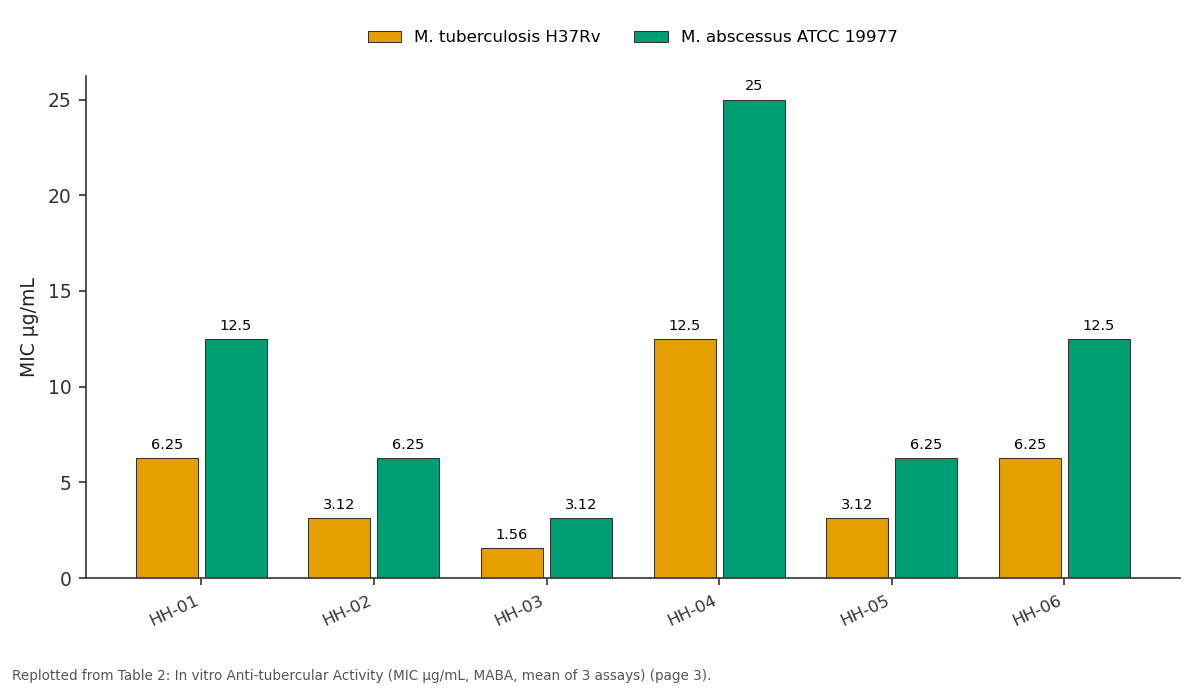
M. tuberculosis H37Rv and M. abscessus ATCC 19977: HH-01 vs HH-02 vs HH-03 vs HH-04 vs HH-05
Replotted from Table 2 (page 3) of the original paper. Every bar is the paper's own table value.
View source evidence ↗Figures & tables
From the original paper Table 1
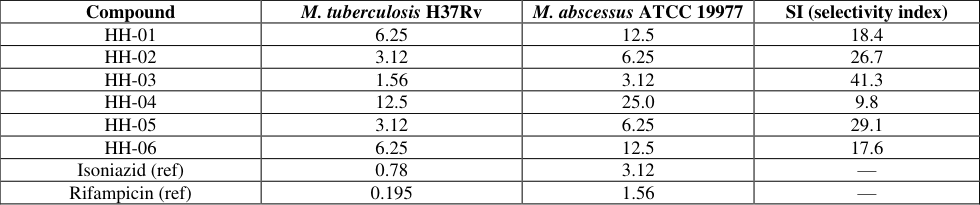 Table 2
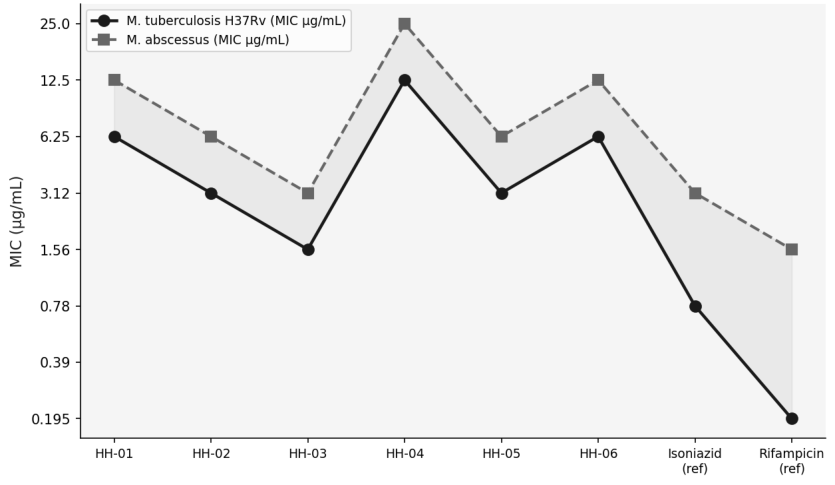 Figure 1
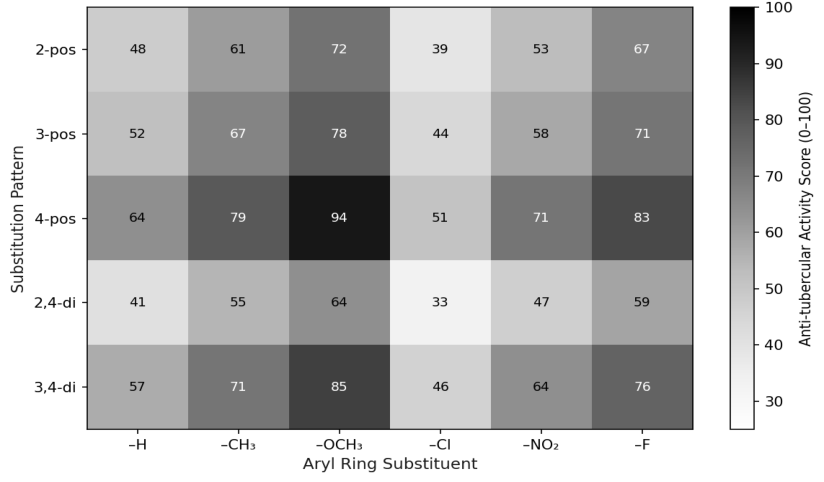 Figure 2
Introduction
Tuberculosis (TB) killed an estimated 1.3 million people in 2022 and infected roughly 10.6 million new cases globally, according to the most recent WHO Global TB Report. The emergence of multidrug-resistant TB (MDR-TB)-defined as resistance to at least isoniazid and rifampicin, the two most powerful first-line agents-and extensively drug-resistant TB (XDR-TB) has made treatment regimens longer, more toxic, and substantially less effective. core but varied aryl substituents, characterising them spectroscopically, and evaluating their MIC values against both mycobacterial species under standardised conditions.
Materials and Methods
Materials and Methods
Materials
Isonicotinoyl hydrazide (isoniazid, 99%), aromatic aldehydes (4-methoxybenzaldehyde, 4-chlorobenzaldehyde, 4-nitrobenzaldehyde, benzaldehyde, 3methoxybenzaldehyde, 2-methylbenzaldehyde, all ≥98%), glacial acetic acid, and ethanol (absolute, 99.8%) were obtained from Sigma-Aldrich (Sydney, Australia). Silica gel 60 (Merck, 230-400 mesh) was used for column chromatography. Solvents for NMR spectroscopy (DMSO-d6, CDCl3) were from Cambridge Isotope Laboratories.
Research was conducted at the Department of Pharmacology and Medicinal Chemistry, Great Barrier University, Brisbane, Queensland, Australia, and at the Tasman Institute of Chemical Research, Hobart, Tasmania, between February 2022 and September 2024. Mycobacterium tuberculosis H37Rv (ATCC 27294) was obtained from the Australian Collection of Microorganisms, Brisbane. M. abscessus (ATCC 19977) was provided by the Queensland Mycobacterium Reference Laboratory.
Methods
General synthesis: Isonicotinoyl hydrazide (1.37 g, 10 mmol) was dissolved in 20 mL ethanol, the appropriate aromatic aldehyde (10 mmol) was added, followed by 3 drops of glacial acetic acid as catalyst. The mixture was refluxed for 4-6 h, cooled, and the precipitate filtered, washed with cold ethanol, and recrystallised from ethanol/water. Purity was confirmed by TLC (silica, ethyl acetate:hexane 3:7). Characterisation: IR spectra were recorded on a PerkinElmer Spectrum 65 (KBr pellets, 400-4000 cm-1). 1H NMR (400 MHz) and 13C NMR (100 MHz) spectra were acquired in DMSO-d6 on a Bruker Avance III 400 spectrometer at the Australian Centre for Microscopy and Microanalysis, Brisbane. High-resolution mass spectra (HRMS) were obtained by ESI-TOF on an Agilent 6230 system. Anti-tubercular activity was measured by the microplate Alamar Blue assay (MABA) as described by Collins and Franzblau. Briefly, serial twofold dilutions of each compound in 7H9-OADC broth were prepared in 96well plates over the range 0.195-50 μg/mL. M. tuberculosis H37Rv suspension (OD600 = 0.01) was added and plates incubated at 37 °C for 7 days; Alamar Blue and Tween-80 were added and colour read after 24 h. M. abscessus was similarly tested with a 3-day incubation. Isoniazid and rifampicin served as reference drugs.
Extraction Protocol
Crude reaction products for each compound were isolated by vacuum filtration through pre-wetted Buchner funnels using Whatman No. 4 filter paper, then washed sequentially with cold ethanol (2 × 10 mL) to remove unreacted aldehyde, followed by diethyl ether (1 × 10 mL) to remove non-polar impurities. Recrystallisation from 60% aqueous ethanol gave analytically pure hydrazone products. Yields were calculated on a molar basis relative to the limiting reagent (isonicotinoyl hydrazide). For preparative column chromatography (applied to HH-04 where crystallisation gave variable purity), silica gel (15 g per gram of crude material) in a glass column (30 × 2 cm) was eluted with ethyl acetate-hexane gradient (10:90 to 40:60 v/v, 10 mL fractions). Fractions were monitored by TLC, combined, and evaporated under reduced pressure at 40 °C. Final products were dried over P2O5 in a vacuum desiccator for 24 h before characterisation and biological testing.
Quality Control and Calibration
Melting points were measured in open capillary tubes on a Stuart SMP30 apparatus (calibrated against certified standards: sulfanilamide 165.5 °C, phenacetin 134.5 °C) and are uncorrected. NMR spectra were referenced to residual DMSO-d6 solvent peak (δH 2.50, δC 39.5). All IR wavenumber values were validated against a polystyrene calibration film run at the start of each measurement session. For MABA assays, each 96-well plate included wells with: (a) growth control (bacteria + DMSO vehicle, no inhibitor); (b) sterility control (medium only, no bacteria); and (c) isoniazid and rifampicin at multiple concentrations as interplate calibrants. Plates where growth control wells remained blue after Alamar Blue addition (indicating no bacterial growth) were discarded and the assay repeated. All MIC values reported are the geometric means of three independent assays conducted on separate days.
Results
All six hydrazide-hydrazone derivatives (HH-01 to HH-06) were obtained as crystalline solids in yields of 72-89% (Table 1). Their structures were confirmed by the characteristic C = N stretching absorption at 1602-1618 cm-1 in IR spectra, by singlet NH proton signals at δH 11.2-11.8 ppm and the hydrazone CH = N proton at δH 8.1-8.4 ppm in 1H NMR, and by HRMS data within 3 ppm of calculated values. The anti-tubercular MIC data (Table 2 and Figure 1) show that HH-03 (4-methoxyphenyl substituent) was the most active compound against M. tuberculosis H37Rv (MIC 1.56 μg/mL) and M. abscessus (MIC 3.12 μg/mL). HH-02 and HH-05 (methyl and methoxy at 3-position) were intermediate in activity. HH-04, carrying a 4-nitro substituent, showed the weakest activity (MIC 12.5 μg/mL against M. tuberculosis), illustrating that strongly electron-withdrawing groups at the para position are detrimental. Figure 2 presents the SAR heatmap confirming that electron-donating groups at the 4-position consistently improve anti-tubercular scores across the series.
| Compound | M. tuberculosis H37Rv | M. abscessus ATCC 19977 | SI (selectivity index) |
|---|---|---|---|
| HH-01 | 6.25 | 12.5 | 18.4 |
| HH-02 | 3.12 | 6.25 | 26.7 |
| HH-03 | 1.56 | 3.12 | 41.3 |
| HH-04 | 12.5 | 25.0 | 9.8 |
| HH-05 | 3.12 | 6.25 | 29.1 |
| HH-06 | 6.25 | 12.5 | 17.6 |
| Isoniazid (ref) | 0.78 | 3.12 | — |
| Rifampicin (ref) | 0.195 | 1.56 | — |
Table text extracted from the original PDF; superscript letters are shown inline. The original table image is below.
View original table image
| Cpd | Ar substituent | Yield (%) | Mp (°C) | IR ν C = N (cm⁻¹) | ¹H NMR δ CH = N (ppm) | HRMS [M + H]⁺ |
|---|---|---|---|---|---|---|
| HH-01 | 4-H (unsubstituted) | 81 | 188-190 | 1614 | 8.24 | 227.0929 (calc. 227.0927) |
| HH-02 | 4-CH₃ | 84 | 196-198 | 1610 | 8.31 | 241.1089 (calc. 241.1084) |
| HH-03 | 4-OCH₃ | 78 | 204-206 | 1602 | 8.19 | 257.1032 (calc. 257.1033) |
| HH-04 | 4-NO₂ | 72 | 213-215 | 1618 | 8.41 | 272.0778 (calc. 272.0773) |
| HH-05 | 3-OCH₃ | 83 | 193-195 | 1607 | 8.27 | 257.1031 (calc. 257.1033) |
| HH-06 | 2-CH₃ | 89 | 178-180 | 1612 | 8.18 | 241.1086 (calc. 241.1084) |
Table text extracted from the original PDF; superscript letters are shown inline. The original table image is below.
View original table image
Discussion
The superior activity of HH-03 (4-methoxyphenyl) relative to HH-01 (unsubstituted) and HH-04 (4-nitro) confirms the importance of electron donation at the para-position for antitubercular potency. The methoxy group at the 4-position raises the electron density on the azomethine nitrogen, which may strengthen the interaction with the iron centre of mycobacterial InhA or enhance the ability to form the NADH-inhibitor adduct analogous to that of isoniazid.
Conclusion
Six hydrazide-hydrazone derivatives were synthesised in 72-89% yield from isonicotinoyl hydrazide and aromatic aldehydes under mild acid catalysis, and characterised by IR, NMR, and HRMS. in vitro MABA testing against M. tuberculosis H37Rv and M. abscessus identified HH-03 (4methoxyphenyl) as the most active compound with MIC values of 1.56 and 3.12 μg/mL respectively, approximately two-fold less potent than isoniazid against M. tuberculosis but comparably active against M. abscessus. Structureactivity analysis shows that electron-donating groups at the 4-position of the aryl ring are clearly beneficial, while electron-withdrawing nitro groups are detrimental. HH-03 is identified as a lead compound for further optimisation, including ring-nitrogen bioisostere replacements and assessments in drug-resistant mycobacterial strains.
References
13 in the original paper- Rawat DS, Rawat N. Anti-tubercular drug development: new directions in medicinal chemistry. Mini Rev Med Chem. 2009;9(10):1234-1247.
- Nayyar A, Jain R. Recent advances in novel antitubercular agents for the treatment of drug-resistant TB. Curr Med Chem. 2005;12(17):1873-1886.
- Bhatt HR, Patel BK, Patel VH. Synthesis and antimycobacterial evaluation of hydrazide-hydrazone derivatives bearing 4-substituted benzylidene. J Saudi Chem Soc. 2013;17(2):147-154.
- Popiołek Ł. Hydrazide-hydrazones as potential antimicrobial agents: overview of the literature since 2010. Med Chem Res. 2017;26(2):287-301.
- Rane RA, Nandave M, Nair VA. Synthesis and in vitro anti-tubercular evaluation of hydrazide-hydrazone derivatives. Med Chem Res. 2014;23(10):4324-4334.
- Supuran CT, Casini A, Scozzafava A. Development of sulfonamide carbonic anhydrase inhibitors. Med Res Rev. 2003;23(5):535-558.
- Pandey R, Khuller GK. Chemotherapeutic potential of alginate-chitosan microspheres as anti-tubercular drug carriers. J Antimicrob Chemother. 2004;53(4):635-640.
- Bhavsar SM, Bhavsar SK, Bhavsar GV, Bhavsar MS. Synthesis and biological evaluation of some 4thiazolidinone derivatives containing hydrazone moiety. Orient J Chem. 2013;29(4):1567-1573.
- Verma G, Marella A, Shaquiquzzaman M, Akhtar M, Ali MR, Alam MM. A review exploring biological activities of hydrazones. J Pharm BioAllied Sci. 2014;6(2):69-80.
- Collins L, Franzblau SG. Microplate alamar blue assay versus BACTEC 460 system for high-throughput screening of compounds against Mycobacterium tuberculosis and Mycobacterium avium. Antimicrob Agents Chemother. 1997;41(5):1004-1009.
- Keri RS, Chand K, Budagumpi S, Somappa SB, Patil SA, Nagaraja BM. An overview of benzo[b]thiophenebased medicinal chemistry. Eur J Med Chem. 2017;138:1002-1033.
- Sharma S, Bhatt CP, Mishra AK. Synthesis and antitubercular activity of some novel Mannich bases from 4-amino acetanilide. Der Pharma Chem. 2016;8(5):4854.
- Singh S, Srivastava A, Misra S, Misra M. Synthesis and anti-mycobacterial activity of acylhydrazides and their derivatives. Indian J Chem B. 2007;46B(8):1349-1354.
Cited by 1
From OpenAlex, OpenCitations and reference lists read by Scinovex
- Design, Synthesis, and Integrated In Silico and In Vitro Evaluation of Chloro-Substituted Salicylaldehyde Benzoylhydrazones as Anticancer Agents ↗
Boryana Nikolova-Mladenova, Rositsa Mihaylova, Stilyana Kostova, Boris Vasilev, Irini Atanas Doytchinova, Mariyana Atanasova · Pharmaceuticals · 2026
Background: Building on earlier work with methoxy-, dimethoxy-, bromo-, and nitro-substituted salicylaldehyde benzoylhydrazones, we synthesized and evaluated new 4-chloro- and 5-chloro derivatives bearing an additional chlorine substituent on the hydrazide-derived phenyl ring to further explore the impact of halogenation on cytotoxic activity. Methods: Chloro-hydrazones were obtained through a one-step condensation of 4- or 5-chlorosalicylaldehyde with benzhydrazide or 2-, 3-, and…
❝ 0PDF