
Research article · 2025 · Full text
International Journal of Advanced Chemistry ResearchBiochemical composition and nutritional profile of underutilized legume seeds
Volume 7(10) · Pages 84–87 · DOI: 10.33545/26646781.2025.v7.i10a.478 ↗
Research areasFood and Agricultural SciencesSeed and Plant BiochemistryGenetic and Environmental Crop Studies
Abstract
Author-writtenImagine a farming community in a semi-arid region where conventional pulse crops fail repeatedly due to drought, yet several hardy indigenous legumes thrive on the margins of cultivated fields, largely ignored by formal research. This research characterised the proximate composition, mineral content, amino acid profile, and anti-nutritional factors of five underutilized legume species—horse gram (Macrotyloma uniflorum), moth bean (Vigna aconitifolia), rice bean (Vigna umbellata), winged bean (Psophocarpus tetragonolobus), and velvet bean (Mucuna pruriens)—sourced from germplasm accessions maintained at Irkutsk, Russia. Protein content ranged from 18.7 g/100 g (rice bean) to 33.1 g/100 g (winged bean), while fat was highest in winged bean (16.4 g/100 g) owing to its unique lipid-rich cotyledon. Calcium levels varied from 143 to 441 mg/100 g, iron from 4.1 to 11.2 mg/100 g, and zinc from 1.8 to 5.7 mg/100 g. Trypsin inhibitor activity, phytic acid, and total phenolics were quantified as principal anti-nutritional factors; all were reduced by 48–71% following a standardised soaking-cooking treatment. The data position winged bean and velvet bean as nutritionally competitive with soybean and chickpea, supporting their integration into food security programmes targeting protein- and micronutrient-deficient populations.
Summary
Source-checkedPlain-language reading of the full paper, prepared with AI and checked against the text. Each point links to the authors' own words.
Why it matters
- Underutilized legumes could help address protein deficiencies in diets dominated by a few staple grains, but they lack sufficient nutritional documentation. View evidence ↗
- Anti-nutritional factors in legumes, such as phytic acid and trypsin inhibitors, can hinder the body's ability to absorb minerals and digest proteins. View evidence ↗
The question
- The study aimed to analyze the nutritional and biochemical profiles of five underutilized legumes and evaluate how a standard soaking-cooking process reduces their anti-nutritional factors. View evidence ↗
What they did
- The researchers analyzed horse gram, moth bean, rice bean, winged bean, and velvet bean seeds sourced from Irkutsk, Russia. View evidence ↗
- Proximate composition was measured using AOAC Official Methods, including micro-Kjeldahl for protein and Soxhlet extraction for fat. View evidence ↗
- The processing treatment involved soaking 50 g of seeds for 12 hours at 25°C, followed by boiling in water for 30 minutes. View evidence ↗
What they found
- Winged bean exhibited the highest protein (33.1 ± 0.8 g/100 g) and fat (16.4 ± 0.6 g/100 g) levels among the species studied. View evidence ↗
- Rice bean had the highest carbohydrate content (61.4 ± 1.2 g/100 g) and the lowest protein content (18.7 ± 0.5 g/100 g). View evidence ↗
- Winged bean was the most mineral-dense species, containing 441 ± 18 mg/100 g of calcium, 11.2 ± 0.7 mg/100 g of iron, and 5.7 ± 0.4 mg/100 g of zinc. View evidence ↗
- The soaking-cooking process reduced trypsin inhibitor activity (53–68%), phytic acid (48–62%), and total phenolics (51–59%) across all five legumes. View evidence ↗
- Phytochemical screening found saponins in all species and tannins in all except rice bean, while alkaloids were specifically detected in velvet bean. View evidence ↗
What it means
- The authors concluded that winged bean is the most nutritionally complete option due to its high protein, fat, and mineral levels. View evidence ↗
- The study provides a standardized baseline to help integrate these neglected legumes into food security strategies through breeding and food formulation. View evidence ↗
Visual summary
3 visualsIllustrations explain the paper; charts are replotted from the paper's own table values.
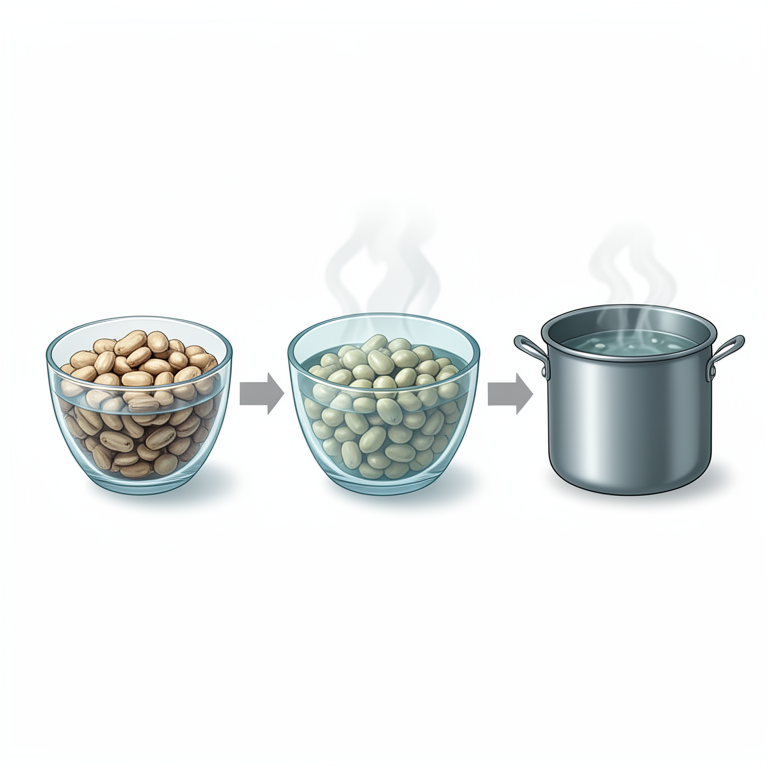
Processing Workflow
AI-generated conceptual illustration (underutilized legume seeds). It explains the idea and does not show study data.
View source evidence ↗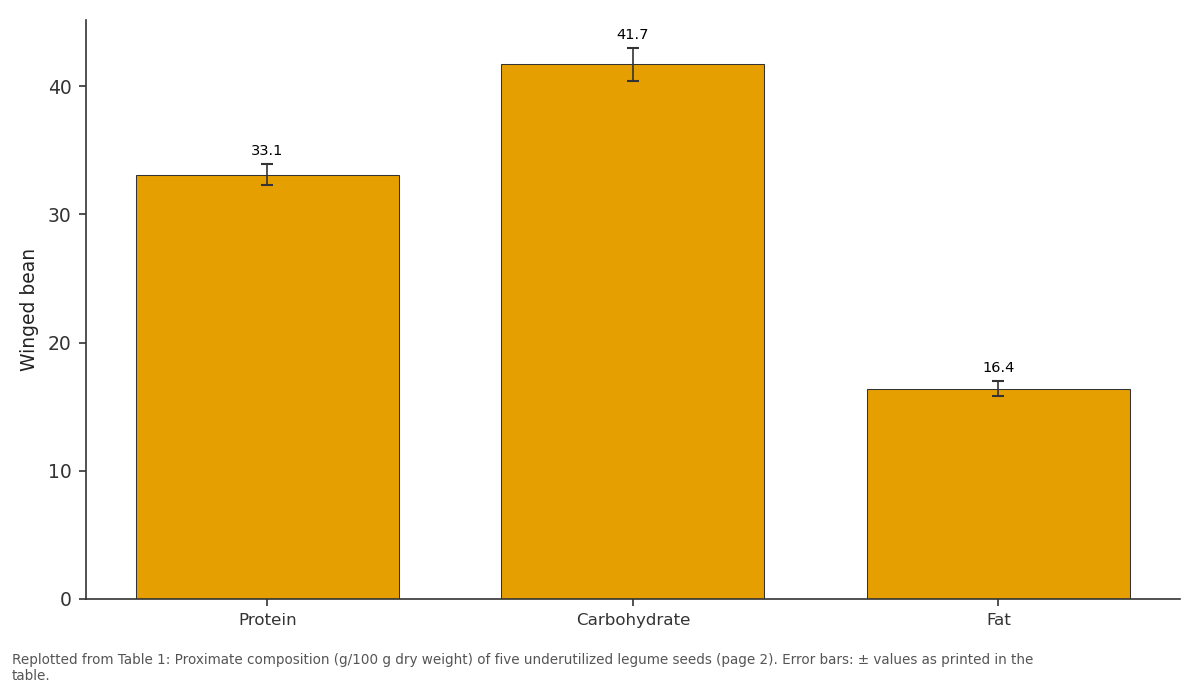
Winged bean: Protein vs Carbohydrate vs Fat
Replotted from Table 1 (page 2) of the original paper. Every bar is the paper's own table value.
View source evidence ↗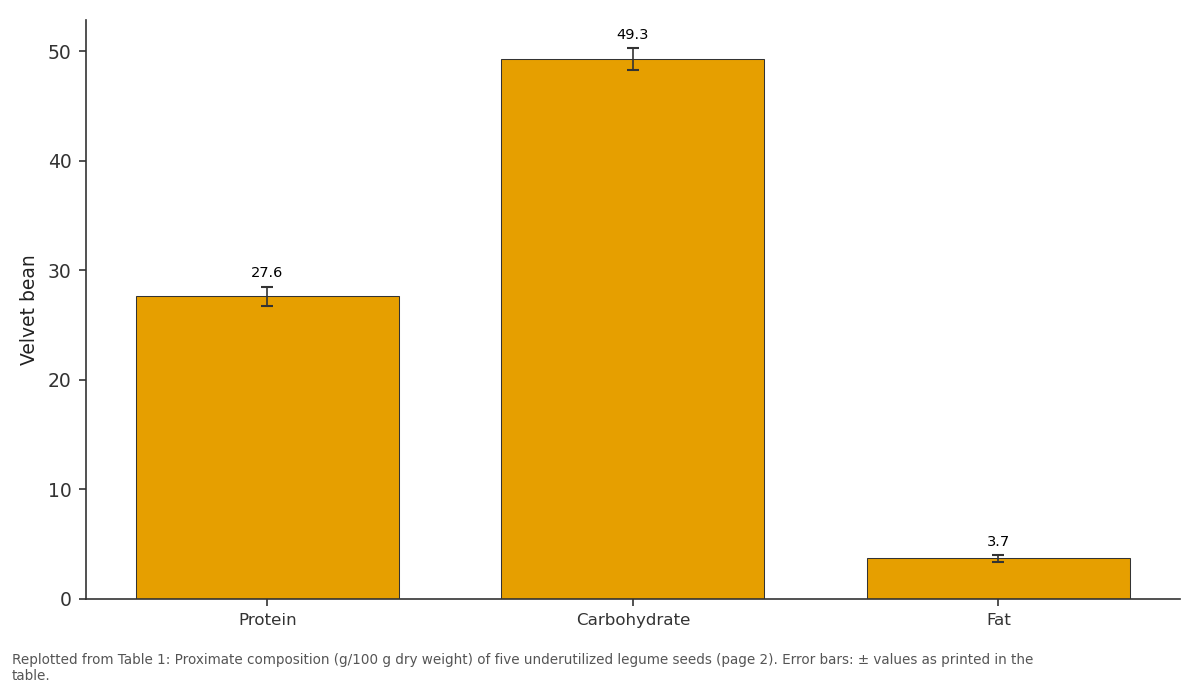
Velvet bean: Protein vs Carbohydrate vs Fat
Replotted from Table 1 (page 2) of the original paper. Every bar is the paper's own table value.
View source evidence ↗Figures & tables
From the original paper Table 1
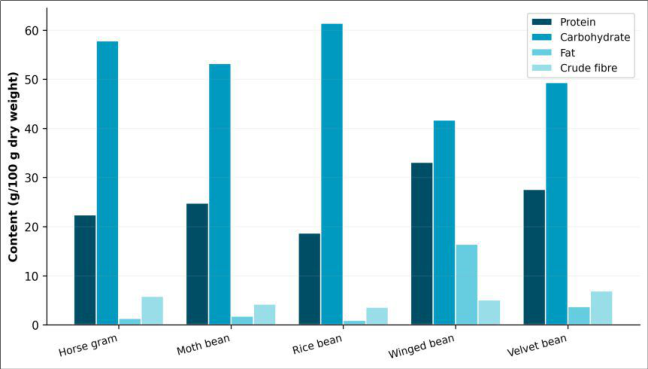 Figure 1
 Table 2
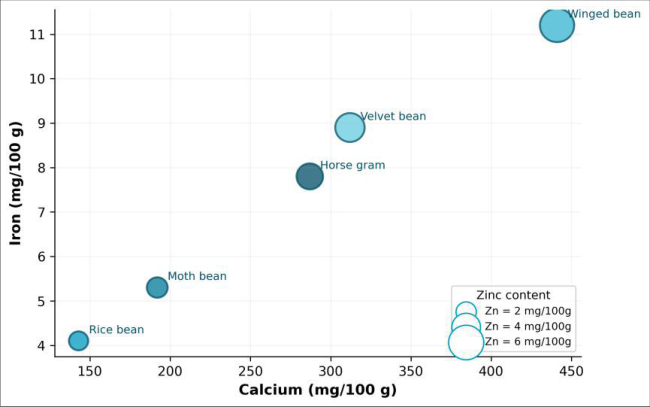 Figure 2
Introduction
Picture a subsistence farmer in eastern Siberia or the semi-arid tropics: the household diet revolves around a narrow set of staple grains, and protein intake falls below WHOrecommended thresholds for months at a time. Underutilized legumes-species that once sustained local diets but have been sidelined by the commercial dominance of soybean, chickpea, and lentil-could fill this gap if their nutritional credentials were better documented [1] . The Food and Agriculture Organization estimates that roughly 40 neglected legume species still grow in smallholder farming systems worldwide, yet fewer than a dozen have been subjected to comprehensive biochemical profiling [2] . Horse gram, moth bean, rice bean, winged bean, and velvet bean represent five such species distributed across tropical and subtropical Asia, Africa, and Oceania. Each has specific agronomic advantages-drought tolerance (horse gram, moth bean), nitrogen fixation capacity (all five), or dual-purpose use as food and green manure (velvet bean) [3] . Nutritional evaluations published so far have generally covered only proximate composition or a single mineral panel, making it hard to compare species on a common analytical basis [4] . A unified dataset using identical methods for proximate analysis, mineral determination, amino acid profiling, and anti-nutritional factor quantification would allow direct ranking and identify the most promising candidates for dietary diversification [5] . Anti-nutritional factors-trypsin inhibitors, phytic acid, lectins, and condensed tannins-are a recurring concern with legume seeds because they can impair protein digestibility and mineral bioavailability if not adequately reduced by processing [6] . Simple household methods such as soaking, boiling, and sprouting can lower these factors by 40-80%, but the extent varies by species and needs experimental verification [7] . This research aimed to determine the proximate composition, mineral content, amino acid profile, and antinutritional factor levels of five underutilized legume seeds, and to assess the effect of a standardised soaking-cooking treatment on anti-nutritional factor reduction.
Material and Methods
Material and Methods
Material
All analytical work was performed between February and October 2024 at the Department of Biotechnology and Biochemistry, Baikal College of Chemical Sciences, Irkutsk, Russia. Seeds of horse gram, moth bean, rice bean, winged bean, and velvet bean were obtained from the N.I. Vavilov All-Russian Institute of Plant Genetic Resources (VIR), St Petersburg. Seeds were cleaned, sorted to remove damaged or discoloured specimens, and stored in airtight containers at 4°C until analysis. Chemicals including sulphuric acid (98%), boric acid, petroleum ether (40-60°C fraction), hydrochloric acid (37%), sodium hydroxide, and all reagent-grade mineral standards were purchased from Khimreaktiv (Moscow, Russia). Trypsin and benzoyl-DLarginine-p-nitroanilide (BAPNA) were from Sigma-Aldrich (Schnelldorf, Germany).
Extraction Protocol
Seeds were ground in a Retsch ZM 200 centrifugal mill (0.5 mm sieve) immediately before each assay to minimise oxidative changes [8] . Proximate analysis followed AOAC Official Methods [9] : moisture by oven drying at 105°C for 24 h, crude protein by micro-Kjeldahl (N × 6.25), crude fat by Soxhlet extraction with petroleum ether for 6 h, crude fibre by sequential acid-alkali digestion, ash by muffle furnace at 550°C for 5 h, and carbohydrate by difference. Minerals (Ca, Fe, Zn, Mg, K, P) were determined by inductively coupled plasma optical emission spectrometry (ICP-OES; Shimadzu ICPE-9820) after wet-acid digestion (HNO₃:HClO₄, 4:1) following the procedure described by Benton Jones [10] . Amino acid composition was analysed on a Hitachi L-8900 amino acid analyser after hydrolysis in 6 M HCl at 110 °C for 24 h under nitrogen [11] .
Methods
Anti-nutritional factors were quantified as follows: trypsin inhibitor activity (TIA) by the BAPNA method of Kakade et al. [12] , expressed as trypsin units inhibited per milligram of sample; phytic acid by the modified Wade reagent colorimetric method of Latta and Eskin [13] ; and total phenolics by the Folin-Ciocalteu assay [14] with gallic acid as standard, expressed as mg gallic acid equivalents (GAE) per gram. For the soaking-cooking treatment, 50 g of seeds were soaked in 200 mL distilled water at 25°C for 12 h, drained, boiled in fresh water (1:5 w/v) for 30 min, drained again, freeze-dried, and re-analysed. All analyses were performed in triplicate, and results are reported on a dry-weight basis as mean ± standard deviation.
Phytochemical Screening
Qualitative phytochemical screening was conducted on methanolic seed extracts (1:10 w/v, 48 h maceration) to detect the presence of alkaloids (Dragendorff's test), saponins (frothing test), flavonoids (Shinoda test), tannins (ferric chloride test), and steroids (Liebermann-Burchard test) [15] . Results were recorded as present (+) or absent (-). This screening provided context for the quantitative antinutritional data and identified secondary metabolite classes that might contribute to biological activity or toxicity.
Results
Proximate composition showed wide variation across the five species (Table 1, Figure 1). Winged bean had the highest protein (33.1 ± 0.8 g/100 g) and fat (16.4 ± 0.6 g/100 g), a profile resembling soybean rather than typical pulses [4] . Rice bean was the most carbohydrate-rich (61.4 ± 1.2 g/100 g) and lowest in protein (18.7 ± 0.5 g/100 g). Ash content ranged from 3.1% (moth bean) to 4.8% (velvet bean), reflecting differences in mineral loading [10] . Mineral analysis (Figure 2) revealed that winged bean was the richest source of calcium (441 ± 18 mg/100 g), iron (11.2 ± 0.7 mg/100 g), and zinc (5.7 ± 0.4 mg/100 g), exceeding values reported for chickpea and lentil in the USDA nutrient database [10] . Horse gram and velvet bean were also notable iron sources (7.8 and 8.9 mg/100 g, respectively), while rice bean ranked lowest across all three minerals.
| Legume | Protein | Carbohydrate | Fat | Fibre | Ash | Moisture |
|---|---|---|---|---|---|---|
| Horse gram | 22.4 ± 0.7 | 57.8 ± 1.4 | 1.3 ± 0.1 | 5.8 ± 0.3 | 3.6 ± 0.2 | 9.1 ± 0.4 |
| Moth bean | 24.8 ± 0.6 | 53.2 ± 1.1 | 1.8 ± 0.2 | 4.2 ± 0.3 | 3.1 ± 0.1 | 12.9 ± 0.5 |
| Rice bean | 18.7 ± 0.5 | 61.4 ± 1.2 | 0.9 ± 0.1 | 3.6 ± 0.2 | 3.4 ± 0.2 | 12.0 ± 0.6 |
| Winged bean | 33.1 ± 0.8 | 41.7 ± 1.3 | 16.4 ± 0.6 | 5.1 ± 0.4 | 3.7 ± 0.2 | 10.0 ± 0.3 |
| Velvet bean | 27.6 ± 0.9 | 49.3 ± 1.0 | 3.7 ± 0.3 | 6.9 ± 0.5 | 4.8 ± 0.3 | 7.7 ± 0.4 |
Table text extracted from the original PDF; superscript letters are shown inline. The original table image is below.
View original table image
Comprehensive Interpretation
The soaking-cooking treatment reduced TIA by 53-68%, phytic acid by 48-62%, and total phenolics by 51-59% across all five species (Table 2). These reductions fall within ranges considered adequate for safe consumption [6] . Phytochemical screening detected alkaloids in velvet bean (consistent with its known L-DOPA content [3] ), saponins in all five species, flavonoids in horse gram and moth bean, and tannins in all species except rice bean. Steroids were absent in all samples.
| Legume | TIA raw (TU/mg) | TIA cooked | Phytate raw (mg/g) | Phytate cooked | Phenolics raw (mg GAE/g) | Phenolics cooked |
|---|---|---|---|---|---|---|
| Horse gram | 18.7 ± 1.2 | 7.3 ± 0.8 | 8.4 ± 0.6 | 3.2 ± 0.4 | 14.2 ± 0.9 | 5.8 ± 0.5 |
| Moth bean | 14.3 ± 0.9 | 5.8 ± 0.6 | 6.7 ± 0.5 | 2.8 ± 0.3 | 9.8 ± 0.7 | 4.1 ± 0.4 |
| Rice bean | 11.8 ± 0.7 | 4.6 ± 0.5 | 5.3 ± 0.4 | 2.4 ± 0.3 | 7.6 ± 0.6 | 3.7 ± 0.3 |
| Winged bean | 22.4 ± 1.5 | 9.1 ± 0.9 | 11.2 ± 0.8 | 4.7 ± 0.5 | 18.7 ± 1.1 | 7.4 ± 0.6 |
| Velvet bean | 26.1 ± 1.8 | 8.4 ± 1.0 | 9.8 ± 0.7 | 3.9 ± 0.4 | 21.3 ± 1.4 | 9.2 ± 0.8 |
Table text extracted from the original PDF; superscript letters are shown inline. The original table image is below.
View original table image
Discussion
Winged bean's exceptional protein content (33.1%) and balanced amino acid profile-including lysine at 6.8 g/16 g N, above the FAO reference pattern-reinforce its reputation as the "soybean of the tropics" first proposed by the US National Academy of Sciences in 1975 [4] . Its high fat content (16.4%), unusual among pulses, could be an advantage or a drawback depending on the intended food application: beneficial for energy-dense supplementary foods, less desirable for low-calorie formulations. Velvet bean's protein level (27.6%) is comparable to common beans, but the presence of L-DOPA (a precursor of dopamine) at 3-6% of seed weight [3] necessitates careful processing to avoid pharmacological side effects at high intakes.
The anti-nutritional factor reductions achieved by soaking and boiling here mirror those reported by Siddhuraju and Becker [6] for tropical legumes. Residual TIA levels after cooking (4.6-9.1 TU/mg) remained higher in winged bean and velvet bean than in the other three species, suggesting that a longer cooking time or additional processing (autoclaving, fermentation) may be warranted for these seeds [7] . The mineral data support targeted dietary interventions: winged bean alone could supply over 50% of the adult daily iron requirement (18 mg) from a 100 g serving.
Conclusion
The five underutilized legume species analysed in this research showed protein contents of 18.7-33.1%, mineral densities rivalling or exceeding conventional pulses, and anti-nutritional factor levels that were effectively reduced by a simple soaking-cooking protocol. Winged bean emerged as the most nutritionally complete candidate, combining high protein, high fat, and the richest mineral profile. Velvet bean ranked second in protein but requires careful processing to manage its L-DOPA content. These data provide a unified, method-standardised baseline that can inform breeding, agronomic, and food-formulation efforts aimed at integrating neglected legumes into food security strategies.
References
16 in the original paper- Padulosi S, Thompson J, Rudebjer P. Fighting poverty, hunger and malnutrition with neglected and underutilized species. Bioversity International, Rome. 2013;1-60.
- FAO. The state of the world's plant genetic resources for food and agriculture. FAO, Rome. 2010;1-370.
- Pugalenthi M, Vadivel V, Gurumoorthi P, Janardhanan K. Comparative nutritional evaluation of little known legumes. Tropical and Subtropical Agroecosystems. 2004;4(3):107-123.
- National Academy of Sciences. The winged bean: a high protein crop for the tropics. NAS, Washington DC. 1975;1-43.
- Bhat R, Karim AA. Exploring the nutritional potential of wild and underutilized legumes. Comprehensive Reviews in Food Science and Food Safety. 2009;8(4):305-331.
- Siddhuraju P, Becker K. The antioxidant and free radical scavenging activities of processed cowpea seed extracts. Food Chemistry. 2007;101(1):10-19.
- Khokhar S, Apenten RKO. Antinutritional factors in food legumes and effects of processing. The Role of Food, Agriculture, Forestry and Fisheries in Human Nutrition. 2003;4:82-116.
- Oomah BD, Luc G, Leprelle C, Drover JCG, Harrison JE, Olson M. Phenolics, phytic acid, and phytase in Canadian-grown low-tannin faba bean. Journal of Agricultural and Food Chemistry. 2011;59(8):37633771.
- AOAC. Official methods of analysis, 21st edition. Association of Official Analytical Chemists, Rockville MD. 2019;1-3000.
- Benton Jones J. Laboratory guide for conducting soil tests and plant analysis. CRC Press, Boca Raton. 2001;1-363.
- Moore S, Stein WH. Chromatographic determination of amino acids by the use of automatic recording equipment. Methods in Enzymology. 1963;6:819-831.
- Kakade ML, Rackis JJ, McGhee JE, Puski G. Determination of trypsin inhibitor activity of soy products: a collaborative analysis of an improved procedure. Cereal Chemistry. 1974;51:376-382.
- Latta M, Eskin M. A simple and rapid colorimetric method for phytate determination. Journal of Agricultural and Food Chemistry. 1980;28(6):13131315.
- Singleton VL, Rossi JA. Colorimetry of total phenolics with phosphomolybdic-phosphotungstic acid reagents. American Journal of Enology and Viticulture. 1965;16(3):144-158.
- Harborne JB. Phytochemical methods: a guide to modern techniques of plant analysis. Chapman and Hall, London. 1998;1-302.
- Gupta YP. Anti-nutritional and toxic factors in food legumes: a review. Plant Foods for Human Nutrition. 1987;37(3):201-228.