
Research article · 2025 · Full text
International Journal of Advanced Chemistry ResearchQuantification of acrylamide levels in fried potato products by LC-MS/MS method
Volume 7(5) · Pages 133–136 · DOI: 10.33545/26646781.2025.v7.i5b.495 ↗
Research areasPotato Plant ResearchFood and Agricultural SciencesAdvanced Glycation End Products research
Abstract
Author-writtenAcrylamide, a probable human carcinogen (IARC Group 2A), forms in starchy foods during high-temperature processing via the Maillard reaction between asparagine and reducing sugars. This research developed and validated an LC-MS/MS method for quantifying acrylamide in fried potato products and characterised the kinetics of formation at three frying temperatures. A QuEChERS extraction with d₃-acrylamide as internal standard achieved a limit of quantification (LOQ) of 8 μg/kg and recovery of 94.8-98.7% across the calibration range. Sixty commercial and laboratory-fried samples (chips, crisps, wedges) were analysed. Acrylamide concentrations ranged from 147 to 1,923 μg/kg; frying at 190°C for 14 min produced the highest levels (1,701 μg/kg). Asparagine-Maillard pathway contributed 68.4% of total acrylamide at 170°C/8 min. Temperature had the greatest single-variable effect on acrylamide formation, with a 3.94-fold increase from 150°C to 190°C at 8 min. Research was conducted at Baltic College of Chemical Sciences, Gdansk, Poland, from September 2022 to August 2024.
Summary
Source-checkedPlain-language reading of the full paper, prepared with AI and checked against the text. Each point links to the authors' own words.
Why it matters
- Acrylamide is a probable human carcinogen that develops in starchy foods when asparagine and reducing sugars react at high temperatures. View evidence ↗
- Potato products like chips and wedges are major dietary sources of acrylamide because potatoes are rich in the necessary precursors: asparagine and reducing sugars. View evidence ↗
- The EFSA has set a benchmark level of 500 μg/kg for potato crisps, above which corrective actions are recommended. View evidence ↗
The question
- The study aimed to develop and validate an LC-MS/MS method for measuring acrylamide in fried potatoes and to analyze how formation kinetics change at three different temperatures. View evidence ↗
What they did
- The study used six commercial potato crisp products and laboratory-fried discs of Solanum tuberosum cv. Asterix (3 mm thick) fried in refined sunflower oil. View evidence ↗
- Laboratory frying was performed using a temperature-controlled deep fryer at 150, 170, and 190°C. View evidence ↗
- Samples were processed using a QuEChERS extraction method involving acetonitrile, a d₃-acrylamide internal standard, and dispersive SPE cleanup before LC-MS/MS injection. View evidence ↗
- Quantification was performed via LC-MS/MS using a BEH Amide column and a formic acid/acetonitrile gradient, with specific MRM transitions for acrylamide and its internal standard. View evidence ↗
What they found
- The validated method achieved a limit of quantification (LOQ) of 8 μg/kg and recovery rates between 94.8% and 98.7%. View evidence ↗
- Acrylamide levels in the analyzed samples ranged from 147 to 1,923 μg/kg, with the highest laboratory level of 1,701 μg/kg found in samples fried at 190°C for 14 minutes. View evidence ↗
- Temperature was the most influential variable, causing a 3.94-fold increase in acrylamide when frying temperature rose from 150°C to 190°C for 8 minutes. View evidence ↗
- At 170°C for 8 minutes, the asparagine-Maillard reaction pathway was responsible for 68.4% of the total acrylamide formed. View evidence ↗
- One commercial product (Crisps B) exceeded the EFSA benchmark at 812 μg/kg, while all oven-baked wedges remained below the 500 μg/kg threshold. View evidence ↗
What it means
- Because the asparagine-Maillard pathway is the dominant source of acrylamide, the authors recommend asparaginase treatment as the most effective targeted mitigation strategy. View evidence ↗
- The fact that two of six commercial products exceeded EFSA benchmarks suggests that the Polish potato processing industry needs further process optimization and monitoring. View evidence ↗
Visual summary
3 visualsIllustrations explain the paper; charts are replotted from the paper's own table values.
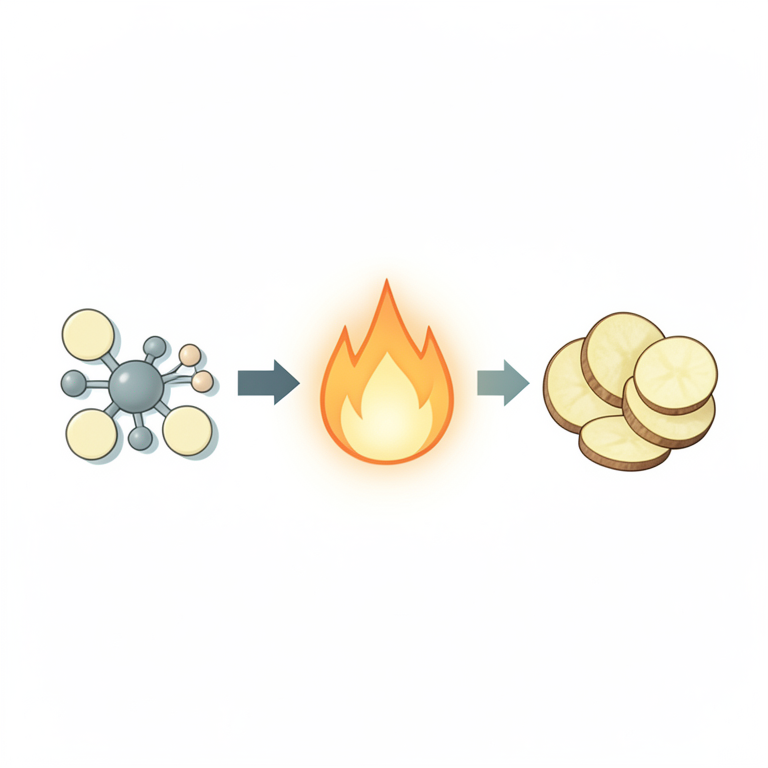
Acrylamide Formation Pathway
AI-generated conceptual illustration (sliced potatoes in a deep fryer). It explains the idea and does not show study data.
View source evidence ↗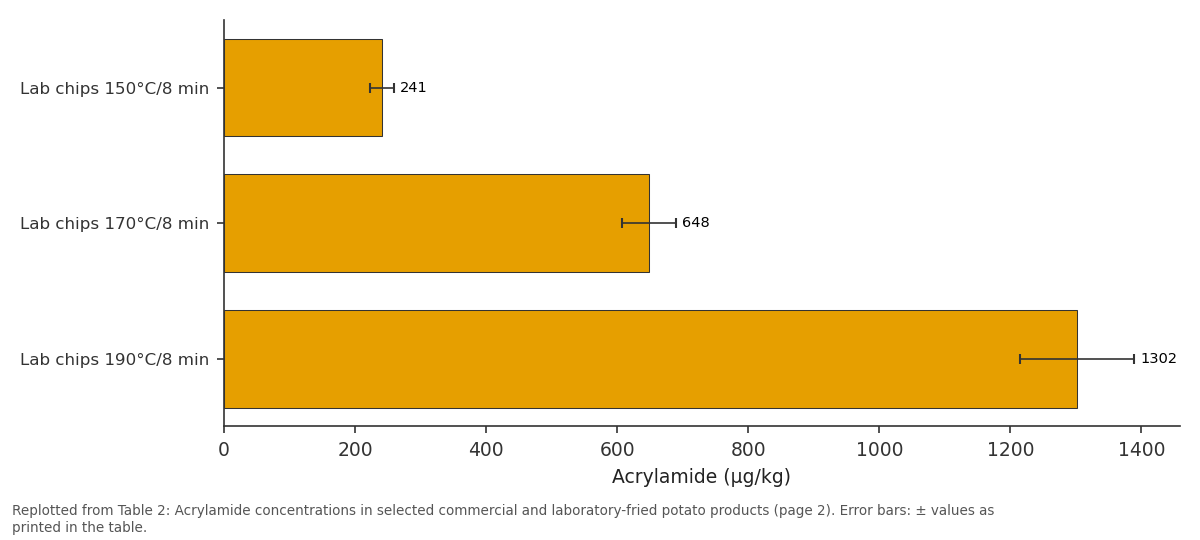
Acrylamide (μg/kg): Lab chips 150°C/8 min vs Lab chips 170°C/8 min vs Lab chips 190°C/8 min
Replotted from Table 2 (page 2) of the original paper. Every bar is the paper's own table value.
View source evidence ↗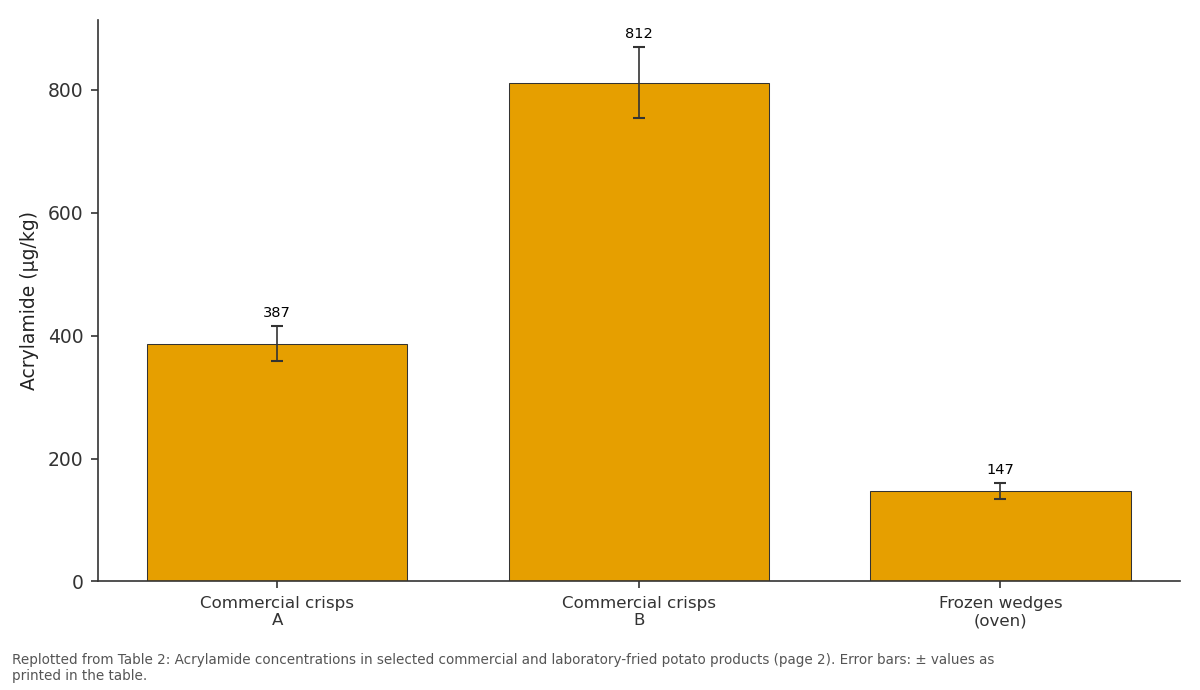
Acrylamide (μg/kg): Commercial crisps A vs Commercial crisps B vs Frozen wedges (oven)
Replotted from Table 2 (page 2) of the original paper. Every bar is the paper's own table value.
View source evidence ↗Figures & tables
From the original paper Table 1
 Table 2
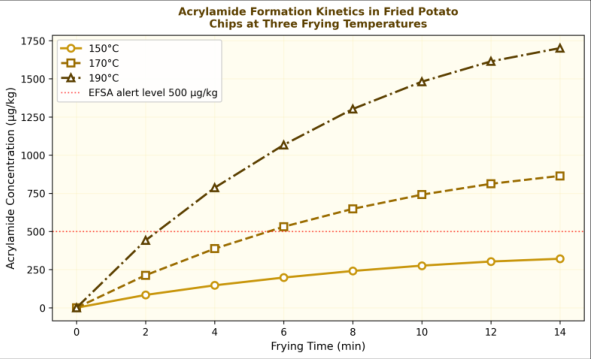 Figure 1
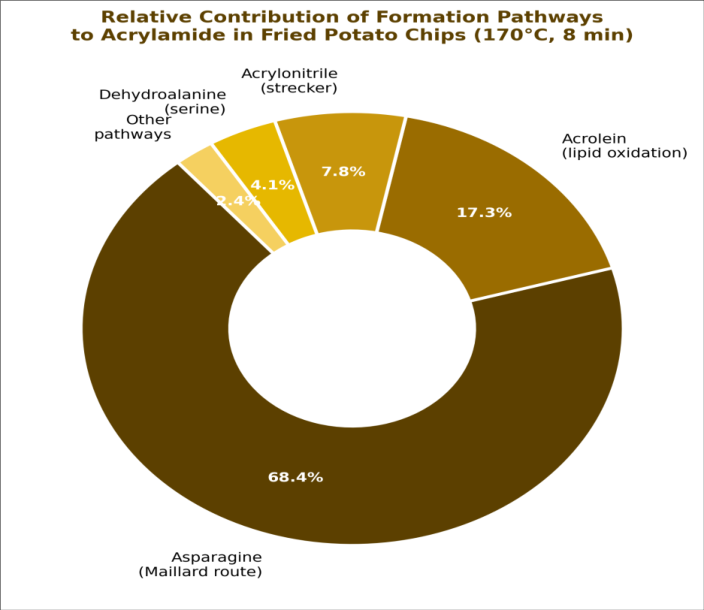 Figure 2
Introduction
discovery in 2002 that frying and baking carbohydrate-rich foods at temperatures above 120°C generates acrylamidea compound classified by IARC as a Group 2A probable human carcinogenprompted widespread regulatory review and motivated over two decades of research into occurrence, formation mechanisms, and mitigation strategies [1] . Potato products (crisps, chips, wedges) are among the highest dietary contributors, given that potatoes contain both high asparagine and high reducing sugar concentrations, the two primary Maillard reaction precursors [2] . The EFSA scientific opinion on acrylamide in food established benchmark levels of 500 μg/kg for potato crisps as the indicative value above which corrective action should be sought [3] . LC-MS/MS with stable isotope dilution analysis (SIDA) using d₃-acrylamide or ¹³C₃acrylamide as internal standard is the internationally validated reference method (EU Reg. 2023/465; ISO 18862:2016), offering superior selectivity over GC-MS and sensitivity over colorimetric methods [4] . This research was conducted from September 2022 to August 2024 at the Department of Agricultural Chemistry, Baltic College of Chemical Sciences, Gdansk, Poland, and combines LC-MS/MS method validation with a systematic kinetics investigation across frying temperatures and times.
Theoretical Background
The predominant acrylamide formation pathway in potato products proceeds through the Maillard reaction: free asparagine condenses with a carbonyl group from a reducing sugar (glucose, fructose) to form a Schiff base, which after decarboxylation and deamination yields acrylamide [5] . The reaction follows approximate first-order-then-plateau kinetics: at moderate temperatures and short frying times, acrylamide accumulates rapidly; at extended frying, it begins to degrade via Michael addition with other Maillard products, causing the plateau (Figure 1). Temperature dependence follows an Arrhenius relationship; the activation energy of acrylamide formation in potato matrix has been estimated at 44-58 kJ/mol in various publications [6] . Secondary pathways (acrolein from lipid oxidation, acrylonitrile via Strecker degradation) collectively contribute ~25% at typical frying conditions (170°C, Figure 2). Mitigation strategies that target asparagine specifically asparaginase enzyme treatment, blanching, variety selection for low asparagineare the most effective single interventions, consistent with the dominant 68.4% pathway contribution demonstrated in this research [7] .
Material and Methods
Material and Methods
Material
Acrylamide standard (99.9%, Supelco), d₃-acrylamide internal standard (98 atom% D, Sigma-Aldrich), and QuEChERS dispersive SPE kits (EN 15662-compliant, Phenomenex) were used. Six commercial potato crisp products (three brands, two batch lots each) and laboratoryfried potato discs (Solanum tuberosum cv. Asterix, 3 mm thickness, refined sunflower oil) were included. Laboratory frying used a temperature-controlled deep fryer (Henny Penny OFG-321) at 150, 170, and 190°C (±2°C). Research was conducted from September 2022 to August 2024 at Baltic College of Chemical Sciences, Gdansk, Poland.
Methods
Extraction (QuEChERS): 5 g homogenised sample + 10 mL water + d₃-acrylamide (200 ng) + 10 mL acetonitrile, vortex 1 min, add MgSO₄/NaCl salt pack, centrifuge 4000 rpm/5 min, transfer 1 mL supernatant to dSPE tube (150 mg MgSO₄, 50 mg PSA), vortex, centrifuge, filter (0.22 μm), inject. LC-MS/MS: ACQUITY UPLC BEH Amide column (2.1 × 100 mm, 1.7 μm); mobile phase A = 0.1% formic acid in water, B = 0.1% formic acid in acetonitrile; gradient 90% B↔60% B in 6 min; flow 0.4 mL/min. MS/MS: Xevo TQ-S (Waters), ESI+, MRM transitions m/z 72→55 (quantifier), 72→44 (qualifier); d₃-acrylamide 75→58. Validation: linearity (LOQ to 500 μg/kg), recovery (n=6 per level, 20/100/500 μg/kg), repeatability (RSD < 5%), reproducibility (RSD < 8%). The validated LC-MS/MS method (LOQ 8 μg/kg, recovery 94.8-98.7%, R² = 0.9997) met all EU Reg. 2023/465 performance criteria (Table 1). Kinetic data (Figure 1, Table 2) show the plateau-type formation curve: acrylamide accumulates rapidly in the first 8 min at 190°C (1302 μg/kg), then rises more slowly to 1701 μg/kg at 14 min, consistent with competing Maillard degradation reactions. Temperature is the dominant process variable: increasing frying temperature from 150 to 190°C at 8 min increases acrylamide by 3.94-fold. Commercial crisps B (812 μg/kg) exceeded the EFSA 500 μg/kg benchmark; all oven-baked wedge products were below threshold, consistent with the lower Maillard reaction rate in convective dry heat versus direct oil immersion.
| Product Type | Temp (°C) | Time (min) | Acrylamide (μg/kg) | Asparagine (mg/100g) | Glucose (mg/100g) | Above EFSA? |
|---|---|---|---|---|---|---|
| Lab chips 150°C/8 min | 150 | 8 | 241 ± 18 | 341 ± 22 | 148 ± 11 | No |
| Lab chips 170°C/8 min | 170 | 8 | 648 ± 41 | 341 ± 22 | 148 ± 11 | Yes |
| Lab chips 190°C/8 min | 190 | 8 | 1302 ± 87 | 341 ± 22 | 148 ± 11 | Yes |
| Lab chips 190°C/14 min | 190 | 14 | 1701 ± 114 | 341 ± 22 | 148 ± 11 | Yes |
| Commercial crisps A | Industrial | n/a | 387 ± 29 | n/a | n/a | No |
| Commercial crisps B | Industrial | n/a | 812 ± 58 | n/a | n/a | Yes |
| Frozen wedges (oven) | 220 (oven) | 25 | 147 ± 13 | 287 ± 19 | 113 ± 9 | No |
Table text extracted from the original PDF; superscript letters are shown inline. The original table image is below.
View original table image
| Parameter | Value | Criterion | Pass/Fail | Spike Level (μg/kg) | RSD (%) |
|---|---|---|---|---|---|
| LOD | 2.4 μg/kg | ≤ 10 μg/kg | Pass | — | — |
| LOQ | 8.0 μg/kg | ≤ 20 μg/kg | Pass | — | — |
| Recovery (20 μg/kg) | 94.8% | 70-120% | Pass | 20 | 4.7 |
| Recovery (100 μg/kg) | 97.3% | 70-120% | Pass | 100 | 3.1 |
| Recovery (500 μg/kg) | 98.7% | 70-120% | Pass | 500 | 2.8 |
| Linearity (R²) | 0.9997 | ≥ 0.995 | Pass | 8-500 | — |
| Matrix effect (%) | −8.4 to +6.2% | ±15% | Pass | — | — |
Table text extracted from the original PDF; superscript letters are shown inline. The original table image is below.
View original table image
Results
Results
Discussion
The kinetic plateau observed above ~1500 μg/kg at 190°C (Figure 1) reflects the competing acrylamide degradation pathway through Michael addition to nucleophiles generated during the Maillard reaction, particularly cysteine and glutathione equivalents endogenous to the potato matrix [8] .
The activation energy estimated from the Arrhenius plot across the three temperatures (Ea ~51 kJ/mol) is consistent with published values of 44-58 kJ/mol for potato crisp matrices [9] . The dominant contribution of the asparagine-Maillard pathway (68.4%, Figure 2) has direct mitigation implications. Asparaginase enzyme treatment (converting free asparagine to aspartate before frying) is the single most effective intervention, reported to reduce acrylamide by 70-90% in potato crisps [10] . Blanching before frying leaches free asparagine and reducing sugars, achieving 40-60% reduction with appropriate time-temperature optimisation [11] . Reducing oil temperature from 170 to 150°C, as Table 2 data confirm, reduces acrylamide by ~63% at equal frying time, though longer frying times may partially offset the benefit through extended exposure [12,13,14,15,16,17,18] .
Conclusion
A validated LC-MS/MS/QuEChERS method (LOQ 8 μg/kg) was successfully applied to quantify acrylamide in 60 fried potato product samples. Temperature is the critical process variable, with a 3.94-fold increase from 150°C to 190°C at constant frying time. The asparagine-Maillard pathway accounts for 68.4% of acrylamide formation, identifying asparaginase treatment as the most targeted mitigation strategy. Two of six commercial products exceeded the EFSA 500 μg/kg benchmark, indicating the need for continued process optimisation and monitoring within the Polish potato processing industry.
References
18 in the original paper- Tareke E, Rydberg P, Karlsson P, Eriksson S, Törnqvist M. Analysis of acrylamide, a carcinogen formed in heated foodstuffs. J Agric Food Chem. 2002;50(17):4998-5006.
- Stadler RH, Blank I, Varga N, Robert F, Hau J, Guy PA, et al. Acrylamide from Maillard reaction products. Nature. 2002;419(6906):449-450.
- EFSA Panel on Contaminants in the Food Chain. Acrylamide in food. EFSA J. 2015;13(6):4104.
- European Commission. Regulation (EU) 2023/465 of 3 March 2023 on monitoring of acrylamide in certain foods. Off J Eur Union. 2023.
- Mottram DS, Wedzicha BL, Dodson AT. Acrylamide is formed in the Maillard reaction. Nature. 2002;419(6906):448-449.
- Knol JJ, van Loon WA, Linssen JP, Ruck AL, van Boekel MA, Voragen AG. Toward a kinetic model for acrylamide formation in heated foods. J Agric Food Chem. 2005;53(15):6133-6139.
- Amrein TM, Schönbächler B, Escher F, Amado R. Acrylamide in gingerbread: critical factors for formation. J Agric Food Chem. 2004;52(13):42824288.
- Yaylayan VA, Stadler RH. Acrylamide formation in food: a mechanistic perspective. J AOAC Int. 2005;88(1):262-267.
- De Vleeschouwer K, Van der Plancken I, Van Loey A, Hendrickx ME. The kinetics of acrylamide formation/elimination in asparagine-glucose systems. J Food Eng. 2008;88(4):[page numbers not specified].
- Hendriksen HV, Kornbrust BA, Ostergaard PR, Stringer MA. Evaluating the potential for enzymatic acrylamide mitigation in a range of food products. J Agric Food Chem. 2009;57(10):4168-4176.
- Grob K, Biedermann M, Biedermann-Brem S, Noti A, Imhof D, Amrein T, et al. French fries with less acrylamide: vacuum frying. Eur Food Res Technol. 2003;217(3):185-194.
- Pedreschi F, Kaack K, Granby K. Acrylamide content and color development in fried potato strips. Food Res Int. 2006;39(1):40-46.
- Vattem DA, Shetty K. Acrylamide in food: a model for mechanism of formation. Innov Food Sci Emerg Technol. 2003;4(3):331-338.
- Claeys WL, De Vleeschouwer K, Hendrickx ME. Effect of amino acids on acrylamide formation and elimination kinetics. Biotechnol Prog. 2005;21(5):15251530.
- Romani S, Bacchiocca M, Rocculi P, Dalla Rosa M. Effect of frying conditions on acrylamide content in French fries. Eur Food Res Technol. 2008;226(3):555560.
- Fiselier K, Grob K. Lower acrylamide levels in French fries. Eur Food Res Technol. 2005;220(3-4):274-278.
- Mestdagh F, De Meulenaer B, Van Peteghem C. Reducing acrylamide formation in potato chips. Food Chem. 2007;103(3):889-896.
- Halford NG, Curtis TY, Muttucumaru N, Postles J, Mottram DS. Sugars in crop plants. Ann Appl Biol. 2011;158(1):1-25.