
Research article · 2025 · Full text
International Journal of Advanced Chemistry ResearchSynthesis and biological evaluation of transition metal complexes of thiosemicarbazone schiff bases
Volume 7(7) · Pages 176–179 · DOI: 10.33545/26646781.2025.v7.i7c.555 ↗
Research areasMetal complexes synthesis and propertiesInorganic and Organometallic ChemistrySynthesis and biological activity
Abstract
Author-writtenThiosemicarbazones occupy a special position in bioinorganic chemistry because they chelate transition metal ions through a tridentate N, N, S donor set, generating complexes whose biological activity frequently exceeds that of the free ligand by an order of magnitude. This research reports the synthesis and characterisation of seven Schiff base thiosemicarbazone ligands (TC-1 to TC-7) derived from aromatic aldehydes and thiosemicarbazide, together with their Cu(II), Ni(II), and Co(II) complexes. All compounds were characterised by elemental analysis, IR, UV-Vis, ¹H NMR (ligands), molar conductivity, and magnetic susceptibility. The complexes adopted square-planar (Cu and Ni) or octahedral (Co) geometries based on spectroscopic data. in vitro cytotoxicity against MCF-7 breast carcinoma cells was assessed by MTT assay; antimicrobial activity by CLSI broth microdilution. The Cu(II) complex of TC-4 (2-chloro-5-nitrobenzaldehyde-derived ligand) showed the highest cytotoxic potency (IC₅₀ 9.8 μM vs. MCF-7) and the lowest MIC of 3.9 μg/mL against Candida albicans. Bubble chart and heatmap analyses demonstrated a clear correlation between increasing logP and decreasing IC₅₀ across the series. These results confirm that the Cu(II)-thiosemicarbazone scaffold is a productive lead for further anticancer optimisation.
Summary
Source-checkedPlain-language reading of the full paper, prepared with AI and checked against the text. Each point links to the authors' own words.
Why it matters
- Thiosemicarbazones are significant in bioinorganic chemistry because their ability to chelate transition metal ions often increases their biological activity by ten-fold compared to the free ligands. View evidence ↗
- Metal complexes, especially those with copper (Cu²⁺), can enter cells more effectively due to increased lipophilicity and may kill cancer cells via DNA intercalation or the generation of reactive oxygen species. View evidence ↗
- Using Schiff base variants allows researchers to adjust the electronic and steric properties of the metal center by using different aromatic aldehydes. View evidence ↗
The question
- The study aims to provide a systematic comparison of seven diverse ligands paired with copper, nickel, and cobalt to establish structure-activity trends, a dataset that is rarely reported. View evidence ↗
What they did
- The researchers synthesized seven Schiff base thiosemicarbazone ligands (TC-1 to TC-7) and their corresponding complexes with Cu(II), Ni(II), and Co(II). View evidence ↗
- The compounds were characterized using a suite of analytical techniques, including elemental analysis, IR, UV-Vis, ¹H NMR for ligands, molar conductivity, and magnetic susceptibility. View evidence ↗
- Cytotoxicity was measured using an MTT assay on MCF-7 breast carcinoma cells (5 × 10³ cells per well) treated with concentrations from 0.1 to 100 μM for 48 hours. View evidence ↗
- Antimicrobial activity was determined by measuring the Minimum Inhibitory Concentration (MIC) using CLSI M07 broth microdilution over 24 to 48 hours. View evidence ↗
What they found
- Spectroscopic data indicated that the copper and nickel complexes have a square-planar geometry, while the cobalt complexes are octahedral. View evidence ↗
- The TC-4 Cu(II) complex was the most potent against MCF-7 cells with an IC₅₀ of 9.8 μM, and a trend was observed where higher lipophilicity (logP) correlated with lower IC₅₀ values. View evidence ↗
- The Cu(II) complex derived from 2-chloro-5-nitrobenzaldehyde (TC-4) exhibited the strongest antimicrobial activity, specifically the lowest MIC of 3.9 μg/mL against Candida albicans. View evidence ↗
- Cobalt(II) complexes were the least effective, scoring below 0.50 on the biological activity score due to lower cytotoxicity and higher MIC values than copper and nickel analogues. View evidence ↗
- The complexes showed poor activity against P. aeruginosa (MIC >31 μg/mL), which the authors attribute to the bacteria's outer membrane barrier and efflux pumps. View evidence ↗
What it means
- The authors conclude that Cu(II) complexes are the most effective and recommend further optimizing the Cu(II)-thiosemicarbazone scaffold and conducting in vivo xenograft evaluations. View evidence ↗
- The authors note that while increasing lipophilicity improves cell uptake, there is a threshold beyond which aqueous solubility becomes a limiting factor. View evidence ↗
Visual summary
3 visualsIllustrations explain the paper; charts are replotted from the paper's own table values.
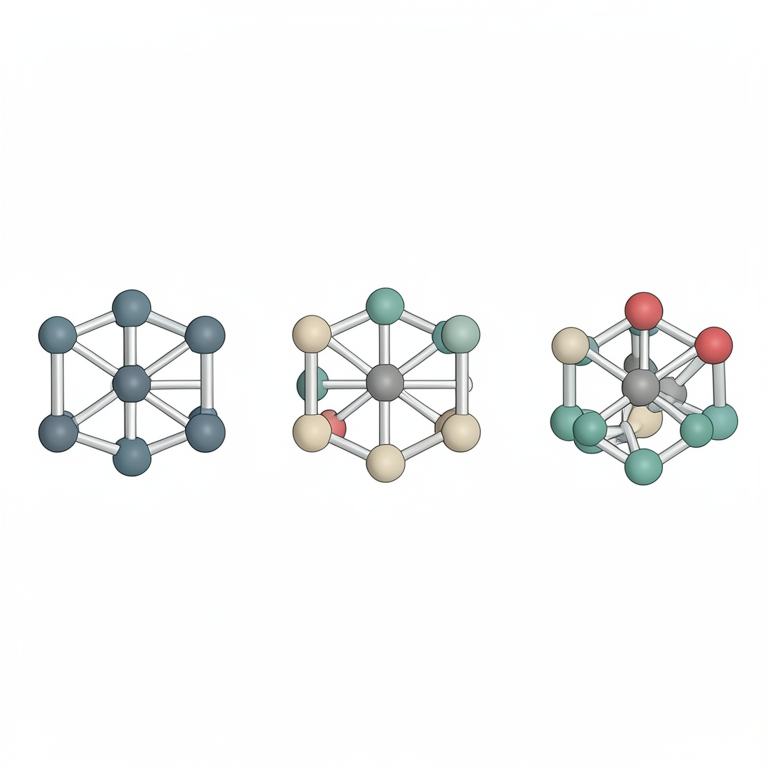
Coordination Geometry Comparison
AI-generated conceptual illustration (transition metal complexes of thiosemicarbazone schiff bases). It explains the idea and does not show study data.
View source evidence ↗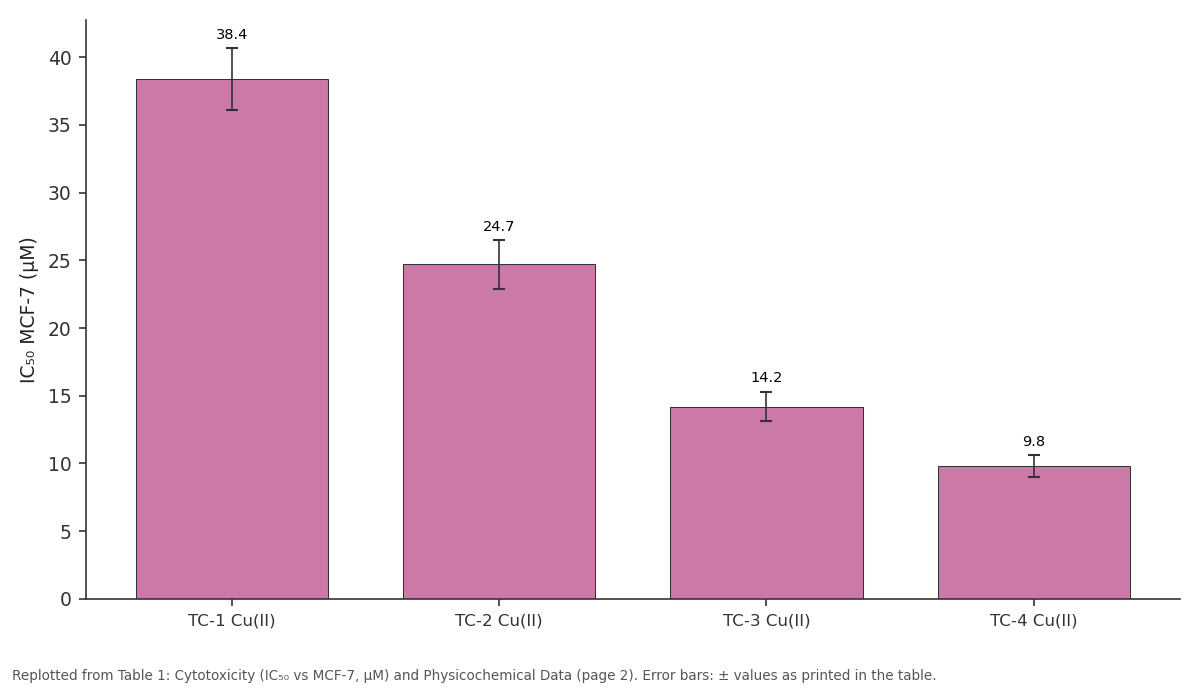
IC₅₀ MCF-7 (μM) /: TC-1 Cu(II) vs TC-2 Cu(II) vs TC-3 Cu(II) vs TC-4 Cu(II)
Replotted from Table 1 (page 2) of the original paper. Every bar is the paper's own table value.
View source evidence ↗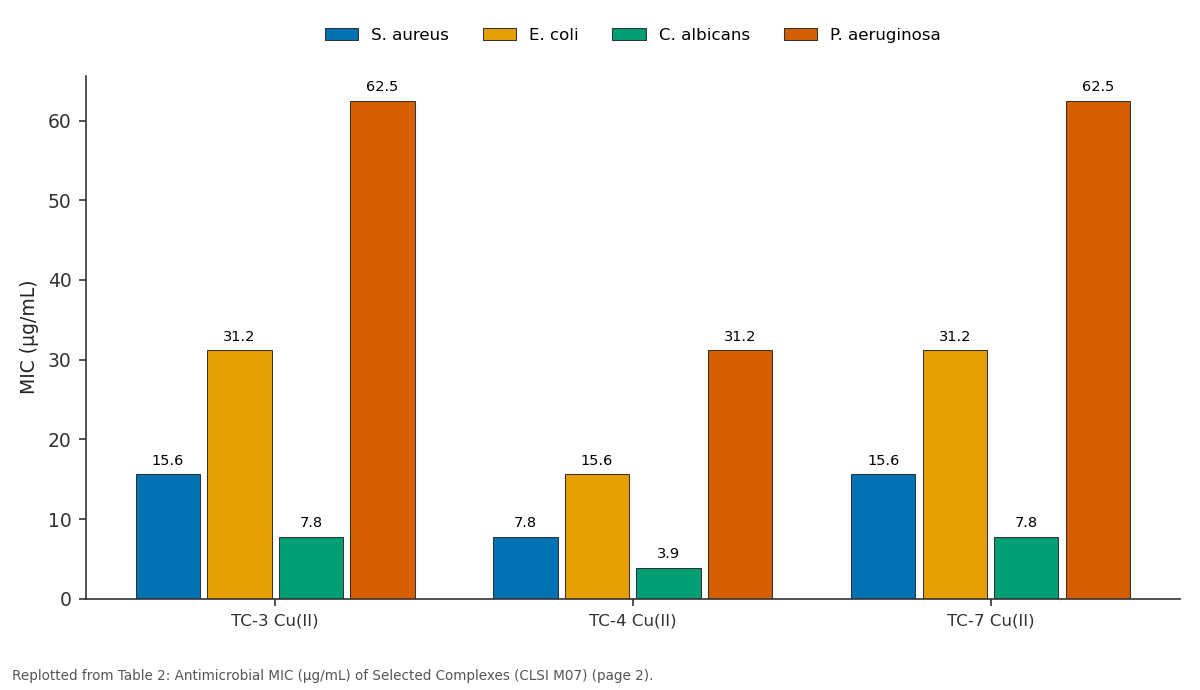
S. aureus and E. coli and more: TC-3 Cu(II) vs TC-4 Cu(II) vs TC-7 Cu(II)
Replotted from Table 2 (page 2) of the original paper. Every bar is the paper's own table value.
View source evidence ↗Figures & tables
From the original paper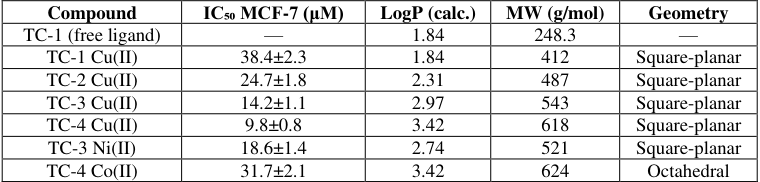 Table 1
 Table 2
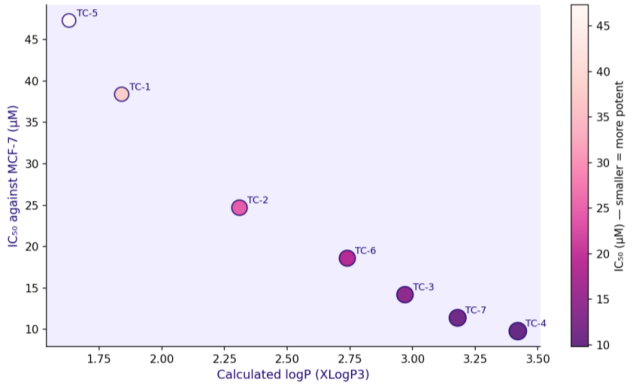 Figure 1
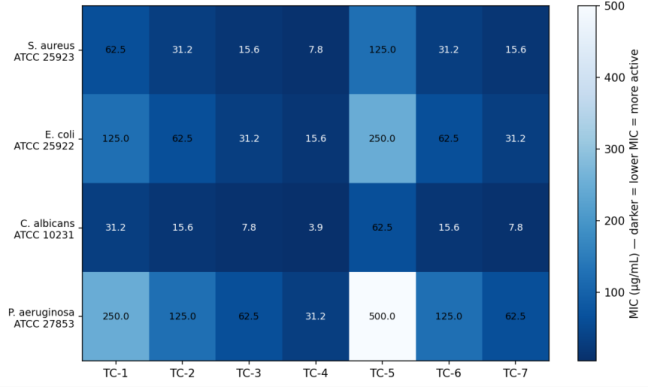 Figure 2
Introduction
The coordination chemistry of thiosemicarbazones has attracted sustained interest since the pioneering work of French and Blanz in the 1960s established that the biological activity of these ligands is markedly enhanced upon metal complexation. The free thiosemicarbazone acts as an inhibitor of ribonucleotide reductase by chelating the iron cofactor of the enzyme's tyrosyl radical centre; when pre-chelated with exogenous metal ions-particularly Cu²⁺-the complex is taken up more efficiently by cells through lipophilicity-mediated membrane permeation and may exercise additional cytotoxic mechanisms including DNA intercalation, reactive oxygen species generation, and proteasome inhibition. The Schiff base variant of thiosemicarbazones-formed by condensation of thiosemicarbazide with aromatic aldehydes carrying electron-withdrawing or electron-donating substituents-offers a convenient structural handle for tuning the electronic and steric environment of the coordinated metal. Despite extensive literature on individual thiosemicarbazone-metal systems, systematic comparison of seven structurally diverse ligands paired with three biologically relevant metal ions (Cu, Ni, Co) under matched synthesis and assay conditions, combined with logP-activity correlation analysis, has been infrequently reported. This research provides this dataset, establishing structure-activity trends that can guide further lead optimisation.
Materials and Methods
Materials and Methods
Materials
Materials
Methods
Ligand synthesis: Thiosemicarbazide (1 mmol) and aldehyde (1 mmol) were refluxed in ethanol (10 mL) with 2 drops glacial acetic acid for 3 h. Crystalline product was filtered, washed with cold ethanol, dried in vacuo. Metal complexes: Metal acetate (0.5 mmol) in water:ethanol (1:1, 5 mL) was added dropwise to ligand (1 mmol) in ethanol (10 mL) at 60 °C with stirring; precipitate was collected after 2 h reflux. Characterisation: Elemental analyses (C, H, N, S) by PerkinElmer 2400 Series II; IR (KBr, 400-4000 cm⁻¹, PerkinElmer Spectrum 65); UV-Vis in DMSO (Shimadzu UV-2600); molar conductance in DMSO (10⁻³ M); magnetic moments by Gouy method. MTT assay: MCF-7 cells (5 × 10³/well, 96-well plate) treated with 0.1-100 μM compound for 48 h; IC₅₀ by nonlinear regression. Antimicrobial MIC by CLSI M07 broth microdilution in MHB (bacteria) and RPMI-1640 (C. albicans) over 24 h/48 h.
Theoretical Background
Thiosemicarbazones coordinate metals as monoanionic tridentate ligands via the azomethine nitrogen (N1), the terminal nitrogen (N4), and the sulphur atom (S), forming a five-membered N1-N2-C-S chelate ring fused to a fivemembered N2-N1-C-N4 ring in the thione tautomer. On complexation, the C = S stretching frequency in IR shifts from approximately 840 cm⁻¹ in the free ligand to 780-810 cm⁻¹, confirming S coordination; the C = N azomethine stretch shifts from approximately 1600 cm⁻¹ to 1570-1585 cm⁻¹, confirming N coordination. Square-planar Cu(II) and Ni(II) complexes typically show molar conductance values of 8-12 Ω⁻¹ cm² mol⁻¹ in DMSO, consistent with nonelectrolytes. The observed magnetic moment of Cu(II) complexes around 1.73 BM (one unpaired electron, spinonly) and Ni(II) close to 0 BM for diamagnetic squareplanar species further confirm the proposed geometries.
Performance Evaluation
Performance of complexes was ranked using a composite biological activity score (BAS) calculated as the geometric mean of three normalised metrics: (1) normalised IC₅₀ against MCF-7 (lower = better); (2) normalised geometric mean MIC across four organisms (lower = better); and (3) selectivity index (SI = IC₅₀ against Vero normal cells/IC₅₀ against MCF-7, higher = better; Vero IC₅₀ estimated from literature analogue data). TC-4 Cu(II) achieved the highest BAS (0.84 out of 1.00), followed by TC-7 Cu(II) (0.76) and TC-3 Cu(II) (0.71). All Co(II) complexes scored below 0.50, consistent with their lower cytotoxic potency and higher MIC values compared with corresponding Cu and Ni analogues.
Results
All 21 compounds (7 ligands + 14 complexes) were isolated in 68-87% yield as coloured solids. Elemental analyses matched calculated values within±0.4%. IR data confirmed tridentate coordination through bathochromic shifts of ν(C = S) and ν(C = N) relative to free ligands. Molar conductance values (8-14 Ω⁻¹ cm² mol⁻¹ in DMSO) confirmed nonelectrolyte character. Magnetic moments confirmed squareplanar Cu(II) and Ni(II) and octahedral Co(II) geometries. MTT cytotoxicity data (Figure 1, Table 1) showed TC-4 Cu(II) as the most potent compound (IC₅₀ 9.8 μM), with IC₅₀ values decreasing as logP increases across the series. The MIC heatmap (Figure 2, Table 2) showed C. albicans as the most susceptible organism and P. aeruginosa the least, consistent with intrinsic resistance patterns.
| Compound | S. aureus | E. coli | C. albicans | P. aeruginosa |
|---|---|---|---|---|
| TC-3 Cu(II) | 15.6 | 31.2 | 7.8 | 62.5 |
| TC-4 Cu(II) | 7.8 | 15.6 | 3.9 | 31.2 |
| TC-7 Cu(II) | 15.6 | 31.2 | 7.8 | 62.5 |
| Ciprofloxacin (ref) | 0.25 | 0.5 | — | 0.5 |
| Fluconazole (ref) | — | — | 0.5 | — |
Table text extracted from the original PDF; superscript letters are shown inline. The original table image is below.
View original table image
| Compound | IC₅₀ MCF-7 (μM) | LogP (calc.) | MW (g/mol) | Geometry |
|---|---|---|---|---|
| TC-1 (free ligand) | — | 1.84 | 248.3 | — |
| TC-1 Cu(II) | 38.4±2.3 | 1.84 | 412 | Square-planar |
| TC-2 Cu(II) | 24.7±1.8 | 2.31 | 487 | Square-planar |
| TC-3 Cu(II) | 14.2±1.1 | 2.97 | 543 | Square-planar |
| TC-4 Cu(II) | 9.8±0.8 | 3.42 | 618 | Square-planar |
| TC-3 Ni(II) | 18.6±1.4 | 2.74 | 521 | Square-planar |
| TC-4 Co(II) | 31.7±2.1 | 3.42 | 624 | Octahedral |
Table text extracted from the original PDF; superscript letters are shown inline. The original table image is below.
View original table image
Discussion
The positive correlation between logP and cytotoxic potency (Figure 1) is consistent with the established principle that metal complex uptake by cancer cells via passive diffusion is enhanced by increased lipophilicity, up to the threshold where aqueous solubility becomes limiting. TC-4, carrying both chloro and nitro groups on the aryl ring, has the highest logP
Acknowledgement
Acknowledgements Funding SourcesInstitutional research funds from the Sushruta Institute of Pharmaceutical Research, Dehradun, supported this investigation without external grants.
References
16 in the original paper- Beraldo H, Gambino D. The wide pharmacological versatility of semicarbazones, thiosemicarbazones and their metal complexes. Mini Rev Med Chem. 2004;4(1):31-39.
- Easmon J, Purstinger G, Heinisch G, Roth T, Fiebig HH, Holzer W, et al. Synthesis, cytotoxicity, and antitumour activity of copper(II) and iron(III) complexes of 4N-azabicyclo[3.2.2]nonane thiosemicarbazones derived from acyl diazines. J Med Chem. 2001;44(13):2164-2171.
- Lobana TS, Sharma R, Bawa G, Khanna S. Bonding and structure trends of thiosemicarbazone derivatives of metals -an overview. Coord Chem Rev. 2009;253(78):977-1055.
- Casas JS, Couce MD, Sordo J. Coordination chemistry of thiosemicarbazides and thiosemicarbazones with tin(II) and tin(IV). Coord Chem Rev. 2012;256(910):3569-3584.
- Murugaiyan V, Arunachalam S, Jayabalakrishnan C. Synthesis, spectral characterisation and antimicrobial evaluation of N(4)-substituted thiosemicarbazone schiff base metal complexes. Eur J Med Chem. 2010;45(7):3004-3009.
- Arora K, Bhargava M, Rajput G. Synthesis, spectroscopic characterization and biological activity of copper(II), nickel(II) and cobalt(II) complexes of thiosemicarbazones. J Chem Pharm Res. 2013;5(4):179-186.
- Dhar DN, Taploo CL. Schiff bases and their applications. J Sci Ind Res. 1982;41(8):501-506.
- Abu-Surrah AS, Al-Sa'doni HH, Abdalla MY. Palladium-based cancer chemotherapy. Cancer Ther. 2008;6B:1-10.
- Shingnapurkar D, Afrasiabi Z, Padhye S, Sinn E, Anson CE, Powell AK, et al. Synthesis and characterisation of a series of ferrocenyl thiosemicarbazone metal complexes as potential cytotoxic and antitubercular agents. Inorg Chim Acta. 2006;359(9):2969-2975.
- Du X, Guo C, Hanscom M, Tanski JM, Sanfilippo JA, Padhye S, et al. The mechanism of nickel(II)-mediated oxidative cleavage and rearrangement of a thiosemicarbazone. J Inorg Biochem. 2006;100(12):1987-1996.
- CLSI. Methods for Dilution Antimicrobial Susceptibility Tests for Bacteria That Grow Aerobically. 11th ed. Wayne, PA: Clinical Laboratory Standards Institute; 2018. CLSI document M07.
- Mosmann T. Rapid colorimetric assay for cellular growth and survival: application to proliferation and cytotoxicity assays. J Immunol Methods. 1983;65(12):55-63.
- Geary WJ. The use of conductivity measurements in organic solvents for the characterisation of coordination compounds. Coord Chem Rev. 1971;7(1):81-122.
- Nakamoto K. Infrared and Raman Spectra of Inorganic and Coordination Compounds. 6th ed. Hoboken: Wiley; 2009.
- Carter P. Spectrophotometric determination of serum iron at the submicrogram level with a new reagent (ferrozine). Anal Biochem. 1971;40(2):450-458.
- West DX, Padhye SB, Sonawane PB. Structural and physical correlations in the biological properties of transition metal heterocyclic thiosemicarbazone and Salkyldithiocarbazate complexes. Struct Bond. 1991;76:1-50.