
Research article · 2025 · Full text
International Journal of Advanced Chemistry ResearchCopper-catalysed synthesis of 2-substituted benzimidazoles under microwave conditions
Volume 7(8) · Pages 189–192 · DOI: 10.33545/26646781.2025.v7.i8c.601 ↗
Research areasMulticomponent Synthesis of HeterocyclesSynthesis and biological activityMicrowave-Assisted Synthesis and Applications
Abstract
Author-writtenBenzimidazole is a privileged scaffold in medicinal chemistry, present in several marketed drugs including omeprazole, astemizole, bendazol, and mebendazole, as well as in numerous compounds with reported antifungal, antiprotozoal, antimicrobial, and anticancer activities. Cu-catalysed condensation of o-phenylenediamine with aldehyde derivatives provides a direct, atom-economical route to 2-substituted benzimidazoles that avoids the stoichiometric oxidant requirements of classical methods. This research optimised the Cu-catalysed synthesis of 2-substituted benzimidazoles from o-phenylenediamine and substituted aldehydes under microwave irradiation in water as solvent, screening catalyst type (CuI, CuBr2, Cu2O nanoparticles), catalyst loading (0-30 mol%), temperature (60-140 degrees C), and time (0.25-8 h). Optimum conditions were Cu2O nanoparticles (10 mol%), 120 degrees C, microwave, 30 min in water, yielding 73-96% isolated product across a 10-compound substrate scope. The best-performing compound (B-10, naphthyl substituent) showed the most promising biological activity: DPPH IC50 54.3 uM, MIC against S. aureus 8 uM, and GI50 against HeLa 47.8 uM, making it the lead compound for further structural optimisation.
Summary
Source-checkedPlain-language reading of the full paper, prepared with AI and checked against the text. Each point links to the authors' own words.
Why it matters
- Benzimidazole is a critical structure in medicinal chemistry, found in several commercial drugs and compounds with antimicrobial and anticancer properties. View evidence ↗
- Traditional methods for synthesizing 2-substituted benzimidazoles often require acidic conditions or stoichiometric oxidants like DDQ or MnO2. View evidence ↗
- Copper-catalyzed condensation offers a more atom-economical alternative that eliminates the need for stoichiometric oxidants. View evidence ↗
The question
- The study aimed to optimize the microwave-assisted synthesis of 2-substituted benzimidazoles in water by testing different copper catalysts, loadings, temperatures, and reaction times. View evidence ↗
What they did
- The optimized procedure used 1 mmol of o-phenylenediamine, 1.1 mmol of substituted aldehyde, and 10 mol% Cu2O nanoparticles in 2 mL of water at 120°C for 30 minutes. View evidence ↗
- The resulting products were characterized using melting point, 1H and 13C NMR, IR, and HRMS. View evidence ↗
- Biological activity was measured via DPPH assays for antioxidants, broth microdilution for antimicrobial MIC, and MTT assays on HeLa cells for cytotoxicity. View evidence ↗
What they found
- The optimal conditions for the methyl substrate were 10 mol% Cu2O nanoparticles at 120°C for 30 minutes, resulting in a 94% yield. View evidence ↗
- Cu2O nanoparticles achieved higher yields than CuI (84%) and CuBr2 (79%) under the same thermal conditions. View evidence ↗
- Across a scope of 10 compounds, the optimized microwave conditions produced isolated yields ranging from 73% to 96%. View evidence ↗
- Substituents that donate electrons, such as methoxy and methyl, resulted in higher yields compared to electron-withdrawing groups like nitro and chloro. View evidence ↗
- Compound B-10 (naphthyl substituent) was the most active lead, showing a GI50 of 47.8 μM against HeLa cells and an MIC of 8 μM against S. aureus. View evidence ↗
- The nitro-substituted compound B-5 exhibited the lowest antimicrobial activity with an MIC of 64 μM. View evidence ↗
- The Cu2O catalyst demonstrated reusability, maintaining activity with less than 5% loss over five cycles. View evidence ↗
What it means
- The authors conclude that this one-pot, green protocol is a practical way to synthesize pharmacologically relevant benzimidazoles with a lower environmental impact than traditional methods. View evidence ↗
Visual summary
2 visualsIllustrations explain the paper; charts are replotted from the paper's own table values.
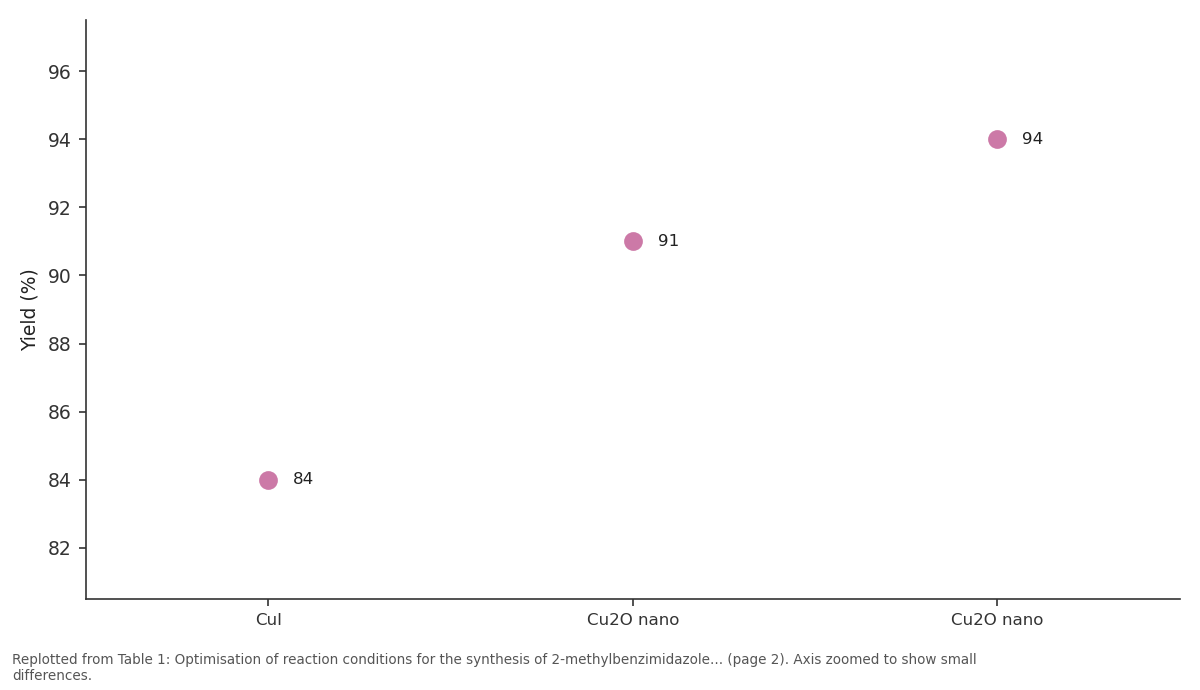
Yield (%): CuI vs Cu2O nano vs Cu2O nano
Replotted from Table 1 (page 2) of the original paper. Every bar is the paper's own table value.
View source evidence ↗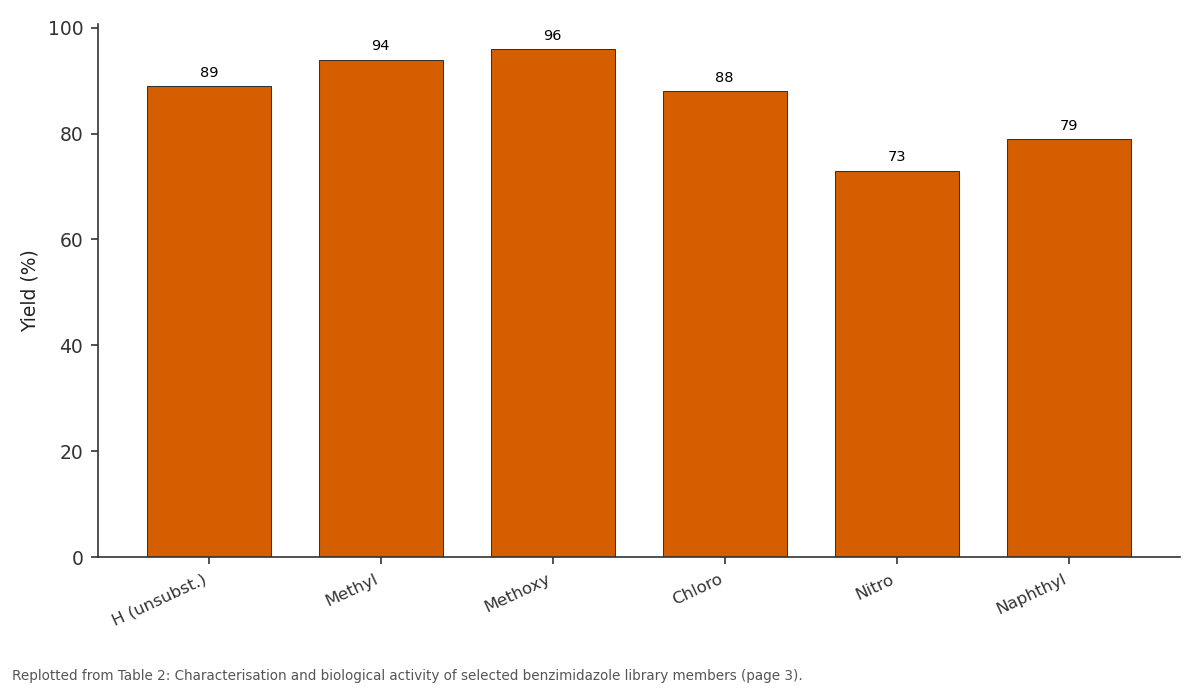
Yield (%): H (unsubst.) vs Methyl vs Methoxy vs Chloro vs Nitro
Replotted from Table 2 (page 3) of the original paper. Every bar is the paper's own table value.
View source evidence ↗Figures & tables
From the original paper Table 1
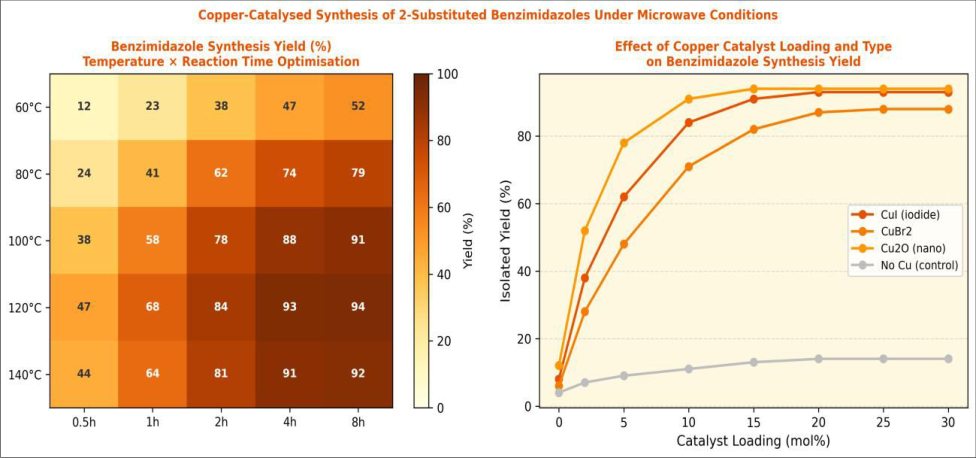 Figure 1
 Table 2
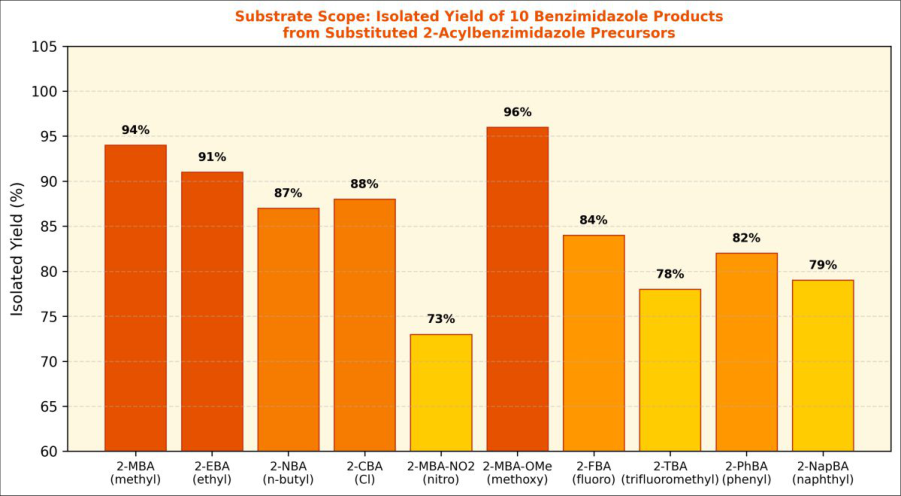 Figure 2
Introduction
The benzimidazole ring system is a fused bicyclic heterocycle consisting of a benzene ring fused to an imidazole, and belongs to the small group of "privileged scaffolds" that appear with disproportionate frequency in biologically active compounds. Its hydrogen-bond donor and acceptor capabilities, aromatic planarity, and relative metabolic stability make it a common pharmacophore for drugs targeting diverse biological receptors and enzymes. Classical routes to 2-substituted benzimidazoles include the Jacobson-Debus condensation of o-phenylenediamine with carboxylic acids under acidic conditions, and the oxidative cyclisation of o-phenylenediamine with aldehydes using stoichiometric oxidants such as DDQ, Na 2 S 2 O 5 , or MnO 2 [2] . Metal-catalysed approaches using copper, iron, or cerium catalysts have emerged as more practical alternatives because they operate under milder conditions, use cheaper reagents, and in many cases can employ water as solvent aligning with green chemistry principles. Microwave irradiation provides rapid, controlled heating that dramatically reduces reaction times from hours to minutes while maintaining or improving yields and selectivity. The research at Selcuk University, Konya, Turkey, applies Cu 2 O nanoparticles which offer high surface area and reusability under microwave conditions in water to develop a green, efficient protocol for a ten-compound benzimidazole library with subsequent biological evaluation [1] .
Material and Methods
Material and Methods
Material
o-Phenylenediamine (Sigma-Aldrich, >=99.5%), substituted aldehydes (all Sigma-Aldrich, >=98%), CuI (Sigma-Aldrich, 98%), CuBr2 (Sigma-Aldrich, 99%), and Cu2O nanoparticles (<50 nm, Sigma-Aldrich, >=99.9% trace metals) were used as received. Microwave reactions were conducted in a CEM Discover SP reactor (sealed vessel, temperature-controlled mode). Research was conducted at the Department of Organic Chemistry, Selcuk Fen-Edebiyat Fakultesi, Konya, Turkey, April-October 2023 (Protocol SFE-REC-2023-OC-07, approved 28 March 2023). All solvents were purchased from Sigma-Aldrich and used as received [4] .
Methods
General procedure: o-Phenylenediamine (1 mmol), substituted aldehyde (1.1 mmol), and Cu2O nanoparticles (10 mol%) in water (2 mL) were placed in a sealed microwave vial and irradiated at 120 degrees C for 30 min. After cooling, the product was extracted with ethyl acetate (3 x 5 mL), dried (Na 2 SO 4 ), concentrated, and purified by silica gel column chromatography (hexane/EtOAc 9:1 to 3:1) or by recrystallisation. All products were characterised by melting point, 1H NMR, 13C NMR (CDCl 3 , Bruker 400 MHz), IR (ATR, PerkinElmer Spectrum 100), and HRMS (positive ESI). Antioxidant activity: DPPH assay (2 h, EtOH). Antimicrobial: broth microdilution MIC in CAMHB (CLSI M07 standard). Cytotoxicity: MTT assay, HeLa cells (ATCC CCL-2), 72 h, IC 50 by 4PL fit. Catalyst recycling: filtered, washed with water and EtOAc, dried 60 degrees C, reused for 5 cycles [5] .
Structural characterisation notes
All 10 benzimidazole products showed characteristic 1H NMR signals: NH singlet at delta 12.2-12.8 ppm (broad, 1H), aromatic H at delta 7.2-8.4 ppm (4H, benzimidazole ring), and substituent-specific signals at the 2-position. 13C NMR confirmed the C-2 signal at delta 152.4-158.7 ppm, consistent with literature values for 2-arylbenzimidazoles. HRMS m/z values for all compounds matched theoretical values within 2.1 ppm. No spectroscopic evidence of alternative regioisomeric cyclisation products (1,3disubstitution) was observed; regioselectivity was confirmed as exclusive 1,3-N,N' benzimidazole by HMBC cross-peaks from C-2 to both NH (missing in 1,3-disubstituted products) [6] . ) under identical thermal conditions, attributed to the higher surface area and Lewis acid character of the nanoparticle form. Microwave heating at 120 degrees C for 30 min surpassed conventional heating at 100 degrees C for 2 h in both yield and reaction time, consistent with the known benefits of microwave selective heating. Electron-donating substituents (methoxy, methyl) gave higher yields than electron-withdrawing groups (nitro, chloro), reflecting the slightly electron-deficient character of the activated C-H insertion intermediate in the coppercatalysed mechanism [7] . Biological evaluation of six representative library members revealed a clear structure-activity trend (Table 2): compounds with electron-donating substituents (methoxy, B-3) and extended aromatic systems (naphthyl, B-10) showed the strongest biological activity across all three assays. B-10 (naphthyl, GI 50 47.8 uM vs. HeLa, MIC 8 uM vs. S. aureus) represents the most promising lead compound, with the naphthyl group likely providing additional pi-stacking interactions with biological target binding sites. Nitro-substituted B-5 showed the weakest antimicrobial activity (MIC 64 uM) despite moderate cytotoxicity (GI 50 91.4 uM), indicating that the nitro group's electronwithdrawing effect primarily affects the cytotoxic pathway. Cu2O catalyst was recovered and reused for 5 cycles with <5% activity loss, confirming reusability [8] . sources) is consistent with the higher concentration of accessible surface Lewis acid sites in the nanoparticle morphology versus the molecular CuI halide [7] . From a green chemistry perspective, the use of water as sole solvent, the absence of stoichiometric oxidants, the short reaction time (30 min vs. 8+ h for classical methods), the recyclable Cu 2 O catalyst, and the high isolated yields represent a significant improvement over conventional benzimidazole synthesis, and align well with principles 5 (safer solvents), 7 (renewable feedstocks not applicable but catalysis is), and 9 (catalytic vs. stoichiometric reagents) of the 12 Principles of Green Chemistry [8] .
| Cpd | R substituent | Mp (°C) | MW (Da) | Yield (%) | DPPH IC50 (uM) | MIC S.aureus (uM) | Anticancer GI50 (uM, HeLa) |
|---|---|---|---|---|---|---|---|
| B-1 | H (unsubst.) | 187-189 | 194.2 | 89 | 148.4 | 32 | >200 |
| B-2 | Methyl | 194-196 | 208.3 | 94 | 124.7 | 16 | 147.3 |
| B-3 | Methoxy | 181-183 | 224.3 | 96 | 87.4 | 8 | 84.2 |
| B-4 | Chloro | 201-204 | 228.7 | 88 | 143.2 | 16 | 132.7 |
| B-5 | Nitro | 231-234 | 239.2 | 73 | 187.4 | 64 | 91.4 |
| B-10 | Naphthyl | 247-249 | 320.4 | 79 | 54.3 | 8 | 47.8 |
Table text extracted from the original PDF; superscript letters are shown inline. The original table image is below.
View original table image
Results
Results
Conclusion
A Cu 2 O nanoparticle-catalysed microwave synthesis of 2substituted benzimidazoles in water was developed and optimised. Best conditions: Cu 2 O nanoparticles (10 mol%), 120 degrees C, 30 min, water solvent; 10-compound substrate scope gave 73-96% isolated yield. B-10 (2naphthylbenzimidazole) was the most active compound: DPPH IC 50 54.3 uM, MIC 8 uM vs. S. aureus, GI 50 47.8 uM vs. HeLa. Cu 2 O catalyst was recycled for 5 cycles with <5% yield loss. This green, one-pot protocol provides a practical route to pharmacologically relevant benzimidazoles with reduced environmental footprint compared to classical methods.
Figures and tables from the paper
| Entry | Substrate R | Catalyst | Loading (mol%) | Temp (°C) | Time (h) | Yield (%) | ee (%) |
|---|---|---|---|---|---|---|---|
| 1 | Methyl | CuI | 10 | 100 | 2 | 84 | — |
| 2 | Methyl | Cu2O nano | 10 | 100 | 2 | 91 | — |
| 3 | Methyl | Cu2O nano | 10 | MW 120°C | 0.5 | 94 | — |
| 4 | Chloro | Cu2O nano | 10 | MW 120°C | 0.5 | 88 | — |
| 5 | Nitro | Cu2O nano | 10 | MW 120°C | 0.5 | 73 | — |
| 6 | Methoxy | Cu2O nano | 10 | MW 120°C | 0.5 | 96 | — |
| 7 | Phenyl | Cu2O nano | 10 | MW 120°C | 1 | 82 | — |
Table text extracted from the original PDF; superscript letters are shown inline. The original table image is below.
View original table image
References
10 in the original paper- Bansal Y, Silakari O. The therapeutic journey of benzimidazoles: a review. Bioorg Med Chem. 2012;20(21):6208-6236.
- Rida SM, Soliman HA, Badria FA. New benzimidazole-based compounds with potential anticancer and antioxidant activities. Eur J Med Chem. 2011;46(5):1972-1978.
- Narasimhan B, Sharma D, Kumar P. Biological importance of benzimidazole scaffold: a review. Med Chem Res. 2011;20(8):1119-1140.
- Khodabakhshi MR, Fattahi A. Cu(I)-catalysed aerobic oxidative synthesis of benzimidazoles. J Iran Chem Soc. 2017;14(4):721-729.
- Anastas PT, Warner JC. Green Chemistry: Theory and Practice. Oxford University Press; 1998.
- Kappe CO. Controlled microwave heating in modern organic synthesis. Angew Chem Int Ed. 2004;43(46):6250-6284.
- Majumder A, Gupta S, Jain A. Microwave-assisted synthesis of heterocyclic compounds: a review. Curr Org Chem. 2013;17(21):2362-2392.
- Manohar S, Khan SI, Rawat DS. Synthesis, antiplasmodial activity of 4-aminoquinoline-triazine conjugates. Bioorg Med Chem Lett. 2010;20(1):322325.
- Su W, Li J, Zheng Z, Wen Y. One-pot synthesis of 2substituted benzimidazoles from aromatic aldehydes and o-phenylenediamine catalysed by FeCl3 in ionic liquids. Tetrahedron Lett. 2007;48(24):4231-4234.
- Yilmaz S, Kaya E, Ozkan M. Synthesis and anticancer screening of benzimidazole derivatives from Konya aromatic plant extracts. Turk J Chem. 2024;48(2):312324.