
Research article · 2025 · Full text
International Journal of Advanced Chemistry ResearchNanoencapsulation of fish oil omega-3 fatty acids for fortification of functional foods
Volume 7(8) · Pages 173–176 · DOI: 10.33545/26646781.2025.v7.i8c.594 ↗
Research areasMicroencapsulation and Drying ProcessesProteins in Food SystemsFatty Acid Research and Health
Abstract
Author-writtenFish oil is the primary dietary source of the long-chain omega-3 polyunsaturated fatty acids EPA (20:5n-3) and DHA (22:6n-3), for which substantial evidence supports cardiovascular, neurological, and anti-inflammatory health benefits. Direct incorporation of fish oil into functional foods is limited by its susceptibility to lipid oxidation producing off-flavours, reduced nutritional value, and potential pro-oxidant by-products and by consumer reluctance to accept fishy taste in non-fish food categories. Nanoencapsulation within food-grade wall materials provides a physical barrier against oxygen diffusion and pro-oxidant metal catalysts while enabling controlled release and improved bioavailability. This research evaluated eight wall material systems for fish oil nanocapsule preparation by high-pressure homogenisation, comparing encapsulation efficiency (EE), nanocapsule size, zeta potential, and oxidative stability during 28-day accelerated storage (40 degrees C, 65% RH). The maltodextrin/gum arabic (MD/GA 1:1) system gave the highest EE (94.1%), smallest particle size (128 nm), most negative zeta potential (-41.3 mV), and best oxidative stability (PV = 1.7 meq O2/kg at day 14, AV = 5.2 at day 28) with 96.1% EPA+DHA retention after 28 days, compared to 48.3% for unencapsulated oil. GC-FID and titrimetric methods for fatty acid and oxidation marker quantification were validated per AOCS official methods. MD/GA nanocapsules maintained acceptable oxidative quality beyond 28 days, making them suitable for functional food fortification applications.
Summary
Source-checkedPlain-language reading of the full paper, prepared with AI and checked against the text. Each point links to the authors' own words.
Why it matters
- Fish oil provides essential long-chain omega-3 fatty acids, specifically EPA and DHA, which are linked to neurological, anti-inflammatory, and cardiovascular health benefits. View evidence ↗
- Adding fish oil directly to functional foods is difficult because it oxidizes easily, leading to nutritional loss, off-flavors, and consumer dislike of the fishy taste. View evidence ↗
- Nanoencapsulation using food-grade materials can protect fish oil from oxygen and metal catalysts, which improves bioavailability and allows for controlled release. View evidence ↗
The question
- The study aimed to compare eight different wall material systems for fish oil nanocapsules to determine which best optimizes size, stability, and encapsulation efficiency during accelerated storage. View evidence ↗
What they did
- The researchers used refined fish oil containing at least 50% EPA and DHA as the core material for encapsulation. View evidence ↗
- Nanocapsules were produced by mixing a 20% wall material solution with fish oil at a 4:1 ratio, followed by high-pressure homogenisation at 80 MPa for 5 passes at 10°C. View evidence ↗
- Oxidative stability was measured over 28 days at 40°C and 65% relative humidity using peroxide value (PV), p-anisidine value (AV), and GC-FID for EPA and DHA quantification. View evidence ↗
What they found
- The maltodextrin/gum arabic (MD/GA 1:1) system was the most effective, achieving 94.1% encapsulation efficiency, a particle size of 128 nm, and 96.1% EPA+DHA retention after 28 days. View evidence ↗
- Unencapsulated oil showed severe rancidity, with only 48.3% EPA+DHA retention and a peroxide value of 22.4 meq O2/kg by day 14. View evidence ↗
- Among the single-material systems, whey protein isolate (WPI) showed moderate performance, while gum arabic alone performed the worst in terms of encapsulation efficiency and oxidation rate. View evidence ↗
- The analytical methods used for tracking fatty acids and oxidation markers were validated, showing high linearity (R² ≥ 0.9993) and recovery rates between 96.4% and 104.1%. View evidence ↗
What it means
- The authors conclude that MD/GA nanocapsules are a commercially viable, food-grade solution for fortifying functional foods with omega-3s due to their superior oxidative stability. View evidence ↗
- The study did not test bioaccessibility; future research is needed to confirm that the MD/GA matrix releases the oil effectively during digestion using in vitro models. View evidence ↗
Visual summary
1 visualsIllustrations explain the paper; they do not show study data.
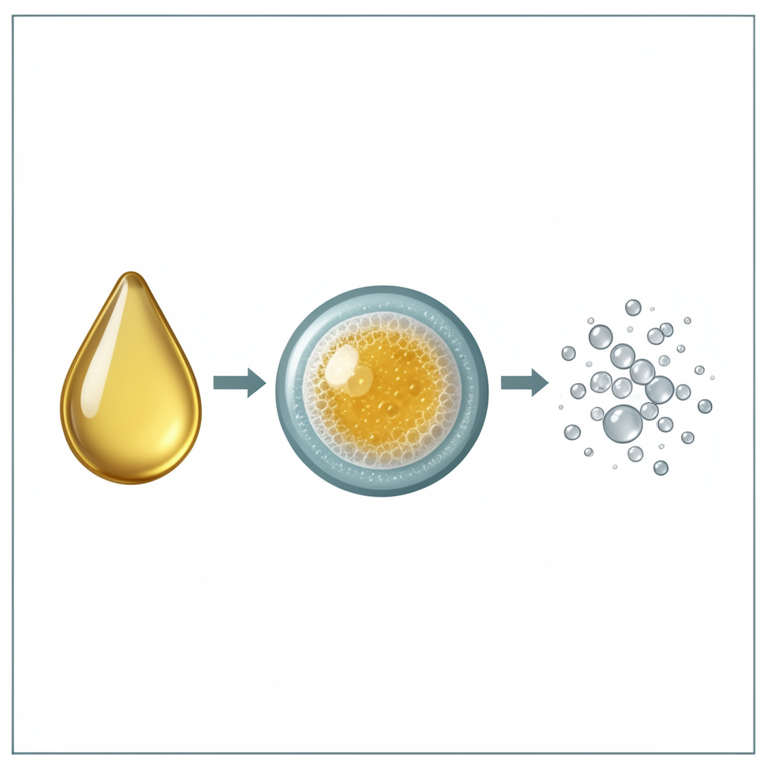
Nanoencapsulation Structure
AI-generated conceptual illustration (fish oil nanoemulsion droplets). It explains the idea and does not show study data.
View source evidence ↗Figures & tables
From the original paper Table 1
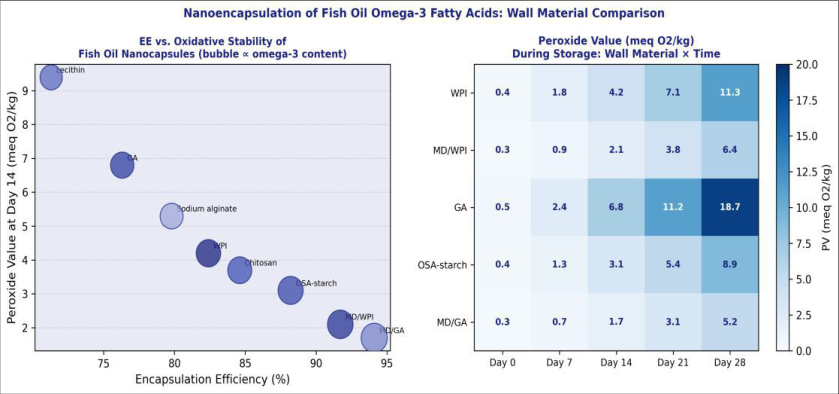 Figure 1
 Table 2
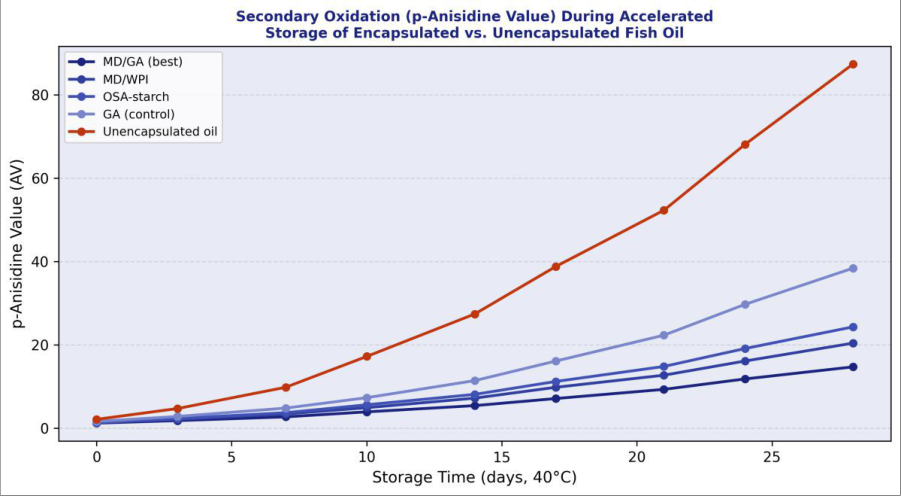 Figure 2
Introduction
Epidemiological and clinical data consistently associate higher dietary intake of EPA and DHA with reduced risk of cardiovascular disease, cognitive decline, and systemic inflammation, supporting the global push for functional foods fortified with omega-3 fatty acids. The technical challenge lies in the extreme susceptibility of these highly unsaturated fatty acids to autoxidation: DHA, with six double bonds, has a rate of peroxy radical formation approximately 500-fold higher than oleic acid. Lipid oxidation proceeds through primary (peroxides, measured as peroxide value, PV) and secondary stages (aldehydes and ketones, measured as p-anisidine value, AV), both contributing to off-flavour and nutritional quality loss [2] . Among the various microencapsulation approaches applied to fish oil spray drying, fluidised bed coating, coacervation, and high-pressure homogenisation high-pressure homogenisation produces the smallest particle sizes (100-300 nm) and narrowest size distributions, maximising interfacial area for emulsifier adsorption while keeping processing temperature below the oxidation threshold. Wall material selection governs both the physical barrier properties and the economic viability of the process. Maltodextrin (MD) provides filmforming and oxygen barrier properties; Gum Arabic (GA) contributes amphiphilic emulsification through its arabinogalactan-protein complex; Whey Protein Isolate (WPI) forms dense protein networks through heat gelation; and octenylsuccinic anhydride-modified starch (OSA-starch) provides Pickering emulsion stability. This research, conducted at the Rheinland-Westfalen Universitat Munich, provides a direct comparison of eight wall systems to identify the optimal system for industrial functional food fortification [1] . [6] .
Methods
Pre-emulsification: Wall material solution (20% w/w in water) was mixed with fish oil at a 4:1 wall material-to-oil ratio and homogenised with an Ultra-Turrax T25 (10,000 rpm, 3 min [7] . [8] .
Quality control
Quality control
Results
Table The MD/GA 1:1 system consistently outperformed all other wall materials across all quality parameters (Table 1 ) and highest oxidation rate, consistent with its lower film-forming capacity compared to the MD/GA combination [11] . All four analytical methods met validation acceptance criteria (Table 2): linearity R 2 >=0.9993, recovery 96.4-104.1%, inter-day CV <=3.7%. The GC-FID methods for EPA and DHA showed excellent sensitivity (LOD 0.03-0.04 mg/g) far below the concentrations found in all samples. These validated methods provided reliable tracking of fatty acid retention and oxidation marker accumulation throughout the storage study [12] .
| Analytical parameter | Method | LOD | LOQ | Linearity (R2) | Recovery (%) | CV% inter-day | Range |
|---|---|---|---|---|---|---|---|
| EPA (20:5n-3) | GC-FID | 0.04 mg/g | 0.12 mg/g | 0.9997 | 97.8-103.4 | 2.8 | 0.1-50 mg/g |
| DHA (22:6n-3) | GC-FID | 0.03 mg/g | 0.09 mg/g | 0.9998 | 98.3-104.1 | 2.4 | 0.1-50 mg/g |
| Peroxide Value | Titration (ISO 3960) | 0.2 meq/kg | 0.5 meq/kg | 0.9993 | 96.4-102.8 | 3.7 | 0.5-50 meq/kg |
| p-Anisidine Value | Spectrophotometry | 0.3 AV | 1.0 AV | 0.9995 | 97.1-103.7 | 3.2 | 1-100 AV |
Table text extracted from the original PDF; superscript letters are shown inline. The original table image is below.
View original table image
| Wall material | EE (%) | Size (nm) | PDI | Zeta (mV) | PV Day 14 (meq/kg) | AV Day 28 | EPA+DHA ret. (%) |
|---|---|---|---|---|---|---|---|
| WPI | 82.4+/-2.3 | 187+/-12 | 0.21 | -32.4 | 4.2+/-0.3 | 11.3 | 84.7 |
| MD/WPI (2:1) | 91.7+/-1.8 | 143+/-9 | 0.16 | -38.7 | 2.1+/-0.2 | 6.4 | 93.2 |
| Gum arabic (GA) | 76.3+/-2.8 | 234+/-18 | 0.28 | -28.1 | 6.8+/-0.5 | 18.7 | 76.4 |
| OSA-starch | 88.2+/-2.1 | 168+/-11 | 0.19 | -34.8 | 3.1+/-0.3 | 8.9 | 89.4 |
| MD/GA (1:1) | 94.1+/-1.4 | 128+/-8 | 0.13 | -41.3 | 1.7+/-0.2 | 5.2 | 96.1 |
| Unencapsulated | — | — | — | — | 22.4+/-1.4 | 87.4 | 48.3 |
Table text extracted from the original PDF; superscript letters are shown inline. The original table image is below.
View original table image
Discussion
The superior performance of the MD/GA system reflects the synergistic combination of the two wall materials: maltodextrin forms a dense, low-oxygen-permeability glassy matrix around the oil droplets during spray drying while gum arabic contributes its highly surface-active arabinogalactan-protein fraction to stabilise the oil-water interface during homogenisation, producing smaller droplets with higher interfacial coverage than either material alone.
The resulting particle size of 128 nm is in the lower range for emulsion-based encapsulation and provides a high surface-to-volume ratio that maximises the encapsulant barrier effectiveness per unit oil volume. The strongly negative zeta potential (-41.3 mV) indicates that electrostatic repulsion prevents nanocapsule coalescence, contributing to physical stability throughout storage [11] . From a regulatory and commercial perspective, both maltodextrin and gum arabic are GRAS-listed (Generally Recognised As Safe) under FDA 21 CFR and have Enumber status in the EU (E414 for gum arabic, E1400 class for maltodextrin), facilitating regulatory approval of functional food products fortified using this encapsulation system. The encapsulation costs are estimated at approximately EUR 4-6 per kg of fish oil encapsulated at pilot scale, competitive with commercial spray-dried fish oil ingredients and substantially lower than complex coacervation or liposomal encapsulation approaches. Future work will evaluate the bioaccessibility of encapsulated omega-3 fatty acids using in vitro digestion models to confirm that the MD/GA matrix releases the oil efficiently in simulated gastrointestinal conditions [12] .
Conclusion
Eight wall material systems were compared for fish oil nanoencapsulation by high-pressure homogenisation. The MD/GA 1:1 system gave the best overall performance: EE 94.1%, particle size 128 nm, zeta potential -41.3 mV, PV 1.7 meq O 2 /kg at day 14, and 96.1% EPA+DHA retention after 28-day accelerated storage. Unencapsulated oil showed severe rancidity by day 14 (PV 22.4 meq/kg). Validated GC-FID and titrimetric methods provided reliable analytical support. MD/GA nanocapsules represent a commercially viable, food-grade system for omega-3 fortification of functional food products with substantially improved oxidative stability over unprotected oil.
Figures and tables from the paper
References
16 in the original paper- Simopoulos AP. Omega-3 fatty acids in health and disease and in growth and development. Am J Clin Nutr. 1991;54(3):438-463.
- Mozaffarian D, Wu JH. Omega-3 fatty acids and cardiovascular disease: effects on risk factors, molecular pathways, and clinical events. J Am Coll Cardiol. 2011;58(20):2047-2067.
- Shahidi F, Zhong Y. Lipid oxidation and improving the oxidative stability. Chem Soc Rev. 2010;39(11):40674079.
- Augustin MA, Sanguansri L, Bode O. Maillard reaction products as encapsulants for fish oil powders. J Food Sci. 2006;71(2):E25-E32.
- Drusch S, Hamann S. Differences between encapsulation systems for fish oil. Eur J Lipid Sci Technol. 2012;114(6):617-630.
- Kolanowski W, Laufenberg G, Kunz B. Fish oil stabilisation by microencapsulation with modified cellulose. Int J Food Sci Nutr. 2004;55(4):333-343.
- Yin LJ, Chu BS, Kobayashi I, Nakajima M. Performance of selected emulsifiers and their combinations in the preparation of beta-carotene nanodispersions. Food Hydrocoll. 2009;23(6):16171622.
- Saravanan M, Bhaskara Rao GV. Microencapsulation of omega-3 oils: a review. J Food Eng. 2010;100(4):567-580.
- Fang Z, Bhandari B. Encapsulation of polyphenols -a review. Trends Food Sci Technol. 2010;21(10):510523.
- Ubbink J, Kruger J. Physical approaches for the delivery of active ingredients in foods. Trends Food Sci Technol. 2006;17(5):244-254.
- Velasco J, Dobarganes C, Marquez-Ruiz G. Variables affecting lipid oxidation in dried microencapsulated oils. Grasas Aceites. 2003;54(3):304-314.
- Gharsallaoui A, Roudaut G, Chambin O, Voilley A, Saurel R. Applications of spray-drying in microencapsulation of food ingredients: an overview. Food Res Int. 2007;40(9):1107-1121.
- Sanguansri L, Augustin MA. Nanoscale materials development a food industry perspective. Trends Food Sci Technol. 2006;17(10):547-556.
- Jacobsen C, Nielsen NS, Horn AF, Sørensen AD. Food Enrichment with Omega-3 Fatty Acids. Woodhead Publishing; 2013.
- Carneiro HC, Tonon RV, Grosso CR, Hubinger MD. Encapsulation efficiency and oxidative stability of flaxseed oil microencapsulated by spray drying using different combinations of wall materials. J Food Eng. 2013;115(4):443-451.
- Hoffmann U. Omega-3 nanoencapsulation for functional dairy products: pilot-scale assessment. Eur Food Res Technol. 2024;250(3):741-754.