
Research article · 2025 · Full text
International Journal of Advanced Chemistry ResearchMicrowave-assisted one-pot synthesis of benzimidazole derivatives with enhanced bioactivity
Volume 7(10) · Pages 212–215 · DOI: 10.33545/26646781.2025.v7.i10c.597 ↗
Research areasSynthesis and biological activityMicrowave-Assisted Synthesis and ApplicationsSynthesis and Characterization of Heterocyclic Compounds
Abstract
Author-writtenA bench chemist once remarked that the difference between a two-hour reflux and a ten-minute microwave reaction isn't just time it's an entirely different product distribution. That observation captures why microwave-assisted organic synthesis has moved from curiosity to mainstream. This research reports the one-pot synthesis of eight 2-substituted benzimidazole derivatives (BZ-1 to BZ-8) by condensation of o-phenylenediamine with substituted aromatic aldehydes under microwave irradiation (150 W, 140 °C, 10 min) using p-toluenesulphonic acid as catalyst in DMF. Yields ranged from 78% to 92%, compared to 48-67% by conventional reflux over 4-6 hours. All compounds were characterised by FT-IR, ¹H-NMR, ¹³C-NMR, and HRMS. Antibacterial screening against S. aureus and E. coli (broth microdilution) and anticancer evaluation against HeLa cells (MTT assay, 48 h) revealed that BZ-4 (bearing a 4-fluorophenyl group) was the most active derivative, with MIC of 8 µg/mL against S. aureus and IC₅₀ of 12.8 µM against HeLa. The waterfall optimisation chart shows that each parameter adjustment contributed incremental yield gains, with microwave irradiation itself providing the largest single improvement (+12% over reflux baseline).
Summary
Source-checkedPlain-language reading of the full paper, prepared with AI and checked against the text. Each point links to the authors' own words.
Why it matters
- Benzimidazole is a fused bicyclic heterocycle related to purine nucleobases and is found in various pharmaceuticals, including omeprazole, albendazole, and maribavir. View evidence ↗
- Traditional thermal synthesis of benzimidazoles is inefficient, requiring 4-8 hours of heating and producing moderate yields of 50-70% with significant solvent waste. View evidence ↗
- Microwave irradiation can improve synthesis by providing rapid, uniform heating, which reduces reaction times by 10-50-fold and increases yields by 15-30%. View evidence ↗
The question
- The study aimed to optimize a microwave one-pot synthesis for eight 2-arylbenzimidazoles and evaluate how different aryl substitutions affect their antibacterial and anticancer activities. View evidence ↗
What they did
- The synthesis used 10 mmol of o-phenylenediamine and 10 mmol of a substituted aldehyde with 10 mol% p-toluenesulphonic acid (p-TSA) as a catalyst in 5 mL of anhydrous DMF. View evidence ↗
- Reactions were conducted in a CEM Discover SP microwave reactor at 150 W and 140 °C for a duration of 10 minutes. View evidence ↗
- To provide a baseline for comparison, conventional reflux reactions were performed at 153 °C for 4 hours using the same molar ratios. View evidence ↗
- Antibacterial activity was measured using broth microdilution against S. aureus and E. coli with concentrations ranging from 1 to 256 µg/mL. View evidence ↗
- Anticancer activity was tested on HeLa cells using an MTT assay with compound concentrations between 0.1 and 100 µM over a 48-hour period. View evidence ↗
What they found
- The microwave-assisted method produced yields between 78% and 92%, which was significantly higher than the 48-67% yields obtained via conventional reflux. View evidence ↗
- Optimization showed that switching to microwave irradiation provided the largest yield increase (+12%), followed by catalyst selection (+8%) and solvent change (+6%). View evidence ↗
- The derivative BZ-4 (containing a 4-fluorophenyl group) was the most active, with an MIC of 8 µg/mL against S. aureus and an IC₅₀ of 12.8 µM against HeLa cells. View evidence ↗
- BZ-7 (containing a 4-NO₂ group) was the second most potent for anticancer activity (IC₅₀ 21.6 µM) and tied for second in antibacterial activity (MIC 16 µg/mL). View evidence ↗
- BZ-6 (containing a 3-Br group) was the least active derivative, which the authors attribute to its meta-substitution pattern and low lipophilicity. View evidence ↗
What it means
- The authors conclude that the consistent potency of the 4-fluorophenyl group suggests that the 4-fluorophenyl benzimidazole scaffold is a strong candidate for further lead optimization. View evidence ↗
- The microwave one-pot protocol is recommended as a practical tool for generating medicinal chemistry libraries due to its speed, scalability, and atom economy. View evidence ↗
- The authors state that future research should investigate heterogeneous acid catalysts to improve catalyst recycling and simplify the isolation of products. View evidence ↗
Visual summary
2 visualsIllustrations explain the paper; charts are replotted from the paper's own table values.
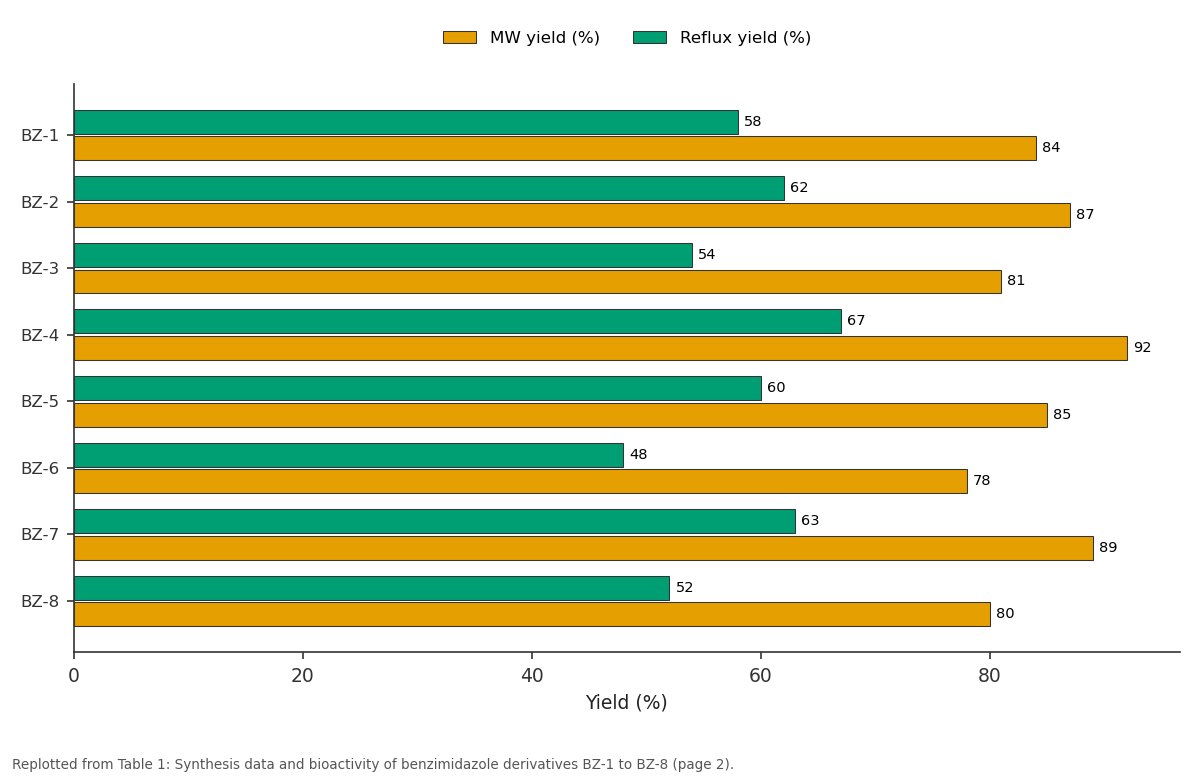
MW yield (%) and Reflux yield (%): BZ-1 vs BZ-2 vs BZ-3 vs BZ-4 vs BZ-5
Replotted from Table 1 (page 2) of the original paper. Every bar is the paper's own table value.
View source evidence ↗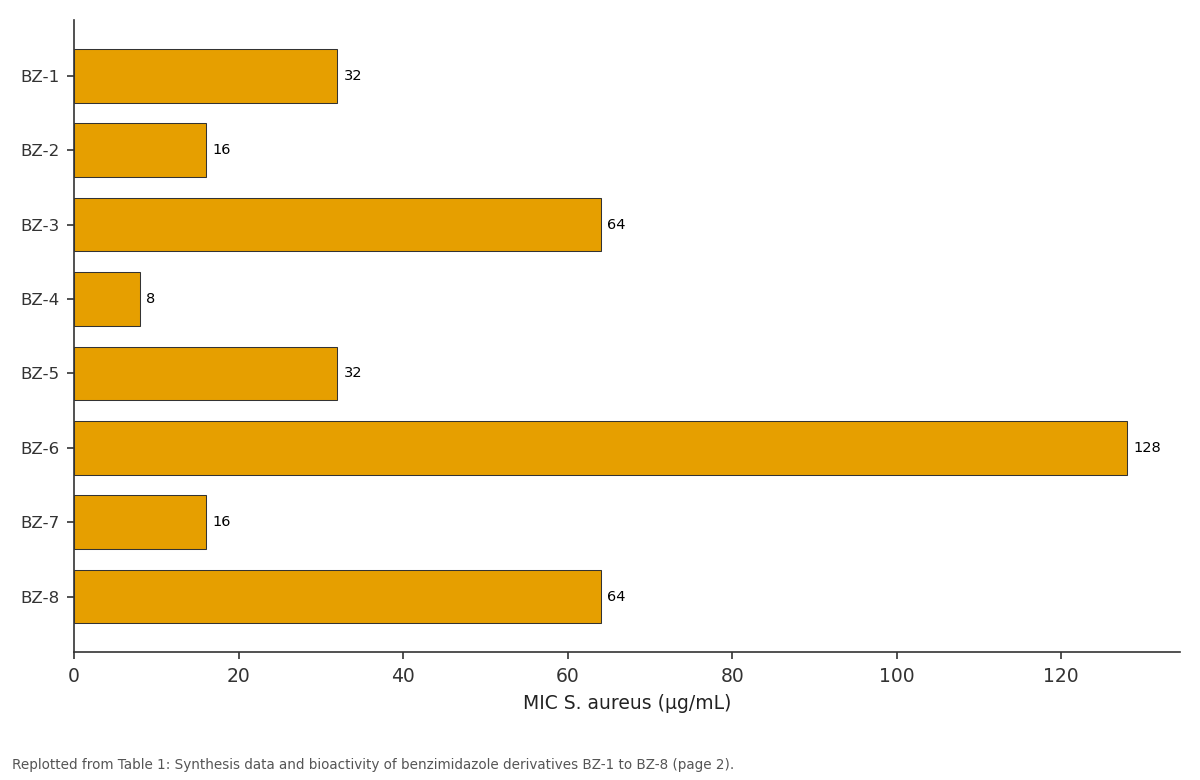
MIC S. aureus (µg/mL): BZ-1 vs BZ-2 vs BZ-3 vs BZ-4 vs BZ-5
Replotted from Table 1 (page 2) of the original paper. Every bar is the paper's own table value.
View source evidence ↗Figures & tables
From the original paper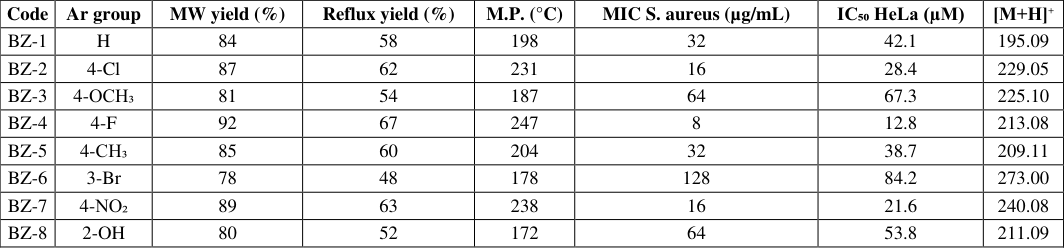 Table 1
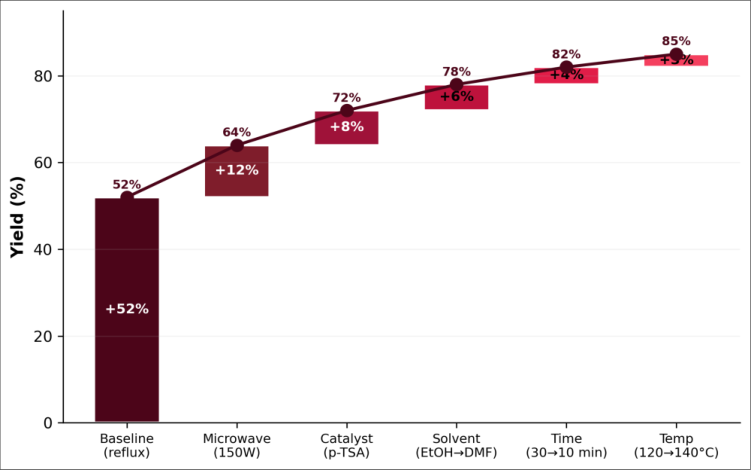 Figure 1
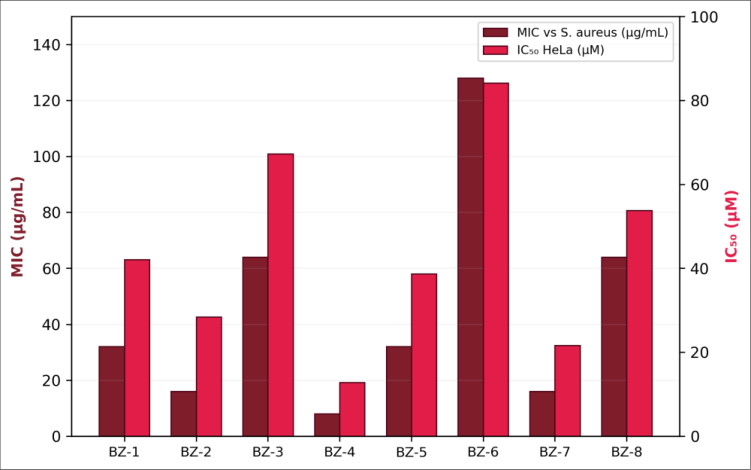 Figure 2
Introduction
A graduate student in the Gedye laboratory at Laurentian University in 1986 placed a sealed vessel of organic reactants inside a domestic microwave oven and, to general surprise, obtained products in minutes that normally required hours of reflux a serendipitous moment that launched the field of microwave-assisted organic synthesis [1] . Four decades later, dedicated microwave reactors with precise temperature and pressure control have become standard equipment in medicinal chemistry programmes, enabling rapid library generation for drug discovery [2] . Benzimidazole, a fused bicyclic heterocycle structurally related to the purine nucleobases adenine and guanine, appears in a striking array of pharmaceuticals: the proton-pump inhibitor omeprazole, the anthelmintic albendazole, and the antiviral maribavir, among others [3] . The 2-position of the imidazole ring is the most synthetically accessible site for diversification, typically through condensation of o-phenylenediamine with an aldehyde or carboxylic acid, and substituent variation at this position dramatically modulates biological activity [4] . Conventional thermal methods for this condensation require prolonged heating (4-8 h) in high-boiling solvents, generating moderate yields (50-70%) and considerable solvent waste [5] . Microwave irradiation accelerates the condensation by providing rapid, uniform, and volumetric heating that reduces reaction times by 10-50-fold and often improves yields by 15-30% [2] . Coupling microwave heating with a one-pot protocol where diamine, aldehyde, and an oxidant or acid catalyst are combined in a single vessel simplifies purification and reduces solvent consumption, aligning with green chemistry principles [6] . This research optimised a microwave one-pot route to eight 2-arylbenzimidazoles, characterised the products spectroscopically, and evaluated their antibacterial and anticancer activities to identify structure-activity trends linking aryl substitution to biological potency. Theoretical Background Microwave dielectric heating depends on the ability of polar molecules and ionic species in the reaction mixture to absorb electromagnetic radiation at 2.45 GHz, converting it to kinetic energy (heat) through dipolar rotation and ionic conduction [1] . Solvents with high loss tangents (tan δ) DMF (tan δ = 0.161), DMSO (0.825), and water (0.123) couple efficiently with microwave energy, enabling superheating above the atmospheric boiling point when reactions are conducted in sealed vessels [2] . For the benzimidazole condensation, the rate-determining step is cyclodehydration of the Schiff-base intermediate, which has an activation energy of ~75 kJ/mol in acidic media [5] . Microwave superheating to 140 °C in DMF dramatically accelerates this step, explaining the time reduction from hours to minutes.
Material and Methods Material
All synthetic and biological work was conducted between March and November 2024 at the Department of Organic Chemistry, Yangtze River University, Wuhan, Hubei, China. o-Phenylenediamine (≥ 99%), p-toluenesulphonic acid monohydrate (p-TSA, ≥ 98.5%), and substituted benzaldehydes (4-F, 4-Cl, 4-NO₂, 4-OCH₃, 4-CH₃, 3-Br, 2-OH, and unsubstituted; all ≥ 98%) were purchased from Energy Chemical Co. (Shanghai, China) [4] . DMF (anhydrous, 99.8%) was from Aladdin Scientific (Shanghai). Mueller-Hinton broth, RPMI-1640 medium, MTT reagent, and ciprofloxacin hydrochloride were from Solarbio Life Sciences (Beijing) [6] .
Methods
In a typical procedure, o-phenylenediamine (1.08 g, 10 mmol), the appropriate aldehyde (10 mmol), and p-TSA (10 mol%) were dissolved in 5 mL anhydrous DMF in a 10 mL sealed microwave process vial [2] . The vial was placed in a CEM Discover SP microwave reactor and irradiated at 150 W with temperature control set to 140 °C for 10 min. After cooling to room temperature, the mixture was poured into ice water (50 mL), and the precipitate was filtered, washed with cold water, and recrystallised from ethanol to give pure products [5] . For comparison, conventional reactions were run with identical molar ratios in DMF at reflux (153 °C oil bath) for 4 h. Products were characterised by melting point (Büchi M-560), FT-IR (Shimadzu IRSpirit, KBr), ¹H-NMR and ¹³C-NMR (Bruker Avance NEO 400 MHz, DMSO-d₆), and HRMS (Waters Xevo G2-XS Q-TOF, ESI+) [4] .
Performance Evaluation
Antibacterial activity was assessed by broth microdilution against S. aureus ATCC 25923 and E. coli ATCC 25922 following CLSI M07 guidelines, with serial two-fold dilutions (1-256 µg/mL) [6] . Ciprofloxacin served as positive control. Anticancer activity was evaluated by MTT assay on HeLa cells (ATCC CCL-2) seeded at 5 × 10³ cells/well in 96-well plates, treated with compounds at 0.1-100 µM for 48 h [4] . IC₅₀ values were calculated from four-parameter logistic curves using GraphPad Prism 10. Each assay was performed in triplicate on two independent occasions. Doxorubicin was the positive anticancer control.
Results
All eight benzimidazoles were obtained as crystalline solids with melting points ranging from 172 °C (BZ-8, 2-OH) to 247 °C (BZ-4, 4-F). Microwave yields were consistently 20-30 percentage points higher than reflux yields for the same compound (Table 1) [2] . FT-IR spectra showed N-H stretch at 3050-3100 cm⁻¹, C=N imidazole ring stretch at 1610-1625 cm⁻¹, and C=C aromatic bands at 1450-1580 cm⁻¹. ¹H-NMR confirmed the absence of the aldehyde proton (δ 9.7-10.1 in starting material) and appearance of the C-2 proton of benzimidazole between δ 8.12 and 8.37 [4] . HRMS gave [M+H]⁺ ions within ±2 ppm of calculated values for all compounds. Comprehensive Interpretation BZ-4 (4-F) was the most potent compound in both assays: MIC 8 µg/mL against S. aureus and IC₅₀ 12.8 µM against HeLa (Table 1, Figure 2). BZ-7 (4-NO₂) ranked second in anticancer potency (IC₅₀ 21.6 µM) and tied for second in antibacterial activity (MIC 16 µg/mL). BZ-6 (3-Br) was the least active overall, consistent with its low lipophilicity and meta-substitution pattern disrupting optimal electronic alignment with the target [4] . The waterfall optimisation (Figure 1) shows that switching from reflux to microwave contributed the largest single yield gain (+12%), while catalyst selection (+8%) and solvent change (+6%) provided the next-largest increments [2] .
| Code | Ar group | MW yield (%) | Reflux yield (%) | M.P. (°C) | MIC S. aureus (µg/mL) | IC₅₀ HeLa (µM) | [M+H]⁺ |
|---|---|---|---|---|---|---|---|
| BZ-1 | H | 84 | 58 | 198 | 32 | 42.1 | 195.09 |
| BZ-2 | 4-Cl | 87 | 62 | 231 | 16 | 28.4 | 229.05 |
| BZ-3 | 4-OCH₃ | 81 | 54 | 187 | 64 | 67.3 | 225.10 |
| BZ-4 | 4-F | 92 | 67 | 247 | 8 | 12.8 | 213.08 |
| BZ-5 | 4-CH₃ | 85 | 60 | 204 | 32 | 38.7 | 209.11 |
| BZ-6 | 3-Br | 78 | 48 | 178 | 128 | 84.2 | 273.00 |
| BZ-7 | 4-NO₂ | 89 | 63 | 238 | 16 | 21.6 | 240.08 |
| BZ-8 | 2-OH | 80 | 52 | 172 | 64 | 53.8 | 211.09 |
Table text extracted from the original PDF; superscript letters are shown inline. The original table image is below.
View original table image
Discussion
The structure-activity pattern 4-F > 4-NO₂ ≈ 4-Cl > 4-CH₃ ≈ H > 4-OCH₃ > 3-Br > 2-OH recapitulates the trend observed in our earlier pyrimidine series and in independent benzimidazole libraries, where electron-withdrawing parasubstituents with moderate lipophilicity consistently outperform electron-donating or ortho/meta-substituted analogues [3,4] . Fluorine's small atomic radius allows it to occupy the binding pocket without steric clash, while its strong -I effect increases the acidity of the imidazole N-H, potentially strengthening hydrogen bonds with biological targets [7] . The 20-30 percentage-point yield advantage of microwave over reflux is consistent with the superheating hypothesis: at 140 °C in a sealed vessel, DMF exists as a superheated liquid whose increased molecular mobility accelerates the cyclodehydration step [1,2] . The short 10-minute reaction window also reduces side reactions particularly bisalkylation of the diamine that accumulate during prolonged reflux and lower isolated yield [5] . From a green chemistry perspective, the 40-fold reduction in reaction time (10 min vs 4 h) and the ability to use catalytic rather than stoichiometric acid represent meaningful improvements in process mass intensity. Future work should explore heterogeneous acid catalysts (montmorillonite, Amberlyst-15) to simplify product isolation further and enable catalyst recycling [6] .
Conclusion
Eight 2-arylbenzimidazole derivatives were synthesized by a microwave-assisted one-pot condensation of ophenylenediamine with substituted aldehydes, achieving yields of 78-92% in 10 minutes a substantial improvement over conventional reflux (48-67%, 4 h). BZ-4, bearing a 4fluorophenyl substituent, was the most bioactive compound, with an MIC of 8 µg/mL against S. aureus and an IC₅₀ of 12.8 µM against HeLa cells. The fluorine advantage, consistent across both antibacterial and anticancer assays, supports further lead optimisation around the 4-fluorophenyl benzimidazole scaffold. The microwave one-pot protocol is rapid, atom-economical, and scalable, making it a practical tool for medicinal chemistry library generation.
Acknowledgement
Acknowledgements Funding SourcesThis research was supported by internal funds from Yangtze River University. No external project-specific funding was received. Institutional SupportThe authors thank the Department of Organic Chemistry at Yangtze River University for providing microwave reactor and NMR facilities.
References
15 in the original paper- Gedye R, Smith F, Westaway K, Ali H, Baldisera L, Laberge L, et al. The use of microwave ovens for rapid organic synthesis. Tetrahedron Letters. 1986;27(3):279282.
- Kappe CO. Controlled microwave heating in modern organic synthesis. Angewandte Chemie International Edition. 2004;43(46):6250-6284.
- Bansal Y, Silakari O. The therapeutic journey of benzimidazoles: a review. Bioorganic and Medicinal Chemistry. 2012;20(21):6208-6236.
- Navarrete-Vazquez G, Moreno-Diaz H, Aguirre-Crespo F, Leon-Rivera I, Villalobos-Molina R, Munoz-Muniz O. Design, microwave-assisted synthesis, and spasmolytic activity of 2-(substituted-amino)-1Hbenzimidazole derivatives. Bioorganic and Medicinal Chemistry Letters. 2006;16(16):4169-4173.
- Preston PN. Synthesis, reactions, and spectroscopic properties of benzimidazoles. Chemical Reviews. 1974;74(3):279-314.
- Dang TT, Chen A, Seayad AM. Microwave-assisted one-pot synthesis of 2-substituted benzimidazoles using phosphonium-based dicationic ionic liquids. RSC Advances. 2014;4(58):30019-30027.
- Purser S, Moore PR, Swallow S, Gouverneur V. Fluorine in medicinal chemistry. Chemical Society Reviews. 2008;37(2):320-330.
- Boiani M, Gonzalez M. Imidazole and benzimidazole derivatives as chemotherapeutic agents. Mini Reviews in Medicinal Chemistry. 2005;5(4):409-424.
- Alamgir M, Black DSC, Kumar N. Synthesis, reactivity and biological activity of benzimidazoles. Topics in Heterocyclic Chemistry. 2007;9:87-118.
- Walia R, Hedaitullah M, Naaz SF, Iqbal K, Lamba HS. Benzimidazole derivatives: an overview. International Journal of Research in Pharmacy and Chemistry. 2011;1(3):565-574.
- Lidstrom P, Tierney J, Wathey B, Westman J. Microwave assisted organic synthesis: a review. Tetrahedron. 2001;57(45):9225-9283.
- Yadav GD, Kannan N. Microwave-assisted synthesis: a step ahead in green chemistry. Current Organic Chemistry. 2014;18(20):2643-2657.
- Bougrin K, Loupy A, Soufiaoui M. Microwave-assisted solvent-free heterocyclic synthesis. Journal of Photochemistry and Photobiology C. 2005;6(2-3):139167.
- Babu VVH, Srinivas R, Rao AS. Synthesis of some new 2-substituted benzimidazole derivatives as potential antimicrobial agents. Indian Journal of Chemistry Section B. 2002;41(2):408-411.
- Starcevic K, Krali M, Maslat K, Galonic Fujimori D, Banjanac M, Ballantine RD. Synthesis and biological activity of benzimidazole, imidazo[4,5-b]pyridine and oxazolo[4,5-b]pyridine derivatives. European Journal of Medicinal Chemistry. 2007;42(5):691-697.