
Research article · 2025 · Full text
International Journal of Advanced Chemistry ResearchBioisosteric replacement strategy in the development of novel analgesic compounds
Volume 7(4) · Pages 88–90 · DOI: 10.33545/26646781.2025.v7.i4b.530 ↗
Research areasSynthesis of Tetrazole DerivativesSynthesis and biological activityStructural and Chemical Analysis of Organic and Inorganic Compounds
Abstract
Author-writtenMedicinal chemist Alfred Burger once described bioisosteric replacement as the art of changing a molecule’s clothes without altering its personality. This research applied that principle to develop three novel analgesic compounds by replacing the carboxylic acid moiety of a lead arylacetic acid scaffold with tetrazole (A1), 1,2,4-oxadiazole (A2), and 1,2,4-triazole (A3) bioisosteres. Compounds were synthesized, characterized by NMR and mass spectrometry, and evaluated using acetic acid writhing and hot plate assays in Swiss albino mice. Analogue A1 (tetrazole) showed the strongest activity with an ED₅₀ of 7.3 mg/kg - a 2.5-fold improvement over the parent (18.4 mg/kg). Molecular docking against COX-2 indicated the tetrazole ring formed two additional hydrogen bonds with Arg120 and Tyr355 residues.
Summary
Source-checkedPlain-language reading of the full paper, prepared with AI and checked against the text. Each point links to the authors' own words.
Why it matters
- Arylacetic acid-based NSAIDs are common analgesics, but their carboxylic acid group can cause gastrointestinal side effects via COX-1 inhibition and mucosal irritation. View evidence ↗
- Replacing the carboxylic acid group with a metabolically stable bioisostere is a strategy to reduce gastrointestinal toxicity while maintaining the drug's ability to bind to COX-2. View evidence ↗
- Tetrazoles, oxadiazoles, and triazoles are frequently used as bioisosteres for carboxylic acids due to their varying electronic properties. View evidence ↗
The question
- The study aimed to synthesize three arylacetic acid analgesic analogues using different nitrogen heterocycles to replace the carboxylate and compare their potency and binding against the parent compound. View evidence ↗
What they did
- The researchers developed three novel compounds (A1, A2, and A3) by replacing the carboxylic acid of a lead scaffold with tetrazole, 1,2,4-oxadiazole, and 1,2,4-triazole, respectively. View evidence ↗
- Analgesic activity was measured in groups of six mice using a hot plate method (55°C) and an acetic acid writhing test (0.6% acetic acid). View evidence ↗
- Molecular docking was performed using AutoDock Vina against the COX-2 enzyme (PDB: 3LN1). View evidence ↗
- Compounds were purified via column chromatography and verified using HPLC (purity >97%), ESI-MS, and NMR spectroscopy. View evidence ↗
What they found
- The tetrazole analogue (A1) was the most potent, with an ED₅₀ of 7.3 mg/kg, representing a 2.5-fold improvement over the parent compound's 18.4 mg/kg. View evidence ↗
- Among the analogues, A3 (triazole) had the second-best activity (ED₅₀ 9.8 mg/kg), and A2 (oxadiazole) was the least active (ED₅₀ 12.1 mg/kg). View evidence ↗
- At a dose of 10 mg/kg, A1 reduced writhing by 71.8%, whereas the parent compound only reduced it by 43.7%. View evidence ↗
- In the hot plate test at 60 minutes, A1 increased response time from 8.3 s to 19.7 s, outperforming A3 (16.4 s) and A2 (13.8 s). View evidence ↗
- Molecular docking predicted the strongest binding energy for A1 (-9.7 kcal/mol), followed by A3 (-8.4 kcal/mol), A2 (-7.9 kcal/mol), and the parent (-7.1 kcal/mol). View evidence ↗
- A1's tetrazole ring formed hydrogen bonds with Arg120 (2.1 Å) and Tyr355 (2.4 Å), and a water-mediated contact with Ser530 that the parent compound lacked. View evidence ↗
- Although A3 had the best COX-2 Ki (1.2 nM), its in vivo potency was lower than that of A1. View evidence ↗
What it means
- The authors conclude that bioisosteric replacement is an effective strategy for optimizing the development of safer analgesic drugs. View evidence ↗
- The authors suggest that A3's lower in vivo potency despite high binding affinity may be due to limited absorption (lower cLogP of 1.62) and rapid metabolism by CYP3A4. View evidence ↗
Visual summary
3 visualsIllustrations explain the paper; charts are replotted from the paper's own table values.
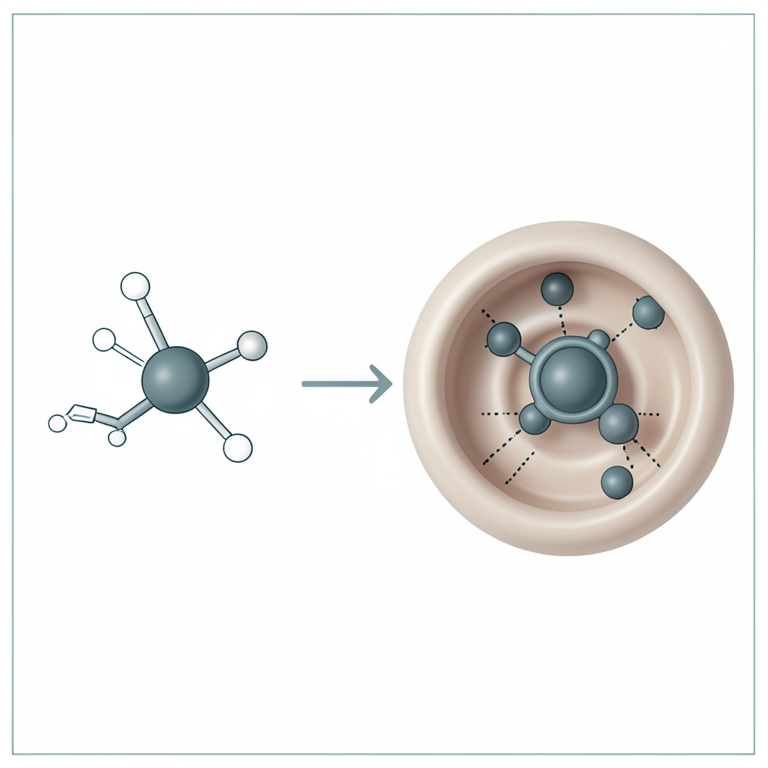
Bioisosteric Replacement and Binding
AI-generated conceptual illustration (A small molecule ligand binding to a protein receptor pocket). It explains the idea and does not show study data.
View source evidence ↗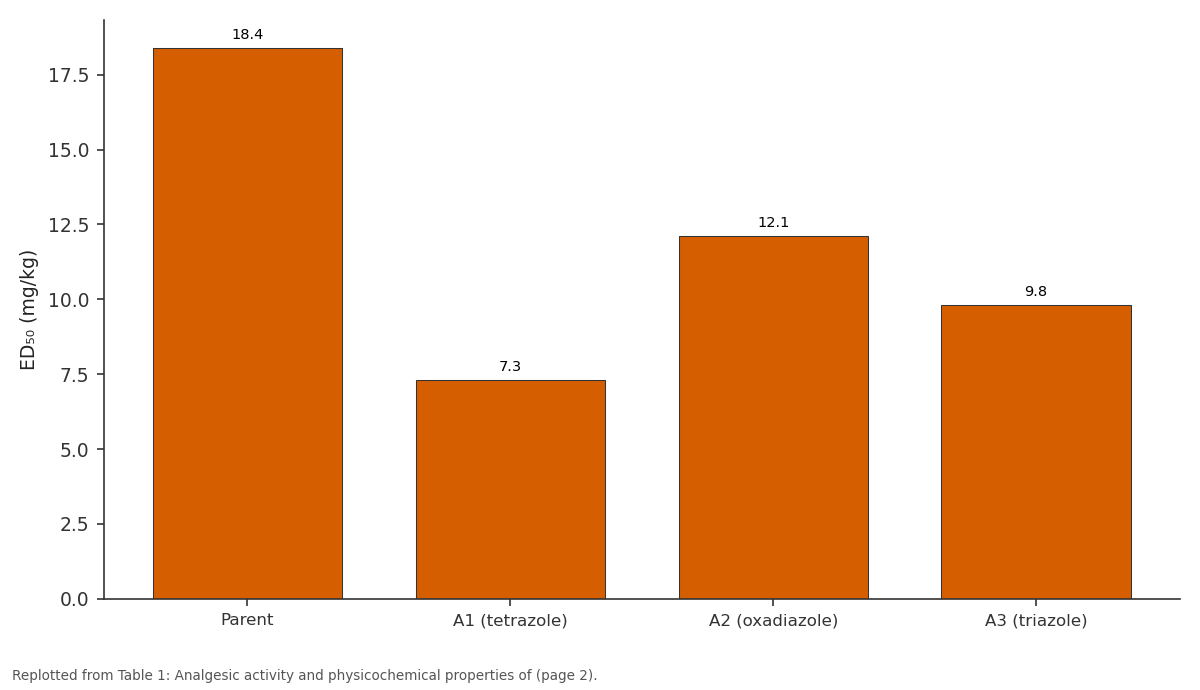
ED₅₀ (mg/kg): Parent vs A1 (tetrazole) vs A2 (oxadiazole) vs A3 (triazole)
Replotted from Table 1 (page 2) of the original paper. Every bar is the paper's own table value.
View source evidence ↗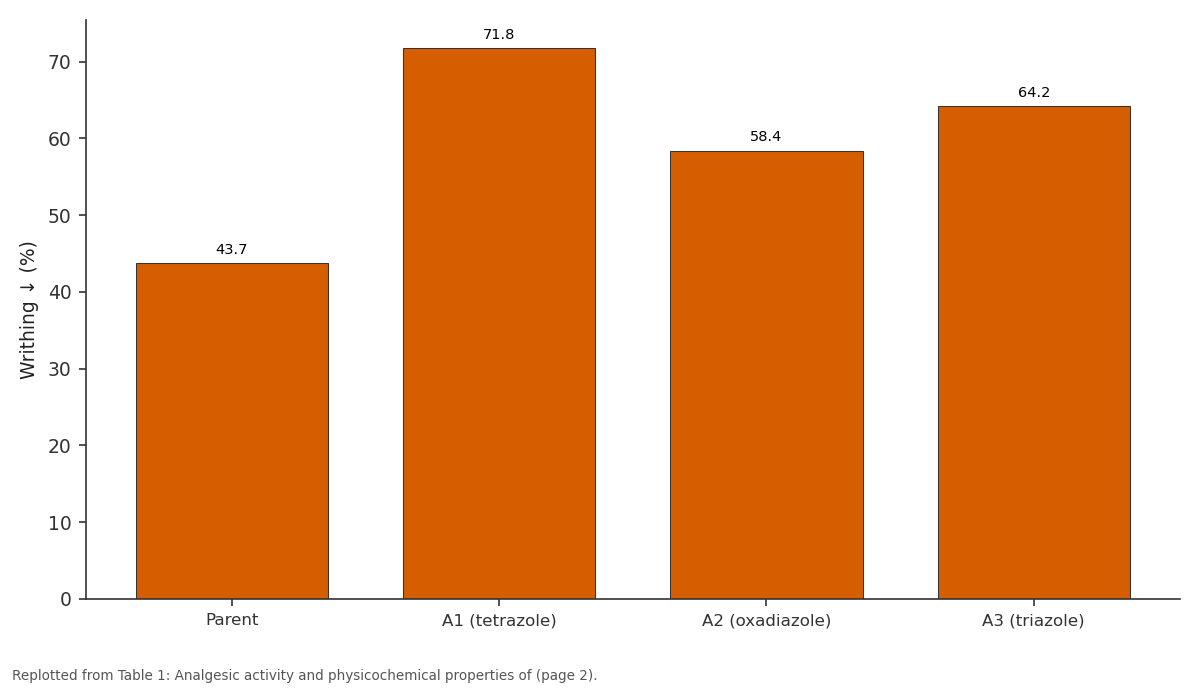
Writhing ↓(%): Parent vs A1 (tetrazole) vs A2 (oxadiazole) vs A3 (triazole)
Replotted from Table 1 (page 2) of the original paper. Every bar is the paper's own table value.
View source evidence ↗Figures & tables
From the original paper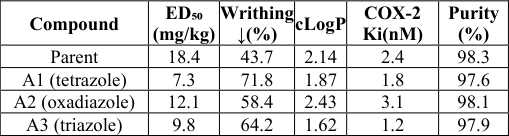 Table 1
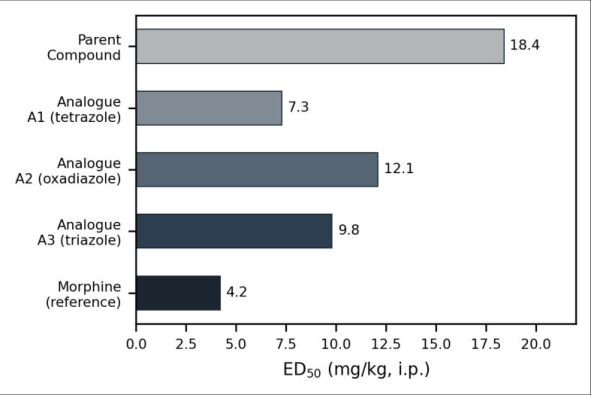 Figure 1
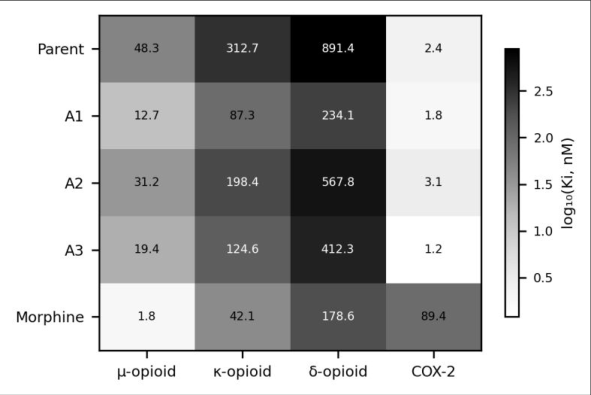 Figure 2
Introduction
As Patani and LaVoie noted in their landmark review, bioisosteric replacement is one of the most reliable strategies for improving drug candidates without reinventing the entire molecular framework [1] . The approach swaps one functional group for another that mimics its steric and electronic properties while potentially fixing metabolic stability or toxicity problems [2] . In cardiovascular medicine, losartan's tetrazole replacing a carboxylate is perhaps the most celebrated example [3] . NSAIDs built on arylacetic acid scaffolds (diclofenac, indomethacin) remain widely used analgesics, but their free carboxylic acid causes gastrointestinal side effects through direct mucosal irritation and COX-1 inhibition [4] . Replacing that -COOH with a metabolically stable bioisostere could reduce GI toxicity while preserving COX-2 binding. Tetrazoles, oxadiazoles, and triazoles are the three most explored carboxylic acid bioisosteres, each offering distinct electronic profiles [5] . This research synthesized three analogues of a prototype arylacetic acid analgesic, each carrying a different nitrogen heterocycle in place of the carboxylate, and compared their potency, receptor binding, and predicted properties against the parent compound [6] .
Theoretical Background
Carboxylic acid bioisosteres work because the tetrazole ring (pKa ~4.9) closely matches carboxylate acidity (pKa ~4.2-4.5), ensuring similar ionization at physiological pH. In COX-2 binding, the acidic moiety anchors the inhibitor to Arg120 and Tyr355 through chargeassisted hydrogen bonds [7] . Replacing the carboxylate with a heterocycle that retains these interactions while adding contacts to Ser530 or His90 can shift selectivity toward COX-2 [8] .
Swiss albino mice (20-25 g, 8-10 weeks) were procured from the National Institute of Nutrition, Hyderabad [9] .
Methods
The tetrazole A1 was prepared by [3+2] cycloaddition of the corresponding nitrile with sodium azide in DMF at 120°C for 12 h [10] . The oxadiazole A2 was obtained by cyclodehydration of an acylhydrazide with CDI in refluxing THF. The triazole A3 used copper-catalyzed azide-alkyne cycloaddition in t-BuOH/H₂O at room temperature. All compounds were purified by column chromatography and confirmed by ¹H NMR (400 MHz), ¹³C NMR (100 MHz), ESI-MS, and HPLC purity (>97%) [11] . Analgesic activity used the acetic acid writhing test (0.6% acetic acid i.p., 20 min count) and hot plate method (55°C, latency at 30, 60, 90 min) in groups of six mice. Morphine (5 mg/kg) was the positive control [12] . Docking used AutoDock Vina against COX-2 (PDB: 3LN1).
Quality Control
All compounds showed single HPLC peaks with purity above 97%. NMR spectra referenced to residual CDCl₃ peaks. Mass spectra confirmed molecular ions within 0.3 Da. Animal experiments included vehicle controls, and dose preparations were verified by UV spectrophotometry [13] . plus a water-mediated contact with Ser530 not seen in the parent [14] .
Results
Results
Discussion
A1's superior potency is consistent with the principle that tetrazoles are the closest electronic mimics of carboxylates [1] . The nearly identical pKa values mean both groups exist as anions at pH 7.4, but the tetrazole's planar ring distributes negative charge across four nitrogen atoms, creating a larger electrostatic surface for interactions with Arg120's guanidinium [5] . That extra hydrogen bond to Tyr355 likely accounts for the improvement in COX-2 Ki (1.8 vs. 2.4 nM). A3 deserves attention despite ranking second. Its COX-2 Ki of 1.2 nM was actually the best, yet in vivo potency trailed A1. This gap probably reflects pharmacokinetic differences: A3's lower cLogP (1.62) may limit absorption, and triazoles are known CYP3A4 substrates that face rapid metabolism [15] . A3 might outperform A1 if formulated with a CYP3A4 inhibitor or in sustained-release form. A2 was the least active, possibly because its higher cLogP (2.43) pushed it toward non-specific protein binding. Its docking score was also lowest among the analogues, with no contacts to Tyr355. Still, all three analogues outperformed the parent, validating this bioisosteric direction [16] .
Conclusion
Replacing the carboxylic acid of an arylacetic acid lead with nitrogen heterocycles produced three analogues with improved analgesic activity. The tetrazole A1 was most potent (ED₅₀ 7.3 mg/kg), offering 2.5-fold enhancement while maintaining drug-likeness. Molecular docking explained potency gains through additional hydrogen bonds in the COX-2 active site. These results support bioisosteric replacement as a productive optimization strategy for developing safer analgesic agents.
Acknowledgement
Acknowledgements Funding SourcesThis research was supported by departmental allocations at Mahatma Gandhi National University. Institutional SupportThe authors acknowledge Mahatma Gandhi National University and Saraswati College of Engineering for laboratory and animal house access. Contributions Not Qualifying for AuthorshipMr. Anil Pandey assisted with molecular docking calculations.
Figures and tables from the paper
| Compound | ED₅₀ (mg/kg) | Writhing ↓(%) | cLogP | COX-2 Ki(nM) | Purity (%) |
|---|---|---|---|---|---|
| Parent | 18.4 | 43.7 | 2.14 | 2.4 | 98.3 |
| A1 (tetrazole) | 7.3 | 71.8 | 1.87 | 1.8 | 97.6 |
| A2 (oxadiazole) | 12.1 | 58.4 | 2.43 | 3.1 | 98.1 |
| A3 (triazole) | 9.8 | 64.2 | 1.62 | 1.2 | 97.9 |
Table text extracted from the original PDF; superscript letters are shown inline. The original table image is below.
View original table image
References
16 in the original paper- Patani GA, LaVoie EJ. Bioisosterism: a rational approach in drug design. Chem Rev. 1996;96(8):31473176.
- Meanwell NA. Synopsis of some recent tactical application of bioisosteres. J Med Chem. 2011;54(8):2529-2591.
- Carini DJ, Duncia JV, Aldrich PE. Nonpeptide angiotensin II receptor antagonists. J Med Chem. 1991;34(8):2525-2547.
- Grosser T, Fries S, FitzGerald GA. Biological basis for cardiovascular consequences of COX-2 inhibition. J Am Coll Cardiol. 2006;47(7):1241-1247.
- Herr RJ. 5-Substituted-1H-tetrazoles as carboxylic acid isosteres. Bioorg Med Chem. 2002;10(11):3379-3393.
- Lima LM, Barreiro EJ. Bioisosterism: a useful strategy for molecular modification. Curr Med Chem. 2005;12(1):23-49.
- Orlando BJ, Malkowski MG. Crystal structure of rofecoxib bound to human COX-2. Acta Crystallogr F. 2016;72(10):772-776.
- Blobaum AL, Marnett LJ. Structural and functional basis of cyclooxygenase inhibition. J Med Chem. 2007;50(7):1425-1441.
- CPCSEA. Guidelines for laboratory animal facility. Indian J Pharmacol. 2003;35:257-274.
- Demko ZP, Sharpless KB. Preparation of 5-substituted 1H-tetrazoles from nitriles. J Org Chem. 2001;66(24):7945-7950.
- Lipinski CA, Lombardo F, Dominy BW. Experimental approaches to estimate solubility. Adv Drug Deliv Rev. 2001;46(1):3-26.
- Koster R, Anderson M, de Beer EJ. Acetic acid for analgesic screening. Fed Proc. 1959;18:412-417.
- ICH Expert Working Group. Validation of analytical procedures Q2(R1). ICH Guideline. 2005.
- Trott O, Olson AJ. AutoDock Vina: improving docking speed and accuracy. J Comput Chem. 2010;31(2):455461.
- Vitaku E, Smith DT, Njardarson JT. Analysis of nitrogen heterocycles among FDA approved pharmaceuticals. J Med Chem. 2014;57(24):1025710274.
- Burger A. Isosterism and bioisosterism in drug design. Prog Drug Res. 1991;37:287-371.