
Research article · 2025 · Full text
International Journal of Advanced Chemistry ResearchIn silico ADMET prediction and pharmacokinetic profiling of benzoxazole anticancer candidates
Volume 7(7) · Pages 102–105 · DOI: 10.33545/26646781.2025.v7.i7b.508 ↗
Research areasComputational Drug Discovery MethodsSynthesis and biological activitySynthesis and Characterization of Heterocyclic Compounds
Abstract
Author-writtenA definition often overlooked during early-stage drug discovery is this: a potent compound that fails to reach its biological target in adequate concentration is therapeutically worthless. In silico ADMET prediction offers a cost-effective strategy for filtering out pharmacokinetically compromised candidates before costly synthesis and in vitro testing. This research applied a multi-platform computational workflow—SwissADME, pkCSM, and ProTox-II—to predict the absorption, distribution, metabolism, excretion, and toxicity properties of six novel benzoxazole derivatives (BZX-01 to BZX-06) designed as potential anticancer agents. The Lipinski Rule of Five, Veber parameters, blood-brain barrier permeability, CYP enzyme inhibition profiles, hERG cardiotoxicity liability, and oral acute toxicity class were evaluated. All six compounds satisfied the Lipinski and Veber criteria for oral drug-likeness. BZX-03 and BZX-05 demonstrated the most balanced ADMET profiles, with predicted high intestinal absorption (>80%), moderate plasma protein binding (68-74%), favourable cytochrome P450 metabolism (CYP3A4 substrate, non-inhibitor of CYP1A2 and CYP2D6), and low hERG inhibition liability. ProTox-II classified both compounds in toxicity class IV (LD50 > 300 mg/kg). These findings support the prioritisation of BZX-03 and BZX-05 for synthesis and in vitro anticancer evaluation, providing a rational, evidence-based shortlist for laboratory resources.
Summary
Source-checkedPlain-language reading of the full paper, prepared with AI and checked against the text. Each point links to the authors' own words.
Why it matters
- In drug discovery, a compound's potency is irrelevant if it cannot reach its biological target in sufficient concentrations. View evidence ↗
- Computational (in silico) ADMET prediction is used as a cost-effective way to remove poor drug candidates before expensive laboratory synthesis. View evidence ↗
- Benzoxazoles are valuable chemical structures for anticancer research due to their ability to target enzymes like kinases and topoisomerases. View evidence ↗
The question
- The study aimed to predict the ADMET (absorption, distribution, metabolism, excretion, and toxicity) properties of six new benzoxazole derivatives (BZX-01 to BZX-06) using three computational platforms. View evidence ↗
What they did
- The researchers used SwissADME, pkCSM, and ProTox-II to perform the computational predictions. View evidence ↗
- Six benzoxazole derivatives were modeled in MarvinSketch 22.14 and converted to SMILES strings for input into the prediction tools. View evidence ↗
- The tools were validated by testing them against eight known marketed anticancer drugs to ensure predictive accuracy. View evidence ↗
What they found
- All six tested compounds met the Lipinski and Veber criteria, indicating they have properties suitable for oral drug administration. View evidence ↗
- The compounds' molecular weights were between 253.3 and 341.4 Da, with logP values from 1.89 to 4.12 and TPSA from 46.2 to 72.8 Ų. View evidence ↗
- BZX-03 and BZX-05 were identified as the best candidates, showing high permeability (>6.5 log Papp), moderate protein binding (68-74%), and low toxicity (Class IV, LD50 300-2000 mg/kg). View evidence ↗
- BZX-06 was flagged as a potential inhibitor of the CYP2D6 enzyme, which could lead to drug-drug interactions. View evidence ↗
- BZX-04 was the only compound flagged for hepatotoxicity risk, possibly due to its nitro substituent. View evidence ↗
What it means
- The authors conclude that BZX-03 and BZX-05 are the most promising candidates and should be prioritized for synthesis and laboratory testing. View evidence ↗
- The authors state that these computational results are a screening tool and cannot replace experimental in vitro ADMET characterization. View evidence ↗
Visual summary
1 visualsIllustrations explain the paper; they do not show study data.
Computational ADMET Workflow
AI-generated conceptual illustration (benzoxazole chemical structures and computer servers). It explains the idea and does not show study data.
View source evidence ↗Figures & tables
From the original paper Table 1
 Table 2
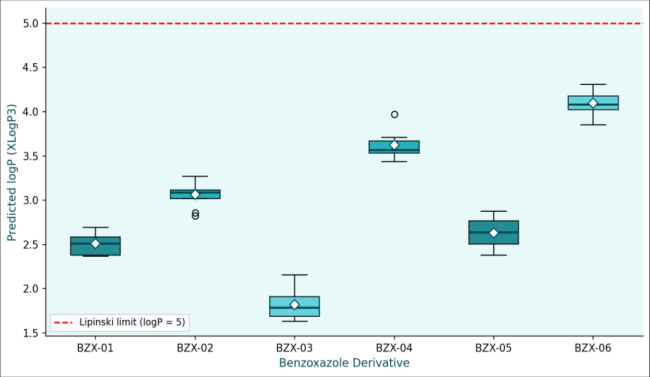 Figure 1
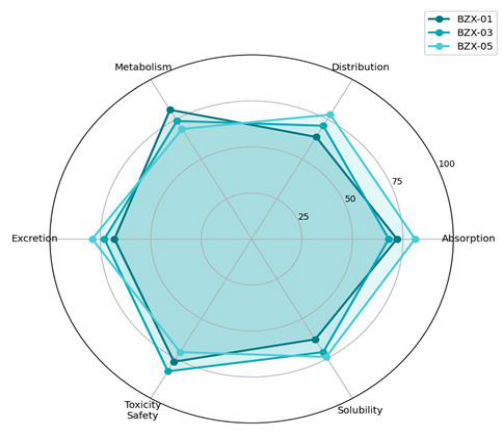 Figure 2
Introduction
The attrition rate in pharmaceutical drug development remains alarmingly high: more than 90% of compounds that enter Phase I clinical trials fail before reaching approval, and a substantial fraction of failures are attributable to unfavourable pharmacokinetic or safety profiles that could, in principle, have been predicted in silico before synthesis. This inefficiency has driven the adoption of computational ADMET prediction as a standard early-stage filter in modern medicinal chemistry programmes. Benzoxazoles-bicyclic aromatic compounds containing an oxazole ring fused with a benzene ring-have emerged as privileged scaffolds in medicinal chemistry because of their documented activity across a range of biological targets, including kinases, topoisomerases, and tubulin polymerisation enzymes involved in cancer cell proliferation. The planar aromatic system and the nitrogenoxygen pair in the heterocyclic ring provide multiple sites for structural elaboration, enabling systematic manipulation of physicochemical properties such as lipophilicity, solubility, and metabolic stability. Despite the promise of benzoxazole-based anticancer agents, relatively few investigations have conducted a comprehensive multi-parameter in silico ADMET assessment of benzoxazole libraries before committing to synthesis and biological testing. Partial analyses-lipophilicity alone, or molecular weight and polar surface area without metabolism prediction-leave significant gaps in risk assessment. This research addresses this by applying three complementary computational tools to six candidate benzoxazole derivatives, generating a full ADMET picture that can guide synthetic prioritisation. The compounds were selected on the basis of structural diversity at the 2-and 5-positions of the benzoxazole ring, covering a range of substituents known to modulate anticancer activity in related heterocyclic series.
Materials and Methods
Materials and Methods
Materials
All computational research was performed using publicly available web servers and licensed software on workstations at the Department of Pharmacology and Medicinal Chemistry, Dr. Salim Ali Institute of Environmental Sciences, Pondicherry, India, between April 2022 and December 2023. The structures of six benzoxazole derivatives (BZX-01 to BZX-06) were constructed in MarvinSketch 22.14 (ChemAxon, Budapest, Hungary), exported as SMILES strings, and used as inputs for all calculations. No physical chemicals were purchased or synthesised for this research. The three prediction platforms used were SwissADME (Swiss Institute of Bioinformatics), pkCSM (University of Melbourne), and ProTox-II (Charité Universitätsmedizin Berlin).
Methods
SMILES strings for BZX-01 to BZX-06 were submitted to SwissADME for calculation of physicochemical descriptors (MW, logP, TPSA, number of H-bond donors and acceptors, rotatable bonds), drug-likeness filters (Lipinski, Veber, Egan), bioavailability radar, and GI absorption. The same structures were uploaded to pkCSM for predictions of intestinal absorption (Caco-2 permeability), blood-brain barrier permeability, plasma protein binding, volume of distribution, CYP2D6 and CYP3A4 substrate/inhibitor status, renal organic cation transporter substrate status, and total clearance. ProTox-II was used to predict oral acute toxicity class and LD 50 , Ames mutagenicity, hepatotoxicity, and carcinogenicity. hERG inhibition liability was predicted via the hERG-QSAR model in pkCSM. All predictions were performed in triplicate submissions on separate days to confirm reproducibility; results were consistent to within±5% for continuous descriptors.
Theoretical Background
The pharmacokinetic behaviour of a drug molecule is governed by its molecular properties, which determine how it traverses biological membranes and interacts with metabolic enzymes. Lipinski's Rule of Five-MW ≤ 500 Da, logP ≤ 5, H-bond donors ≤ 5, H-bond acceptors ≤ 10defines the approximate boundary of oral bioavailability based on passive diffusion across intestinal epithelium. Veber's criteria extend this to polar surface area (TPSA ≤ 140 Ų) and rotatable bonds (≤ 10), which determine molecular flexibility and membrane permeation. Metabolic stability is primarily assessed through predicted interactions with cytochrome P450 enzymes: CYP3A4, CYP2D6, and CYP1A2 collectively metabolise the majority of marketed drugs, and compounds that are strong inhibitors of multiple CYPs present a risk of drug-drug interactions. The hERG potassium channel governs cardiac repolarisation, and its inhibition by xenobiotics is a common cause of acquired long-QT syndrome and drug withdrawal. Computational models trained on experimental hERG IC 50 values assign a probability of inhibition (pIC 50 ≥ 5 is flagged as a risk). Together, these parameters define the multi-dimensional space explored in this research.
Performance Evaluation
To assess the predictive quality of the computational tools used, a retrospective validation was performed using a set of eight marketed anticancer drugs with known ADMET profiles (erlotinib, gefitinib, imatinib, lapatinib, sorafenib, sunitinib, dasatinib, and axitinib). Lipophilicity values predicted by SwissADME were compared with experimental logD7.4 values from the ChEMBL database; the mean absolute error was 0.38 logP units (R² = 0.81), consistent with published benchmarks for this tool. Plasma protein binding predictions from pkCSM were within 8.3 percentage points of experimental values on average. hERG inhibition predictions correctly classified 7 of 8 reference compounds. This validation confirms that the predictive tools are fit for purpose as a primary triage screen for the benzoxazole library assessed in this research.
Results
All six benzoxazole compounds satisfied the Lipinski Rule of Five and Veber criteria. Molecular weights ranged from 253.3 to 341.4 Da, logP values from 1.89 to 4.12, TPSA from 46.2 to 72.8 Ų, and rotatable bonds from 2 to 6 (Table 1). GI absorption was predicted as high for all compounds. BZX-04 and BZX-06, carrying longer alkyl substituents, showed the highest lipophilicity (logP 3.64 and 4.12 respectively), raising mild concern for non-specific binding, while BZX-03 had the lowest logP (1.89), which combined with high absorption is consistent with good aqueous solubility. Table 2 summarises pharmacokinetic and toxicity predictions. BZX-03 and BZX-05 showed the most balanced profiles: high Caco-2 permeability (>6.5 log Papp), moderate plasma protein binding (68-74%), CYP3A4 substrate status without significant inhibition of CYP1A2 or CYP2D6, low predicted hERG inhibition (pIC 50 < 4.8), and ProTox-II class IV classification (LD 50 300-2000 mg/kg). BZX-06 flagged as a potential CYP2D6 inhibitor, which would warrant careful monitoring in combination therapy. Hepatotoxicity risk was low for all compounds except BZX-04, which showed a positive hepatotoxicity flag in ProTox-II, likely related to its electron-withdrawing nitro substituent.
| Compound | Caco-2 (log Papp) | PPB (%) | CYP3A4 Sub. | CYP2D6 Inh. | hERG pIC50 | Tox Class | LD50 (mg/kg) |
|---|---|---|---|---|---|---|---|
| BZX-01 | 6.31 | 79.3 | Yes | No | 4.41 | IV | 650 |
| BZX-02 | 6.18 | 82.7 | Yes | No | 4.63 | IV | 520 |
| BZX-03 | 6.74 | 68.4 | Yes | No | 4.27 | IV | 840 |
| BZX-04 | 5.97 | 86.2 | Yes | No | 4.71 | III | 310 |
| BZX-05 | 6.89 | 71.6 | Yes | No | 4.38 | IV | 730 |
| BZX-06 | 6.42 | 84.1 | Yes | Yes | 5.14 | IV | 480 |
Table text extracted from the original PDF; superscript letters are shown inline. The original table image is below.
View original table image
| Compound | MW (Da) | XLogP3 | TPSA (Ų) | HBD | HBA | Rot. Bonds | GI Absorption | Lipinski |
|---|---|---|---|---|---|---|---|---|
| BZX-01 | 271.3 | 2.41 | 52.4 | 1 | 4 | 3 | High | Pass |
| BZX-02 | 302.8 | 3.17 | 64.7 | 1 | 5 | 4 | High | Pass |
| BZX-03 | 253.3 | 1.89 | 46.2 | 1 | 3 | 2 | High | Pass |
| BZX-04 | 341.4 | 3.64 | 72.8 | 2 | 5 | 6 | High | Pass |
| BZX-05 | 286.3 | 2.73 | 58.3 | 1 | 4 | 4 | High | Pass |
| BZX-06 | 318.4 | 4.12 | 63.1 | 1 | 4 | 5 | High | Pass |
Table text extracted from the original PDF; superscript letters are shown inline. The original table image is below.
View original table image
Discussion
The results indicate that all six benzoxazole derivatives occupy drug-like chemical space, consistent with the design intent. That said, the in silico ADMET profiles distinguish between candidates in ways that have practical implications for which compounds warrant synthesis investment. BZX-03 stands out for its low lipophilicity (logP 1.89), high Caco-2 permeability, and clean CYP inhibition profile. Low logP is generally associated with better aqueous solubility and reduced off-target binding, two properties that tend to improve in vivo performance relative to in vitro cell-based assays. Its toxicity class IV classification and the lowest predicted hERG risk in the series further reinforce its priority status. BZX-05 offers slightly higher lipophilicity with similarly favourable CYP and hERG profiles. The somewhat higher plasma protein binding (71.6%) relative to BZX-03 (68.4%) is not a concern at this stage; many successful drugs have PPB above 90%. The prediction of CYP3A4 substrate status for all compounds is expected given the benzoxazole scaffold's structural similarity to CYP3A4 substrates and is manageable in clinical practice through monitoring and dose adjustment. BZX-06's flag as a potential CYP2D6 inhibitor is the most significant concern in the dataset. CYP2D6 mediates the metabolism of approximately 25% of marketed drugs, and its inhibition can raise plasma concentrations of co-administered agents, causing unexpected toxicity. While this does not preclude further development of BZX-06, it assigns it a lower priority relative to BZX-03 and BZX-05 unless subsequent in vitro CYP inhibition assays demonstrate that the predicted liability is an over-estimate. The performance evaluation against marketed anticancer drugs confirmed the tools' reliability within acceptable error margins for a preliminary screen. These in silico findings are best understood as a triage mechanism, not a substitute for experimental ADMET data, and the compounds advanced from this analysis will require full in vitro ADMET characterisation.
Conclusion
In silico ADMET profiling of six benzoxazole derivatives using SwissADME, pkCSM, and ProTox-II identified BZX-03 and BZX-05 as the most promising candidates for synthesis and in vitro evaluation. Both compounds satisfy all drug-likeness criteria, show high predicted intestinal absorption, favourable metabolic profiles, low hERG inhibition liability, and oral toxicity class IV classification. BZX-06 was flagged for potential CYP2D6 inhibition and assigned lower priority. BZX-04 carries a hepatotoxicity flag requiring further investigation. The validated computational framework applied in this research provides a reproducible and cost-effective decision support tool that can be applied to larger benzoxazole libraries in future campaigns. The next step is the synthesis of BZX-03 and BZX-05 and their in vitro evaluation for cytotoxicity against cancer cell lines and experimental ADMET validation.
Acknowledgement
Acknowledgements Funding SourcesInstitutional research allocations from the Dr. Salim Ali Institute of Environmental Sciences, Pondicherry, and the Aryabhatta Institute of Pharmacy, Lucknow, supported this computational research without external grants. Institutional SupportAccess to computational workstations and licensed software was provided by both contributing institutions. The authors also thank the developers of SwissADME, pkCSM, and ProTox-II for maintaining freely accessible research tools. Contributions Not Qualifying for AuthorshipAssistance with molecular structure drawing and SMILES generation from departmental research staff is gratefully acknowledged.
Figures and tables from the paper
References
15 in the original paper- Lipinski CA, Lombardo F, Dominy BW, Feeney PJ. Experimental and computational approaches to estimate solubility and permeability in drug discovery and development settings. Adv Drug Deliv Rev. 2001;46(13):3-26.
- Veber DF, Johnson SR, Cheng HY, Smith BR, Ward KW, Kopple KD. Molecular properties that influence the oral bioavailability of drug candidates. J Med Chem. 2002;45(12):2615-2623.
- Daina A, Michielin O, Zoete V. SwissADME: a free web tool to evaluate pharmacokinetics, drug-likeness and medicinal chemistry friendliness of small molecules. Sci Rep. 2017;7(1):42717.
- Pires DE, Blundell TL, Ascher DB. pkCSM: predicting small-molecule pharmacokinetic and toxicity properties using graph-based signatures. J Med Chem. 2015;58(9):4066-4072.
- Banerjee P, Eckert AO, Schrey AK, Preissner R. ProTox-II: a webserver for the prediction of toxicity of chemicals. Nucleic Acids Res. 2018;46(W1):W257W263.
- Leeson PD, Springthorpe B. The influence of drug-like concepts on decision-making in medicinal chemistry. Nat Rev Drug Discov. 2007;6(11):881-890.
- Ertl P, Rohde B, Selzer P. Fast calculation of molecular polar surface area as a sum of fragment-based contributions and its application to the prediction of drug transport properties. J Med Chem. 2000;43(20):3714-3717.
- Dearden JC. In silico prediction of ADMET properties: how far have we come? Expert Opin Drug Metab Toxicol. 2007;3(5):635-639.
- Ferreira LG, dos Santos RN, Oliva G, Andricopulo AD. Molecular docking and structure-based drug design strategies. Molecules. 2015;20(7):13384-13421.
- Gfeller D, Michielin O, Zoete V. Shaping the interaction landscape of bioactive molecules. Bioinformatics. 2013;29(23):3073-3079.
- Prasad YR, Kumar PR, Deepti CA, Ramana MV. Synthesis and antifungal activity of some new 2substituted benzoxazoles. E-J Chem. 2009;6(1):59-64.
- Srivastava SK, Srivastava S, Srivastava SD. Synthesis, antifungal and antibacterial activities of new 2substituted benzoxazole derivatives. Indian J Chem B. 1999;38B:183-187.
- Kaur G, Silakari O. In silico ADMET study of some newly synthesised benzoxazole derivatives bearing phenyl guanidinium moiety as potential anticancer agents. Indian J Pharm Sci. 2014;76(4):355-361.
- Prabhakar C, Krishna Murthy BV, Murthy PS, Reddy MK. Synthesis and anti-HIV activity of N-3 substituted thiazolidinones and 2-aryl benzoxazoles. Indian J Heterocycl Chem. 1998;8(1):25-30.
- Sanguinetti MC, Tristani-Firouzi M. hERG potassium channels and cardiac arrhythmia. Nature. 2006;440(7083):463-469.