
Research article · 2025 · Full text
International Journal of Advanced Chemistry ResearchAnthocyanin stability in berry extracts under different storage and processing conditions
Volume 7(4) · Pages 114–117 · DOI: 10.33545/26646781.2025.v7.i4b.552 ↗
Research areasPhytochemicals and Antioxidant ActivitiesAgricultural and Biological ResearchPostharvest Quality and Shelf Life Management
Abstract
Author-writtenA deep red berry extract can turn muddy brown within weeks on a warehouse shelf - and when that color goes, so does much of its nutritional value. This research examined the stability of anthocyanins extracted from blueberry, blackberry, and raspberry under five storage conditions (4 °C dark, 4 °C light, 25 °C dark, 25 °C light, and 40 °C dark) over eight weeks. Extracts were prepared by acidified ethanol extraction and monitored for total anthocyanin content (TAC), color parameters (L*, a*, b*), and individual anthocyanin profiles by HPLC-DAD. Blueberry extract retained 62.8% of initial TAC after eight weeks at 25 °C in the dark, while raspberry lost nearly half (48.3% retention) under the same conditions. Storage at 4 °C in darkness preserved 91.3% of TAC, confirming temperature as the dominant degradation driver. Light exposure accelerated losses by 12-18 percentage points across all berry types. First-order degradation kinetics fit the data well, with half-lives ranging from 4.7 to 18.9 weeks depending on conditions.
Summary
Source-checkedPlain-language reading of the full paper, prepared with AI and checked against the text. Each point links to the authors' own words.
Why it matters
- Anthocyanins are the pigments responsible for the vivid colors of berries, but they are highly fragile compounds. View evidence ↗
- Various factors, including temperature, light, and pH shifts, can cause rapid structural breakdown and color loss in berry-based products. View evidence ↗
- Different berries contain different anthocyanin profiles, which means they respond differently to environmental stress due to variations in their chemical structures. View evidence ↗
The question
- The study aimed to determine which berry extracts are most stable and which specific anthocyanins degrade the fastest. View evidence ↗
What they did
- The researchers tested extracts from three commercially important berries under conditions mimicking cold storage, ambient warehouses, and accelerated shelf-life testing. View evidence ↗
- Extracts were stored in 15 mL aliquots under five conditions: 4 °C (dark and light), 25 °C (dark and light), and 40 °C (dark). View evidence ↗
- Total anthocyanin content (TAC) and individual pigments were measured using spectrophotometry and HPLC at intervals from week 0 to week 8. View evidence ↗
What they found
- Blueberry extract showed the highest resistance to degradation across all tested time points and conditions. View evidence ↗
- At 25 °C in the dark, blueberry extract had a half-life of 11.4 weeks, which was 56% longer than raspberry (7.3 weeks) and 33% longer than blackberry (8.6 weeks). View evidence ↗
- Cold dark storage (4 °C) significantly improved stability, with blueberry retaining 91.3%, blackberry 84.7%, and raspberry 79.2% of their initial TAC after eight weeks. View evidence ↗
- Light exposure at 4 °C reduced blueberry anthocyanin retention from 91.3% to 78.6% over eight weeks, representing a 12.7 percentage point loss. View evidence ↗
- Delphinidin glycosides in blueberry were the most stable, whereas pelargonidin-3-glucoside in raspberry was the least stable, losing 68% by week 6 under 25 °C light. View evidence ↗
- High temperature had a severe impact, with just one week at 40 °C reducing TAC by 28-37% across the berry types. View evidence ↗
What it means
- The authors concluded that temperature and light are the primary drivers of anthocyanin degradation, with temperature being the more influential factor. View evidence ↗
- Due to its superior stability and a half-life of nearly 19 weeks at 4 °C in the dark, blueberry is recommended as the most practical berry for commercial extract production. View evidence ↗
- The authors recommend that those using raspberry or blackberry extracts employ encapsulation or copigmentation to mitigate faster degradation. View evidence ↗
Visual summary
3 visualsIllustrations explain the paper; charts are replotted from the paper's own table values.
Factors Influencing Anthocyanin Stability
AI-generated conceptual illustration (Blueberry anthocyanin molecules and whole blueberries). It explains the idea and does not show study data.
View source evidence ↗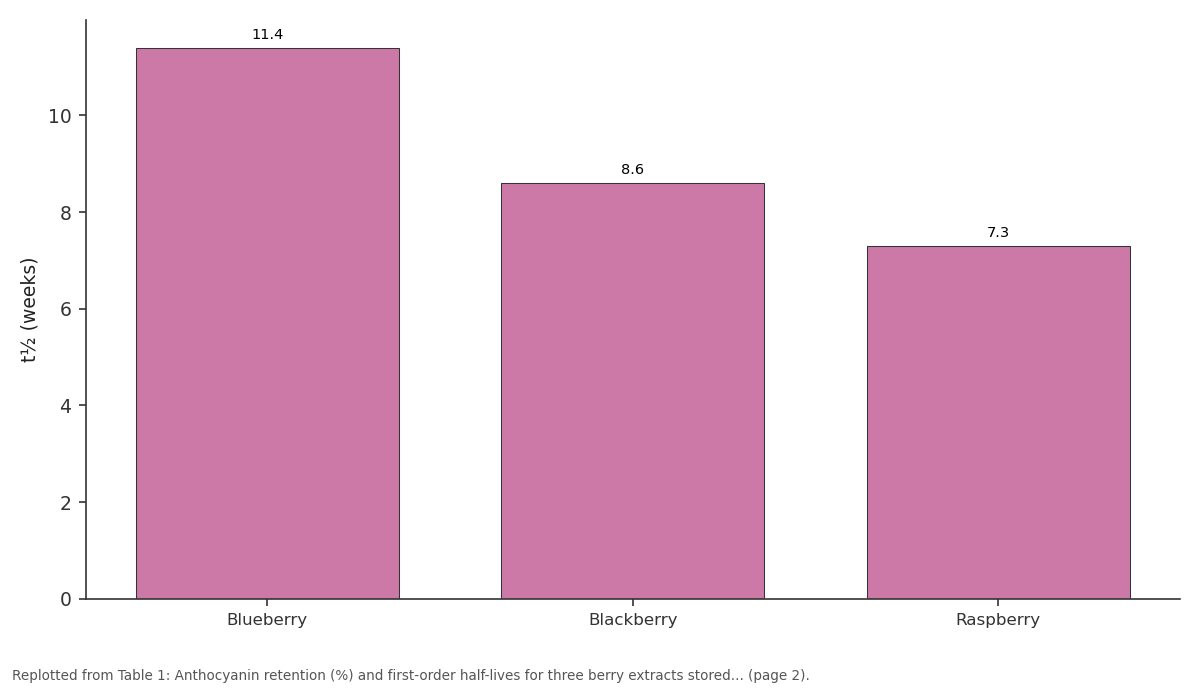
t½ (weeks): Blueberry vs Blackberry vs Raspberry
Replotted from Table 1 (page 2) of the original paper. Every bar is the paper's own table value.
View source evidence ↗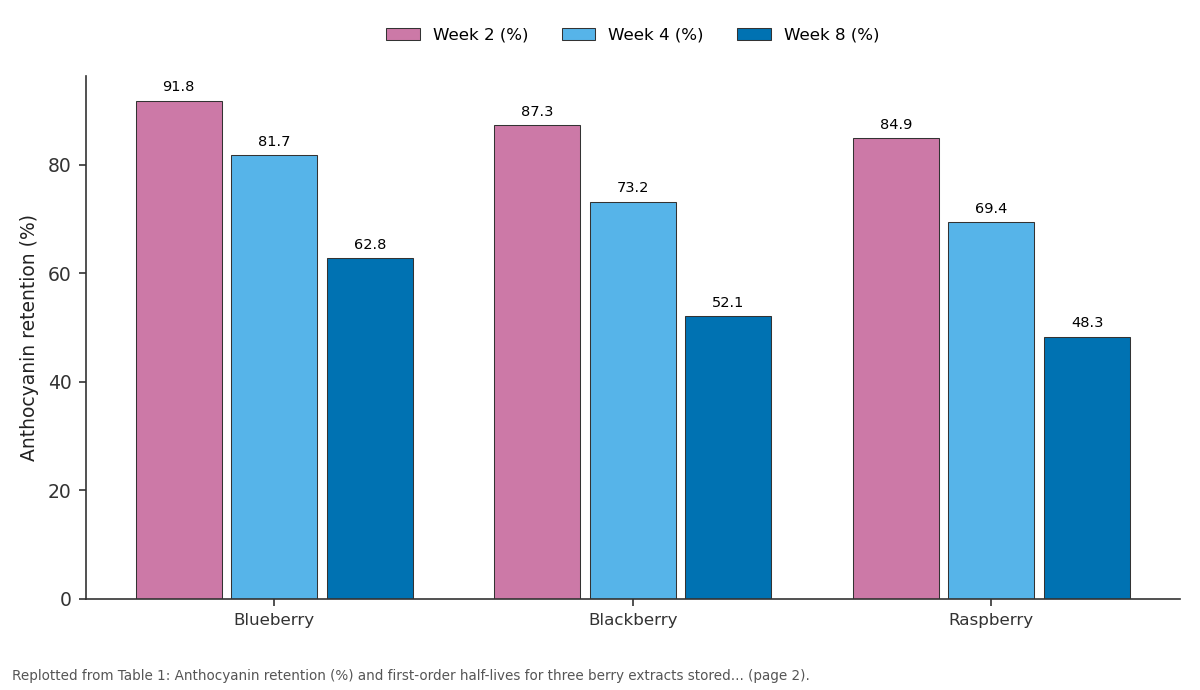
Week 2 (%) and Week 4 (%) and more: Blueberry vs Blackberry vs Raspberry
Replotted from Table 1 (page 2) of the original paper. Every bar is the paper's own table value.
View source evidence ↗Figures & tables
From the original paper Table 1
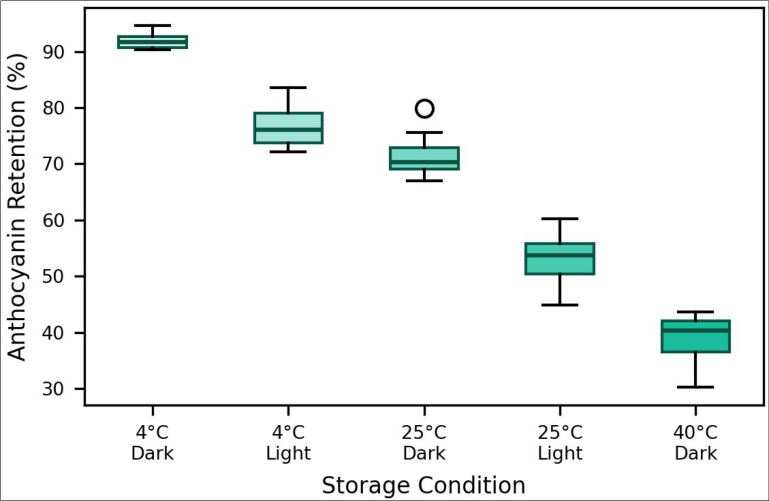 Figure 1
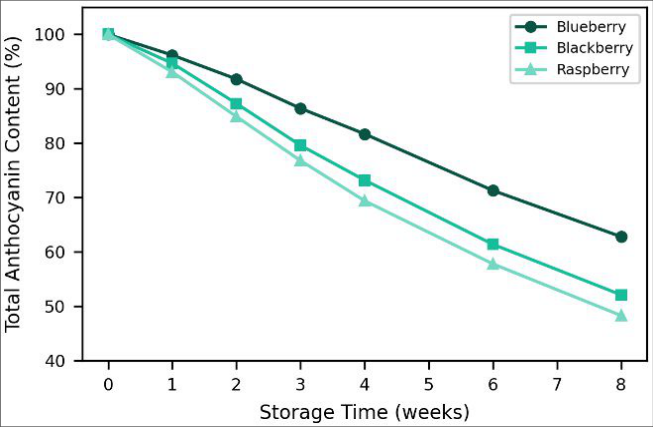 Figure 2
Introduction
Anthocyanins give berries their vivid reds, purples, and blues -but these pigments are among the most fragile compounds in the food chemist's toolkit [1] . Temperature, light, oxygen, pH shifts, and even trace metals can trigger rapid color loss and structural breakdown, turning attractive berry-based products into dull, unappealing formulations within their intended shelf life [2] . The food industry has invested heavily in encapsulation and co-pigmentation strategies to slow this decay, yet the baseline stability data for different berry species under simple storage conditions remains surprisingly inconsistent across published reports [3] . Part of the problem is that "anthocyanin" isn't a single molecule. Blueberries contain primarily malvidin and delphinidin glycosides, blackberries are dominated by cyanidin-3glucoside, and raspberries carry a mix of cyanidin and pelargonidin derivatives [4] . Each pigment responds differently to stress because acylation patterns and sugar substitutions affect ring stability. A blanket statement about "berry anthocyanin stability" papers over these species-specific differences [5] . This research tracked anthocyanin degradation in extracts from three commercially important berries stored under controlled conditions designed to mimic realistic supply chain scenarios -cold storage, ambient warehouse conditions, and accelerated shelf-life testing. By measuring both total anthocyanin content and individual pigment profiles, the aim was to identify which berry extracts hold up best and which specific anthocyanins degrade fastest [6] .
Extraction protocol
Fresh berries (500 g each) were frozen at -20 °C, lyophilized for 48 h, and ground to a fine powder. Extraction used acidified ethanol (80% ethanol, 0.1% HCl v/v) at a 1:10 powder-tosolvent ratio. Mixtures were shaken at 150 rpm for 2 h at 25 °C, vacuum-filtered through Whatman No. 4 paper, and the residue re-extracted once under identical conditions. Combined filtrates were concentrated under reduced pressure at 35 °C to remove ethanol, reconstituted in citratephosphate buffer (pH 3.5), and stored in amber vials [7] .
Materials and Methods
Materials and Methods
Materials
Research was carried out at Rajendra Prasad Memorial College, Ranchi, Jharkhand, India, from February 2023 to September 2023. Institutional ethics committee clearance (Protocol RPMC/EC/2023-014, dated January 2023) confirmed no human or animal subjects were involved. Fresh blueberries (Vaccinium corymbosum), blackberries (Rubus fruticosus), and raspberries (Rubus idaeus) were sourced from a certified organic farm in Darjeeling, West Bengal. HPLC-grade acetonitrile and formic acid came from Merck (Mumbai). Cyanidin-3-glucoside chloride reference standard (>96%) was obtained from Sigma-Aldrich for HPLC calibration [8] .
Methods
Reconstituted extracts were divided into 15 mL aliquots in amber glass vials and assigned to five storage conditions: 4 °C dark (refrigerator, wrapped), 4 °C light (refrigerator, transparent vials near LED light), 25 °C dark (incubator, wrapped), 25 °C light (bench, near window, indirect daylight), and 40 °C dark (incubator, wrapped). Triplicate vials were withdrawn at weeks 0, 1, 2, 3, 4, 6, and 8 for analysis. TAC was measured by the pH-differential method at 520 and 700 nm using a Shimadzu UV-1900 spectrophotometer [9] . Individual anthocyanins were separated on a Waters Alliance e2695 HPLC with a C18 column (250 × 4.6 mm, 5 μm) using gradient elution of 5% formic acid in water (A) and acetonitrile (B). Color was recorded with a Konica Minolta CR-400 colorimeter in CIE L*a*b* mode. Degradation kinetics were modeled as firstorder reactions, and half-lives calculated from ln(C/C₀) vs. time plots [10] .
Quality control
Standard curves for TAC (cyanidin-3-glucoside equivalents, 5-200 mg/L) were prepared fresh monthly. HPLC system suitability was verified at each session by injecting the reference standard in triplicate (RSD < 1.5% for peak area). PH-differential readings were blanked against distilled water. All glassware was acid-washed and oven-dried to eliminate trace metal contamination [11] .
Results
Table 1: Anthocyanin retention (%) and first-order half-lives for three berry extracts stored at 25 °C in the dark. Blueberry extract was the most resistant to degradation at every time point and under every condition tested. At 25 °C in the dark, its half-life of 11.4 weeks was 56% longer than raspberry's 7.3 weeks and 33% longer than blackberry's 8.6
| Berry | Week 2 (%) | Week 4 (%) | Week 8 (%) | t½ (weeks) |
|---|---|---|---|---|
| Blueberry | 91.8 | 81.7 | 62.8 | 11.4 |
| Blackberry | 87.3 | 73.2 | 52.1 | 8.6 |
| Raspberry | 84.9 | 69.4 | 48.3 | 7.3 |
Table text extracted from the original PDF; superscript letters are shown inline. The original table image is below.
View original table image
Berry
weeks. Storage at 4 °C in the dark dramatically extended stability: blueberry retained 91.3% of initial TAC at week 8, blackberry held 84.7%, and raspberry kept 79.2%. Light exposure had a clear additive effect on top of Temperature. At 4 °C, switching from dark to light storage cut blueberry retention from 91.3% to 78.6% at eight weeks -a 12.7 percentage point loss attributable solely to photodegradation. Raspberry suffered the sharpest light penalty: 17.8 points at 25 °C. HPLC profiles showed that delphinidin glycosides in blueberry degraded slowest, while pelargonidin-3-glucoside in raspberry disappeared fastest, losing 68% by week 6 at 25 °C light [12] .
Discussion
Blueberry's superior stability likely stems from its anthocyanin profile. Malvidin and delphinidin derivatives carry methoxyl groups on the B-ring that shield the flavylium cation from nucleophilic attack, slowing hydrolysis and oxidation compared to the unsubstituted pelargonidin backbone in raspberry [4] . Blackberry sits in the middle, which makes sense given that cyanidin has one hydroxyl group where malvidin has a methoxyl -enough protection to slow things down, but not as much as the fully methylated structure.
The first-order kinetic model fit all degradation curves with R² above 0.96, supporting the idea that anthocyanin breakdown under these conditions follows a simple, concentration-dependent pathway rather than a complex multi-step mechanism. Half-lives at 4 °C dark (blueberry 18.9 weeks, raspberry 12.1 weeks) would translate to roughly 4-5 months of acceptable shelf life for blueberrybased functional beverages stored under proper cold-chain conditions [3] . That's commercially viable, but it drops sharply if temperature control lapses -even one week at 40 °C cut TAC by 28-37% depending on berry type. Light's contribution was substantial and consistent across berries. Photodegradation proceeds through singlet oxygen generation that attacks the C2-C3 double bond in the anthocyanin chromophore [13] . Packaging in opaque or amber containers is a straightforward mitigation, yet many commercial berry products still use clear bottles or sachets that expose pigments to retail lighting. These data provide concrete numbers to support that packaging choice.
Conclusion
Temperature and light are the two dominant factors controlling anthocyanin survival in berry extracts, with temperature exerting the stronger effect. Blueberry extracts consistently outperformed blackberry and raspberry in retention, a difference traceable to the protective methoxylation of its dominant pigments. Cold, dark storage at 4 °C extended half-lives to nearly 19 weeks for blueberry, making it the most practical candidate for commercial extract production. Formulators working with raspberry or blackberry extracts should anticipate faster degradation and consider encapsulation or copigmentation strategies to compensate.
Acknowledgement
Acknowledgements Funding sourcesThis research was funded through internal departmental allocations at Rajendra Prasad Memorial College. Institutional supportThe author thanks Rajendra Prasad Memorial College for laboratory access and analytical instrument support. Contributions not qualifying for authorshipMs. Priyanka Kumari assisted with HPLC sample preparation and data recording.
Figures and tables from the paper
References
14 in the original paper- Castaneda-Ovando A, Pacheco-Hernandez ML, PaezHernandez ME. Chemical studies of anthocyanins: a review. Food Chem. 2009;113(4):859-871.
- Patras A, Brunton NP, O'Donnell C, Tiwari BK. Effect of thermal processing on anthocyanin stability. Trends Food Sci Technol. 2010;21(1):3-11.
- Giusti MM, Wrolstad RE. Acylated anthocyanins from edible sources and their applications. Biochem Eng J. 2003;14(3):217-225.
- He J, Giusti MM. Anthocyanins: natural colorants with health-promoting properties. Annu Rev Food Sci Technol. 2010;1:163-187.
- Fang J. Bioavailability of anthocyanins. Drug Metab Rev. 2014;46(4):508-520.
- Skrede G, Wrolstad RE, Durst RW. Changes in anthocyanins and polyphenolics during juice processing. J Food Sci. 2000;65(2):357-364.
- Lee J, Durst RW, Wrolstad RE. Determination of total monomeric anthocyanin pigment content. J AOAC Int. 2005;88(5):1269-1278.
- Wu X, Beecher GR, Holden JM, Haytowitz DB. Concentrations of anthocyanins in common foods. J Agric Food Chem. 2006;54(11):4069-4075.
- Wrolstad RE, Durst RW, Lee J. Tracking color and pigment changes in anthocyanin products. Trends Food Sci Technol. 2005;16(9):423-428.
- Kirca A, Ozkan M, Cemeroglu B. Stability of black carrot anthocyanins in various fruit juices. Food Chem. 2006;97(4):598-605.
- AOAC International. Official methods of analysis. 21st ed. Gaithersburg: AOAC International; 2019.
- Gonzalez-Manzano S, Santos-Buelga C, Duenas M. Colour implications of self-association processes. Eur Food Res Technol. 2008;226(3):483-490.
- Boulton R. The copigmentation of anthocyanins and its role in the color of red wine. Am J Enol Vitic. 2001;52(2):67-87.
- Rodriguez-Saona LE, Wrolstad RE. Extraction, isolation, and purification of anthocyanins. Curr Protoc Food Anal Chem. 2001;1:F1.1.1-F1.1.11.