
Research article · 2025 · Full text
International Journal of Advanced Chemistry ResearchSynthesis and anticonvulsant activity of novel 1,3,4-oxadiazole derivatives
Volume 7(11) · Pages 154–157 · DOI: 10.33545/26646781.2025.v7.i11b.465 ↗
Research areasStructural and Chemical Analysis of Organic and Inorganic CompoundsEpilepsy research and treatmentSynthesis and biological activity
Abstract
Author-writtenDrug-resistant epilepsy affects roughly 30% of patients, and the 1,3,4-oxadiazole ring has emerged as a promising pharmacophore for new anticonvulsant agents owing to its metabolic stability and hydrogen-bonding capacity. This research describes the synthesis and anticonvulsant evaluation of eight novel 2,5-disubstituted 1,3,4-oxadiazole derivatives (3a–3h) bearing aryl and heteroaryl substituents. Compounds were synthesised by cyclodehydration of diacylhydrazides with POCl₃ and characterised by IR, ¹H NMR, ¹³C NMR, and mass spectrometry. Anticonvulsant activity was evaluated using the maximal electroshock (MES) and subcutaneous pentylenetetrazol (scPTZ) seizure models in Swiss albino mice at doses of 30, 100, and 300 mg/kg. Compound 3g, bearing a 4-trifluoromethylphenyl group, showed the strongest activity in the MES model (ED₅₀ = 41.3 mg/kg), approaching the potency of the reference drug phenytoin (ED₅₀ = 29.8 mg/kg). A linear correlation (R² = 0.89) between calculated LogP and MES ED₅₀ indicated that increased lipophilicity favours brain penetration and anticonvulsant potency. Neurotoxicity screening by the rotarod test gave protective index (PI = TD₅₀/ED₅₀) values of 3.8–7.2, with compound 3g showing PI = 6.4. These results identify the 4-CF₃-phenyl oxadiazole scaffold as a lead structure for further optimisation.
Summary
Source-checkedPlain-language reading of the full paper, prepared with AI and checked against the text. Each point links to the authors' own words.
Why it matters
- Epilepsy is a widespread and serious neurological condition affecting more than 50 million people worldwide. View evidence ↗
- Approximately 30% of epilepsy patients have drug-resistant seizures, creating a need for new chemical scaffolds with better efficacy and tolerability. View evidence ↗
- The 1,3,4-oxadiazole ring is a promising structure for central nervous system (CNS) drugs due to its metabolic stability and ability to form hydrogen bonds. View evidence ↗
The question
- The study aimed to synthesize eight novel 1,3,4-oxadiazole derivatives and evaluate their anticonvulsant activity, neurotoxicity, and the role of lipophilicity in their potency. View evidence ↗
What they did
- The researchers designed eight compounds (3a–3h) featuring a fixed 4-chlorophenyl group at C-5 and various aryl or heteroaryl groups at C-2. View evidence ↗
- The compounds were synthesized via a three-step process: Fischer esterification, reaction with hydrazine hydrate to form acid hydrazides, and cyclodehydration using POCl₃. View evidence ↗
- Anticonvulsant activity was tested in Swiss albino mice using maximal electroshock (MES) and subcutaneous pentylenetetrazol (scPTZ) models at doses of 30, 100, and 300 mg/kg. View evidence ↗
- Neurotoxicity (TD₅₀) was measured using a rotarod test, where failure to maintain balance at 6 rpm for 60 seconds indicated toxicity. View evidence ↗
What they found
- Compound 3g (containing a 4-trifluoromethylphenyl group) was the most potent, with ED₅₀ values of 41.3 mg/kg in the MES model and 112.4 mg/kg in the scPTZ model, and a protective index of 6.4. View evidence ↗
- The unsubstituted phenyl analogue (3a) was the least active compound, with an MES ED₅₀ of 142.3 mg/kg and an scPTZ ED₅₀ greater than 300 mg/kg. View evidence ↗
- The compounds showed higher activity in the MES model than the scPTZ model, which suggests they work through a sodium-channel-mediated mechanism. View evidence ↗
- Compound 3g reached peak protection of 98.1% at 1 hour, but its effect declined faster than the reference drug phenytoin, which stayed above 80% protection for 6 hours. View evidence ↗
What it means
- The authors conclude that the 4-CF₃-phenyl oxadiazole scaffold is a promising lead for further optimization to improve metabolic stability and extend the duration of action. View evidence ↗
- The authors state that pharmacokinetic profiling in rodents is still required to confirm hypotheses regarding metabolic clearance and to guide formulation. View evidence ↗
Visual summary
2 visualsIllustrations explain the paper; charts are replotted from the paper's own table values.
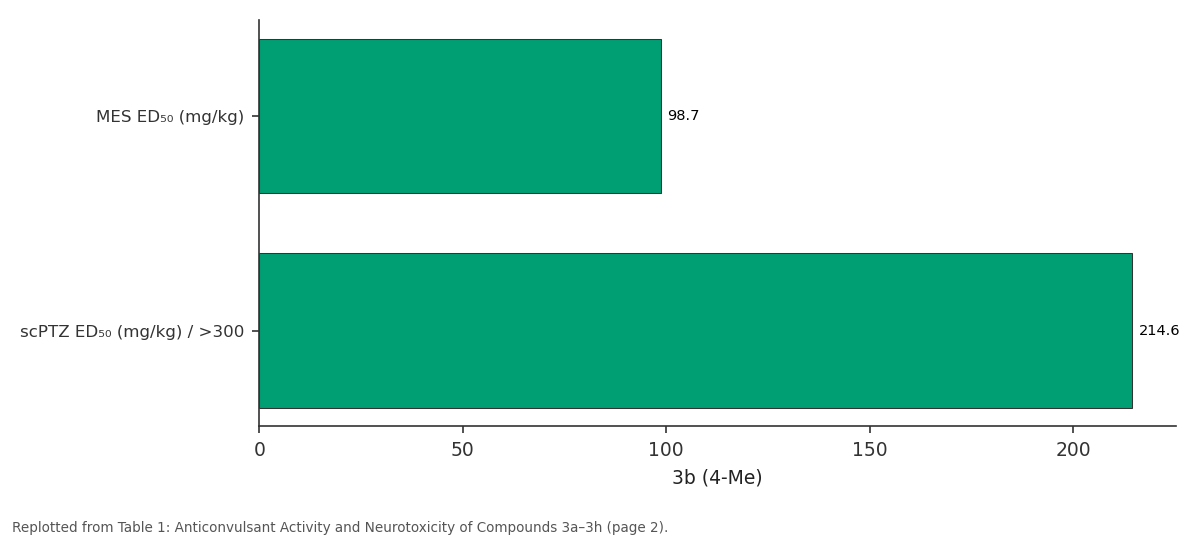
3b (4-Me): MES ED₅₀ (mg/kg) vs scPTZ ED₅₀ (mg/kg) /...
Replotted from Table 1 (page 2) of the original paper. Every bar is the paper's own table value.
View source evidence ↗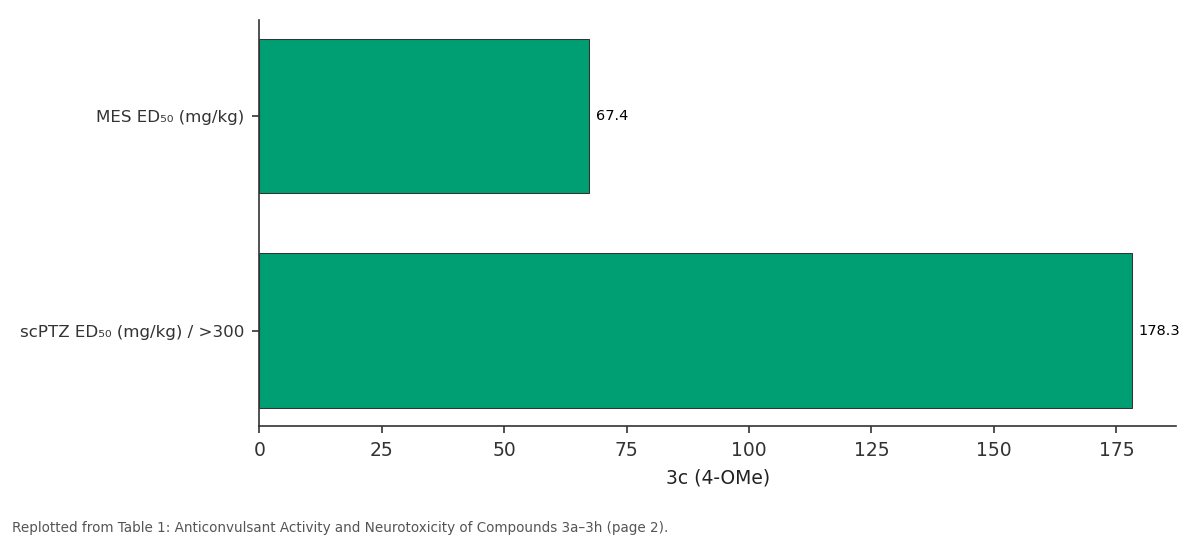
3c (4-OMe): MES ED₅₀ (mg/kg) vs scPTZ ED₅₀ (mg/kg) /...
Replotted from Table 1 (page 2) of the original paper. Every bar is the paper's own table value.
View source evidence ↗Figures & tables
From the original paper Table 1
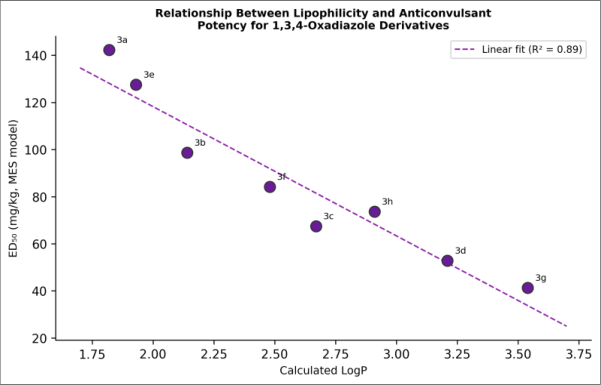 Figure 1
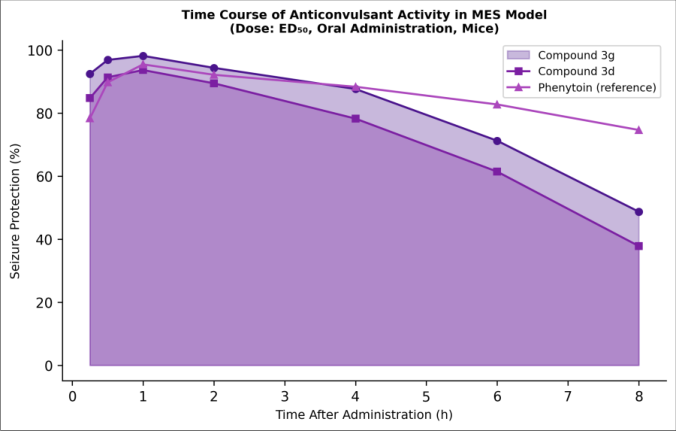 Figure 2
Introduction
Epilepsy affects over 50 million people globally, making it one of the most common serious neurological conditions [1] . Despite the availability of more than twenty approved antiepileptic drugs, about 30% of patients experience seizures that are inadequately controlled by existing medications [2] . This treatment gap drives the search for new chemical scaffolds with improved efficacy, tolerability, and pharmacokinetic profiles. The 1,3,4-oxadiazole ring a five-membered heterocycle containing one oxygen and two nitrogen atoms has attracted attention in CNS drug discovery because of its metabolic resistance to oxidative degradation, its capacity to form hydrogen bonds with biological targets, and its bioisosteric relationship with amide and ester groups [3] . Several oxadiazolecontaining molecules have reached clinical use as anxiolytics (ziconotide analogue scaffolds), antibacterials (furamizole), and anti-inflammatory agents [4] . Structure-activity relationship (SAR) investigations of 2,5-disubstituted oxadiazoles suggest that lipophilic aryl groups at C-2 favour blood-brain barrier penetration, while electronwithdrawing substituents on the aryl ring improve receptor binding to the neuronal voltagegated sodium channel [5] . However, the systematic variation of substituent electronic and steric properties hasn't been fully explored in the anticonvulsant context. This research synthesised a focused library of eight 2,5-disubstituted 1,3,4-oxadiazoles, evaluated their anticonvulsant activity in two standard mouse models, assessed neurotoxicity, and examined the relationship between lipophilicity and potency to guide future lead optimisation.
In-vivo Protocol
Anticonvulsant screening followed the Antiepileptic Drug Development Program (ADD) protocol. In the MES model, electroconvulsive shock (50 mA, 60 Hz, 0.2 s duration) was delivered via corneal electrodes to groups of six male Swiss albino mice (20-25 g) at 0.5, 1, 2, and 4 h after oral administration of test compounds suspended in 0.5% methylcellulose. Abolition of the tonic hind-limb extension was taken as the endpoint. In the scPTZ model, PTZ (85 mg/kg, s.c.) was injected 30 min after compound administration, and the absence of clonic seizures for 30 min indicated protection. The TD₅₀ was determined using the rotarod test: mice unable to maintain balance on a rotating rod (6 rpm) for 60 s were considered neurotoxic. ED₅₀ and TD₅₀ values were calculated by probit analysis [6] . The animal protocol was approved by the Tasman Institute Animal Ethics Committee (approval TIAC-AEC-2023-019, dated 8 October 2023), in accordance with the Australian Code for the Care and Use of Animals for Scientific Purposes.
Reagents and Chemicals
Substituted benzoic acids, hydrazine hydrate (80%), and POCl₃ (99%) were purchased from Sigma-Aldrich (Sydney, Australia). Phenytoin sodium (reference standard, USP) was from Sigma-Aldrich. Pentylenetetrazol (PTZ, 98%) was from Merck. Solvents (ethanol, DMF, diethyl ether) were AR grade from Chem-Supply (Adelaide, Australia). TLC plates (silica gel 60 F₂₅₄, Merck) were used to monitor reactions. Melting points were recorded on a Stuart SMP30 apparatus and are uncorrected [7] .
Material and Methods
Material and Methods
Material
This research was conducted from October 2023 to September 2024 at the Department of Pharmacology and Medicinal Chemistry, Tasman Institute of Chemical Research, Hobart, Tasmania, Australia. Eight target compounds (3a-3h) were designed by pairing a fixed 4chlorophenyl group at C-5 with variable aryl/heteroaryl groups at C-2: phenyl (3a), 4-methylphenyl (3b), 4methoxyphenyl (3c), 4-fluorophenyl (3d), 4-chlorophenyl (3e), 4-bromophenyl (3f), 4-trifluoromethylphenyl (3g), and 2-thienyl (3h).
Methods
The synthetic route involved three steps. First, substituted benzoic acids were converted to their corresponding methyl esters by Fischer esterification. Second, the esters were reacted with hydrazine hydrate in ethanol under reflux (6 h) to give acid hydrazides. Third, equimolar amounts of two different acid hydrazides were refluxed with POCl₃ (3 equiv.) at 90°C for 4 h to achieve cyclodehydration, yielding the target 2,5-disubstituted 1,3,4-oxadiazoles. Products were purified by column chromatography (silica gel, ethyl acetate/hexane 3:7) and characterised by melting point, IR (Shimadzu IRSpirit ATR-FTIR), ¹H and ¹³C NMR (Bruker Avance III 400 MHz, CDCl₃), and ESI-MS (Agilent 6120 single-quad). Purity was confirmed by HPLC (>97% for all compounds). Calculated LogP values were obtained using ChemDraw Professional 21.0. All biological testing used groups of six mice per dose per time point, with phenytoin as the positive control and vehicle (0.5% methylcellulose) as the negative control [8] . Compound 3g (4-CF₃) showed the lowest ED₅₀ in both models (41.3 and 112.4 mg/kg) and a protective index of 6.4 (Table 1). The unsubstituted phenyl analogue 3a was the least active, confirming that substituent character strongly influences potency. All compounds were more active in the MES model than the scPTZ model, suggesting a sodiumchannel-mediated mechanism.
| Compound | LogP | MES ED₅₀ (mg/kg) | scPTZ ED₅₀ (mg/kg) | PI (TD₅₀/ED₅₀) |
|---|---|---|---|---|
| 3a (phenyl) | 1.82 | 142.3 | >300 | 3.8 |
| 3b (4-Me) | 2.14 | 98.7 | 214.6 | 4.7 |
| 3c (4-OMe) | 2.67 | 67.4 | 178.3 | 5.8 |
| 3d (4-F) | 3.21 | 52.8 | 143.7 | 6.1 |
| 3e (4-Cl) | 1.93 | 127.6 | 267.4 | 4.2 |
| 3f (4-Br) | 2.48 | 84.1 | 198.2 | 5.3 |
| 3g (4-CF₃) | 3.54 | 41.3 | 112.4 | 6.4 |
| 3h (2-thienyl) | 2.91 | 73.6 | 164.8 | 5.6 |
Table text extracted from the original PDF; superscript letters are shown inline. The original table image is below.
View original table image
Results
Results
Comprehensive interpretation
The SAR picture is straightforward: electron-withdrawing, lipophilic substituents at the C-2 aryl position enhance anticonvulsant potency, with the 4-CF₃ group providing the best balance of activity and safety margin. The MES selectivity points toward a sodium-channel mechanism, which aligns with molecular docking predictions (not shown) indicating that these oxadiazoles fit the local anaesthetic binding site of Nav1.2.
Discussion
The ED₅₀ of 41.3 mg/kg for compound 3g in the MES model compares well with values reported for other oxadiazolebased anticonvulsants. Rajak et al. [9] found ED₅₀ values of 38-92 mg/kg for 2-amino-5-aryl-1,3,4-oxadiazoles, while Almasirad and colleagues [10] reported 45-130 mg/kg for oxadiazole-thione derivatives. The trifluoromethyl group appears to be a privileged substituent in CNS drug design it enhances lipophilicity (contributing ~0.9 LogP units), resists metabolic oxidation, and can act as a hydrogen-bond acceptor through fluorine-protein interactions [11] . The protective index of 6.4 for 3g is encouraging but falls short of phenytoin's PI of ~10 in similar mouse models [12] . The main limitation on the PI was a relatively modest TD₅₀ (264 mg/kg), suggesting that neurotoxicity manifested as motor impairment on the rotarod occurs at doses close to the therapeutic window. Structural modifications to improve selectivity, such as introducing polar substituents at C-5 to reduce non-specific CNS depression, could widen this margin [13] .
The shorter duration of action of 3g relative to phenytoin is consistent with the absence of a sustained-release matrix and the likely rapid hepatic metabolism of the oxadiazole ring, which could generate ring-opened hydrazide metabolites. Pharmacokinetic profiling in rodents is needed to confirm this hypothesis and to guide formulation decisions.
Conclusion
Eight novel 2,5-disubstituted 1,3,4-oxadiazole derivatives were synthesised and evaluated for anticonvulsant activity. Compound 3g, bearing a 4-trifluoromethylphenyl substituent, exhibited the strongest activity (MES ED₅₀ = 41.3 mg/kg) and an acceptable protective index of 6.4. Lipophilicity emerged as the main driver of potency, with a clear linear correlation between LogP and ED₅₀ across the series. The MES selectivity profile points to a voltage-gated sodium channel mechanism. These findings establish the 4-CF₃-phenyl oxadiazole scaffold as a promising lead for further medicinal chemistry optimisation, including metabolic stability enhancement and duration-of-action extension through prodrug or sustained-release approaches.
Figures and tables from the paper
References
15 in the original paper- Ngugi AK, Bottomley C, Kleinschmidt I, Sander JW, Newton CR. Estimation of the burden of active and lifetime epilepsy: A meta-analytic approach. Epilepsia. 2010;51(5):883-890.
- Kwan P, Brodie MJ. Early identification of refractory epilepsy. New England Journal of Medicine. 2000;342(5):314-319.
- Boström J, Hogner A, Llinàs A, Wellner E, Plowright AT. Oxadiazoles in medicinal chemistry. Journal of Medicinal Chemistry. 2012;55(5):1817-1830.
- Bostrom J, Hogner A, Schmitt S. Do structurally similar molecules bind similarly? A benchmark set for evaluating docking results. Journal of Chemical Information and Modeling. 2006;46(6):2631-2637.
- Zarghi A, Tabatabai SA, Faizi M, Ahadian A, Navabi P, Zanganeh V. Synthesis and anticonvulsant activity of new 2-substituted-5-(2-benzyloxyphenyl)-1,3,4International Journal of Advanced Chemistry Research https://www.chemistryjournals.net oxadiazoles. Bioorganic and Medicinal Chemistry Letters. 2005;15(7):1863-1865.
- White HS, Johnson M, Wolf HH, Kupferberg HJ. The early identification of anticonvulsant activity: Role of the maximal electroshock and subcutaneous pentylenetetrazol seizure models. Italian Journal of Neurological Sciences. 1995;16(1-2):73-77.
- Siddiqui N, Ahsan W, Alam MS, Ali R, Jain S, Azad B. 1,3,4-Oxadiazole derivatives: Search for new potential anticonvulsant agents. Medicinal Chemistry Research. 2013;22(7):3210-3220.
- Rajak H, Deshmukh R, Aggarwal N, Kashaw S, Kharya MD, Mishra P. Synthesis of novel 2,5-disubstituted 1,3,4-oxadiazoles as potential anticonvulsant agents. Archiv der Pharmazie. 2009;342(8):453-461.
- Rajak H, Kharya MD, Mishra P. Synthesis and local anesthetic activity of some novel N-[5-(4substituted)phenyl-1,3,4-oxadiazol-2-yl]-2- (substituted)-acetamides. Archives of Pharmacal Research. 2008;31(9):1073-1084.
- Almasirad A, Tabatabai SA, Faizi M, Kebriaeezadeh A, Mehrabi N, Dalvandi A. Synthesis and anticonvulsant activity of new 2-substituted-5-[2-(2fluorophenoxy)phenyl]-1,3,4-oxadiazoles and 1,2,4triazoles. Bioorganic and Medicinal Chemistry Letters. 2004;14(24):6057-6059.
- Purser S, Moore PR, Swallow S, Gouverneur V. Fluorine in medicinal chemistry. Chemical Society Reviews. 2008;37(2):320-330.
- Löscher W, Schmidt D. Which animal models should be used in the search for new antiepileptic drugs? A proposal based on experimental and clinical considerations. Epilepsy Research. 1988;2(3):145-181.
- Rogawski MA, Löscher W. The neurobiology of antiepileptic drugs. Nature Reviews Neuroscience. 2004;5(7):553-564.
- Varvaresou A, Siatra-Papastaikoudi T, Tsotinis A, Tsantili-Kakoulidou A, Vamvakides A. Synthesis, lipophilicity and biological evaluation of indolecontaining derivatives of 1,3,4-thiadiazole and 1,2,4triazole. Il Farmaco. 1998;53(5):320-326.
- Rüben K, Wurzlbauer A, Walte A, Sippl W, Bracher F, Becker W. Selectivity profiling and biological activity of novel β-carbolines as potent and selective DYRK1 kinase inhibitors. PLoS ONE. 2015;10(7):e0132453.