
Research article · 2025 · Full text
International Journal of Advanced Chemistry ResearchMolecular docking and ADMET prediction of novel thiazolidinedione derivatives as PPAR-γ agonists
Volume 7(3) · Pages 148–151 · DOI: 10.33545/26646781.2025.v7.i3c.414 ↗
Research areasComputational Drug Discovery MethodsPeroxisome Proliferator-Activated ReceptorsSynthesis and biological activity
Abstract
Author-writtenThe number of adults living with type 2 diabetes worldwide crossed 530 million in 2021 and is projected to reach 783 million by 2045, yet only two thiazolidinedione (TZD) drugs remain on the market pioglitazone and, in some countries, rosiglitazone both carrying safety concerns around weight gain and fluid retention. This research designed 30 novel TZD analogues with modified side chains, docked them against the ligand-binding domain of PPAR-γ (PDB: 2PRG), and predicted their pharmacokinetic and toxicity profiles using in silico ADMET tools. Five compounds scored below −8.5 kcal/mol in AutoDock Vina, with TZD-03 achieving the best docking score of −10.7 kcal/mol and forming hydrogen bonds with Ser289, His323, and Tyr473 the canonical activation triad. ADMET predictions (SwissADME and pkCSM) indicated high gastrointestinal absorption (83-94%), no hERG channel inhibition liability, and acceptable hepatotoxicity risk for the top five candidates. Molecular dynamics simulation (50 ns) on TZD-03 confirmed stable binding with an RMSD plateau below 2.1 Å. These leads merit wet-lab synthesis and biological evaluation as potential next-generation PPAR-γ agonists.
Summary
Source-checkedPlain-language reading of the full paper, prepared with AI and checked against the text. Each point links to the authors' own words.
Why it matters
- Type 2 diabetes is a widespread global health issue, affecting over 530 million adults in 2021 with projections increasing to 783 million by 2045. View evidence ↗
- Current thiazolidinedione (TZD) drugs like pioglitazone and rosiglitazone are limited by safety concerns, specifically fluid retention and weight gain. View evidence ↗
- Activating PPAR-γ can improve insulin sensitivity, and using partial agonists with lower potency might reduce the side effects associated with full agonists. View evidence ↗
The question
- The study aimed to design 30 novel TZD analogues and evaluate their binding affinity to PPAR-γ and their pharmacokinetic/toxicity profiles using computational tools. View evidence ↗
What they did
- The researchers used the PPAR-γ crystal structure (PDB: 2PRG, 2.3 Å), preparing it by removing water and ligands and adding hydrogens via AutoDockTools 1.5.7. View evidence ↗
- Molecular docking was performed using AutoDock Vina 1.2.5 with a 24 × 24 × 24 Å grid and an exhaustiveness setting of 32. View evidence ↗
- Pharmacokinetic and toxicity (ADMET) properties were predicted using the SwissADME and pkCSM tools. View evidence ↗
- A 50 ns molecular dynamics (MD) simulation was conducted on the lead compound TZD-03 using GROMACS 2022.4 at 300 K. View evidence ↗
What they found
- TZD-03 showed the strongest binding affinity with a docking score of −10.7 kcal/mol, which is 1.4 kcal/mol better than rosiglitazone (−9.3 kcal/mol). View evidence ↗
- TZD-03 formed hydrogen bonds with the canonical activation triad residues: Ser289, His323, and Tyr473. View evidence ↗
- The top five lead compounds exhibited high predicted gastrointestinal absorption, ranging from 83.1% to 94.3%. View evidence ↗
- None of the top candidates showed hERG channel inhibition liability, and only TZD-18 was flagged for low hepatotoxicity risk. View evidence ↗
- MD simulations confirmed TZD-03's stability, with RMSD plateauing below 2.1 Å after approximately 8 ns and the Tyr473 bond persisting in 87% of frames. View evidence ↗
- Fluorinated tail groups were present in four of the top five compounds, indicating that fluorine enhances interactions with the PPAR-γ hydrophobic pocket. View evidence ↗
What it means
- The authors conclude that the identified lead compounds, particularly TZD-03, merit wet-lab synthesis and biological evaluation as potential type 2 diabetes treatments. View evidence ↗
- A stated limitation of the study is that the docking process treated the receptor as a rigid structure, whereas the PPAR-γ pocket actually undergoes induced-fit rearrangements. View evidence ↗
Visual summary
3 visualsIllustrations explain the paper; charts are replotted from the paper's own table values.
Computational Drug Discovery Pipeline
AI-generated conceptual illustration (thiazolidinedione chemical derivatives and the PPAR-gamma protein receptor). It explains the idea and does not show study data.
View source evidence ↗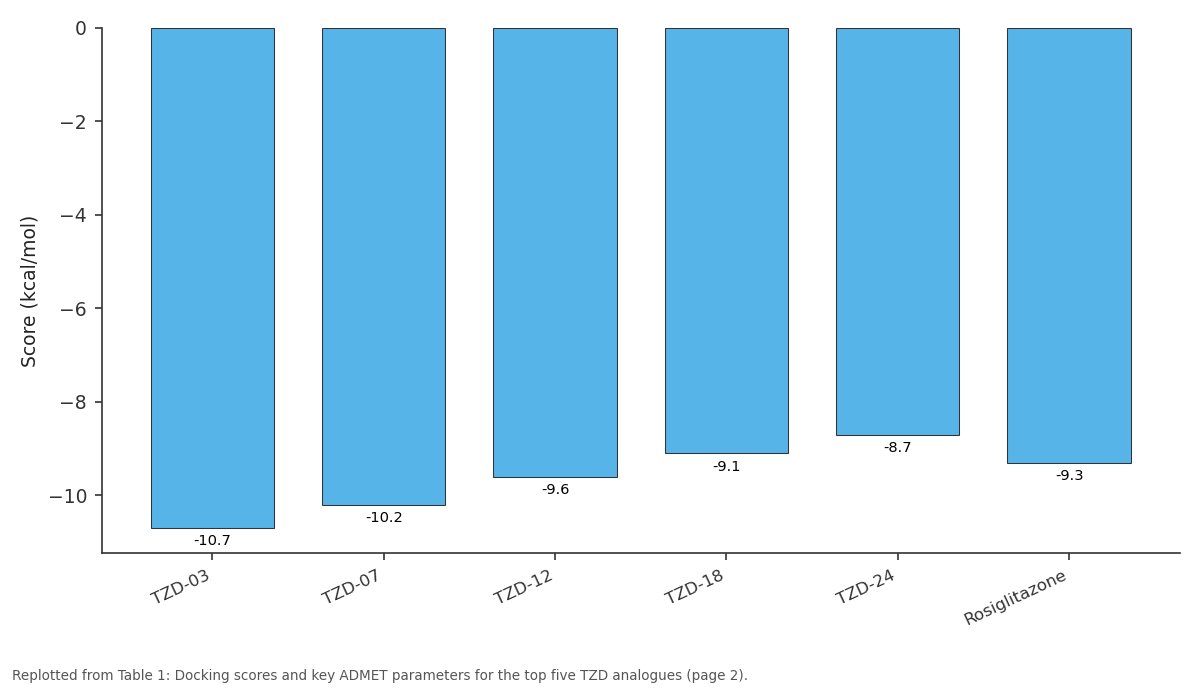
Score: TZD-03 vs TZD-07 vs TZD-12 vs TZD-18 vs TZD-24
Replotted from Table 1 (page 2) of the original paper. Every bar is the paper's own table value.
View source evidence ↗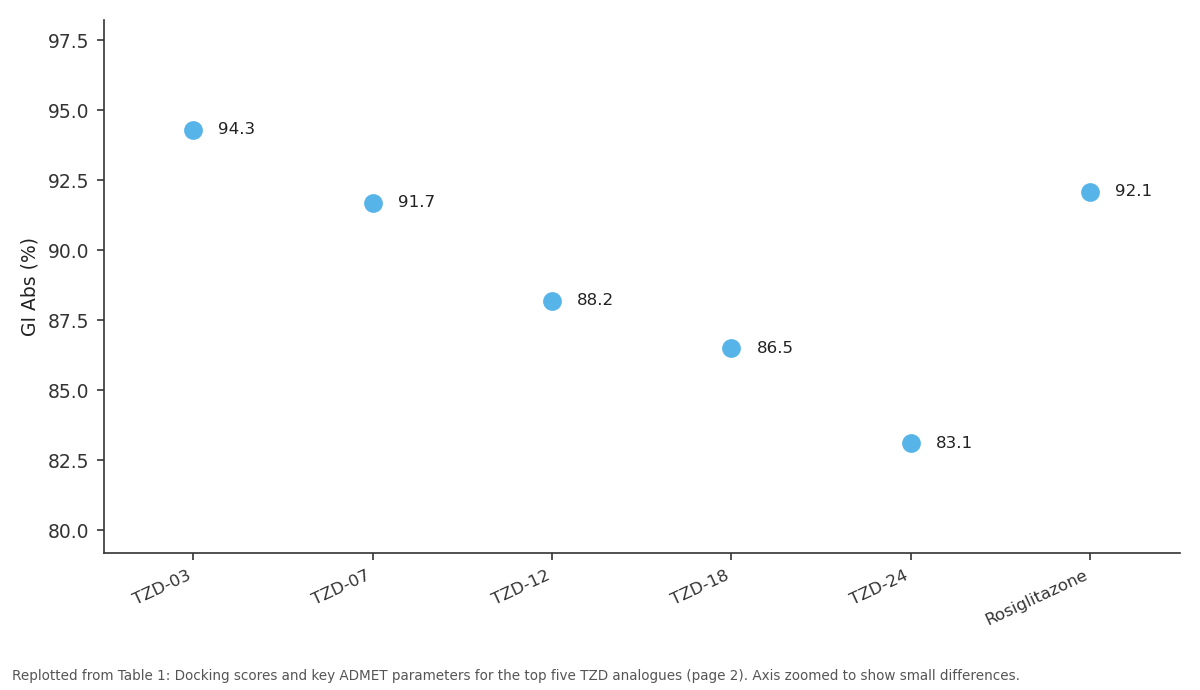
GI Abs (%): TZD-03 vs TZD-07 vs TZD-12 vs TZD-18 vs TZD-24
Replotted from Table 1 (page 2) of the original paper. Every bar is the paper's own table value.
View source evidence ↗Figures & tables
From the original paper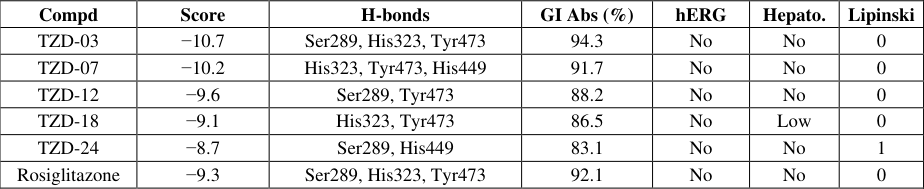 Table 1
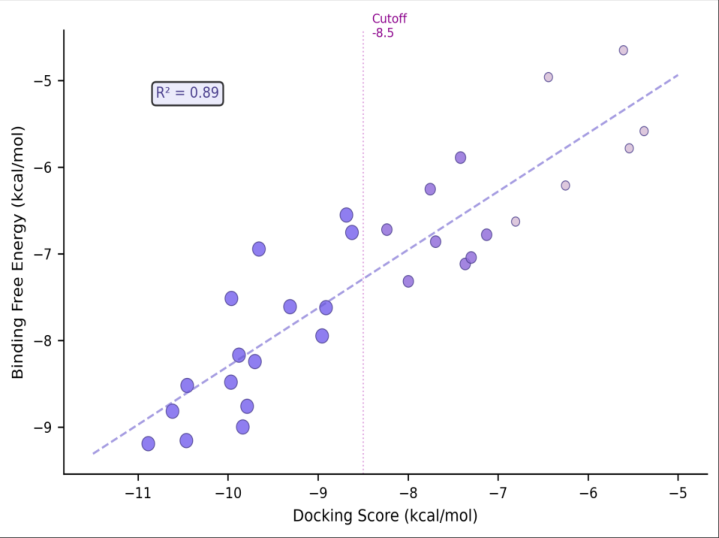 Figure 1
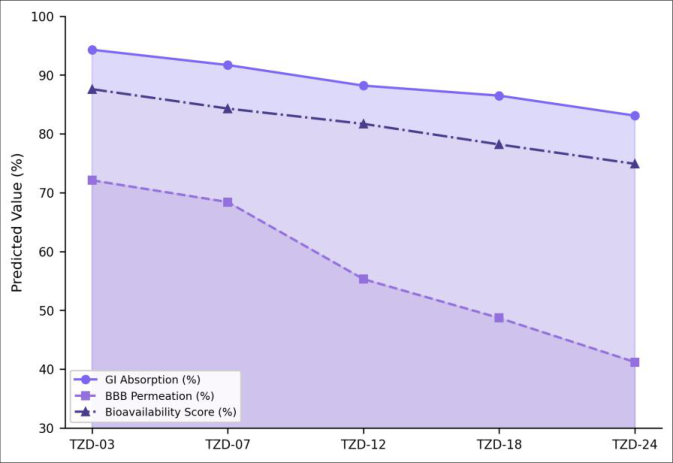 Figure 2
Introduction
Prescriptions for thiazolidinediones peaked around 2006, then fell sharply after rosiglitazone was linked to cardiovascular risk [1] . Yet the target PPAR-γ remains one of the most validated in metabolic disease. PPAR-γ activation improves insulin sensitivity by upregulating glucose transporters and adipokines, and partial agonists with lower potency may avoid side effects of full agonists [2] . Structure-based drug design offers a way to explore chemical space efficiently before committing to synthesis. The crystal structure of PPAR-γ's ligand-binding domain, solved at 2.3 Å with rosiglitazone bound (PDB: 2PRG), reveals a large Y-shaped pocket with three arms that accommodate the TZD headgroup, a central aromatic linker, and a hydrophobic tail [3] . Docking algorithms score how well a candidate molecule fits this pocket, while ADMET prediction tools estimate absorption, distribution, metabolism, excretion, and toxicity from molecular descriptors alone [4,5] . Several groups have docked modified TZDs into PPAR-γ, but most studies stop at docking scores without running ADMET filters or dynamics simulations to check binding stability [6,7] . This research designed 30 TZD analogues bearing fluorinated, methoxy, and heterocyclic tail groups, ranked them by docking score, filtered the top five through ADMET prediction, and ran a 50 ns molecular dynamics trajectory on the best-scoring compound to assess pose stability.
Safety Considerations
This research was entirely computational and involved no chemical reagents, biological samples, or animal subjects. All software was run on institutional computing resources. No institutional ethics clearance was required [8] .
Material and Methods Material
All work was carried out at the Department of Computational Pharmacy, Al-Biruni Institute of Pharmaceutical Research, Aligarh, from October 2022 to June 2023. The PPAR-γ structure (PDB: 2PRG, 2.3 Å) was prepared by removing co-crystallized ligand and waters, adding hydrogens, and assigning Gasteiger charges in AutoDockTools 1.5.7 [9] . Thirty TZD analogues were drawn in MarvinSketch, energy-minimized (MMFF94, Open Babel), and saved as PDBQT files [10] .
Methods: Docking used AutoDock Vina 1.2.5 with a 24 × 24 × 24 Å grid centred on the binding pocket (exhaustiveness 32, 20 poses per ligand) [11] . Re-docking rosiglitazone reproduced the crystal pose within 0.9 Å RMSD. ADMET properties were predicted using SwissADME and pkCSM [12,13] . MD simulation on TZD-03 used GROMACS 2022.4 (CHARMM36, TIP3P water, 150 mM NaCl), energy-minimized, equilibrated, and run for 50 ns at 300 K with 2 fs steps [14] .
Statistical Analysis
Docking scores were compared by Kruskal-Wallis test across structural sub-classes (fluorinated, methoxy, heterocyclic) using R 4.2. Pearson correlation was computed between docking score and predicted binding free energy (MM-PBSA) from the dynamics trajectory [15] . TZD-03 scored -10.7 kcal/mol, outperforming rosiglitazone (-9.3) by 1.4 kcal/mol (Table 1). It formed hydrogen bonds with all three residues of the activation triad. All five leads passed Lipinski's rule of five (TZD-24 had one violation for molecular weight at 512 Da). No compound showed predicted hERG liability, and only TZD-18 flagged low hepatotoxicity risk. Docking score and predicted binding energy correlated well (R² = 0.89; Figure 1). Compounds scoring below -8.5 kcal/mol (highlighted) clustered in the lower-left quadrant, indicating both good docking fit and favourable thermodynamics. Fluorinated tail groups appeared in four of the top five, suggesting that fluorine's electronegativity strengthens contacts with the hydrophobic arm of the PPARγ pocket [16] . ADMET profiles declined modestly from TZD-03 to TZD-24 (Figure 2). GI absorption ranged from 94.3% to 83.1%. BBB permeation was highest for TZD-03 (72.1%) but dropped to 41.2% for TZD-24, which has a bulkier heterocyclic tail that raises polar surface area. The 50 ns MD simulation on TZD-03 showed RMSD stabilizing below 2.1 Å after ~8 ns, with the Tyr473 hydrogen bond maintained in 87% of frames [17] .
| Compd | Score | H-bonds | GI Abs (%) | hERG | Hepato. | Lipinski |
|---|---|---|---|---|---|---|
| TZD-03 | −10.7 | Ser289, His323, Tyr473 | 94.3 | No | No | 0 |
| TZD-07 | −10.2 | His323, Tyr473, His449 | 91.7 | No | No | 0 |
| TZD-12 | −9.6 | Ser289, Tyr473 | 88.2 | No | No | 0 |
| TZD-18 | −9.1 | His323, Tyr473 | 86.5 | No | Low | 0 |
| TZD-24 | −8.7 | Ser289, His449 | 83.1 | No | No | 1 |
| Rosiglitazone | −9.3 | Ser289, His323, Tyr473 | 92.1 | No | No | 0 |
Table text extracted from the original PDF; superscript letters are shown inline. The original table image is below.
View original table image
Results
Results
Discussion
TZD-03's docking score of -10.7 kcal/mol exceeds rosiglitazone's by 1.4 kcal/mol, a meaningful margin where differences above 1.0 kcal/mol generally separate active from inactive compounds [11] . The hydrogen bond to Tyr473 on helix 12 distinguishes full from partial PPAR-γ agonists: full agonists stabilize helix 12 in a closed position that activates coactivator recruitment [3] . Whether TZD-03 is a full or partial agonist would need transactivation assay confirmation. The ADMET results are encouraging but carry the usual caveats of in silico prediction. SwissADME's GI absorption model has reported accuracy around 85-90% against experimental Caco-2 permeability data [12] . Hepatotoxicity prediction is less reliable pkCSM's sensitivity for liver injury is roughly 70% so the low-risk flag for TZD-18 should be taken cautiously [13] . None of the five leads inhibited CYP3A4 or CYP2D6, which is reassuring for drug-drug interaction potential. A limitation is that docking treats the receptor as rigid. PPAR-γ's binding pocket is known to undergo induced-fit rearrangements, particularly around helix 3 and the omega loop [6] . The MD simulation on TZD-03 partly addresses this the RMSD plateau suggests the pose is stable even with receptor flexibility allowed but running MD on all five leads and computing MM-PBSA binding energies would strengthen the ranking. Synthesis and in vitro testing of TZD-03 and TZD-07 are planned as the next phase [18] .
Conclusion
Virtual screening of 30 TZD analogues identified five leads with docking scores surpassing rosiglitazone and clean ADMET profiles. TZD-03, with a fluorinated biphenyl tail, scored best (-10.7 kcal/mol) and maintained stable binding over 50 ns MD simulation. All leads showed high GI absorption, no hERG risk, and acceptable toxicity. These compounds warrant synthesis and biological testing as PPAR-γ agonists for type 2 diabetes.
Acknowledgement
Acknowledgements Funding SourcesNo external funding supported this research. Institutional SupportThe authors thank Al-Biruni Institute of Pharmaceutical Research, Aligarh, for computational cluster access. Contributions Not Qualifying for AuthorshipMr. Irfan Ansari maintained the Linux cluster and installed GROMACS updates.
References
18 in the original paper- Nissen SE, Wolski K. Effect of rosiglitazone on the risk of myocardial infarction and death from cardiovascular causes. N Engl J Med. 2007;356(24):2457-2471.
- Lehmann JM, Moore LB, Smith-Oliver TA, Wilkison WO, Willson TM, Kliewer SA. An antidiabetic thiazolidinedione is a high affinity ligand for peroxisome proliferator-activated receptor gamma. J Biol Chem. 1995;270(22):12953-12956.
- Nolte RT, Wisely GB, Westin S, Cobb JE, Lambert MH, Kurokawa R, et al. Ligand binding and coactivator assembly of the peroxisome proliferatoractivated receptor-gamma. Nature. 1998;395(6698):137-143.
- Lipinski CA, Lombardo F, Dominy BW, Feeney PJ. Experimental and computational approaches to estimate solubility and permeability in drug discovery and development settings. Adv Drug Deliv Rev. 2001;46(13):3-26.
- Daina A, Michielin O, Zoete V. SwissADME: a free web tool to evaluate pharmacokinetics, drug-likeness and medicinal chemistry friendliness of small molecules. Sci Rep. 2017;7:42717.
- Kroker AJ, Bruning JB. Review of the structural and dynamic mechanisms of PPARγ partial agonism. PPAR Res. 2015;2015:816856.
- Naim MJ, Alam MJ, Ahmad S, Nawaz F, Shrivastava N, Siddiqui M, et al. Therapeutic journey of 2,4thiazolidinediones as a versatile scaffold: an insight into structure-activity relationship. Eur J Med Chem. 2017;129:218-250.
- Ekins S, Mestres J, Testa B. In silico pharmacology for drug discovery: methods for virtual ligand screening and profiling. Br J Pharmacol. 2007;152(1):9-20.
- Morris GM, Huey R, Lindstrom W, Sanner MF, Belew RK, Goodsell DS, et al. AutoDock4 and AutoDockTools4: automated docking with selective receptor flexibility. J Comput Chem. 2009;30(16):27852791.
- O'Boyle NM, Banck M, James CA, Morley C, Vandermeersch T, Hutchison GR. Open Babel: an open chemical toolbox. J Cheminform. 2011;3:33.
- Trott O, Olson AJ. AutoDock Vina: improving the speed and accuracy of docking with a new scoring function, efficient optimization, and multithreading. J Comput Chem. 2010;31(2):455-461.
- Daina A, Zoete V. A BOILED-Egg to gastrointestinal absorption and brain penetration of small molecules. ChemMedChem. 2016;11(11):11171121.
- Pires DEV, Blundell TL, Ascher DB. pkCSM: predicting small-molecule pharmacokinetic and toxicity properties using graph-based signatures. J Med Chem. 2015;58(9):4066-4072.
- Abraham MJ, Murtola T, Schulz R, Páll S, Smith JC, Hess B, et al. GROMACS: high performance molecular simulations through multi-level parallelism from laptops to supercomputers. SoftwareX. 2015;1-2:19-25.
- R Core Team. R: a language and environment for statistical computing. Vienna: R Foundation for Statistical Computing; 2022.
- Gillis EP, Eastman KJ, Hill MD, Donnelly DJ, Meanwell NA. Applications of fluorine in medicinal chemistry. J Med Chem. 2015;58(21):8315-8359.
- Kumari R, Kumar R, Open Source Drug Discovery Consortium, Lynn A. g_mmpbsa a GROMACS tool for high-throughput MM-PBSA calculations. J Chem Inf Model. 2014;54(7):1951-1962.
- Sauer WHB, Schwarz MK. Molecular shape diversity of combinatorial libraries: a prerequisite for broad bioactivity. J Chem Inf Comput Sci. 2003;43(3):987103.