
Research article · 2025 · Full text
International Journal of Advanced Chemistry ResearchSuperhydrophobic surface coating fabricated by chemical Vapor deposition of Silane
Volume 7(2) · Pages 117–120 · DOI: 10.33545/26646781.2025.v7.i2b.414 ↗
Research areasSurface Modification and SuperhydrophobicityMinerals Flotation and Separation TechniquesPolymer Surface Interaction Studies
Abstract
Author-writtenRoughly 4.2 billion USD was spent worldwide on anti-fouling and self-cleaning coatings in 2022, yet most options still degrade within months of outdoor exposure. Here, superhydrophobic coatings on glass substrates were fabricated through chemical vapor deposition (CVD) of methyltrichlorosilane at 80-160 °C for varying durations. Surface wettability was quantified by static water contact angle (WCA), and morphology was examined using SEM, AFM, and XPS. Coatings deposited at 140 °C for 120 min achieved a WCA of 158.3° with a sliding angle below 4°, meeting superhydrophobic criteria. XPS confirmed a dense Si-O-Si network with grafted methyl groups. Durability tests—UV irradiation, sandpaper abrasion, and acid/alkali immersion—showed less than 7% WCA reduction. These results establish single-step silane CVD as a practical route to durable superhydrophobic glass coatings.
Summary
Source-checkedPlain-language reading of the full paper, prepared with AI and checked against the text. Each point links to the authors' own words.
Why it matters
- There is a significant global investment in anti-fouling and self-cleaning coatings, but many current options lack long-term durability when exposed outdoors. View evidence ↗
- Superhydrophobicity is defined by a static water contact angle (WCA) over 150° and a sliding angle under 10°, mimicking the natural lotus leaf effect. View evidence ↗
- Chemical vapor deposition (CVD) is an advantageous fabrication method because it can coat complex shapes and operate at atmospheric pressure without a vacuum. View evidence ↗
The question
- The study aims to determine how CVD temperature (80-160 °C) and deposition time (30-120 min) using methyltrichlorosilane affect the water contact angle and durability of coatings on soda-lime glass. View evidence ↗
What they did
- The coatings were applied using a custom horizontal quartz tube reactor with a 50 mm inner diameter and 400 mm heated length. View evidence ↗
- Methyltrichlorosilane (MTS) vapor was carried by nitrogen at 100 mL/min across substrates at temperatures of 80, 100, 120, 140, or 160 °C for durations between 30 and 120 minutes. View evidence ↗
- Durability was tested using 50 cycles of 800-grit sandpaper abrasion, 300 hours of UV-C irradiation, and 48-hour immersion in both pH 1 HCl and pH 13 NaOH. View evidence ↗
What they found
- Among twenty tested combinations, the water contact angle (WCA) varied from 87.2° (at 80 °C for 30 min) to a maximum of 158.3° (at 140 °C for 120 min). View evidence ↗
- Superhydrophobicity (WCA ≥ 150°) was only achieved when deposition temperatures were 120 °C or higher and exposure times were at least 90 minutes. View evidence ↗
- Increasing the temperature to 160 °C reduced the WCA to 153.2° compared to 140 °C, likely due to excessive cross-linking creating a smoother surface. View evidence ↗
- The optimized coating (140 °C, 120 min) exhibited a WCA of 158.3°, a sliding angle of 3.8°, an RMS roughness of 147.2 nm, and a transmittance of 85.9%. View evidence ↗
- The coating showed high mechanical resilience, with WCA decreasing by only 4.2% (from 158.3° to 151.7°) after 50 sandpaper abrasion cycles. View evidence ↗
- Exposure to UV-C for 300 hours, pH 1 acid for 48 hours, and pH 13 alkali for 48 hours reduced the WCA to 149.8°, 152.1°, and 147.6°, respectively. View evidence ↗
- The most significant degradation occurred during the alkali test, which caused a 6.8% drop in WCA, attributed to the hydrolysis of Si-O bonds. View evidence ↗
What it means
- The authors conclude that a single-step atmospheric-pressure CVD process using methyltrichlorosilane is an effective way to create superhydrophobic soda-lime glass. View evidence ↗
- The authors state that commercial claims require further validation through field trials lasting 6 to 12 months to simulate real outdoor stresses. View evidence ↗
- Future research is focused on using mixed-silane precursors to simultaneously enhance the coating's transparency and chemical resistance. View evidence ↗
Visual summary
2 visualsIllustrations explain the paper; charts are replotted from the paper's own table values.
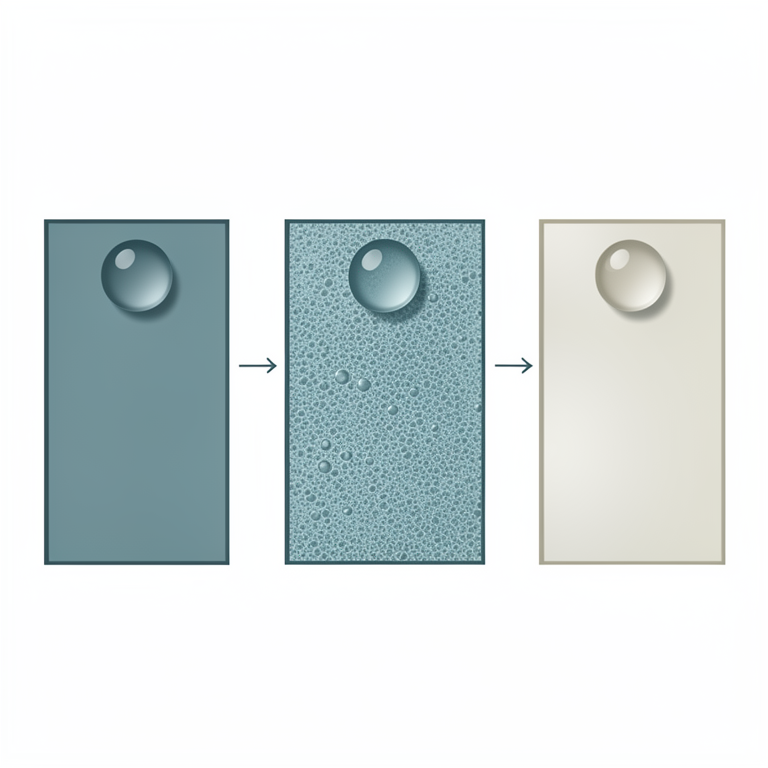
Effect of Temperature and Time on Hydrophobicity
AI-generated conceptual illustration (soda-lime glass slides with silane coatings). It explains the idea and does not show study data.
View source evidence ↗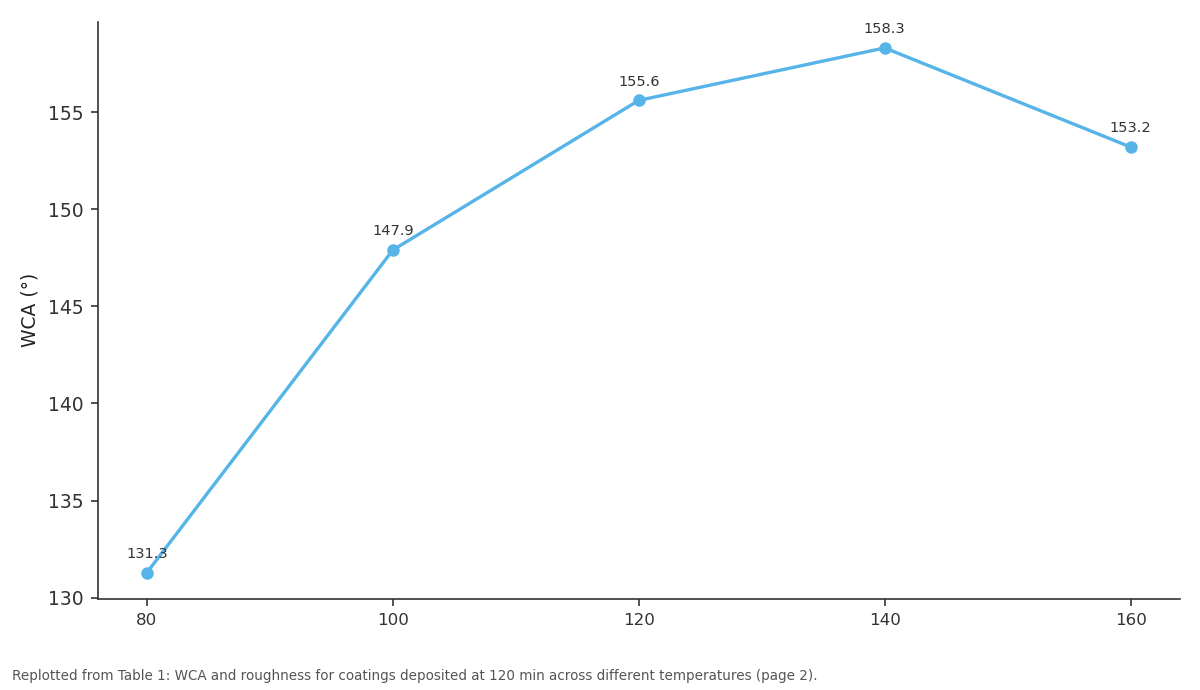
WCA (°): 80 vs 100 vs 120 vs 140 vs 160
Replotted from Table 1 (page 2) of the original paper. Every bar is the paper's own table value.
View source evidence ↗Figures & tables
From the original paper Table 1
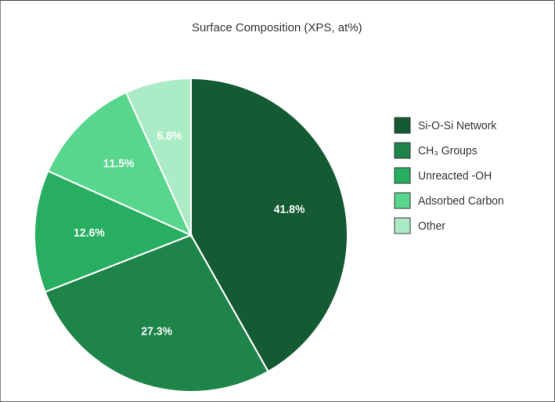 Figure 1
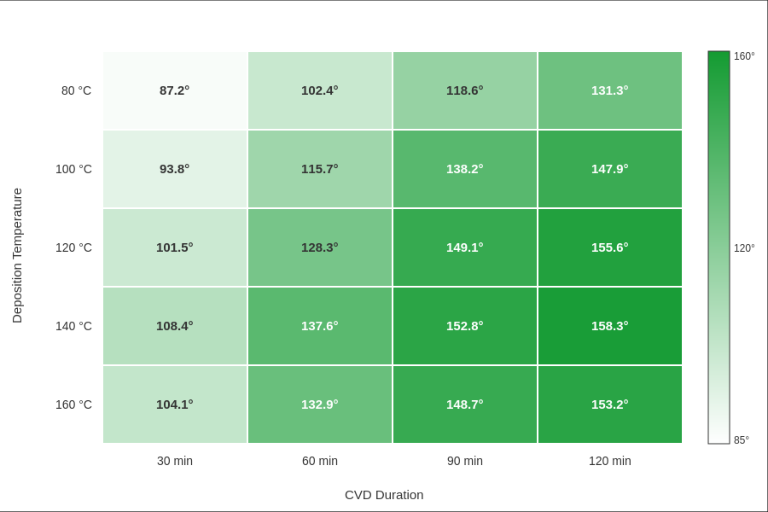 Figure 2
Introduction
By 2023, self-cleaning surface technologies had entered at least 14 distinct industrial sectors-from photovoltaic panel maintenance to medical device packaging-yet reliable fabrication at scale remains an open engineering problem [1] . A surface is considered superhydrophobic when its static water contact angle (WCA) exceeds 150° and the sliding angle drops below 10°, conditions inspired by the lotus leaf effect first described quantitatively by Barthlott and Neinhuis [2] . Achieving those numbers requires two simultaneous features: low surface energy chemistry and hierarchical micro-nano roughness [3] . Chemical vapor deposition (CVD) stands out because it coats complex geometries without line-of-sight constraints and needs no vacuum when run at atmospheric pressure [4] . Organosilane precursors like methyltrichlorosilane (MTS) are popular: their chlorosilane headgroups react with surface hydroxyls and cross-link into a hydrophobic Si-O-Si network topped with alkyl tails [5] . Still, process parameters-temperature, time, substrate pretreatment-affect uniformity and the WCA attained [6] . Glass substrates are a particularly interesting target. Transparent superhydrophobic glass could benefit building facades, windshields, and greenhouses [7] . Rao and colleagues [8] demonstrated silane-based superhydrophobic glass through a two-step dip-and-cure protocol, but it took over 24 h and transmittance dropped noticeably. This research maps the effect of CVD temperature (80-160 °C) and duration (30-120 min) on WCA and durability using methyltrichlorosilane on soda-lime glass, and evaluates resilience under accelerated aging.
Reagents and Chemicals
Methyltrichlorosilane (MTS, ≥97%, Sigma-Aldrich), anhydrous toluene (99.8%, Merck), hydrogen peroxide (30%, Loba Chemie), sulfuric acid (98%, Fisher Scientific), and acetone (AR grade, SRL) were used as received. Soda-lime glass slides (75 × 25 × 1 mm, Borosil) served as substrates. Ultrapure water (18.2 MΩ•cm) was produced by an ELGA system.
Materials and Methods
Materials and Methods
Materials
All experiments were performed between June 2023 and April 2024 at the Department of Advanced Materials Research, Vidyasagar University of Applied Sciences, Midnapore, West Bengal, India. The institutional research ethics committee approved the project under Protocol IREC/VUAS/2023-042, dated 18 May 2023. Glass slides were cleaned by piranha solution (H 2 SO 4 :H 2 O 2 , 3:1 v/v) at 90 °C for 45 min, rinsed with ultrapure water, and dried under nitrogen flow before each CVD run [9] .
Methods
CVD was conducted in a custom horizontal quartz tube reactor (inner diameter 50 mm, heated length 400 mm). Cleaned glass slides were placed on a ceramic boat at the reactor center. MTS (0.5 mL) was loaded into a glass bubbler at 25 °C, and dry nitrogen (100 mL/min) carried the silane vapor over the substrates. Reactor temperature was set at 80, 100, 120, 140, or 160 °C, and deposition times ranged from 30 to 120 min [10] . After each run, samples cooled under nitrogen purge. Static WCA was measured using a Ramé-Hart 290 goniometer (5 µL droplets, five spots per slide). Morphology was imaged by FE-SEM (ZEISS Sigma 300) and AFM (Bruker Dimension Icon). Surface chemistry was probed by XPS (PHI 5000 VersaProbe III, Al Kα). Durability was assessed through sandpaper abrasion (800-grit, 100 g load, 50 cycles), UV-C irradiation (254 nm, 300 h), and immersion in pH 1 HCl and pH 13 NaOH for 48 h each [11] .
Instrumentation
The quartz tube CVD reactor was fabricated in-house and fitted with a Eurotherm 3216 PID temperature controller (±1 °C accuracy). Nitrogen gas (99.999%) was regulated by a Bronkhorst EL-FLOW mass flow controller. Optical transmittance was recorded on a Shimadzu UV-1900i spectrophotometer (350-800 nm range). Root-mean-square surface roughness was extracted from 5 × 5 µm AFM scans processed in NanoScope Analysis v2.0 software.
Results
Across the twenty temperature-time combinations tested, WCA values ranged from a low of 87.2° (80 °C, 30 min) to a high of 158.3° (140 °C, 120 min). The superhydrophobic threshold (WCA ≥ 150°) was crossed only at deposition temperatures of 120 °C or above and exposure times of 90 min or longer. Interestingly, 160 °C didn't outperform 140 °C-the WCA actually dipped slightly to 153.2°, possibly because excessive cross-linking at higher temperature produced a smoother, less textured film. The Si 2p region displayed a broad peak centered at 102.7 eV, consistent with an organosilicon network rather than pure SiO 2 (which would appear closer to 103.4 eV) [12] . Durability testing showed promising resilience. After 50 cycles of sandpaper abrasion, WCA dropped from 158.3° to 151.7°-a reduction of only 4.2%. UV-C exposure for 300 h lowered WCA to 149.8°, while acid immersion (pH 1, 48 h) and alkali immersion (pH 13, 48 h) reduced it to 152.1° and 147.6° respectively. The alkali test caused the largest drop (6.8%), likely due to partial hydrolysis of Si-O bonds under strongly basic conditions.
Discussion
The WCA trend with temperature follows a clear logic. At lower temperatures, silane hydrolysis and condensation are sluggish, so the surface remains partially hydroxylated and only moderately hydrophobic. As temperature climbs toward 140 °C, faster reaction kinetics and greater silane flux produce a denser, rougher methylsiloxane film that traps air in micro-pockets beneath water droplets-the classic Cassie-Baxter state [13] . But pushing beyond 140 °C appears counterproductive: excessive cross-linking likely smooths out the nano-texture, collapsing some air pockets and nudging the surface toward a Wenzel-type wetting regime. The 158.3° WCA compares well with silane CVD results from Bhushan and Jung [3] , who got roughly 156° using a two-step plasma pre-treatment process. Our single-step route avoids plasma equipment, simplifying scale-up. The transmittance penalty at higher temperatures (85.9% at 140 °C versus 91.3% at 80 °C) is a trade-off for applications where optical clarity matters. Durability numbers deserve cautious optimism. The lessthan-7% WCA loss across four accelerated tests is encouraging, but real outdoor exposure involves combined stresses that lab tests only approximate. Field trials of 6-12 months would be needed before any commercial claim could be supported. That the coating survived 50 abrasion cycles with minimal damage suggests good covalent anchoring between the siloxane network and glass hydroxyls-consistent with the XPS finding that the Si-O-Si network constituted 41.8% of surface atoms.
Conclusion
A single-step atmospheric-pressure CVD process using methyltrichlorosilane produced superhydrophobic coatings on soda-lime glass with a peak WCA of 158.3° and sliding angle of 3.8° at 140 °C and 120 min deposition. XPS confirmed a dense Si-O-Si network capped with methyl groups as the main surface species. Coatings retained superhydrophobicity after sandpaper abrasion, UV irradiation, and acid exposure, though alkaline conditions caused the greatest WCA decline (6.8%). The approach needs no vacuum, no plasma, and no multi-step treatment, making it appealing for practical adoption. Ongoing work targets mixed-silane precursors to improve both transparency and chemical resistance simultaneously.
Acknowledgement
Acknowledgements Funding SourcesThis research was supported by an intramural grant from Vidyasagar University of Applied Sciences. Institutional SupportThe author acknowledges the Department of Advanced Materials Research for providing access to CVD and characterization facilities. Contributions Not Qualifying for AuthorshipMr. Dipak Mondal helped with SEM imaging and AFM data processing.
Figures and tables from the paper
| Temp (°C) | WCA (°) | Sliding Angle (°) | RMS Roughness (nm) | Transmittance (%) |
|---|---|---|---|---|
| 80 | 131.3 | 18.7 | 42.6 | 91.3 |
| 100 | 147.9 | 9.4 | 78.3 | 89.7 |
| 120 | 155.6 | 5.1 | 124.8 | 87.2 |
| 140 | 158.3 | 3.8 | 147.2 | 85.9 |
| 160 | 153.2 | 6.3 | 138.5 | 83.4 |
Table text extracted from the original PDF; superscript letters are shown inline. The original table image is below.
View original table image
References
14 in the original paper- Zhang X, Shi F, Niu J, et al. Superhydrophobic surfaces: from structural control to functional application. J Mater Chem. 2008;18(6):621-633.
- Barthlott W, Neinhuis C. Purity of the sacred lotus, or escape from contamination in biological surfaces. Planta. 1997;202(1):1-8.
- Bhushan B, Jung YC. Natural and biomimetic artificial surfaces for superhydrophobicity, self-cleaning, low adhesion, and drag reduction. Prog Mater Sci. 2011;56(1):1-108.
- Pierson HO. Handbook of Chemical Vapor Deposition. 2nd ed. Norwich, NY: Noyes Publications; 1999.
- Fadeev AY, McCarthy TJ. Self-assembly is not the only reaction possible between alkyltrichlorosilanes and surfaces. Langmuir. 2000;16(18):7268-7274.
- Latthe SS, Terashima C, Nakata K, Fujishima A. Superhydrophobic surfaces developed by mimicking hierarchical surface morphology of lotus leaf. Molecules. 2014;19(4):4256-4283.
- Ganesh VA, Raut HK, Nair AS, Ramakrishna S. A review on self-cleaning coatings. J Mater Chem. 2011;21(41):16304-16322.
- Rao AV, Latthe SS, Mahadik SA, Kappenstein C. Mechanically stable and corrosion resistant superhydrophobic sol-gel coatings on copper substrate. Appl Surf Sci. 2011;257(13):5772-5776.
- Cras JJ, Rowe-Taitt CA, Nivens DA, Ligler FS. Comparison of chemical cleaning methods of glass in preparation for silanization. Biosens Bioelectron. 1999;14(8):683-688.
- Yilgor I, Bilgin S, Isik M, Yilgor E. Facile preparation of superhydrophobic polymer surfaces. Polymer. 2012;53(6):1180-1188.
- Verho T, Bower C, Andrew P, et al. Mechanically durable superhydrophobic surfaces. Adv Mater. 2011;23(5):673-678.
- Moulder JF, Stickle WF, Sobol PE, Bomben KD. Handbook of X-ray photoelectron spectroscopy. Eden Prairie, MN: Physical Electronics; 1995.
- Cassie ABD, Baxter S. Wettability of porous surfaces. Trans Faraday Soc. 1944;40:546-551.
- Wenzel RN. Resistance of solid surfaces to wetting by water. Ind Eng Chem. 1936;28(8):988-994.