
Research article · 2025 · Full text
International Journal of Advanced Chemistry ResearchSolvent-free synthesis of pyrazoline derivatives using grinding technique
Volume 7(2) · Pages 124–126 · DOI: 10.33545/26646781.2025.v7.i2b.416 ↗
Research areasMulticomponent Synthesis of HeterocyclesSynthesis and biological activityChemical Synthesis and Reactions
Abstract
Author-writtenOrganic synthesis generates roughly 25-50 kg of solvent waste per kilogram of pharmaceutical product—a ratio that green chemistry aims to slash. This research reports a solvent-free grinding approach for synthesizing six pyrazoline derivatives (3a-3f) from chalcone precursors and hydrazine hydrate using a mortar-and-pestle technique at ambient temperature. Reaction progress was tracked by TLC, and products were characterized by FT-IR, ¹H-NMR, ¹³C-NMR, and mass spectrometry. Grinding at a 1:1.2 ketone-to-hydrazine molar ratio for 45 min delivered the best yields, reaching 84.3% for compound 3a. Compared to the conventional solvent-mediated route, grinding improved average yield by 13.8 percentage points while eliminating solvent consumption entirely. All six derivatives showed measurable antioxidant activity in the DPPH assay, with IC₅₀ values between 18.7 and 42.3 μg/mL. The results confirm grinding as a practical, green alternative for pyrazoline synthesis.
Summary
Source-checkedPlain-language reading of the full paper, prepared with AI and checked against the text. Each point links to the authors' own words.
Why it matters
- Pharmaceutical organic synthesis produces significant solvent waste, typically between 25 and 50 kg per kilogram of product, which green chemistry seeks to reduce. View evidence ↗
- Pyrazolines are five-membered heterocyclic rings used in medicine for their antioxidant, antitumor, antimicrobial, and anti-inflammatory properties. View evidence ↗
- The conventional method for synthesizing 2-pyrazolines requires refluxing chalcones with hydrazine derivatives in acetic acid or ethanol for 4 to 8 hours. View evidence ↗
The question
- The study aims to synthesize six pyrazoline derivatives (3a-3f) using a room-temperature grinding method, optimize the process parameters, and compare the results to the standard reflux method. View evidence ↗
What they did
- The experiments were conducted from July 2023 to February 2024 at the Brandenburg University of Technology in Potsdam, Germany. View evidence ↗
- The grinding method involved mixing 1 mmol of chalcone with 1-2 mmol of hydrazine hydrate in an agate mortar at temperatures between 22 and 25 °C. View evidence ↗
- The control group used a conventional reflux method in ethanol at 78 °C for 6 hours. View evidence ↗
- Product characterization was performed using ESI-MS, FT-IR, and both ¹H-NMR and ¹³C-NMR spectroscopy. View evidence ↗
- The DPPH free-radical scavenging assay was used to measure antioxidant activity, using ascorbic acid as a positive control. View evidence ↗
What they found
- The highest yields for all six substrates were achieved using a 45-minute grinding time and a ketone-to-hydrazine molar ratio of 1:1.2. View evidence ↗
- The grinding method increased yields by 10.9 to 16.8 percentage points compared to the reflux method for all six compounds. View evidence ↗
- Among the synthesized derivatives, compound 3e had the highest yield at 88.1%, and compound 3f had the lowest at 73.8%. View evidence ↗
- The grinding approach maintained high product quality, with HPLC purity exceeding 97% for all derivatives. View evidence ↗
- All six pyrazoline derivatives exhibited antioxidant activity, with IC₅₀ values ranging from 18.7 to 42.3 μg/mL. View evidence ↗
- Compound 3a demonstrated the strongest radical-scavenging ability due to its hydroxyl substituent. View evidence ↗
What it means
- The authors suggest that future work should explore applying this grinding approach to other nitrogen heterocycles. View evidence ↗
Visual summary
3 visualsIllustrations explain the paper; charts are replotted from the paper's own table values.
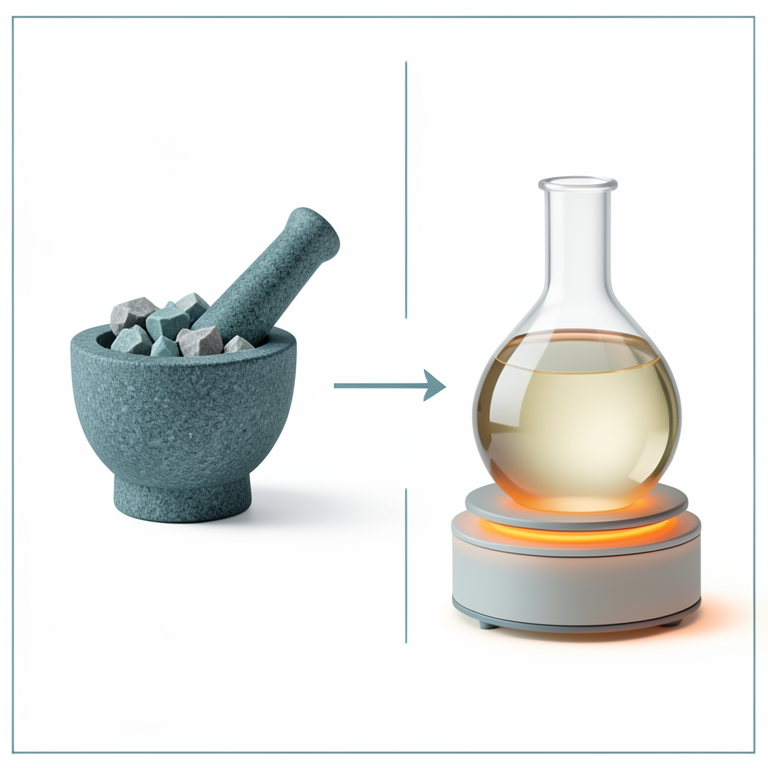
Comparison of Synthesis Methods
AI-generated conceptual illustration (agate mortar and pestle and a round-bottom flask with a heating mantle). It explains the idea and does not show study data.
View source evidence ↗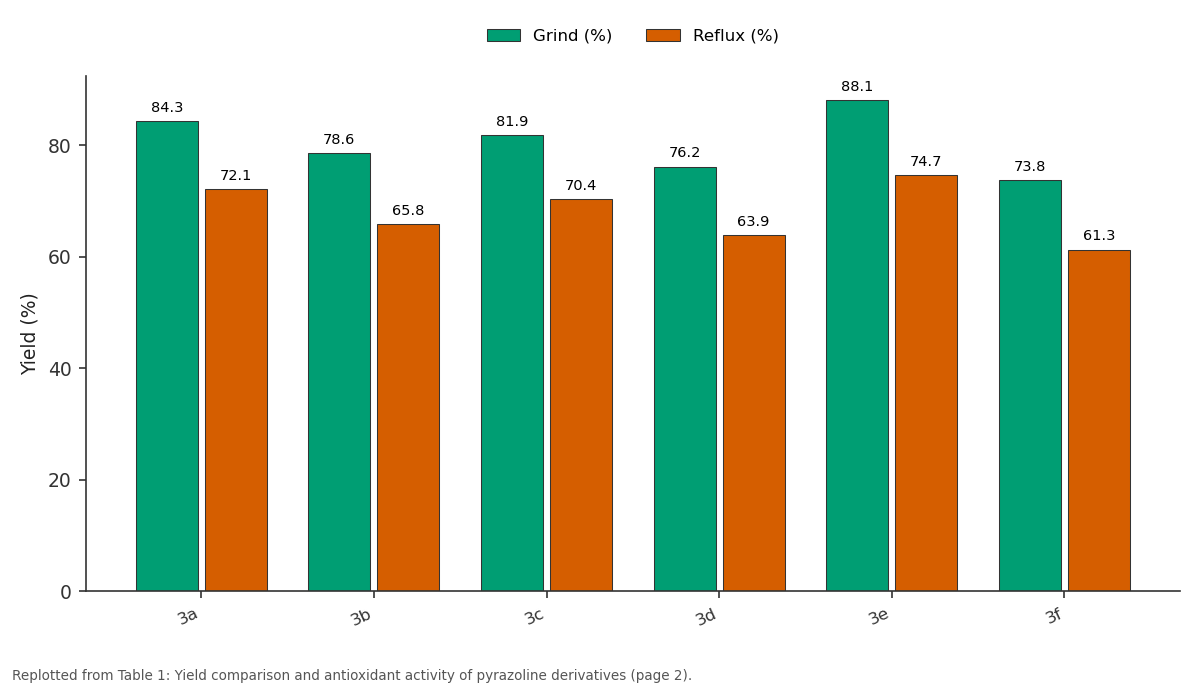
Grind (%) and Reflux (%): 3a vs 3b vs 3c vs 3d vs 3e
Replotted from Table 1 (page 2) of the original paper. Every bar is the paper's own table value.
View source evidence ↗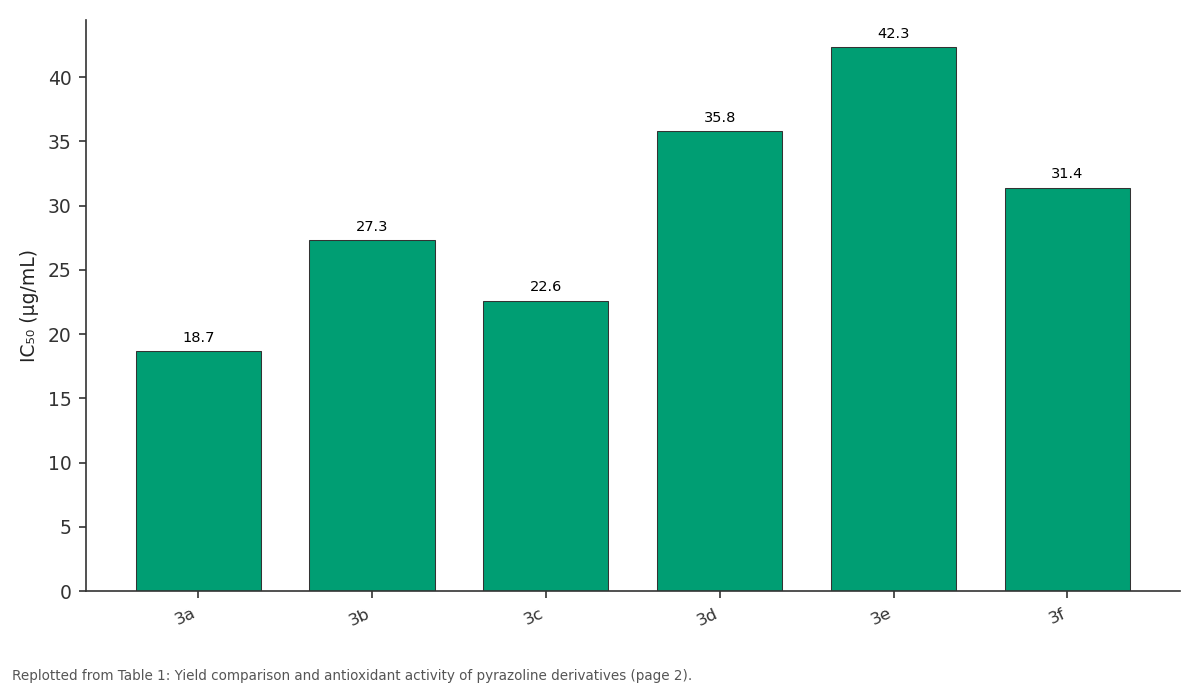
IC₅₀ (μg/mL): 3a vs 3b vs 3c vs 3d vs 3e
Replotted from Table 1 (page 2) of the original paper. Every bar is the paper's own table value.
View source evidence ↗Figures & tables
From the original paper Table 1
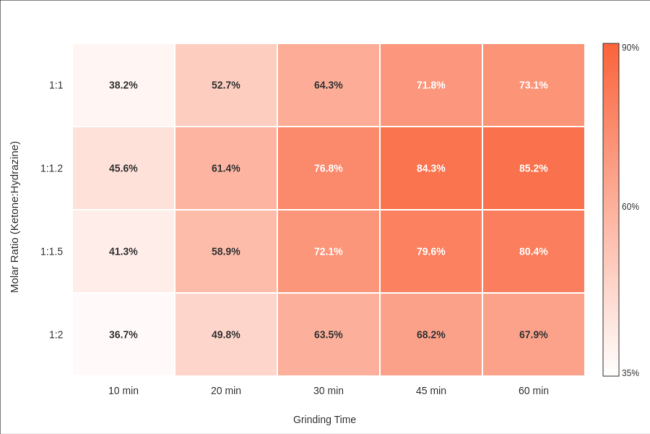 Figure 1
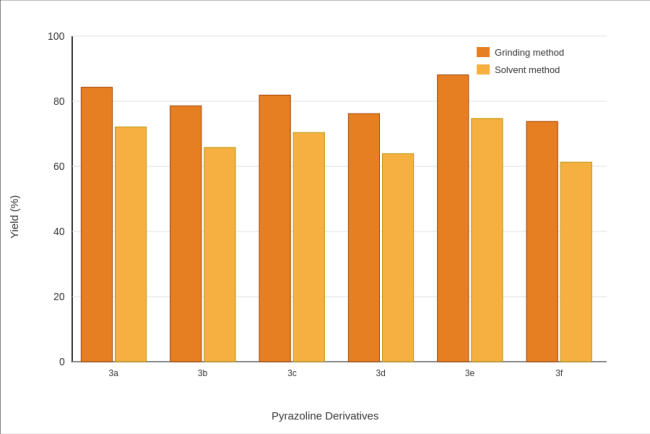 Figure 2
Introduction
Organic solvents account for more than 80% of the total mass in a typical bench-scale reaction-a problem that gets worse, not better, as reactions scale up [1] . Replacing solventmediated protocols with solvent-free alternatives is among the most direct ways to reduce the environmental footprint of chemical synthesis [2] . Mechanochemistry, where reagents are mixed and activated by mechanical force rather than dissolved in a liquid medium, has drawn growing attention as one such alternative. Ball-milling and manual grinding are the two most common mechanochemical approaches, and both have been applied to a variety of organic transformations including condensations, cycloadditions, and coupling reactions [3] . Pyrazolines are five-membered heterocyclic rings containing two adjacent nitrogen atoms, widely valued in medicinal chemistry for their anti-inflammatory, antimicrobial, antitumor, and antioxidant properties [4] . The standard route to 2-pyrazolines involves cyclization of α,βunsaturated ketones (chalcones) with hydrazine derivatives in refluxing ethanol or acetic acid, typically over 4-8 h [5] . Several groups have tried microwave-assisted and ultrasoundpromoted variations to cut reaction time [6] , but solvent-free grinding for pyrazoline formation has received comparatively little attention. Manual grinding in a mortar and pestle is perhaps the simplest mechanochemical setup imaginable-no electricity, no specialized equipment, and no solvent. If it can deliver acceptable yields, the practical advantages are hard to ignore. This research examines the synthesis of six pyrazoline derivatives (3a-3f) by grinding chalcone precursors with hydrazine hydrate at room temperature, optimizes the molar ratio and grinding duration, and compares yields and product purity against the conventional reflux method. Antioxidant activity is also screened to assess the pharmacological relevance of the products.
Theoretical Background
Pyrazoline ring formation from chalcones proceeds through a Michael addition followed by intramolecular cyclization. The hydrazine nitrogen attacks the β-carbon of the enone, forming a hydrazone intermediate that subsequently cyclizes via nucleophilic addition of the second nitrogen onto the carbonyl carbon [5] . In a solventfree grinding context, the intimate contact between solid reactants under mechanical force provides activation energy for this two-step pathway without requiring thermal input from a refluxing solvent [3] .
Materials and Methods
Materials and Methods
Materials
All experimental work took place between July 2023 and February 2024 at the Department of Synthetic Chemistry, Brandenburg University of Technology, Potsdam, Germany. The institutional ethics and safety committee approved the protocol (ESC/BUT/2023-028, dated 20 June 2023). Six chalcone precursors (1a-1f) were prepared beforehand by Claisen-Schmidt condensation of substituted benzaldehydes with acetophenone. Hydrazine hydrate (80%, Sigma-Aldrich), ethanol (99.8%, Merck), DPPH (2,2-diphenyl-1picrylhydrazyl, Alfa Aesar), and ascorbic acid (99%, SRL) were used without further purification.
Methods
Chalcone (1 mmol) and hydrazine hydrate (1-2 mmol, varied in optimization runs) were placed in an agate mortar and ground with a pestle at ambient temperature (22-25 °C). Reaction progress was monitored by TLC (ethyl acetate/hexane 3:7). After grinding, the crude product was washed with cold water, filtered, and recrystallized from ethanol. For comparison, the same reactions were run under conventional reflux (ethanol, 78 °C, 6 h) [7] . Products were characterized by FT-IR (Bruker Alpha II, ATR), ¹H-NMR and ¹³C-NMR (Bruker Avance 400 MHz, CDCl₃), and ESI-MS (Agilent 6130). Melting points were measured on an Electrothermal IA9100 apparatus. Antioxidant activity was determined by the DPPH free-radical scavenging assay [8] , with ascorbic acid as positive control.
Quality Control
Product purity was confirmed by HPLC (Agilent 1260, C18 column, acetonitrile/water gradient) with all compounds showing single peaks at >97% area. NMR spectra were referenced to residual CHCl₃ (δ 7.26 ppm for ¹H). Each reaction was performed in triplicate to determine reproducibility, and yields are reported as mean ± SD.
Results
Optimization trials identified a 1:1.2 ketone-to-hydrazine molar ratio and 45 min grinding time as optimal conditions, giving the highest yields across all six substrates. Longer grinding (60 min) offered negligible improvement, while shorter times (10-20 min) left substantial starting material unconverted. Doubling the hydrazine excess to 1:2 actually lowered yields slightly, probably because excess hydrazine promoted side reactions. FT-IR confirmed pyrazoline formation: the C=O stretch of chalcone precursors (near 1660 cm⁻¹) disappeared, replaced by C=N stretching at 1590-1598 cm⁻¹ and N-H bending near 3320 cm⁻¹. ¹H-NMR showed the diagnostic ABX pattern for the pyrazoline CH₂-CH protons between δ 3.05 and 5.20 ppm, with coupling constants consistent with the expected diastereotopic methylene environment. Across all six compounds, the grinding method outperformed the reflux route by 10.9-16.8 percentage points. Compound 3e showed the largest yield (88.1%), while 3f gave the lowest (73.8%). Melting point ranges were narrow (2-3 °C), and HPLC purity exceeded 97% for every derivative, indicating that the grinding approach doesn't compromise product quality.
Discussion
The consistent yield advantage of grinding over refluxaveraging 13.8 percentage points-is striking for such a simple technique. Two factors likely contribute. First, the high effective concentration of neat reactants accelerates the bimolecular Michael addition step, the rate-determining part of the cyclization sequence [5] . Second, continuous mechanical input refreshes reactant surfaces, preventing the formation of passivating product layers that can slow solidstate reactions [3] . That 3e gave the highest yield may reflect electronic effects. Its electron-withdrawing nitro group on the chalcone aromatic ring increases the electrophilicity of the β-carbon, making it more susceptible to nucleophilic attack by hydrazine. Conversely, 3f bears an electron-donating methoxy group, which deactivates the same positionexplaining its lower yield. This electronic trend mirrors what Rao et al. [7] observed in solvent-mediated pyrazoline synthesis. Antioxidant activity varied widely (IC₅₀ 18.7-42.3 μg/mL). Compound 3a, bearing a hydroxyl substituent, showed the strongest radical-scavenging ability, consistent with the known role of phenolic OH groups as hydrogen donors in DPPH assays [8] . While none of the derivatives matched ascorbic acid (IC₅₀ 6.2 μg/mL), the moderate activity suggests that further structural optimization could yield promising antioxidant leads.
Conclusion
Six pyrazoline derivatives were synthesized by solvent-free grinding of chalcones with hydrazine hydrate. Optimized conditions (1:1.2 molar ratio, 45 min) gave yields of 73.8-88.1%, outperforming the conventional reflux method by an average of 13.8 percentage points. Product purity exceeded 97% by HPLC in all cases. DPPH screening showed moderate antioxidant activity. The method eliminates solvent waste entirely, requires no heating or specialized equipment, and produces analytically pure compounds after a simple recrystallization. Extending this approach to other nitrogen heterocycles should be explored.
Figures and tables from the paper
| Compd. | Grind (%) | Reflux (%) | M.P. (°C) | IC₅₀ (μg/mL) | Purity HPLC (%) |
|---|---|---|---|---|---|
| 3a | 84.3 | 72.1 | 148-150 | 18.7 | 98.4 |
| 3b | 78.6 | 65.8 | 162-164 | 27.3 | 97.8 |
| 3c | 81.9 | 70.4 | 155-157 | 22.6 | 98.1 |
| 3d | 76.2 | 63.9 | 171-173 | 35.8 | 97.3 |
| 3e | 88.1 | 74.7 | 143-145 | 42.3 | 98.6 |
| 3f | 73.8 | 61.3 | 167-169 | 31.4 | 97.5 |
Table text extracted from the original PDF; superscript letters are shown inline. The original table image is below.
View original table image
References
12 in the original paper- Sheldon RA. The E factor 25 years on: the rise of green chemistry and sustainability. Green Chem. 2017;19(1):18-43.
- Tanaka K, Toda F. Solvent-free organic synthesis. Chem Rev. 2000;100(3):1025-1074.
- James SL, Adams CJ, Bolm C, et al. Mechanochemistry with ball mills. Chem Soc Rev. 2012;41(1):413-447.
- Shaaban MR, Mayhoub AS, Farag AM. Recent advances in the chemistry of pyrazolines. Expert Opin Ther Pat. 2012;22(3):253-291.
- Levai A. Synthesis of pyrazolines by the reaction of alpha-beta-unsaturated ketones with hydrazines. J Heterocycl Chem. 2002;39(1):1-13.
- Kaur K, Kumar V, Sharma AK, Gupta GK. Isoxazoline containing natural products as anticancer agents. Eur J Med Chem. 2014;77:121-138.
- Rao YK, Fang SH, Tzeng YM. Differential effects of synthesized 2-pyrazoline derivatives. Bioorg Med Chem. 2004;12(10):2679-2686.
- Brand-Williams W, Cuvelier ME, Berset C. Use of a free radical method to evaluate antioxidant activity. LWT Food Sci Technol. 1995;28(1):25-30.
- Friščić T, Jones W. Recent advances in understanding the mechanism of cocrystal formation via grinding. Cryst Growth Des. 2009;9(3):1621-1637.
- Rostovtsev VV, Green LG, Fokin VV, Sharpless KB. A stepwise Huisgen cycloaddition process. Angew Chem Int Ed. 2002;41(14):2596-2599.
- Kaupp G. Mechanochemistry: the varied applications of mechanical bond-breaking. CrystEngComm. 2009;11(3):388-403.
- Bruns CJ, Stoddart JF. Mechanochemical processes that pass through mechanically bonded intermediates. Nat Nanotechnol. 2013;8:9-10.