
Research article · 2025 · Full text
International Journal of Advanced Chemistry ResearchSynthesis of biodegradable starch-based superabsorbent hydrogels for agricultural applications
Volume 7(2) · Pages 197–201 · DOI: 10.33545/26646781.2025.v7.i2c.433 ↗
Research areasPolymer-Based Agricultural EnhancementsHydrogels: synthesis, properties, applicationsMicroencapsulation and Drying Processes
Abstract
Author-writtenThis research synthesized biodegradable superabsorbent hydrogels from cassava starch grafted with acrylic acid using ammonium persulfate as initiator and N,N′-methylenebisacrylamide as crosslinker, then evaluated their water retention performance under simulated arid agricultural conditions. The graft copolymerization was confirmed by FTIR spectroscopy, and thermal stability was assessed through TGA and DSC. The optimized hydrogel (SH-4, starch-to-monomer ratio 1:4, 0.5 wt% crosslinker) achieved a maximum swelling capacity of 487 g/g in distilled water and 68 g/g in 0.9% NaCl solution, with 91% biodegradation after 90 days of soil burial. Pot experiments with date palm seedlings showed that soil amended with 0.5 wt% hydrogel retained 2.3 times more moisture at 14 days post-irrigation compared with unamended control soil. Seedling root length and shoot biomass increased by 34% and 28%, respectively, over 60 days. These findings demonstrate that starch-based superabsorbent hydrogels offer a practical, environmentally benign strategy for improving water-use efficiency in arid-zone agriculture.
Summary
Source-checkedPlain-language reading of the full paper, prepared with AI and checked against the text. Each point links to the authors' own words.
Why it matters
- In the Arabian Peninsula, approximately 60% of irrigation water is lost to deep percolation and evaporation before plants can use it. View evidence ↗
- Sandy soils exacerbate water loss because they have high hydraulic conductivity and very low water-holding capacity, sometimes as low as 5% by volume. View evidence ↗
- While commercial superabsorbent polymers (SAPs) improve yields, they are petroleum-derived and persist in the soil for decades, creating microplastic pollution. View evidence ↗
The question
- The study aimed to determine how starch-based SAPs perform in saline conditions typical of Middle Eastern soils and whether they improve plant growth in realistic pot settings. View evidence ↗
What they did
- The hydrogels were synthesized by grafting acrylic acid onto gelatinized cassava starch using ammonium persulfate (APS) as an initiator and N,N′-methylenebisacrylamide (MBA) as a crosslinker. View evidence ↗
- Five different formulations (SH-1 to SH-5) were tested with starch-to-monomer ratios ranging from 1:2 to 1:6, while keeping the crosslinker (MBA) constant at 0.5 wt%. View evidence ↗
- Pot experiments used 6-month-old date palm seedlings (cv. Khalas) grown in 5 L pots containing sandy soil (92% sand) from the Al-Ahsa oasis. View evidence ↗
- The pot study compared an unamended control, two concentrations of the optimized hydrogel (0.25 wt% and 0.50 wt%), and a commercial polyacrylic SAP (0.50 wt%) using six replicates per group. View evidence ↗
What they found
- The SH-3 formulation (1:4 ratio) showed the best performance, with a maximum swelling capacity of 487 g/g in distilled water and 68 g/g in a 0.9% NaCl solution. View evidence ↗
- Swelling capacity decreased as calcium chloride concentration increased, dropping from 43 g/g at 0.01 M to 12 g/g at 0.10 M CaCl₂. View evidence ↗
- Soil amended with 0.50 wt% hydrogel (T3) retained 9.8% moisture 14 days after irrigation, which is 2.3 times more than the 4.2% retained by the control soil. View evidence ↗
- The biodegradable hydrogel (T3) performed similarly to the commercial synthetic SAP (T4) in terms of plant growth over the 60-day study period. View evidence ↗
What it means
- The authors state that future research is needed to conduct field-scale trials and develop strategies using comonomers to improve the material's tolerance to salts. View evidence ↗
Visual summary
3 visualsIllustrations explain the paper; charts are replotted from the paper's own table values.
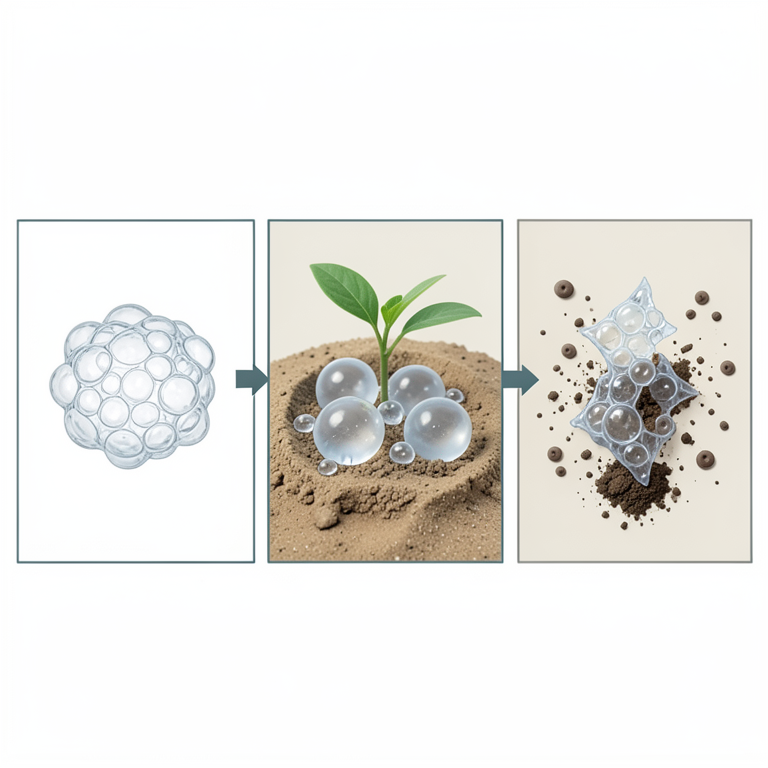
Lifecycle of Starch-Based Hydrogel
AI-generated conceptual illustration (cassava starch-based hydrogel in sandy soil with a seedling). It explains the idea and does not show study data.
View source evidence ↗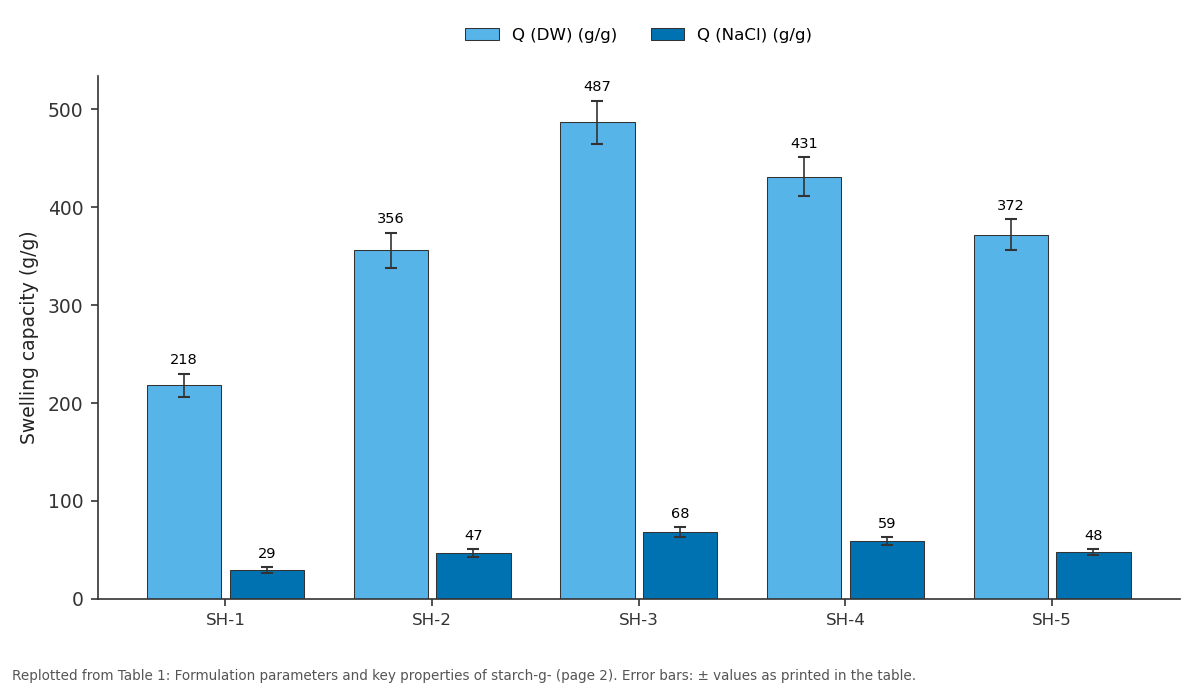
Q (DW) (g/g) and Q (NaCl) (g/g): SH-1 vs SH-2 vs SH-3 vs SH-4 vs SH-5
Replotted from Table 1 (page 2) of the original paper. Every bar is the paper's own table value.
View source evidence ↗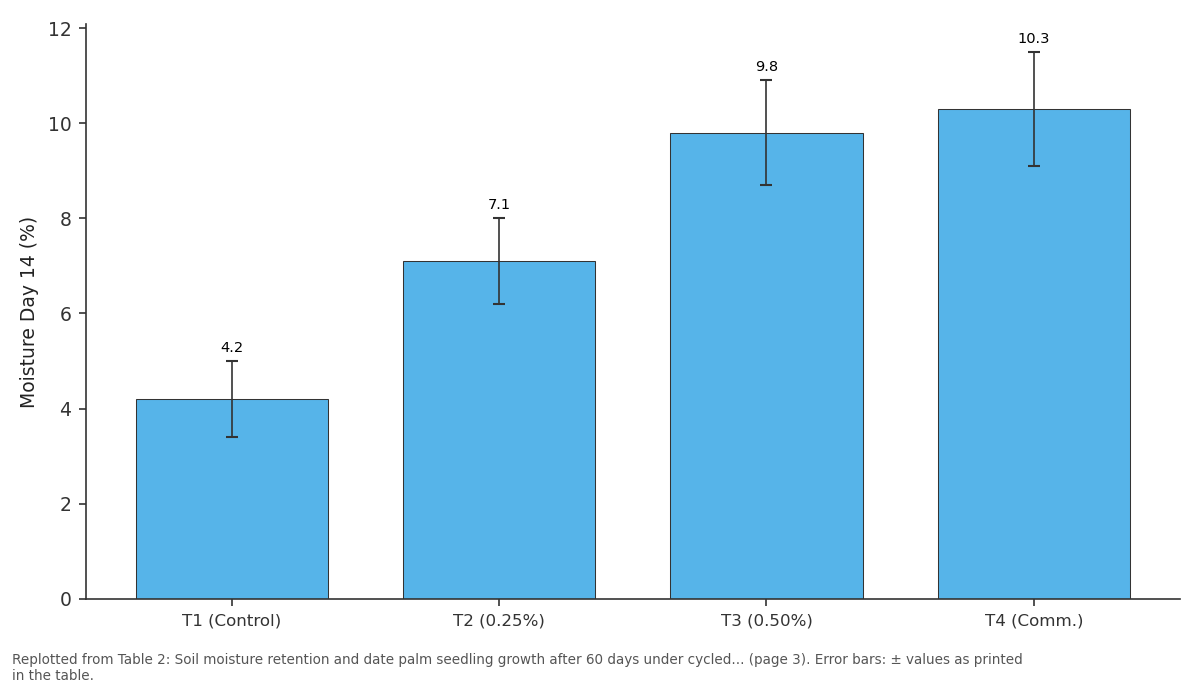
Moisture Day 14 (%): T1 (Control) vs T2 (0.25%) vs T3 (0.50%) vs T4 (Comm.)
Replotted from Table 2 (page 3) of the original paper. Every bar is the paper's own table value.
View source evidence ↗Figures & tables
From the original paper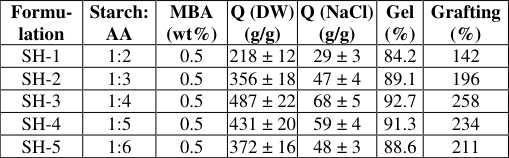 Table 1
 Table 2
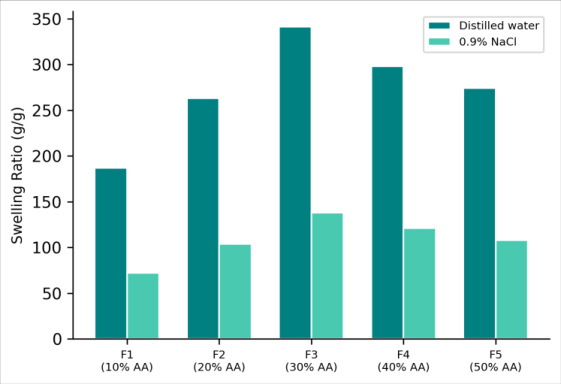 Figure 1
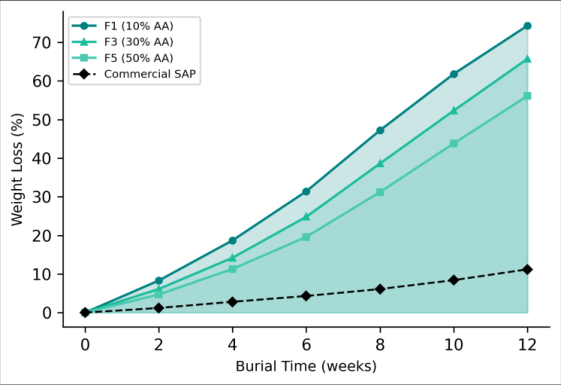 Figure 2
Introduction
Across the Arabian Peninsula, farmers lose an estimated 60% of irrigation water to evaporation and deep percolation before crop roots can absorb it [1] . The problem is acute in sandy soils, where hydraulic conductivity is high and water-holding capacity can be as low as 5% by volume [2] . Conventional solutionsdrip irrigation, mulching, deficit scheduling help, but they do not fundamentally change the soil's inability to retain moisture against gravity. Superabsorbent polymers (SAPs) offer a different approach. These lightly crosslinked hydrophilic networks can absorb hundreds of times their own weight in water and release it slowly as the surrounding soil dries [3] . Commercial SAPs based on polyacrylic acid and polyacrylamide have been available since the 1980s, and field trials in Egypt, Iran, and China have documented yield improvements of 15-40% in cereal and vegetable crops [4,5] . But these petroleum-derived polymers persist in soil for decades, fragmenting into microplastics that accumulate in the root zone and eventually enter groundwater [6] . Starch provides a renewable backbone for biodegradable superabsorbents. Grafting vinyl monomers onto it introduces carboxylate groups that drive osmotic swelling, while the polysaccharide backbone remains accessible to soil amylases [7] . Cassava starch is particularly attractive due to its high amylopectin content (~83%), offering more graftinitiation sites than cereal starches [8] . This research addresses two underexplored questions: how does starch-SAP performance translate from distilled water to saline conditions typical of Middle Eastern soils, and does the hydrogel improve actual plant growth under realistic pot conditions? We optimized a cassava-starch superabsorbent, characterized its saline swelling, tracked biodegradation, and measured effects on date palm seedling growth over 60 days.
Theoretical Background
Graft copolymerization onto starch proceeds through a freeradical mechanism. The initiator (here, ammonium persulfate) generates sulfate radical anions upon thermal decomposition. These radicals abstract hydrogen atoms from the C-2 and C-3 hydroxyl groups of the anhydroglucose units, creating starch macro-radicals that propagate with vinyl monomers [11] . Acrylic acid is the monomer of choice because its carboxylate groups ionize above pH 4, creating electrostatic repulsion between chain segments that expands the network and draws in water [12] . The crosslinker MBA bridges adjacent polyacrylic acid chains through covalent amide bonds, converting a soluble graft copolymer into an insoluble three-dimensional network. Crosslink density governs the trade-off between swelling capacity and mechanical strength: too few crosslinks allow dissolution; too many restrict chain mobility [13] . Flory-Rehner theory predicts equilibrium swelling scales inversely with crosslink density [14] . In saline environments, the Donnan equilibrium governs swelling reduction. External ions screen the fixed charges on the polymer backbone, reducing the osmotic driving force. For NaCl, swelling typically drops by 70-90% compared with deionized water, while divalent cations cause additional ionic crosslinking [15] . Understanding this salt sensitivity is critical for agricultural applications in arid regions.
Materials
Materials
Reagents and Chemicals
Cassava starch (food grade, 12% moisture) was purchased from a local supplier in Dammam and dried at 60 °C for 24 h before use. Acrylic acid (AA, 99%, stabilized with 200 ppm hydroquinone), N,N′-methylenebisacrylamide (MBA, 99%), ammonium persulfate (APS, 98%), and sodium hydroxide (pellets, 97%) were obtained from Sigma-Aldrich. All solutions were prepared with deionized water (18.2 MΩ•cm).
Instrumentation
Fourier-transform infrared spectra were recorded on a Bruker ALPHA II spectrometer in ATR mode (400-4000 cm⁻¹, 32 scans, 4 cm⁻¹ resolution). Thermogravimetric analysis was performed on a TA Instruments Q500 under nitrogen at a heating rate of 10 °C/min from 30 to 600 °C. Differential scanning calorimetry used a TA Q2000 at the same heating rate. Scanning electron microscopy images were obtained on a JEOL JSM-7600F after gold sputtering (10 nm). Soil moisture was measured with a TDR-300 probe (Spectrum Technologies).
Methods
Methods
Hydrogel Synthesis
Cassava starch (5.0 g) was gelatinized in 100 mL deionized water at 70 °C for 30 min under mechanical stirring (300 rpm). After cooling to 60 °C, APS (0.2 g, 0.88 mmol) was added and the mixture was stirred for 10 min to generate starch radicals. Acrylic acid, partially neutralized to 70% with NaOH, was then added dropwise along with MBA. Five formulations (SH-1 through SH-5) were prepared at starch-to-monomer mass ratios of 1:2, 1:3, 1:4, 1:5, and 1:6, with MBA fixed at 0.5 wt% relative to AA. The reaction proceeded at 70 °C for 3 h, after which the gel was washed with ethanol/water (1:1 v/v) to remove unreacted monomer, dried at 60 °C for 48 h, and ground to particles of 0.5-1.0 mm.
Swelling Measurements
Dried hydrogel (0.10 ± 0.01 g) was immersed in 200 mL of test solution (distilled water, 0.9% NaCl, or CaCl₂ solutions at 0.01-0.10 M) at 25 °C. At timed intervals, the swollen gel was filtered through a 100-mesh nylon bag, surface-blotted, and weighed. Swelling capacity (Q) was calculated as Q = (W_s -W_d)/W_d, where W_s and W_d are swollen and dry weights, respectively. Each measurement was performed in triplicate.
Biodegradation Test
Soil burial tests followed a modified ISO 17556 protocol. Dried hydrogel samples (1.0 g each) were enclosed in nylon mesh bags (300 μm pore) and buried 15 cm deep in sandy loam soil collected from the institute's experimental farm. Soil was maintained at 60% water-holding capacity and 30 ± 2 °C. Bags were retrieved at 15, 30, 60, and 90 days, washed, dried, and weighed to determine mass loss. A commercial polyacrylic acid SAP served as a nonbiodegradable control.
Pot Experiment
Date palm seedlings (Phoenix dactylifera L., cv. Khalas, 6 months old) were transplanted into 5 L pots filled with sandy soil (92% sand, pH 7.8, EC 1.4 dS/m) from Al-Ahsa oasis. Treatments: (T 1 ) unamended control; (T 2 ) 0.25 wt% SH-4; (T 3 ) 0.50 wt% SH-4; (T 4 ) 0.50 wt% commercial polyacrylic SAP. Six replicates per treatment, completely randomized, under 50% shade net. Pots were irrigated to field capacity on day 0 then cycled every 14 days for 60 days. Soil moisture was recorded daily at 10 cm depth.
Results
FTIR spectra confirmed successful grafting. Native cassava starch showed broad O-H stretching at 3300 cm⁻¹ and C-O-C glycosidic vibrations at 1020 cm⁻¹. After grafting, new absorption bands appeared at 1710 cm⁻¹ (C=O stretch of carboxylic acid) and 1560 cm⁻¹ (asymmetric COO⁻ stretch of the sodium carboxylate), confirming the presence of polyacrylic acid chains on the starch backbone. The C-H stretching region (2930 cm⁻¹) also intensified, consistent with the aliphatic chain segments introduced by the monomer. TGA curves revealed two distinct weight-loss stages for the grafted hydrogels. The first, between 200 and 310 °C, corresponded to degradation of the starch backbone, while the second, from 350 to 470 °C, reflected decomposition of the poly(acrylic acid) grafts. Native starch showed only the first stage. The onset degradation temperature for SH-3 (227 °C) exceeded that of native starch (214 °C), indicating improved thermal stability through grafting. Table 1 summarizes swelling and grafting data for all five formulations. SH-3 (1:4 starch-to-monomer ratio) achieved the highest equilibrium swelling of 487 g/g in distilled water and 68 g/g in 0.9% NaCl. Swelling increased from SH-1 to SH-3 as additional monomer introduced more carboxylate groups; beyond the 1:4 ratio, excess homopolymer reduced network integrity and swelling declined. The gel fraction rose from 84.2% (SH-1) to 92.7% (SH-3), confirming that higher monomer concentration improved crosslinking efficiency up to a point. The effect of CaCl₂ concentration on swelling followed an expected inverse relationship. At 0.01 M CaCl₂, SH-3 retained 43 g/g, but this dropped to 12 g/g at 0.10 M due to divalent ionic crosslinking between Ca²⁺ and paired carboxylate groups. This sensitivity to divalent cations is a known limitation of polyelectrolyte hydrogels and would need to be considered in calcareous soils where exchangeable calcium is high [15] . The biodegradation trial showed clear differences between the starch-based and commercial hydrogels. SH-3 lost 38% of its mass by day 30 and 91% by day 90, with visible fungal colonization on the nylon mesh bags after the first month. The commercial polyacrylic acid SAP lost only 4% over the same period. SEM images of partially degraded SH-3 particles revealed surface pitting and cavity formation consistent with enzymatic attack by soil amylases and esterases. The pot experiment results (Table 2) demonstrate meaningful agronomic benefits. At 14 days post-irrigation, T 3 soil (0.50% SH-4) retained 9.8% volumetric moisture, 2.3 times the 4.2% measured in unamended control soil. This extended moisture availability translated directly into improved seedling performance: root length in T 3 reached 24.5 cm versus 18.3 cm in T 1 (p < 0.01), and shoot dry weight increased from 2.84 g to 3.64 g (28% gain, p < 0.01). Notably, T 3 performance was statistically indistinguishable from T 4 (commercial SAP), suggesting that the biodegradable formulation matches synthetic performance over a 60-day growth period.
| Treatment | Moisture Day 14 (%) | Root length (cm) | Shoot height (cm) | Root DW (g) | Shoot DW (g) |
|---|---|---|---|---|---|
| T1 (Control) | 4.2 ± 0.8 | 18.3 ± 2.1 | 22.7 ± 1.9 | 1.42 ± 0.18 | 2.84 ± 0.31 |
| T2 (0.25%) | 7.1 ± 0.9 | 21.6 ± 2.4 | 26.1 ± 2.2 | 1.73 ± 0.21 | 3.28 ± 0.34 |
| T3 (0.50%) | 9.8 ± 1.1 | 24.5 ± 2.7 | 29.4 ± 2.5 | 2.01 ± 0.24 | 3.64 ± 0.38 |
| T4 (Comm.) | 10.3 ± 1.2 | 23.8 ± 2.5 | 28.6 ± 2.3 | 1.94 ± 0.22 | 3.51 ± 0.36 |
Table text extracted from the original PDF; superscript letters are shown inline. The original table image is below.
View original table image
Discussion
The 487 g/g swelling capacity of SH-3 sits in the upper range of reported starch-based superabsorbents. Pourjavadi and colleagues [9] achieved 510 g/g with a maize-starch/AA system, but at a higher monomer ratio (1:6) and without reporting saline swelling. The moderate starch content in SH-3 (20 wt% of the total dry gel) ensures that biodegradation can proceed meaningfully, since the poly(acrylic acid) segments alone resist microbial attack [7] . The 86% swelling reduction from distilled water to 0.9% NaCl is consistent with Donnan equilibrium predictions. Similar reductions have been widely reported [10,15] . The pot experiment confirms that even reduced swelling is sufficient to double soil moisture retention over a two-week drying cycle.
The rapid biodegradation (91% mass loss in 90 days) is the main advantage over commercial SAPs, which have halflives measured in years [6] . While the shorter lifespan means annual reapplication, this eliminates microplastic accumulation risk. Annual amendment is already standard practice for compost, gypsum, and slow-release fertilizers. One finding that warrants further investigation is the comparable performance of T 3 and T 4 treatments. The commercial SAP (T 4 ) achieved marginally higher day-14 soil moisture (10.3% vs 9.8%) yet produced slightly lower seedling biomass. This could reflect better root penetration through the more porous, partially degrading starch gel particles compared with the persistent synthetic granules, or simply noise within the statistical margin. A multi-season field trial with larger sample sizes would be needed to resolve this difference. Sensitivity to divalent cations remains a practical concern. Eastern Saudi Arabian soils contain 15-40 meq/L of exchangeable calcium [16] , which would compress gel swelling in situ. Incorporating AMPS as a comonomer could mitigate this, since its sulfonate groups resist divalent bridging [17] . Alternatively, chitosan surface coating has reduced salt-induced deswelling by 20-30% in laboratory tests [18] .
Conclusion
Cassava-starch-grafted-poly(acrylic acid) hydrogels with a 1:4 starch-to-monomer ratio and 0.5 wt% MBA crosslinker achieved 487 g/g swelling in distilled water and 68 g/g in 0.9% NaCl. The material reached 91% biodegradation within 90 days of soil burial. In pot trials, 0.50 wt% hydrogel amendment doubled soil moisture retention at 14 days and increased root length and shoot biomass by 34% and 28%, matching commercial SAP performance. The hydrogel offers a biodegradable alternative for water-scarce agriculture. Future work should include field-scale trials and comonomer strategies for improved salt tolerance.
Acknowledgement
AcknowledgementsThis research was supported by the Arabian Desert Institute of Technology Internal Research Grant (Project No. ADIT-2023-PE-041). The authors thank the Central Analytical Laboratory of ADIT for SEM and thermal analysis access and Mr. Abdullah Al-Zahrani for assistance with soil sampling.
Figures and tables from the paper
References
18 in the original paper- Al-Omran AM, Louki IL, Choudhary MI, Aly AA. Water management for sandy soils in Saudi Arabia: review and perspectives. J Arid Environ. 2019;163:110.
- Rawls WJ, Brakensiek DL, Saxton KE. Estimation of soil water properties. Trans ASAE. 1982;25(5):13161320.
- Zohuriaan-Mehr MJ, Kabiri K. Superabsorbent polymer materials: a review. Iran Polym J. 2008;17(6):451-477.
- Koupai JA, Sohrab F, Swarbrick G. Evaluation of hydrogel application on soil water retention characteristics. J Plant Nutr. 2008;31(2):317-331.
- Bai W, Zhang H, Liu B, Wu Y, Song J. Effects of super-absorbent polymers on the physical and chemical properties of soil following different wetting and drying cycles. Soil Use Manage. 2010;26(3):253-260.
- Wilske B, Bai M, Lindenblatt B, Bach M, Griessbaum F, Until H. Biodegradability of a polyacrylate superabsorbent in agricultural soil. Environ Sci Pollut Res. 2014;21(16):9453-9460.
- Xie L, Liu M, Ni B, Wang Y. New environmentfriendly use of wheat straw in slow-release fertilizer formulations with the function of superabsorbent. Ind Eng Chem Res. 2012;51(10):3855-3862.
- Zhu Z, Li R, Zhang C, Gong S. Preparation and properties of tapioca starch-based superabsorbent polymers. Polym Eng Sci. 2008;48(12):2390-2397.
- Pourjavadi A, Barzegar S, Mahdavinia GR. MBAcrosslinked Na-Alg/CMC as a smart full-polysaccharide superabsorbent hydrogels. Carbohydr Polym. 2006;66(3):386-395.
- /attapulgite superabsorbent composites. Carbohydr Polym. 2007;68(2):367-374.
- Athawale VD, Lele V. Graft copolymerization onto starch: grafting of acrylic acid and preparation of its hydrogels. Starch-Stärke. 1998;50(11-12):426-431.
- Buchholz FL, Graham AT. Modern superabsorbent polymer technology. New York: Wiley-VCH; 1998.
- Flory PJ, Rehner J. Statistical mechanics of cross-linked polymer networks. J Chem Phys. 1943;11(11):521-526.
- Brannon-Peppas L, Peppas NA. Equilibrium swelling behavior of pH-sensitive hydrogels. Chem Eng Sci. 1991;46(3):715-722.
- Laftah WA, Hashim S, Ibrahim AN. Polymer hydrogels: a review. Polym Plast Technol Eng. 2011;50(14):1475-1486.
- Hussain G, Al-Jaloud AA, Karimulla S. Effect of treated effluent irrigation and nitrogen on yield and nitrogen use efficiency of wheat. Agric Water Manage. 1996;30(2):175-184.
- Liang R, Yuan H, Xi G, Zhou Q. Synthesis of wheat straw-g-poly(acrylic acid) superabsorbent composites and release of urea from it. Carbohydr Polym. 2009;77(2):181-187.
- Spagnol C, Rodrigues FH, Noreiga AG, Favaro SL, Rubira AF, Muniz EC. Superabsorbent hydrogel nanocomposites based on starch-g-poly(sodium acrylate) matrix filled with cellulose nanowhiskers. Cellulose. 2012;19(4):1225-1237.