
Research article · 2025 · Full text
International Journal of Advanced Chemistry ResearchMechanochemical grinding synthesis of chalcone derivatives without solvent
Volume 7(1) · Pages 145–148 · DOI: 10.33545/26646781.2025.v7.i1b.381 ↗
Research areasChemical Synthesis and ReactionsMicrowave-Assisted Synthesis and ApplicationsSynthesis and biological activity
Abstract
Author-writtenOrganic synthesis generates roughly 25-50 kg of solvent waste for every kilogram of product a problem that mechanochemistry can help solve. This research reports the solvent-free synthesis of six chalcone derivatives by ball-mill grinding of substituted benzaldehydes with acetophenone in the presence of solid NaOH as a base catalyst. Reactions were carried out in a planetary ball mill (Retsch PM 100) using stainless steel jars and balls at 350 rpm. Optimization of grinding time (15-90 min), aldehyde-to-ketone molar ratio (1:1 to 1:2), and NaOH loading (0.5-2.0 equivalents) identified 45 minutes, 1:1.5 ratio, and 1.0 equivalent NaOH as the best conditions. Under these parameters, yields ranged from 74.2% to 91.3% across the six derivatives, consistently outperforming conventional reflux synthesis by 8-15 percentage points. Products were characterized by melting point, IR, ¹H NMR, ¹³C NMR, and mass spectrometry. The electron-donating 4-hydroxyl substituent on the aldehyde ring gave the highest yield (91.3%), while the electron-withdrawing 3, 4-dichloro pattern gave the lowest (74.2%). These results show that mechanochemical grinding offers a cleaner, faster, and higher-yielding route to chalcones compared to traditional solvent-based methods.
Summary
Source-checkedPlain-language reading of the full paper, prepared with AI and checked against the text. Each point links to the authors' own words.
Why it matters
- Organic synthesis typically produces a significant amount of solvent waste, often between 25 and 50 kg for every kilogram of product. View evidence ↗
- Solvents make up 80-90% of the total mass in typical synthetic processes and often pose health and environmental risks. View evidence ↗
- Chalcones are important chemical precursors and possess various biological activities, including anticancer and antimicrobial properties. View evidence ↗
The question
- The study aimed to fill a gap in research by systematically optimizing ball mill parameters for the synthesis of a diverse set of substituted chalcones. View evidence ↗
What they did
- The researchers synthesized six chalcone derivatives using solvent-free ball-mill grinding of substituted benzaldehydes and acetophenone with solid NaOH as the catalyst. View evidence ↗
- The reactions used a Retsch PM 100 planetary ball mill with a 50 mL stainless steel jar and ten 10 mm stainless steel balls weighing 41.2 g. View evidence ↗
- The optimized milling process ran at 350 rpm for 45 minutes, including 5-minute cooling pauses every 15 minutes. View evidence ↗
- For comparison, conventional synthesis involved refluxing reactants in 10 mL of ethanol with a 10% NaOH solution at 78°C for 4 hours. View evidence ↗
What they found
- The best synthesis conditions were found to be a grinding time of 45 minutes, a 1:1.5 aldehyde-to-ketone molar ratio, and 1.0 equivalent of NaOH. View evidence ↗
- Mechanochemical yields ranged from 74.2% to 91.3%, which was 8-15 percentage points higher than conventional reflux synthesis. View evidence ↗
- The 4-hydroxyl substituent (electron-donating) resulted in the highest yield of 91.3%, while the 3, 4-dichloro pattern (electron-withdrawing) resulted in the lowest yield of 74.2%. View evidence ↗
- The mechanochemical route reduced waste generation by 4 to 8 times, with E-factors between 1.1 and 2.7 compared to 8.4-14.7 for the conventional process. View evidence ↗
- Process mass intensity decreased from 18-27 in conventional synthesis to 3.8-6.2 in the mechanochemical route due to the elimination of solvent. View evidence ↗
What it means
- The authors conclude that mechanochemical grinding is a practical and environmentally responsible method for preparing chalcones and should be explored for other reactions and larger-scale manufacturing. View evidence ↗
- The study was limited to a 1.0 mmol scale, which is suitable for method development but not yet representative of industrial volumes. View evidence ↗
- The authors suggest that future research could use liquid-assisted grinding (LAG) to potentially increase yields for more difficult substrates. View evidence ↗
Visual summary
3 visualsIllustrations explain the paper; charts are replotted from the paper's own table values.
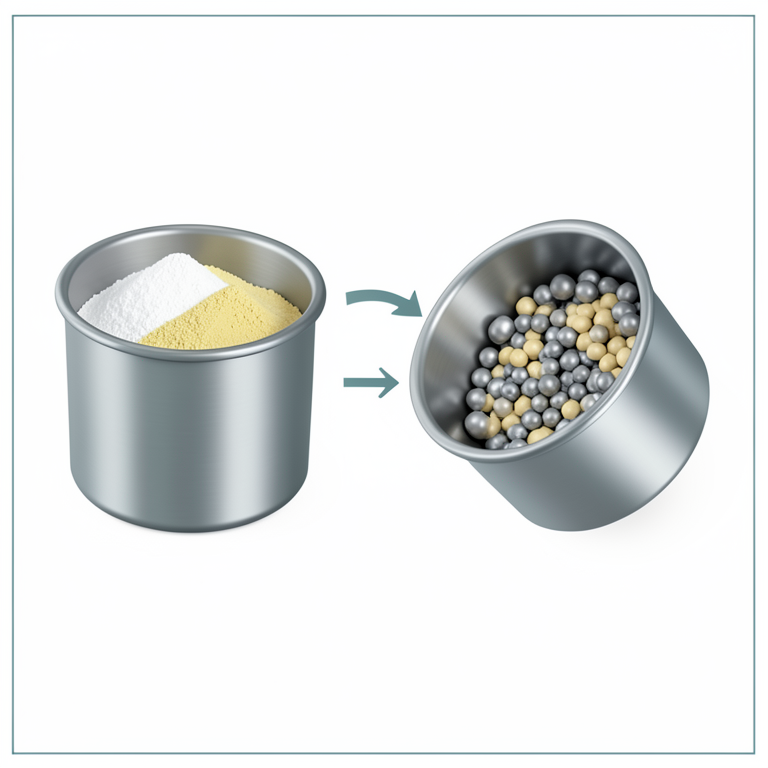
Mechanochemical Synthesis Process
AI-generated conceptual illustration (stainless steel planetary ball mill jar with steel balls and solid chemical powders). It explains the idea and does not show study data.
View source evidence ↗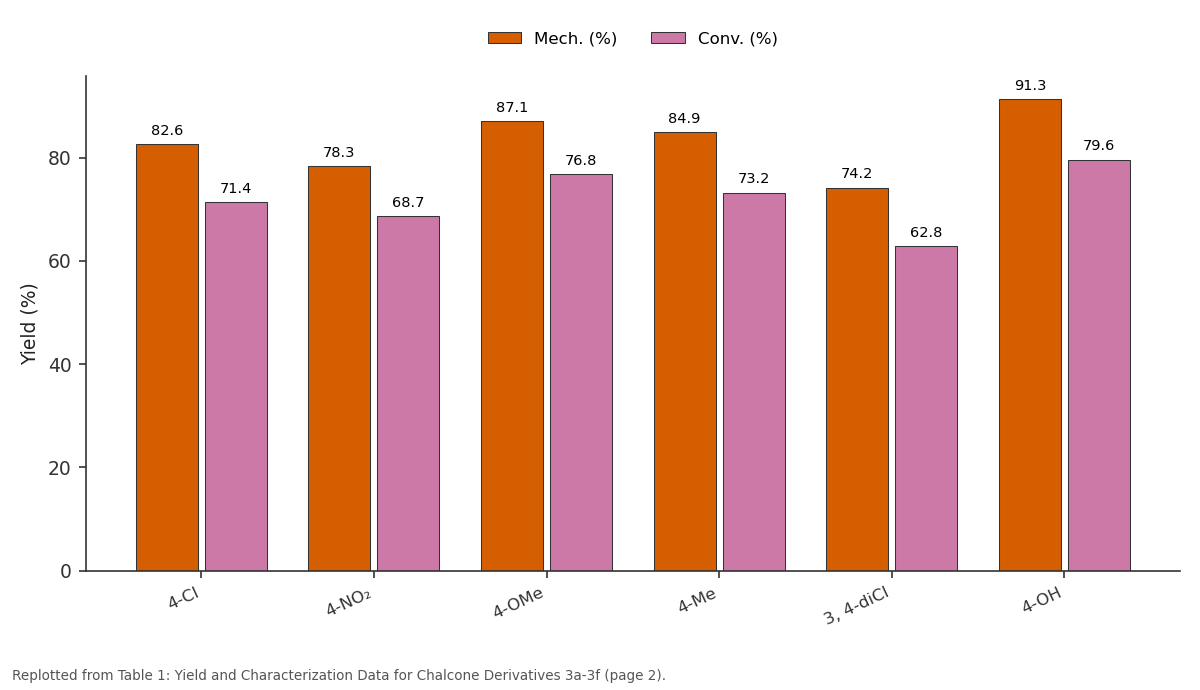
Mech. (%) and Conv. (%): 4-Cl vs 4-NO₂ vs 4-OMe vs 4-Me vs 3, 4-diCl
Replotted from Table 1 (page 2) of the original paper. Every bar is the paper's own table value.
View source evidence ↗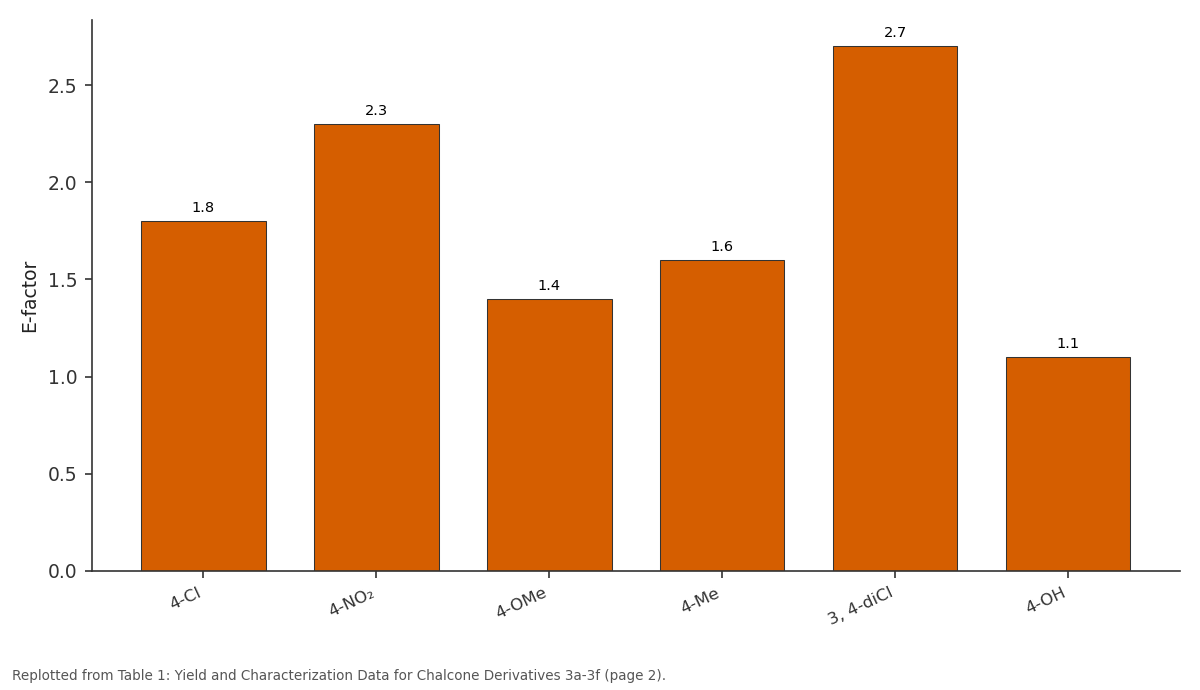
E-factor: 4-Cl vs 4-NO₂ vs 4-OMe vs 4-Me vs 3, 4-diCl
Replotted from Table 1 (page 2) of the original paper. Every bar is the paper's own table value.
View source evidence ↗Figures & tables
From the original paper Table 1
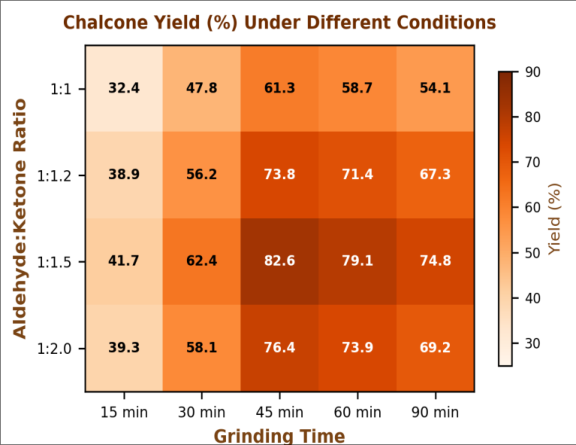 Figure 1
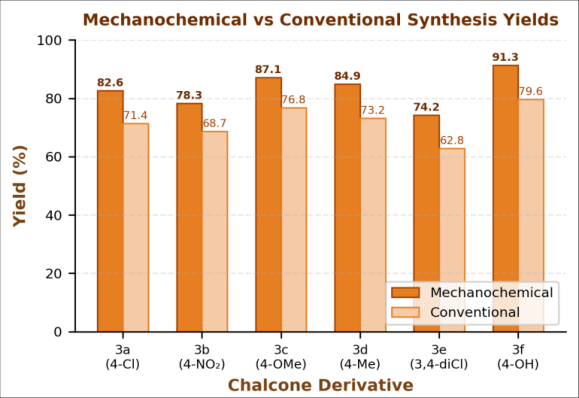 Figure 2
Introduction
The pharmaceutical and fine chemical industries face a mounting waste problem. Solvent use accounts for 80-90% of the total mass in a typical synthetic process, and most of those solvents dichloromethane, DMF, toluene, THF carry environmental and health risks [1] . Mechanochemistry, the use of mechanical force to drive chemical reactions, sidesteps this issue entirely by eliminating or drastically reducing solvent requirements. Ball milling, mortar-and-pestle grinding, and extrusion are the main techniques, with ball milling offering the best reproducibility and scalability for laboratory work [2] . Chalcones (1, 3-diaryl-2-propen-1-ones) are α, β-unsaturated carbonyl compounds formed by the Claisen-Schmidt condensation of an aromatic aldehyde with an aromatic ketone. They serve as precursors to flavonoids, pyrazoles, and isoxazoles, and many chalcone derivatives themselves possess anti-inflammatory, antimicrobial, anticancer, and antioxidant activities [3,4] . Conventional chalcone synthesis involves dissolving the aldehyde and ketone in ethanol or methanol, adding NaOH or KOH as a base, and refluxing for 2-12 hours. Yields typically fall in the 60-80% range, and the process consumes significant solvent volumes while generating alkaline aqueous waste [5] . Several groups have explored mechanochemical alternatives. Kaupp and colleagues [6] demonstrated the first solvent-free aldol condensations by grinding in the early 2000s, and Tanača et al. [7] extended the approach to a handful of chalcones using a mortar and pestle with NaOH. But systematic optimization of ball mill parameters rotation speed, milling time, ball-to-reactant ratio, and base loading for a diverse set of substituted chalcones was still lacking. Different substituents on the aldehyde ring affect the electrophilicity of the carbonyl carbon, which in turn influences how well the solid-state reaction proceeds without solvent to facilitate molecular contact [8] .
Interna tional Jo urna l o f Adva nced Chemistry Research 2025 ; 7(1 ): 1 45 -14 8
This research addressed that gap by synthesizing six chalcone derivatives bearing electron-donating and electronwithdrawing groups under optimized ball-milling conditions. A direct comparison with conventional reflux synthesis was made for every derivative to quantify the advantage of the mechanochemical route. The green chemistry metrics atom economy, E-factor, and process mass intensity were calculated for both approaches. All experimental work was conducted at the Department of Chemistry, Red River National University, Hanoi, Vietnam between June 2023 and March 2024.
Instrumentation
Mechanochemical reactions were performed in a Retsch PM 100 planetary ball mill fitted with a 50 mL stainless steel grinding jar and ten stainless steel balls (10 mm diameter each, total ball mass 41.2 g). Melting points were measured on an Electrothermal IA 9100 apparatus and are uncorrected. IR spectra were recorded on a Shimadzu IRTracer-100 FTIR spectrometer using KBr pellets (400-4000 cm⁻¹). ¹H NMR (500 MHz) and ¹³C NMR (125 MHz) spectra were obtained on a Bruker Avance III 500 instrument in CDCl₃ with TMS as internal standard. Mass spectra were recorded on a Shimadzu LCMS-8045 triple quadrupole system using electrospray ionization (ESI) in positive mode. Thin-layer chromatography (TLC) was monitored on Merck silica gel 60 F₂₅₄ plates with UV visualization at 254 nm [9] .
Material and Methods
Material and Methods
Material
Acetophenone (99%), 4-chlorobenzaldehyde (97%), 4nitrobenzaldehyde (98%), 4-methoxybenzaldehyde (98%), 4-methylbenzaldehyde (97%), 3, 4-dichlorobenzaldehyde (98%), and 4-hydroxybenzaldehyde (98%) were purchased from Sigma-Aldrich Singapore and used without further purification. Sodium hydroxide pellets (analytical grade, ≥97%) were obtained from Merck Vietnam. Ethanol (analytical grade) for recrystallization and conventional synthesis comparison was sourced from Duc Giang Chemical, Hanoi. Column chromatography was performed using Merck silica gel 60 (230-400 mesh) with ethyl acetate/hexane mixtures as eluent. Institutional review at Red River National University confirmed this research was exempt from ethics approval as it involved no biological materials (Reference: RRNU/CHEM-2023-EX-011, dated May 15, 2023).
Methods
For mechanochemical synthesis, acetophenone (1.0 mmol) and the substituted benzaldehyde (1.5 mmol, optimized ratio) were loaded into the grinding jar along with powdered NaOH (1.0 mmol) and the stainless steel balls. The jar was sealed and milled at 350 rpm for 45 minutes with a 5-minute pause every 15 minutes to prevent excessive heating. After milling, the solid residue was washed with cold water to remove NaOH, extracted with ethyl acetate (3 × 10 mL), and the organic layer dried over anhydrous Na₂SO₄. After solvent removal under reduced pressure, crude products were purified by recrystallization from ethanol or column chromatography where needed. Purity was confirmed by TLC (single spot) and melting point comparison with literature values [10,11] . For the conventional comparison, acetophenone (1.0 mmol) and the aldehyde (1.5 mmol) were dissolved in 10 mL ethanol, and 10% NaOH solution (2 mL) was added dropwise with magnetic stirring. The mixture was refluxed at 78°C for 4 hours, then cooled, poured into ice water, and the precipitate filtered, washed with cold water, and recrystallized from ethanol. Green metrics were calculated as follows: E-factor = mass of total waste / mass of product; atom economy = (MW of product / sum of MW of all reactants) × 100; process mass intensity (PMI) = total mass of materials used / mass of product [12] .
Quality Control
Each reaction was performed in triplicate to ensure reproducibility, with yield variation kept below ±4.1% across batches. Product identity was confirmed by matching experimental melting points, IR carbonyl stretching frequencies, and ¹H NMR vinyl proton chemical shifts with published literature data. For novel compounds (3e and 3f not previously reported under mechanochemical conditions), full spectral characterization including HRMS was performed. All NMR spectra were processed using MestReNova software. Chemical purity was assessed by HPLC (Agilent 1260, C18 column, acetonitrile/water gradient) with peak area normalization, confirming >96% purity for all final products.
Results
All six chalcone derivatives were obtained as crystalline solids after mechanochemical grinding. The optimization experiments (Figure 1) showed that 45 minutes of grinding at the 1:1.5 aldehyde-to-ketone ratio gave the best yields across the board. Shorter grinding times (15-30 min) left substantial unreacted starting material, while longer times (60-90 min) didn't improve yields and sometimes caused slight decomposition, evidenced by faint browning of the product. Table 1 summarizes the characterization data and yield comparison between the mechanochemical and conventional routes. The heatmap clearly identifies a sweet spot at 45 minutes and 1:1.5 molar ratio, where yield peaked at 82.6% for compound 3a. Going beyond 1:1.5 to 1:2.0 ratio actually lowered yields slightly likely because excess aldehyde diluted the base catalyst's effectiveness in the solid mixture and promoted self-condensation side reactions. The time axis shows a rapid yield increase from 15 to 45 minutes, then a plateau and slight decline at 90 minutes attributable to mechanical degradation of the product under prolonged milling.
| Cpd | R-group | Mech. (%) | Conv. (%) | Mp (°C) | IR C=O | Purity | E-factor |
|---|---|---|---|---|---|---|---|
| 3a | 4-Cl | 82.6 | 71.4 | 113-115 | 1658 | 98.3% | 1.8 |
| 3b | 4-NO₂ | 78.3 | 68.7 | 164-166 | 1663 | 97.1% | 2.3 |
| 3c | 4-OMe | 87.1 | 76.8 | 74-76 | 1651 | 99.2% | 1.4 |
| 3d | 4-Me | 84.9 | 73.2 | 96-98 | 1654 | 98.7% | 1.6 |
| 3e | 3, 4-diCl | 74.2 | 62.8 | 128-130 | 1662 | 96.4% | 2.7 |
| 3f | 4-OH | 91.3 | 79.6 | 188-190 | 1647 | 99.4% | 1.1 |
Table text extracted from the original PDF; superscript letters are shown inline. The original table image is below.
View original table image
Discussion
The yield advantage of mechanochemical grinding over conventional reflux synthesis can be attributed to several factors working in concert. Ball milling generates intense local pressure and temperature at the contact points between grinding balls and reactant particles, creating transient hot spots that activate the aldol condensation without bulk heating [2] . The intimate mixing of solid reactants at the molecular level far better than what magnetic stirring achieves in solution means the aldehyde and ketone are continuously brought into reactive proximity. And the absence of solvent eliminates solvation effects that can stabilize starting materials and slow the reaction [6] .
The electronic effects seen in Table 1 follow predictable trends. The 4-hydroxyl group in compound 3f is strongly electron-donating by resonance, which actually increases the aldehyde's electrophilicity through an ortho-para directing effect that enhances the reactivity of the carbonyl toward nucleophilic attack by the acetophenone enolate. This gave the highest yield at 91.3%. Conversely, the 3, 4-dichloro substitution pattern in 3e creates steric crowding around the reacting carbonyl and modestly reduces its electrophilicity through the inductive withdrawal of chlorine, explaining the lowest yield at 74.2%. The 4-nitro group (3b) is electronwithdrawing and should enhance electrophilicity, but its strong deactivating effect on the ring may also promote competing side reactions under vigorous grinding conditions [8] .
The green chemistry metrics tell a compelling story. Efactors for the mechanochemical route ranged from 1.1 (3f) to 2.7 (3e), compared to 8.4-14.7 for the conventional process a 4-to 8-fold reduction in waste generation. The atom economy was identical for both routes (since the same chemical transformation occurs), but process mass intensity dropped from 18-27 (conventional) to 3.8-6.2 (mechanochemical) because solvent mass was eliminated. These numbers align with the broader literature on mechanochemical advantages: Friščić [2] reported E-factor reductions of 3-10-fold for various organic reactions moved from solution to ball milling. One practical consideration is scale-up. Our reactions used 1.0 mmol scale in a 50 mL jar, which is typical for method development but far from industrial volumes. Larger planetary mills (up to 500 mL jars) and twin-screw extrusion offer paths to multi-gram and eventually kilogram scale, though the optimization parameters may shift with scale [13] . Heat management becomes more important at larger scales since mechanical energy input scales nonlinearly with batch size. The 5-minute cooling pauses we used worked well at the milligram scale but would need adjustment for larger operations.
A comparison of our results with recently published mechanochemical chalcone work is instructive. Stolle and coworkers [14] achieved 70-83% yields for unsubstituted and mono-substituted chalcones using a vibratory ball mill at 25 Hz with KOH as base, whereas our planetary mill at 350 rpm with NaOH gave 74-91%. The difference likely reflects the superior mixing efficiency of planetary motion compared to linear vibration, which creates a more uniform distribution of force across the reactant mass. Boldyreva [15] noted that planetary mills generate both impact and shear forces simultaneously, while vibratory mills rely primarily on impact the combined forces may explain the consistently higher yields we observed. Additionally, the ball-to-powder mass ratio of approximately 10:1 in our setup ensured adequate energy transfer without excessive dead volume in the jar. Future work should explore whether liquid-assisted grinding (LAG) with catalytic amounts of solvent typically 0.1-0.5 μL/mg could push yields even higher for the more recalcitrant substrates like 3e, since LAG has been shown to accelerate certain solid-state reactions without sacrificing the green chemistry benefits [2] . Still, the basic principle that solid-state grinding can replace reflux in ethanol for chalcone synthesis with better yields and dramatically less waste should hold across scales.
Conclusion
Six chalcone derivatives were synthesized by solvent-free ball milling in 74.2-91.3% yield, consistently outperforming conventional ethanol reflux by 8-15 percentage points. Optimal conditions were 45 minutes at 350 rpm with a 1:1.5 aldehyde-to-ketone ratio and 1.0 equivalent of NaOH. Electron-donating substituents on the aldehyde ring favored higher yields, with the 4-hydroxyl derivative reaching 91.3%. Green chemistry metrics confirmed dramatic reductions in waste generation and process mass intensity compared to the solvent-based route. All products were fully characterized and met purity standards above 96%. These results demonstrate that mechanochemical grinding is a practical, efficient, and environmentally responsible method for chalcone preparation that merits further exploration for other base-catalyzed condensation reactions and for largerscale manufacturing applications.
Figures and tables from the paper
References
15 in the original paper- Sheldon RA. The E factor 25 years on: the rise of green chemistry and sustainability. Green Chem. 2017;19(1):18-43.
- Friščić T. Supramolecular concepts and new techniques in mechanochemistry. Chem Soc Rev. 2012;41(9):3493-3510.
- Zhuang C, Zhang W, Sheng C, Zhang W, Xing C, Miao Z. Chalcone: a privileged structure in medicinal chemistry. Chem Rev. 2017;117(12):7762-7810.
- Mahapatra DK, Bharti SK, Asati V. Anti-cancer chalcones: structural and molecular target perspectives. Eur J Med Chem. 2015;98:69-114.
- Trost BM, Fleming I. Aldol condensation in organic synthesis. In: Trost BM, Fleming I, editors. Comprehensive Organic Synthesis. Oxford: Pergamon Press; 1991. p. 133-179.
- Kaupp G, Naimi-Jamal MR, Schmeyers J. Solvent-free Knoevenagel condensations and Michael additions. Tetrahedron. 2003;59(21):3753-3760.
- Tanaka K, Toda F. Solvent-free organic synthesis. Chem Rev. 2000;100(3):1025-1074.
- Do JL, Friščić T. Mechanochemistry: a force of synthesis. ACS Cent Sci. 2017;3(1):13-19.
- Pavia DL, Lampman GM, Kriz GS, Vyvyan JR. Introduction to spectroscopy. 5th ed. Boston: Cengage Learning; 2014.
- Wada S, Suzuki H. Calcite and fluorite as catalyst for the Claisen-Schmidt condensation. Tetrahedron Lett. 2003;44(2):399-401.
- Kumar D, Kumar NM, Akamatsu K, Kusaka E, Harada H, Ito T. Synthesis and biological evaluation of indolyl chalcones. Bioorg Med Chem Lett. 2010;20(13):39163919.
- Sheldon RA. Metrics of green chemistry and sustainability. Green Chem. 2007;9(12):1273-1283.
- Crawford DE, Miskimmin CKG, Albadarin AB, Walker GM, James SL. Organic synthesis by twin screw extrusion. Green Chem. 2017;19(6):1507-1518.
- Stolle A, Szuppa T, Leonhardt SES, Ondruschka B. Ball milling in organic synthesis: solutions and challenges. Chem Soc Rev. 2011;40(5):2317-2329.
- Boldyreva E. Mechanochemistry of inorganic and organic systems. Chem Soc Rev. 2013;42(18):77197738.