
Research article · 2026 · Full text
International Journal of Horticulture and Food ScienceEffect of growth stage on chemical composition and nutritional quality of different oat (Avena sativa) cultivars
Volume 8(3) · Pages 82–85 · DOI: 10.33545/26631067.2026.v8.i3a.499 ↗
Research areasCrop Yield and Soil FertilityRuminant Nutrition and Digestive PhysiologyFood composition and properties
Abstract
Author-writtenThe present study was undertaken to evaluate the effect of growth stage on the chemical composition and nutritional quality of different oat (Avena sativa L.) cultivars under rabi conditions. Eight oat cultivars were assessed at two growth stages, viz., 60 and 90 Days After Sowing (DAS), using a factorial randomized block design. The results revealed that growth stage exerted a significant influence on all major nutritional parameters. Advancement in maturity resulted in a significant (p<0.01) increase in dry matter, crude fibre, Neutral Detergent Fibre (NDF), Acid Detergent Fibre (ADF), cellulose, lignin, and silica, whereas crude protein, ether extract, total ash, calcium, and phosphorus contents declined significantly. Nitrogen free extract showed non-significant variation across growth stages. Significant genotypic differences were observed among cultivars for most of the parameters studied. Among the cultivars, RO-2000-19 exhibited superior nutritional quality, characterized by higher crude protein and lower fibre and silica content, while RO-2000-16 recorded higher dry matter and fibre fractions, indicating greater biomass accumulation but comparatively lower nutritive value. The study highlights a clear inverse relationship between forage maturity and nutritional quality, emphasizing the importance of optimal harvest timing. Harvesting at 60 DAS was found to be more suitable for obtaining nutritionally superior forage. The findings underscore the combined importance of growth stage and cultivar selection in optimizing forage quality and improving livestock productivity.
Summary
Source-checkedPlain-language reading of the full paper, prepared with AI and checked against the text. Each point links to the authors' own words.
Why it matters
- Oat is a critical winter forage crop for livestock because it provides high biomass, is palatable, and has high nutritional value. View evidence ↗
- The nutritional quality of oat forage depends on its chemical makeup, specifically its protein, fiber fractions, ash, and carbohydrates. View evidence ↗
- The timing of the harvest (growth stage) is one of the most important factors influencing the nutritional quality of the forage. View evidence ↗
The question
- The study aimed to evaluate how growth stage affects the chemical composition and nutritional quality of various oat cultivars to identify the best cultivars and the ideal harvest time. View evidence ↗
What they did
- The research was carried out at the Forage Crop Research Project in Rahuri, Maharashtra, India. View evidence ↗
- The study evaluated eight different oat cultivars, including seven RO-series cultivars and Kent as a check. View evidence ↗
- Samples were collected at two distinct growth stages: 60 days after sowing (Stage I) and 90 days after sowing (Stage II). View evidence ↗
- The researchers used a Factorial Randomized Block Design with eight cultivars, two growth stages, and three replications. View evidence ↗
What they found
- Dry matter (DM) content increased significantly as the plants matured, rising from 86.55% at 60 days to 89.90% at 90 days. View evidence ↗
- Crude fiber (CF) content increased significantly from 23.73% at Stage I to 27.60% at Stage II. View evidence ↗
- Total ash content declined significantly from 11.71% at Stage I to 9.71% at Stage II. View evidence ↗
- Neutral Detergent Fiber (NDF) increased significantly from 52.38% at Stage I to 59.36% at Stage II. View evidence ↗
- Lignin content increased significantly from 2.31% at Stage I to 3.00% at Stage II. View evidence ↗
- Calcium (Ca) content decreased from 0.09% at Stage I to 0.08% at Stage II. View evidence ↗
- Phosphorus (P) content decreased from 0.14% at Stage I to 0.11% at Stage II. View evidence ↗
- Among the cultivars, RO-2000-19 was identified as the superior genotype due to its highest crude protein and lowest silica content. View evidence ↗
- RO-2000-16 had the highest dry matter, crude fiber, and silica, indicating high biomass but lower nutritional quality. View evidence ↗
What it means
- The authors conclude there is a trade-off between yield and quality, recommending harvesting at 60 days after sowing to maximize nutritional value. View evidence ↗
- The authors recommend combining strategic cultivar selection with optimal harvest timing to improve livestock productivity. View evidence ↗
Visual summary
3 visualsIllustrations explain the paper; charts are replotted from the paper's own table values.
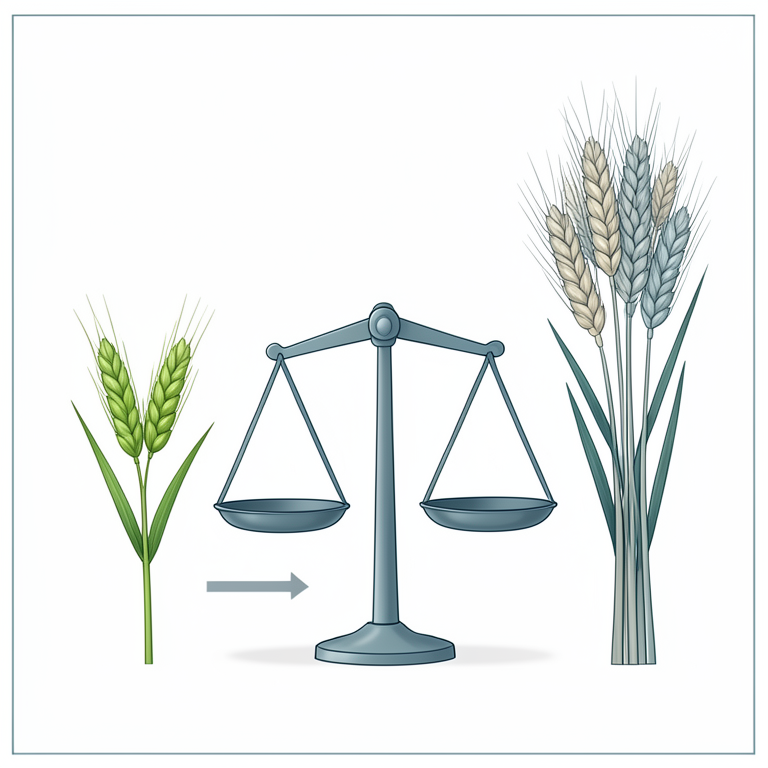
Trade-off between Yield and Quality
AI-generated conceptual illustration (oat plants (Avena sativa)). It explains the idea and does not show study data.
View source evidence ↗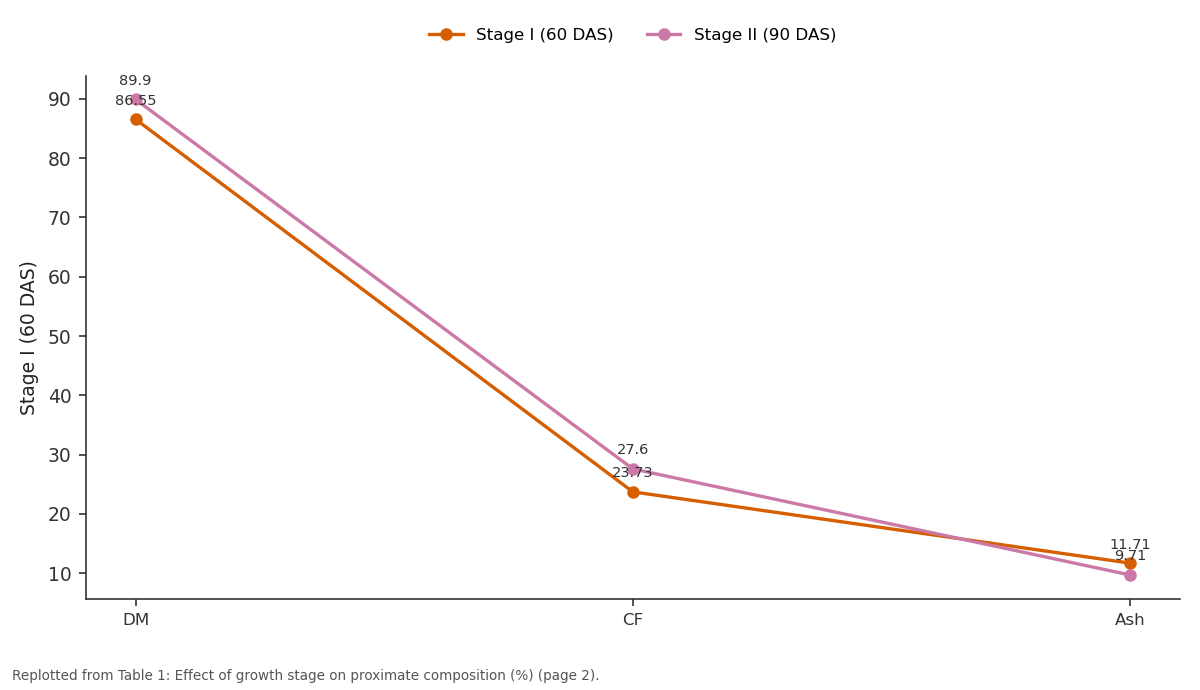
Stage I (60 DAS) and Stage II (90 DAS): DM vs CF vs Ash
Replotted from Table 1 (page 2) of the original paper. Every bar is the paper's own table value.
View source evidence ↗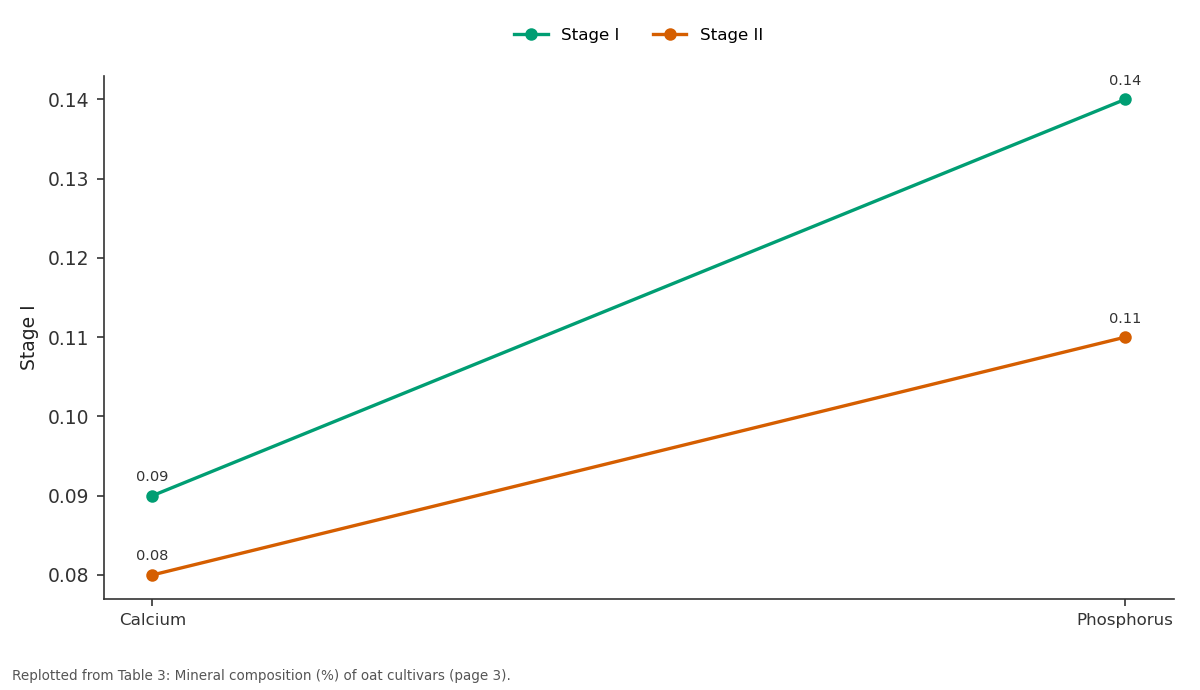
Stage I and Stage II: Calcium vs Phosphorus
Replotted from Table 3 (page 3) of the original paper. Every bar is the paper's own table value.
View source evidence ↗Figures & tables
From the original paper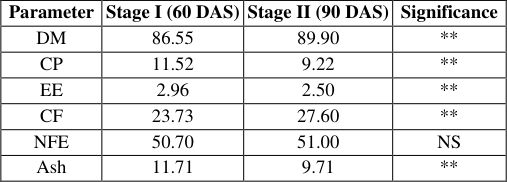 Table 1
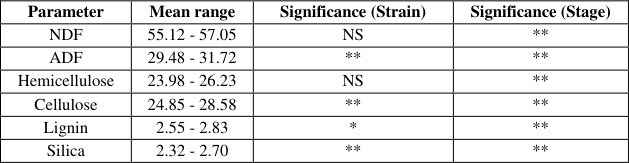 Table 2
 Table 3
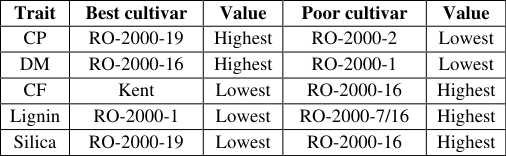 Table 4
Introduction
Oat (Avena sativa L.) is one of the most important winter forage crops widely cultivated for livestock feeding due to its high biomass yield, palatability, and superior nutritive value. It plays a crucial role in bridging the gap between demand and availability of green fodder, particularly in mixed farming systems where dairy and draught animals require balanced nutrition. Oat forage is characterized by a favorable combination of crude protein, digestible carbohydrates, and mineral content, making it an essential component of ruminant feeding systems (Hanoğlu, 2024) [1] . In recent years, increasing emphasis has been placed on improving forage quality alongside yield, as the nutritional composition of fodder directly influences animal productivity, health, and overall farm profitability. The nutritive value of oat forage is determined by its chemical composition, including Crude Protein (CP), fiber fractions such as Neutral Detergent Fiber (NDF) and Acid Detergent Fiber (ADF), ether extract, ash, and soluble carbohydrates. These components collectively influence digestibility, intake, and energy availability in ruminants (Gaytán-Aleman, 2025) [2] . One of the most critical factors affecting the nutritional quality of oat forage is the stage of growth at harvest. As the plant matures, significant biochemical and structural changes occur. Early growth stages are characterized by higher concentrations of crude protein, minerals, and soluble carbohydrates, whereas later stages show increased accumulation of structural carbohydrates such as cellulose, hemicellulose, and lignin. This shift results in reduced digestibility and feeding value. Several studies have demonstrated that crude protein and ash content decline with maturity, while fiber fractions increase, thereby negatively affecting forage quality (Liu, 2015 & Coblentz, 2010) [3,5] .
Moreover, the increase in cell wall constituents with advancing maturity is associated with decreased digestibility and metabolizable energy. The rise in NDF and ADF concentrations reduces the availability of nutrients to rumen microbes, ultimately lowering feed efficiency (Coblentz, 2010) [5] . Concurrently, lignification and silica deposition further restrict microbial degradation of plant tissues, making mature forage less digestible. Therefore, determining the optimal harvest stage is essential to balance forage yield and nutritional quality. Apart from growth stage, genotypic variation among oat cultivars also plays a significant role in determining forage quality. Different cultivars exhibit variability in chemical composition, fiber content, and digestibility characteristics. Recent studies have highlighted substantial genetic variability in oat with respect to nutritional traits, suggesting the potential for selecting superior cultivars for improved forage quality and animal performance (Singh, 2024) [4] . In addition, agronomic and environmental factors such as fertilization, climate, and management practices further influence forage quality. Optimizing these factors, along with selecting appropriate cultivars and harvest stages, is essential for enhancing the efficiency of forage-based livestock systems (Duan, 2024) [6] . Despite extensive research on oat forage, there is still a need for systematic evaluation of different oat cultivars across distinct growth stages under specific agro-climatic conditions, particularly in regions where fodder scarcity is a major constraint. Understanding the interaction between genotype and growth stage is crucial for identifying cultivars that can maintain better nutritional quality over time. Therefore, the present study was undertaken to evaluate the effect of growth stage on chemical composition and nutritional quality of different oat (Avena sativa) cultivars, with the objective of identifying suitable cultivars and optimum harvesting stage for maximizing forage quality.
Materials and Methods
Materials and Methods
Experimental site
The experiment was conducted at the Forage Crop Research Project, Mahatma Phule Krishi Vidyapeeth (MPKV), Rahuri, Maharashtra, India.
Experimental material
Experimental material
Experimental design and layout
The experiment was laid out in a Factorial Randomized Block Design (FRBD) with: Whole plants were harvested, chopped (2-3 cm), sun-dried, and ground to pass through a 2 mm sieve.
Chemical analysis a) Proximate analysis (AOAC, 2012)
b) Fiber fractions (Van Soest and Moore, 1968) [8] • Neutral Detergent Fiber (NDF)
Statistical analysis
Data were analyzed using Factorial Randomized Block Design (FRBD)
Results and Discussion Dry Matter (DM)
Dry matter content increased significantly with advancement of growth stage (p < 0.01) (Table 1). The mean DM content increased from 86.55% at Stage I (60 DAS) to 89.90% at Stage II (90 DAS). Among cultivars (Table 1), DM ranged from 87.23% (RO-2000-1) to 89.05% (RO-2000-16). The non-significant interaction effect indicates that all cultivars followed a similar trend of increasing DM with maturity. This increase reflects progressive accumulation of structural biomass and reduction in moisture content, consistent with findings of Coblentz et al. (2010) [5] . [11,5] .
| Parameter | Stage I (60 DAS) | Stage II (90 DAS) | Significance |
|---|---|---|---|
| DM | 86.55 | 89.90 | ** |
| CP | 11.52 | 9.22 | ** |
| EE | 2.96 | 2.50 | ** |
| CF | 23.73 | 27.60 | ** |
| NFE | 50.70 | 51.00 | NS |
| Ash | 11.71 | 9.71 | ** |
Table text extracted from the original PDF; superscript letters are shown inline. The original table image is below.
View original table image
Ether Extract (EE)
Ether extract content was significantly affected by cultivar and growth stage (p < 0.01) (Table 1). The mean EE content decreased from 2.96% at Stage I to 2.50% at Stage II. Among cultivars (Table 1), EE varied from 2.39% (RO-2000-16) to 3.01% (RO-2000-7). The decline in EE with maturity may be attributed to reduced lipid concentration as structural biomass increases (Cherney & Marten, 1982) [9] .
Crude Fibre (CF)
• Crude fibre content increased significantly with growth stage (p < 0.01) (Table 1), rising from 23.73% at Stage I to 27.60% at Stage II. • Among cultivars (Table 1), CF ranged from 23.72% (Kent) to 26.90% (RO-2000-16). The significant interaction effect indicates that cultivars differed in their rate of fiber accumulation. • The increase in CF is associated with increased lignification and deposition of structural carbohydrates, as reported by Van Soest (1994) [12] .
Nitrogen Free Extract (NFE)
• Nitrogen free extract content showed significant variation among cultivars (p < 0.05) but stage effect was non-significant (Table 1). [11] .
Fiber fractions 5.1 Neutral Detergent Fibre (NDF)
• NDF content increased significantly with growth stage (p < 0.01) ( 2). The increase reflects higher cell wall content and reduced digestibility (Van Soest, 1994) [12] .
Acid Detergent Fibre (ADF)
• ADF increased significantly with maturity (p < 0.01) (Table 2), from 28.85% (Stage I) to 32.43% (Stage II). • Among cultivars, ADF ranged from 29.48% (RO-2000-19) to 31.72% (RO-2000-1) (Table 2). The significan interaction effect indicates genotype-specific variation.
| Parameter | Mean range | Significance (Strain) | Significance (Stage) |
|---|---|---|---|
| NDF | 55.12 - 57.05 | NS | ** |
| ADF | 29.48 - 31.72 | ** | ** |
| Hemicellulose | 23.98 - 26.23 | NS | ** |
| Cellulose | 24.85 - 28.58 | ** | ** |
| Lignin | 2.55 - 2.83 | * | ** |
| Silica | 2.32 - 2.70 | ** | ** |
Table text extracted from the original PDF; superscript letters are shown inline. The original table image is below.
View original table image
Hemicellulose
Hemicellulose content increased significantly (p < 0.01) from 23.53% (Stage I) to 26.93% (Stage II) (Table 2). Differences among cultivars were non-significant.
Cellulose
Cellulose content increased significantly with maturity (p < 0.01) (Table 2), from 24.41% to 29.35%. Among cultivars, cellulose ranged from 24.85% (RO-2000-19) to 28.58% (RO-2000-16).
Lignin
Lignin content increased significantly with growth stage (p < 0.01) (Table 2), from 2.31% at Stage I to 3.00% at Stage II. Among cultivars, lignin ranged from 2.55% (RO-2000-1) to 2.83% (RO-2000-7 and RO-2000-16). Increased lignin reduces digestibility due to restricted microbial access (Jung & Allen, 1995) [10] .
Silica
Silica content increased significantly (p < 0.01) (Table 2), from 2.32% (Stage I) to 2.77% (Stage II). Among cultivars, silica ranged from 2.32% (RO-2000-19) to 2.70% (RO-2000-16).
Mineral composition 7.1 Calcium (Ca)
Calcium content differed significantly among cultivars and growth stages (p < 0.01) (Table 3). The mean Ca content was 0.085%, decreasing from 0.09% (Stage I) to 0.08% (Stage II). Highest Ca content was observed in Kent, while lowest in RO-2000-1, RO-2000-7 and RO-2000-12.
| Parameter | Stage I | Stage II | Mean | Significance |
|---|---|---|---|---|
| Calcium | 0.09 | 0.08 | 0.085 | ** |
| Phosphorus | 0.14 | 0.11 | 0.13 | ** |
Table text extracted from the original PDF; superscript letters are shown inline. The original table image is below.
View original table image
Phosphorus (P)
Phosphorus content also showed significant variation (p < 0.01) (Table 3), with mean value of 0.13%.
Stage-wise values were 0.14% (Stage I) and 0.11% (Stage II). Among cultivars, highest P was recorded in Kent (0.17%), while lowest (~0.10%) in some cultivars.
Conclusion
The present investigation clearly demonstrated that growth stage exerts a predominant influence on the chemical composition and nutritive value of oat (Avena sativa) cultivars, with maturity-associated changes significantly altering forage quality. Advancement from 60 to 90 days after sowing resulted in a marked increase in structural carbohydrates (crude fibre, NDF, ADF, cellulose, lignin, and silica) accompanied by a concomitant decline in crude protein, ether extract, ash, and mineral content (Ca and P). These compositional shifts reflect progressive lignification and cell wall development, ultimately reducing the nutritive value of the forage. Significant genotypic variation was also observed, indicating the potential for selection of superior cultivars. Among the tested entries, RO-2000-19 consistently exhibited superior nutritional attributes, characterized by higher crude protein and lower fibre and silica content, whereas RO-2000-16 showed greater dry matter accumulation but inferior quality due to elevated structural constituents. Overall, the findings establish a clear trade-off between forage yield and nutritional quality, emphasizing that early harvesting (around 60 DAS) is optimal for maximizing nutritive value, while later stages favor biomass accumulation. Therefore, strategic selection of cultivar in conjunction with appropriate harvest timing is critical for optimizing forage utilization and enhancing livestock productivity.
Figures and tables from the paper
| Trait | Best cultivar | Value | Poor cultivar | Value |
|---|---|---|---|---|
| CP | RO-2000-19 | Highest | RO-2000-2 | Lowest |
| DM | RO-2000-16 | Highest | RO-2000-1 | Lowest |
| CF | Kent | Lowest | RO-2000-16 | Highest |
| Lignin | RO-2000-1 | Lowest | RO-2000-7/16 | Highest |
| Silica | RO-2000-19 | Lowest | RO-2000-16 | Highest |
Table text extracted from the original PDF; superscript letters are shown inline. The original table image is below.
View original table image
References
11 in the original paper- Hanoğlu Oral H. Forage yields and nutritive values of oat and triticale pastures for grazing sheep in early spring. PeerJ. 2024;12:e17840. DOI:10.7717/peerj.17840.
- Gaytán-Aleman L, Mendoza-Carreola J, CalderónLeyva G, Arellano-Rodriguez F, Angel-García O, Contreras-Villarreal V, et al. Nutrient composition, digestibility, and intake of diets chosen by goats that grazed alfalfa and oat field residues. J Appl Anim Res. 2025;53(1):2486265.
- Liu K, Mahmood K. Nutrient composition and protein extractability of oat forage harvested at different maturity stages as compared to grain. J Agric Sci. 2015;7(12):50.
- Singh S, Koli P, Ahmed S, Kumar N, Rana M, Singhal R, et al. Exploring the genetic variability in yield, nutritional and digestibility traits in oat grains through ruminant nutrition. Heliyon. 2024;10(10).
- Coblentz WK, Walgenbach RP. Fall growth, nutritive value, and estimation of total digestible nutrients for cereal-grain forages in the north-central United States. J Anim Sci. 2010;88(1):383-399.
- Duan L, Ju Z, Ma X, Pan J, Mustafa AEZM, Jia Z. Research on enhancing the yield and quality of oat forage: Optimization of nitrogen and organic fertilizer management strategies. Agronomy. 2024;14(7):1406.
- Van Soest PJ, Jones LHP. Effect of silica in forages upon digestibility. J Dairy Sci. 1968;51(10):1644-1648.
- Cherney JH, Marten GC. Small grain crop forage potential: II. Interrelationships among biological, chemical, morphological, and anatomical determinants of quality. Crop Sci. 1982;22(2):240-245.
- Jung HG, Allen MS. Characteristics of plant cell walls affecting intake and digestibility of forages by ruminants. J Anim Sci. 1995;73(9):2774-2790.
- Khorasani GR, Jedel PE, Helm JH, Kennelly JJ. Influence of stage of maturity on yield components and chemical composition of cereal grain silages. Can J Anim Sci. 1997;77(2):259-267.
- Van Soest PJ. Nutritional ecology of the ruminant. Ithaca (NY): Cornell University Press; 1994.