
Research article · 2025 · Full text
International Journal of Geography Geology and EnvironmentShaping tomorrow: Green economy as a driver of resilient growth
Volume 7(12) · Pages 83–85 · DOI: 10.22271/27067483.2025.v7.i12a.466 ↗
Research areasInnovation, Sustainability, Human-Machine SystemsSustainable Finance and Green BondsCOVID-19 impact on air quality
Abstract
Author-writtenThe green economy represents a sustainable growth model prioritizing low-carbon development, resource efficiency, and social inclusivity. It drives resilient economic growth by fostering innovation, diversifying sectors, and enhancing environmental stewardship. Through renewable energy, green finance, and circular economy principles, the green economy strengthens economic systems against shocks while promoting equitable social and ecological outcomes for a sustainable future.
Summary
Source-checkedPlain-language reading of the full paper, prepared with AI and checked against the text. Each point links to the authors' own words.
Why it matters
- The green economy is presented as a necessary response to global challenges including climate urgency, the depletion of resources, and economic instability. View evidence ↗
- Rather than being just an ideal, the green economy is a practical strategy based on social inclusivity, resource efficiency, and low-carbon development. View evidence ↗
- This model promotes resilient growth by diversifying economic sectors, encouraging innovation, and improving the stewardship of the environment. View evidence ↗
The question
- The paper aims to review contemporary literature to examine the principles, evolution, and impacts of the green economy, specifically its ability to create shock-resistant and sustainable growth. View evidence ↗
What they did
- The author conducted a review of contemporary literature to analyze the green economy's capacity for driving resilient growth. View evidence ↗
What they found
- As of 2024, renewable energy investments reached $495 billion, and these sources now provide more than 30% of the world's electricity. View evidence ↗
- Green bond issuances have exceeded $1 trillion, providing the funding necessary for nations to develop infrastructure that is resilient to climate change. View evidence ↗
- By 2030, the application of circular economy principles is expected to generate $4.5 trillion in global economic benefits. View evidence ↗
- The transition to a green economy in India is expected to create 7.29 million green jobs by FY 2027-28, increasing to 35 million by 2047. View evidence ↗
- In the Asia-Pacific region, green growth strategies helped create new jobs and reduce resource intensity while mitigating shocks during the recovery from COVID-19. View evidence ↗
- Green finance initiatives in China specifically supported economic and environmental resilience following the pandemic. View evidence ↗
- The European Green Deal used circular economy principles to improve competitiveness and meet Sustainable Development Goals (SDGs). View evidence ↗
- A significant barrier for developing nations is the difficulty in accessing affordable capital to fund green investments. View evidence ↗
- Rapid progress toward a green economy is hindered by shortages in infrastructure, skilled labor, and technological expertise. View evidence ↗
What it means
- The author concludes that the green economy is a strong model for achieving resilient growth amidst current global planetary challenges. View evidence ↗
- The author recommends coordinated action, inclusive vision, and careful policy innovation to balance ecological, social, and economic goals. View evidence ↗
Visual summary
1 visualsIllustrations explain the paper; they do not show study data.
Study overview
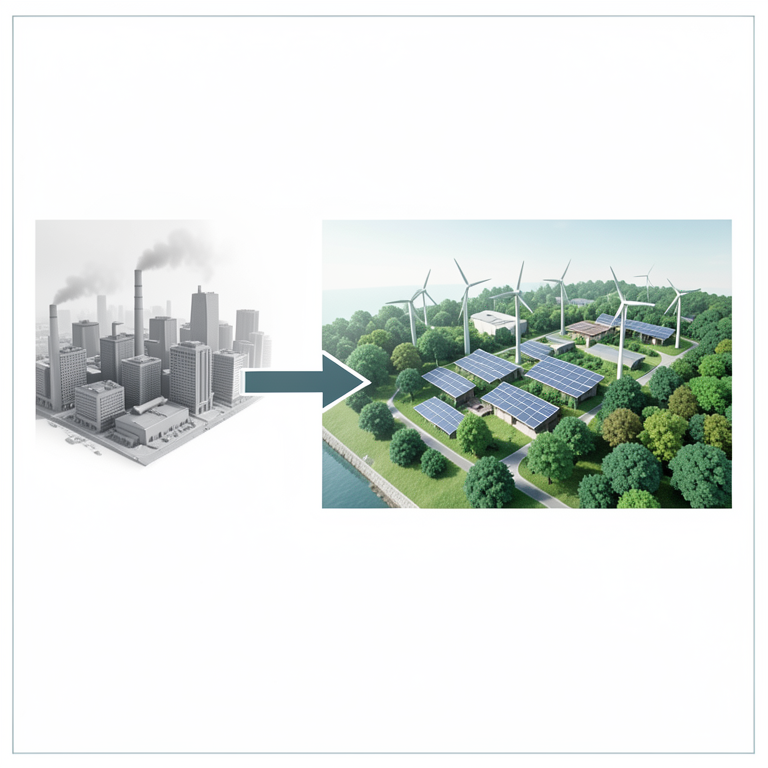
AI-generated conceptual illustration (A sustainable urban landscape featuring wind turbines, solar panels, and integrated green forests). It explains the idea and does not show study data.
View source evidence ↗Introduction
The imperative to shape a sustainable future has thrust the green economy into the heart of global economic and policy debates. The green economy offers an integrated approach to growth, environmental stewardship, and social resilience, positioning itself as a transformative driver for resilient long-term prosperity. This article explores the evolution, principles, and real-world impacts of the green economy, focusing on its capacity to propel economies toward sustainable and shock-resistant growth, with a robust review of contemporary literature. In an era marked by climate urgency, resource depletion, and economic volatility, the green economy emerges as a transformative model for sustainable and resilient growth. Defined by its commitment to low-carbon development, resource efficiency, and social inclusivity, the green economy is not merely an environmental ideal it is a pragmatic economic strategy. Globally, the momentum is undeniable. Renewable energy now contributes over 30% to global electricity generation, with investments reaching $495 billion in 2024. Green finance has surged, with green bond issuances surpassing $1 trillion, empowering nations to build climate-resilient infrastructure. Circular economy principles are projected to unlock $4.5 trillion in global economic benefits by 2030, reshaping industries and consumption patterns. India, poised at the intersection of development and sustainability, is rapidly embracing this paradigm. With non-fossil fuels comprising 50% of its installed energy capacity and a projected green economy valuation of $1 trillion by 2030, the country is aligning economic ambition with ecological responsibility. The promise of 7.29 million green jobs by FY 2027-28 and 35 million by 2047 underscores the inclusive potential of this transition. National missions like FAME and the Hydrogen Mission reflect India's strategic push toward clean mobility and energy innovation.
Understanding the green economy
The green economy is defined as an economic system that aims for sustainable development without degrading the environment, improving human well-being and social equity while significantly reducing environmental risks and ecological scarcities (Basthiani, 2024). It is a paradigm shift from resource-intensive, carbon-heavy practices toward models that embrace clean energy, circular production, and sustainable resource management [1,2] .
At its core, the green economy strives to integrate three central pillars:
• Economic development with minimal ecological damage. • Social inclusivity and poverty reduction.
• Responsible stewardship of natural resources for future generations (Khan, 2025) [3] .
Historical Backdrop and Global Initiatives
The idea of green growth first gained traction in the wake of heightened awareness about climate change and resource depletion. International frameworks like the United Nations' Sustainable Development Goals (SDGs) and the Paris Agreement have provided strategic direction for countries drifting toward greener trajectories. Developing nations have witnessed perceptible shifts in policies, investment in green technologies, and market attitudes, fueling the credibility and feasibility of green growth (ADB, N.D.) [4] .
Countries such as South Korea, Germany, China, and India have taken concrete steps by investing in clean infrastructure, supporting renewable energy sectors, and incentivizing technological innovation. These efforts demonstrate green growth's dual promise of economic opportunity and environmental restoration (Miradji, 2024) [7] . Green finance and policy frameworks, like green bonds, public-private partnerships, and resource efficiency standards, have strengthened resilience in emerging and mature markets alike (Shen, 2024) [13] .
Sectoral Impacts of the Green Economy Renewable Energy
Renewables are perhaps the most visible symbols of the green economy. Globally, solar, wind, hydro, and bioenergy investments have surged, catalyzing job creation and balancing energy security needs. Studies confirm renewables drastically reduce carbon emissions and facilitate economic diversification.
Sustainable Agriculture
Green economy principles in agriculture promote organic farming, biodiversity conservation, and water efficiency practices. In countries like India and Bangladesh, green agriculture has increased rural incomes and fostered climate resilience, though scaling these efforts requires increased investment and stronger policy frameworks (ADB, N.D.).
Circular Economy and Resource Efficiency
Shifting toward circularity where materials are reused, recycled, and product lifecycles extended reduces waste and environmental impact. European Union initiatives like the Green Deal exemplify these strategies' positive effects on resource security, competitiveness, and employment (Adamowicz, 2022) [11] .
Green Finance
Green finance mobilizes resources for climate-aligned projects, supporting the transition through incentives, risksharing, and financial innovation. China's post-COVID-19 experience reveals that green finance critically enhances both environmental and economic resilience (Shen, 2024) [13] .
Green technological progress and policy innovation
Green technology encompasses a broad set of innovations, from energy storage and electric vehicles to smart grids and eco-friendly industrial processes. Ahmed (2023) demonstrates that such technological progress generates positive spillovers boosting overall productivity, reducing pollution, and propelling long-term sustainable growth in Asia, Latin America, and the Pacific. Policy innovation is equally crucial. Success stories highlight the importance of regulatory clarity, investment in research and development, and stable economic incentives. Wang et al. (2023) [10] argue for enabling environments where green entrepreneurship can flourish, supported by access to capital and skilled human resources.
Challenges and Barriers
Despite significant momentum, advancing the green economy faces substantial obstacles:
• Financial Constraints: Developing countries encounter difficulties accessing affordable capital for green investments.
• Technological Gaps: Technological know-how, infrastructure, and skilled workforce shortages impede rapid progress. • Policy Fragmentation: Inconsistent regulations and lack of alignment between national and international efforts dilute effectiveness. • Social Equity: Distributional impacts must be managed to avoid leaving behind vulnerable populations during green transitions (Basthiani, 2024) [3] .
Collaborative efforts, both regionally and globally, are required to harmonize standards, share best practices, and mobilize investments for inclusive green growth.
Case Studies and Empirical Evidence
Recent research and country experiences provide empirical support for the green economy's role in driving resilient growth:
• Asia-Pacific: Green growth strategies mitigated adverse shocks, reduced resource intensity, and created new employment opportunities during COVID-19 recovery phases (ADB, N.D.).
• China:
Green finance initiatives supported environmental and economic resilience, especially postpandemic (Shen, 2024) [13] .
• Europe: The European Green Deal leveraged circular economy principles to boost competitiveness and fulfill SDGs (Adamowicz, 2022) [11] . • Global Analysis: Bibliometric reviews reveal accelerating research, policy innovation, and measurable positive outcomes across diverse institutional contexts (Khan, 2025; Söderholm, 2020) [5,9] .
Conclusion
The green economy presents a robust paradigm for driving resilient growth in an era of planetary challenges and evolutionary opportunity. By fostering innovation, activating new sectors, and prioritizing sustainability, nations can secure long-term prosperity and fortify themselves against future shocks. The journey to a greener future requires coordinated action, careful policy innovation, and an inclusive vision capable of balancing economic, social, and ecological objectives.
References
11 in the original paper- Ahmed EM, Elfaki KE. Green technological progress implications on long-run sustainable economic growth. Int J Environ Res Public Health. 2023;20(5):PMC10171158.
- Basthiani IA. The role of green economy in sustainable development as long-term environmental and economic stability: A literature review. Research Horizon. 2024;4(4):187-196.
- Hao X, Wang Y, Li J. Policy innovation and the green economy: Lessons for developing countries. Magnascientia Appl Reg Res Rev. 2024;13(4):10701073.
- Khan RZ. Green growth and sustainability: A systematic literature review. J Clean Prod. 2025;266:S2666784325000257.
- Ma M. The application of Green GDP and its impact on global economy and environment: analysis of GGDP based on SEEA model. arXiv preprint. 2024;arXiv:2409.02642.
- Miradji MA. Implementation of green economy in increasing economic growth and environmental conservation. Jurnal Ekonomi. 2024;13(4):1070-1073. Available from: https://ejournal.seaninstitute.or.id/index.php/Ekonomi/a rticle/view/5871.
- Shen J. Green finance as a driver for environmental and economic resilience. Sci. Total Environ. 2024;240:115502.
- Söderholm P. Mapping the intellectual structure of green economy and sustainability. Cogent Econ Financ. 2020;8(1):2507135.
- Adamowicz M. Circular economy and the European Green Deal: policy alignment with the SDGs. Cogent Econ Financ. 2022;8(1):2507135.
- Udeagha M, Ngepah N. Green economy transition and sustainable development. Magnascientia Appl Reg Res Rev. 2023;13(4):1070-1073.
- Shen J. Green finance as a driver for environmental and economic resilience during China's post-COVID-19 recovery. Sci Total Environ. 2024;240:115502.