
Research article · 2025 · Full text
International Journal of Horticulture and Food ScienceRapid assessment of melting resistance in fruit-fortified frozen soy yogurt
Volume 7(11) · Pages 47–49 · DOI: 10.33545/26631067.2025.v7.i11a.438 ↗
Research areasProteins in Food SystemsFood Drying and ModelingFood composition and properties
Abstract
Author-writtenBackground: Melting resistance is a critical quality attribute of frozen soy yogurt, directly influencing consumer perception, sensory acceptance, and market competitiveness. Fruit fortification, while enhancing flavour and nutritional value, introduces additional complexity to melting behavior due to changes in water content, acidity, fiber, and sugar composition. Scope and approach: This review critically examines recent advances (2020-2025) in rapid and predictive assessment techniques for melting resistance in fruit-fortified frozen soy yogurt. Emphasis is placed on physicochemical mechanisms, matrix structuring, analytical tools, and correlations between formulation variables and melting performance. Key findings and conclusions: Fruit-derived sugars, organic acids, and fibers significantly influence ice recrystallization, air cell stability, and protein-polysaccharide networks. Rapid instrumental methods, image-based analysis, rheological proxies, and data-driven models offer reliable alternatives to time-consuming conventional melting tests. Integration of rapid assessment tools with formulation optimization is essential for industrial-scale quality control and product innovation.
Summary
Source-checkedPlain-language reading of the full paper, prepared with AI and checked against the text. Each point links to the authors' own words.
Why it matters
- Melting resistance is a vital quality factor for frozen soy yogurt because it affects how consumers perceive the product and its overall market success. View evidence ↗
- Adding fruit to frozen soy yogurt improves nutrition and flavor but complicates how the product melts by altering its sugar, fiber, acidity, and water levels. View evidence ↗
- Conventional methods for testing melting are too slow and labor-intensive to be useful for quickly screening different product formulations. View evidence ↗
The question
- The paper aims to review recent developments from 2020 to 2025 regarding fast and predictive methods to assess melting resistance in fruit-fortified frozen soy yogurt. View evidence ↗
What they did
- The review focuses on the relationship between formulation variables and melting performance, as well as the analytical tools and physicochemical mechanisms involved. View evidence ↗
What they found
- Melting resistance increases when ice crystals are smaller and more uniformly distributed, which helps prevent structural collapse and serum drainage. View evidence ↗
- Fruit sugars like sucrose, fructose, and glucose can speed up melting by lowering the freezing point and increasing the amount of unfrozen water. View evidence ↗
- Fruit acids can improve gel firmness by promoting soy protein aggregation, though too much acid may lead to syneresis and protein destabilization. View evidence ↗
- The addition of fruit fibers improves melting resistance by limiting the growth of ice crystals and increasing the viscosity of the mix. View evidence ↗
- Optical methods, such as video tracking and digital image analysis, enable the real-time monitoring of how the product retains its shape and forms drips. View evidence ↗
- Thermal parameters from DSC and rheological measures like yield stress and storage modulus can act as indirect predictors for how the yogurt will melt. View evidence ↗
- Low-Field Nuclear Magnetic Resonance (LF-NMR) provides a non-destructive way to assess water distribution and mobility to understand melt behavior. View evidence ↗
- Machine learning models that combine thermal properties, rheological data, and formulation parameters are highly accurate at predicting melting resistance. View evidence ↗
What it means
- The authors conclude that rapid assessment techniques are reliable and efficient alternatives to traditional tests, which speeds up quality control and product development. View evidence ↗
- Limitations include the need to calibrate rapid tools, the seasonal variability of fruit composition, and the difficulty of applying lab results to industrial settings. View evidence ↗
Visual summary
1 visualsIllustrations explain the paper; they do not show study data.
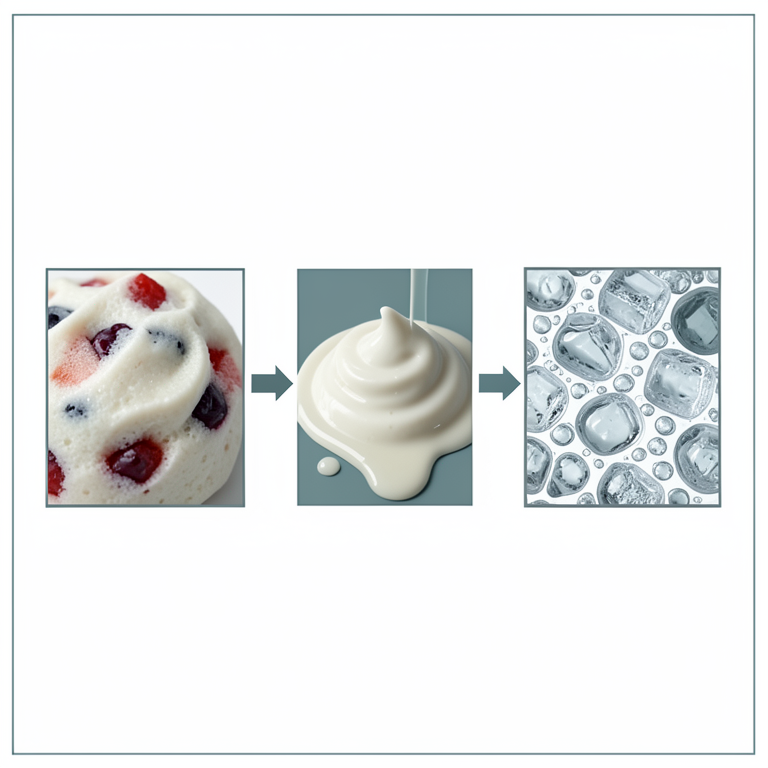
Study overview
AI-generated conceptual illustration (fruit-fortified frozen soy yogurt). It explains the idea and does not show study data.
View source evidence ↗Methods
, image-based analysis, rheological proxies, and data-driven models offer reliable alternatives to time-consuming conventional melting tests. Integration of rapid assessment tools with formulation optimization is essential for industrial-scale quality control and product innovation. Keywords: Frozen soy yogurt, Melting resistance, Fruit fortification, Rapid assessment, Ice recrystallization, Texture stability
Introduction
Frozen soy yogurt has emerged as a promising plant-based alternative to dairy frozen yogurt, combining the nutritional benefits of soy proteins with the sensory appeal of frozen desserts. Among quality attributes, melting resistance is particularly important, as it reflects the structural integrity of the frozen matrix under ambient conditions and strongly affects consumer satisfaction. Fruit fortification further enhances product appeal by improving flavour, colour, and functional value. However, fruits introduce sugars, acids, fibers, and bioactives that modify freezing point, ice crystal dynamics, and protein gel networks, thereby altering melting behaviour.
Traditional melting tests are labor-intensive and poorly suited for rapid formulation screening. Consequently, there is increasing interest in rapid, predictive methods for assessing melting resistance in fruit-fortified frozen soy yogurt systems. 2. Structural Basis of Melting Resistance in Frozen Soy Yogurt 2.1 Ice Crystal Size and Distribution Melting resistance is inversely related to ice crystal size and recrystallization rate. Smaller, uniformly distributed ice crystals reduce serum drainage and delay structural collapse.
Fruit sugars depress freezing point, influencing ice fraction and crystal morphology. 2.2 Air Phase and Overrun Stability Air cells contribute to insulation and slow heat transfer during melting. In soy-based systems, weaker protein interfacial films limit air cell stability. Fruit fibers and pectins can partially compensate by increasing viscosity and stabilizing air-water interfaces. 2.3 Protein-Polysaccharide Network Formation Soy protein gelation, reinforced by fruit-derived pectins and soluble fibers, improves water- holding capacity and structural rigidity. However, excessive fruit juice addition may dilute proteins and weaken the network, accelerating melt-down.
NAAS Rating (2025): 4.74 IJHFS 2025; 7(11): 47-49 Manoj Kumar Assistant Professor, Institute of Food Technology, Bundelkhand University, Jhansi, Uttar Pradesh, India Manoj Kumar Assistant Professor, Institute of Food Technology, Bundelkhand University, Jhansi, Uttar Pradesh, India https://www.hortijournal.com • Reduction in product development time and cost Such approaches are particularly valuable for clean-label formulations where stabilizer options are limited. 7. Challenges and Limitations Key limitations include: • Variability in fruit composition and seasonality • Calibration requirements for rapid analytical tools • Translation of laboratory correlations to industrial conditions Standardization of rapid methods remains a critical research need. 8. Future Perspectives Future research should focus on: • Integration of rapid analytical tools with inline processing sensors • Development of universal predictive models for plant- based frozen systems • Optimization of fruit-protein-polysaccharide interactions for melt control Advances in digitalization and food process analytics will further enhance rapid quality assessment.
Conclusions
Fruit fortification significantly influences the melting resistance of frozen soy yogurt through complex interactions involving sugars, acids, fibers, and protein networks. Rapid assessment techniques provide efficient, reliable alternatives to conventional melting tests, enabling accelerated product development and quality control. Their integration into industrial workflows will be critical for the successful commercialization of fruit-fortified frozen soy yogurt products.
Methods
for Assessing Melting Resistance Traditional techniques include: • Static melt-down tests (drip loss measurement) • First drip time determination • Melting rate under controlled temperature While informative, these methods are time-consuming, operator-dependent, and unsuitable for high-throughput formulation screening. 5. Rapid and Predictive Assessment Techniques 5.1 Image-Based and Optical Methods Digital image analysis and video tracking allow real-time monitoring of shape retention, drip formation, and collapse kinetics. These methods provide rapid, reproducible melting profiles with minimal sample preparation. 5.2 Rheological and Thermal Proxies Dynamic rheology (storage modulus, yield stress) and differential scanning calorimetry (DSC) parameters (freezable water fraction, enthalpy) serve as indirect predictors of melting resistance. 5.3 Low-Field Nuclear Magnetic Resonance (LF-NMR) LF-NMR enables rapid assessment of water mobility and distribution, offering insights into structural stability and melt behavior without destructive testing. 5.4 Spectroscopic and Sensor-Based Approaches Near-infrared (NIR) spectroscopy and hyperspectral imaging are emerging as rapid, non-invasive tools for predicting melting resistance based on compositional fingerprints. 5.5 Data-Driven and Modeling Approaches Machine learning models integrating formulation parameters, rheological data, and thermal properties have demonstrated high predictive accuracy for melting resistance, enabling rapid formulation optimization. 6. Application in Quality Control and Product Development Rapid assessment tools enable: • High-throughput screening of fruit types and concentrations • Real-time quality monitoring during scale-up https://www.hortijournal.com melting behavior of frozen desserts.
Food Hydrocoll. 2020;101:105519. 10. Wang R, Zhang L. Data-driven prediction of melting resistance in frozen plant-based foods. Trends Food Sci Technol. 2025;146:104299. 11.
Yao M, Xie J, McClements DJ. Engineering water mobility to improve melting resistance in frozen foods. Compr Rev Food Sci Food Saf. 2024;23(1):120-145. 12. Zhao Y, Chen L, Li C.
Application of LF-NMR in assessing structural stability of frozen desserts. Food Chem. 2023;404:134548.
References
10 in the original paper- Akhtar M, Ding R. Structure-melting relationships in plant-based frozen desserts. J Food Eng. 2021;292:110345.
- Chung C, Degner B, McClements DJ. Designing plant- based frozen desserts: structure, stability and melting behavior. Food Res Int. 2021;150:110764.
- Deosarkar SS, Khedkar CD, Kalyankar SD. Non-dairy frozen desserts: technological challenges and quality evaluation. LWT Food Sci Technol. 2022;154:112744.
- Goff HD, Hartel RW. Ice recrystallization and melting behavior in frozen foods. Int Dairy J. 2022;126:105264.
- Grossmann L, Weiss J. Stabilization strategies in plant- based frozen systems. Curr Opin Food Sci. 2021;38:116-123.
- McClements DJ. Predicting texture and stability of plant-based foods using rapid analytical tools. Food Res Int. 2023;162:112074.
- Pang Z, Deeth H, Sopade P, Sharma R, Bansal N. Rheological indicators of melting resistance in frozen desserts. J Dairy Sci. 2021;104(3):2794-2808.
- Shao Y, Tang CH. Role of fruit fibers in structuring plant-based frozen desserts. Compr Rev Food Sci Food Saf. 2024;23(2):450-472.
- Soukoulis C, Fisk I. Rapid methods for evaluating
- Influence of Fruit Fortification on Melting Behavior 3.1 Fruit Sugars and Freezing Point Depression Glucose, fructose, and sucrose from fruit juices lower the freezing point, increasing unfrozen water fraction and accelerating melt if not balanced by stabilizers. 3.2 Organic Acids and pH Effects Fruit acids reduce pH, promoting soy protein aggregation and potentially enhancing gel firmness. Over-acidification, however, may cause protein destabilization and syneresis. 3.3 Dietary Fibers and Pectins Fruit fibers increase mix viscosity, limit ice crystal growth, and improve melting resistance. Pectin-protein interactions are particularly effective in fruit-fortified frozen soy yogurt systems.