
Research article · 2025 · Full text
International Journal of Agriculture and Food ScienceEvaluation of different fungicides against Colletotrichum capsici
Volume 7(12) · Pages 60–64 · DOI: 10.33545/2664844x.2025.v7.i12a.1026 ↗
Research areasFungal Plant Pathogen ControlPlant Pathogens and Fungal DiseasesPlant Disease Resistance and Genetics
Abstract
Author-writtenColletotrichum capsici is an important fungal pathogen that causes anthracnose in chilli (Capsicum annuum), leading to considerable yield losses. This study examined the in-vitro effectiveness of nine fungicides against C. capsici using the poisoned food technique. Four fungicides-Propiconazole (0.1%), Carbendazim + Mancozeb (0.2%), Captan + Hexaconazole (0.1%), and Azoxystrobin + Difenoconazole (0.05%)-completely inhibited the fungus’s mycelial growth. These findings indicate that selective systemic and combination fungicides are highly effective for managing C. capsici and may be successfully integrated into disease management programs.
Summary
Source-checkedPlain-language reading of the full paper, prepared with AI and checked against the text. Each point links to the authors' own words.
Why it matters
- Chilli (Capsicum annuum) is a significant solanaceous spice crop used for both commercial and vegetable purposes. View evidence ↗
- Anthracnose, or die-back, is one of the most destructive fungal diseases affecting chilli, primarily caused by Colletotrichum species. View evidence ↗
- Colletotrichum capsici is a globally distributed pathogen that can cause up to 50% yield loss in chilli, particularly affecting ripe fruits. View evidence ↗
The question
- The study aimed to evaluate the in-vitro efficacy of various fungicides to manage C. capsici due to the severe yield losses it causes. View evidence ↗
What they did
- The pathogen C. capsici was isolated from infected fruits and grown on Potato Dextrose Agar (PDA), using 5 mm discs from 7-day-old cultures as the inoculum. View evidence ↗
- Nine different fungicides were evaluated using the poisoned food technique in a Completely Randomized Design (CRD) with three replications. View evidence ↗
- The growth of the fungal mycelium was measured at 3, 5, and 7 days after inoculation (DAI). View evidence ↗
What they found
- Propiconazole (0.1%), Carbendazim + Mancozeb (0.2%), Captan + Hexaconazole (0.1%), and Azoxystrobin + Difenoconazole (0.05%) were the most effective, achieving 100% growth inhibition. View evidence ↗
- Tebuconazole + Trifloxystrobin (0.05%) and Carbendazim (0.1%) showed moderate efficacy, with inhibition rates of 83.61% and 81.46%, respectively. View evidence ↗
- Penflufen + Trifloxystrobin (0.1%) provided a lower level of control, recording 65.95% inhibition. View evidence ↗
- The least effective treatments were Azoxystrobin (0.1%) and Flupicolide + Promocarb hydrochloride (0.1%), with inhibition rates of 40.86% and 43.04%, respectively. View evidence ↗
- All nine tested fungicides were significantly more effective at inhibiting C. capsici growth than the control group. View evidence ↗
What it means
- The authors conclude that Propiconazole and combination fungicides like Carbendazim + Mancozeb and Captan + Hexaconazole are highly effective against C. capsici in vitro. View evidence ↗
- The authors recommend integrating these effective fungicides into disease management programs for chilli anthracnose. View evidence ↗
Visual summary
1 visualsIllustrations explain the paper; they do not show study data.
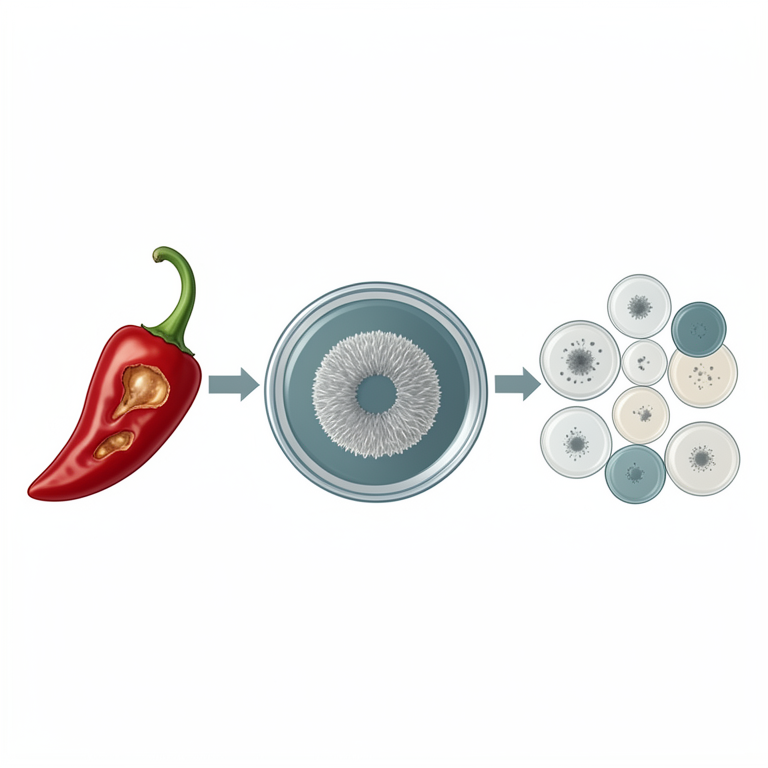
Experimental Setup for Fungicide Testing
AI-generated conceptual illustration (chilli fruits and Colletotrichum capsici fungus). It explains the idea and does not show study data.
View source evidence ↗Figures & tables
From the original paper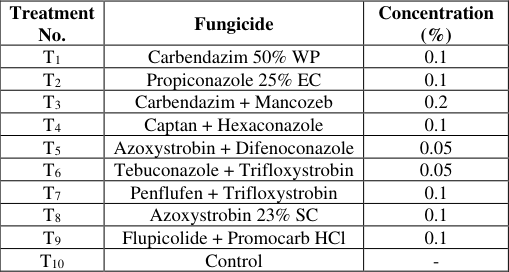 Table 1
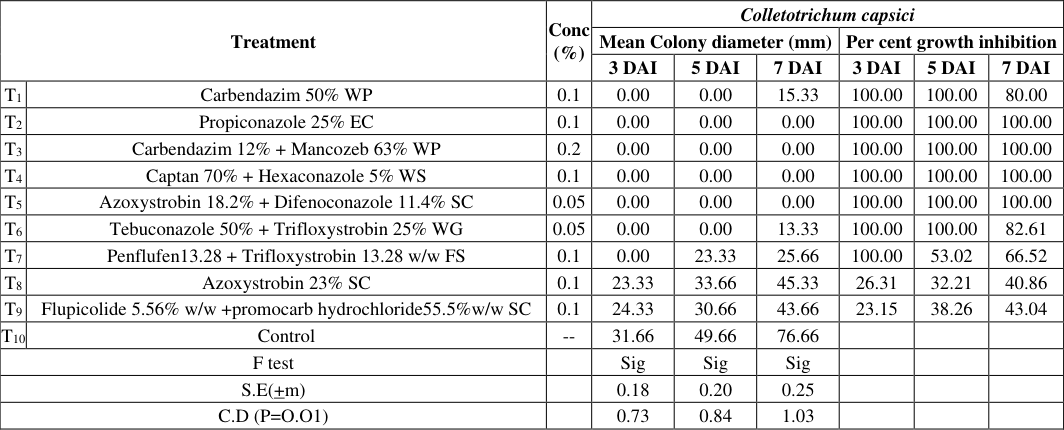 Table 2
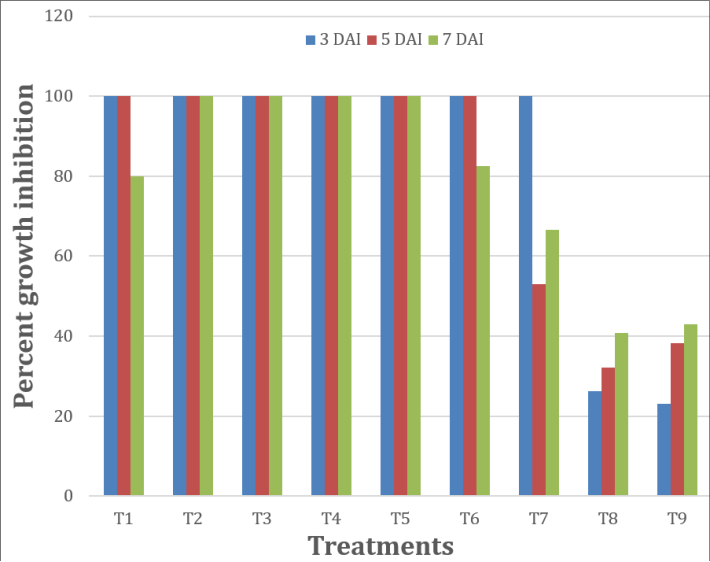 Figure 1
Introduction
Chilli (Capsicum annuum), commonly known as Mirchi, is an important solanaceous spice crop cultivated widely as both a commercial and vegetable crop. It is considered an exotic species, originating from Brazil in South America, and was introduced to India by the Portuguese in the 17th century. Today, it is grown across the entire country, making India the largest producer, consumer, and exporter of chillies. Besides India, major chilli-growing countries include Pakistan, Bangladesh, China, Sri Lanka, Egypt, Italy, and the U.S.A. Globally, India leads chilli production, followed by China, Thailand, Ethiopia, and Indonesia. In India, the main chilli-producing states are Andhra Pradesh, Telangana, Madhya However, excessive chemical use poses environmental risks, highlighting the need to identify fungicides that are both effective and safer. Given the severity of anthracnose caused by C. capsiciwhich can reduce yields by more than 50%-this study was conducted to evaluate the in-vitro efficacy of various fungicides. The goal is to determine the most effective treatments for managing this pathogen and to support integrated disease management strategies in chilli cultivation.
Materials and Methods
Materials and Methods
Glassware plastic wares and requirments
Glass Petri dishes (90 mm), test tube (15×150 mm), conical flasks (250 to 500 ml), borosil measuring cylinder (50ml) and blotter paper were used. The laboratory equipment used included a hot air oven and an autoclave for sterilizing glassware and media respectively, a stereo-binocular microscope and a research binocular microscope for observing the seed borne fungi, a laminar air flow cabinet for isolation, a BOD incubator for incubation, a seed germinator and a weighing balance. Colletotrichum capsici was isolated from infected chilli fruits and cultured on Potato Dextrose Agar (PDA). A 5 mm disc from a 7-day-old culture was used as inoculum. Nine fungicides were tested using the poisoned food technique, with treatments arranged in a Completely Randomized Design (CRD) with three replications. Mycelial growth was measured at 3rd, 5th, and 7th day after inoculation (DAI). Inhibition percentage was calculated using the standard formula.
Preparation of culture media
The common laboratory medium i.e., Potato dextrose agar (PDA) was used for isolation of fungal pathogens associated with chilli, for sub culturing, maintenance of pure cultures, dual culture technique and poison food technique. The medium was prepared with following ingredients. 1. Potato (peeled): 200.00 g 2. Dextrose: 20.00 g 3. Agar: 20.00 g 4. Distilled water: 1000 ml Potato dextrose agar (PDA) medium was made by slicing 200 g of peeled potatoes into pieces and boiling them in 800 ml distilled water until they were thoroughly cooked. The starch extract was strained through muslin cloth. Dextrose and agar (20 g each) were added into it and the volume was adjusted to one litre. Autoclave the media for 15 min at 121°C and 15 lbs pressure. Final pH of the medium should be 5-6 ± 0.5.
Preparation of Slants
For preparing the slants, PDA medium with streptomycin sulphate waspoured into the culture tubes to avoid the bacterial infection. Approximately, ¼ part of the tube was filled in and plugged with non-absorbent cotton. After sterilization that tubes were tilted to 45 0 -60 0 angle till the medium solidified properly.
Sterilization of laboratory materials
To detect fungus on seeds, plastic plates with a diameter of 90 mm were used. The plates were washed with cleaning powder under running water, dried and then disinfected with denatured spirit. However, glasswares were sterilized in hot air oven at 180°C for 1 hour before use. Distilled water, blotter paper discs 9 cm in diameter and plastic plates wrapped with blotter paper were sterilized in an autoclave at 1.04 kg/cm 2 for 15 minutes.
Incubation room
The incubation room was used to keep the petriplates and the temperature in the incubation room was 27 ± 2°C, which was automatically controlled with an alternate cycle of 12 hours of light and 12 hours of darkness.
Isolation and Detection of pathogen through following method Standard blotter paper method Three layers of sterilized blotter paper disc of 90 mm diameter were placed in sterilized Petri plates (90 mm diameter) moistened with sterile distilled water. The excess water was drained out from the plates. Chilli seeds were transferred to the plates containing three layers of moist blotter papers. 25 seeds were placed in each plate (16 in outer layer, 8 in middle and 1 in centre) and the plates were incubated at 27 ± 20C under alternate cycles of 12 hour near light and darkness for 7 days. After seventh day of incubation, the seeds were examined under stereoscopic binocular microscope for associated fungi and they were identified based on habit and colony characters.
Agar plate method
In Northern Ireland, agar plate method was first used for seed health testing. In this method, presterilized Petriplates were poured with 15 ml of autoclaved potato dextrose agar. On cooling the medium, 25 seeds were placed in each plate (16 in outer layer, 8 in middle and 1 in centre) and the the infected fruit tissue were placed in each and the plates were incubated at 27 ± 20C under diurnal conditions. Four hundred seeds of each variety were tested. On seventh day of incubation, plates were examined under stereoscopic microscope for observing the fungal growth. The identification and further confirmation of seed borne fungi was made by preparing slides of the fungi.
Identification of fungi
Identification of the fungal species were done by observing the growth on media, colony characteristics and microscopic observations made from the slides prepared directly from the active cultures. The morphological features like colour, branching and septation of hyphae, conidiophores and conidia of the isolates were studied under compound microscope. The growth characters and morphology were compared with available descriptions from mycological books such as Morphology and taxonomy of fungi, Manual of soil fungi (Gilman, 1957) and Manual on identification of Plant Pathogen and Biocontrol fungi of Agriculture importance.
Purification and maintenances of culture
Following the identification of the fungal culture, it was further purified using the single spore isolation technique or purification of fungal isolates were done by transferring a small bit of hyphae to PDA slants in aseptic condition. The obtained pure culture was maintained on PDA slant and the culture was stored in a refrigerator at 5°C and renewed once a month for further research.
Results and Discussion
Efficacy of nine different fungicides viz., Carbendazim (0.1%), Propiconazole (0.1%), Carbendazim + Mancozeb (0.2%), Captan + Hexaconazole (0.1%), Azoxystrobin + Difenoconazole (0.05%), Tebuconazole + Trifloxystrobin (0.05%), Penflufen + Trifloxystrobin (0.1%), Azoxystrobin (0.1%) and Flupicolide + Promocarb hydrochloride (0.1%) were tested against Colletotrichum capsici in-vitro. Results obtained were tabulated in table 3. The data clearly indicates that all the treatments were significantly superior over control in inhibiting the growth of Colletotrichum capsici. Among the nine fungicides, the most promising fungicide which restricted 100% growth of the test pathogen was Propiconazole (0.1%), Carbendazim + Mancozeb (0.2%), Captan + Hexaconazole (0.1%), Azoxystrobin + Difenoconazole (0.05%) followed by Tebuconazole + Trifloxystrobin (0.
Figures and tables from the paper
| Treatment No. | Fungicide | Concentration (%) |
|---|---|---|
| T1 | Carbendazim 50% WP | 0.1 |
| T2 | Propiconazole 25% EC | 0.1 |
| T3 | Carbendazim + Mancozeb | 0.2 |
| T4 | Captan + Hexaconazole | 0.1 |
| T5 | Azoxystrobin + Difenoconazole | 0.05 |
| T6 | Tebuconazole + Trifloxystrobin | 0.05 |
| T7 | Penflufen + Trifloxystrobin | 0.1 |
| T8 | Azoxystrobin 23% SC | 0.1 |
| T9 | Flupicolide + Promocarb HCl | 0.1 |
| T10 | Control | - |
Table text extracted from the original PDF; superscript letters are shown inline. The original table image is below.
View original table image
| Treatment | — | Conc (%) | Colletotrichum capsici | — | — | — | — | — |
|---|---|---|---|---|---|---|---|---|
| Mean Colony diameter (mm) | Per cent growth inhibition | |||||||
| 3 DAI | 5 DAI | 7 DAI | 3 DAI | 5 DAI | 7 DAI | |||
| T1 | Carbendazim 50% WP | 0.1 | 0.00 | 0.00 | 15.33 | 100.00 | 100.00 | 80.00 |
| T2 | Propiconazole 25% EC | 0.1 | 0.00 | 0.00 | 0.00 | 100.00 | 100.00 | 100.00 |
| T3 | Carbendazim 12% + Mancozeb 63% WP | 0.2 | 0.00 | 0.00 | 0.00 | 100.00 | 100.00 | 100.00 |
| T4 | Captan 70% + Hexaconazole 5% WS | 0.1 | 0.00 | 0.00 | 0.00 | 100.00 | 100.00 | 100.00 |
| T5 | Azoxystrobin 18.2% + Difenoconazole 11.4% SC | 0.05 | 0.00 | 0.00 | 0.00 | 100.00 | 100.00 | 100.00 |
| T6 | Tebuconazole 50% + Trifloxystrobin 25% WG | 0.05 | 0.00 | 0.00 | 13.33 | 100.00 | 100.00 | 82.61 |
| T7 | Penflufen13.28 + Trifloxystrobin 13.28 w/w FS | 0.1 | 0.00 | 23.33 | 25.66 | 100.00 | 53.02 | 66.52 |
| T8 | Azoxystrobin 23% SC | 0.1 | 23.33 | 33.66 | 45.33 | 26.31 | 32.21 | 40.86 |
| T9 | Flupicolide 5.56% w/w +promocarb hydrochloride55.5%w/w SC | 0.1 | 24.33 | 30.66 | 43.66 | 23.15 | 38.26 | 43.04 |
| T10 | Control | -- | 31.66 | 49.66 | 76.66 | |||
| F test | Sig | Sig | Sig | |||||
| S.E(+m) | 0.18 | 0.20 | 0.25 | |||||
| C.D (P=O.O1) | 0.73 | 0.84 | 1.03 |
Table text extracted from the original PDF; superscript letters are shown inline. The original table image is below.
View original table image
References
15 in the original paper- Agrios GN. Plant pathology. 5th ed. San Diego: Academic Press; 2005. 922 p.
- Anonymous. FAO production year book 2010. Rome: FAO; 2010. 333 p.
- Anonymous. Agricultural statistics at a glance 2021. Government of India, Ministry of Agriculture and Farmers Welfare, Department of Agriculture and Farmers Welfare, Directorate of Economics and Statistics; 2021.
- Barhate BG, Bidbag MB, Ilhe BM, Shivagaje AJ. In vitro evaluation of fungicides and bioagents against Colletotrichum capsici causing die-back of capsicum. Journal of Plant Disease Sciences. 2012;7(1):64-66.
- Chacko ST, Gokulapalan C. In-vitro study of fungicides and biocontrol agents against Colletotrichum capsici causing anthracnose of chilli (Capsicum annuum L.). Int J Appl Pure Sci Agric. 2015;1(5):93-98.
- Chauhan YB, Chaudhary RF, Rathod NK. Efficacy of different fungicides and plant extracts as a seed treatment for controlling seed-borne Colletotrichum capsici in chilli. Biosci Trends. 2014;7(21):3442-3446.
- Choudhary. Efficacy of different fungicides, biocides and botanical extract seed treatment for controlling seed-borne Colletotrichum sp. in chilli (Capsicum annuum L.). Bioscan. 2013;8(1):123-126.
- Gomez KA, Gomez AA. Statistical procedures for agricultural research. Philippines: IRRI; 1984.
- Satpathy MR, Parida D, Khillar AK. Assessment of fungitoxic effects of botanicals on the management of growth in Colletotrichum lindemuthianum, the incitant of cowpea anthracnose. J Curr Res Food Sci. 2022;3(1):21-24. doi:10.22271/foodsci.2022.v3.i1a.55.
- Lokhande RD, Tiwari S, Patil RV. Eco-friendly management of anthracnose of chilli (Capsicum annuum L.) caused by Colletotrichum capsici (Syd.) Butler and Bisby. Int J Curr Microbiol App Sci. 2019;8(2):1045-1052.
- Pandey M, Dwivedi PK, Mishra RP, Srivastava M. Evaluation of various fungitoxicants and bio-agents against leaf spot and fruit rot of chilli caused by Alternaria alternata (Fries) Keissler. Int J Curr Microbiol Appl Sci. 2019;8(1):2850-2859.
- Pardhi S, Raut BT. Efficacy of fungicides, bioagents and botanicals against Colletotrichum capsici causing fruit rot of chilli. J Pl Dis Sci. 2011;6(2):114-116.
- Ranasingh N, Beura SK, Das R. In vitro efficacy of fungicides against Colletotrichum capsici causing dieback and fruit rot of chilli. J Mycopathol Res. 2010;48(2):379-382.
- Salma Begum, Devi NS, Marak TR, Nath PS, Saha J. In vitro efficacy of some commercial fungicides against Colletotrichum capsici, the causal agent of anthracnose of chilli. Environ Ecol. 2015;33(4B):1863-1866.
- Gopinath K, Radhakrishnan NV, Jayaraj J. Effect of propiconazole and difenoconazole on the control of anthracnose of chilli fruits caused by Colletotrichum capsici. Crop Protection. 2006;25:1024-1031.