
Research article · 2025 · Full text
International Journal of Agriculture and Food ScienceA study on consumer buying behaviour of non-dairy Amul product: Janmay Oil
Volume 7(11) · Pages 374–377 · DOI: 10.33545/2664844x.2025.v7.i11e.979 ↗
Research areasConsumer Packaging Perceptions and TrendsOrganic Food and AgricultureConsumer Retail Behavior Studies
Abstract
Author-writtenEdible oil is an important component of kitchens in the world. In the market, various types of edible oils are available like cottonseed oil, groundnut oil, sunflower oil, corn oil, mustard oil, etc. During earlier times, people used to consume ‘kachi Ghani oil’ which was extracted by farmers at Ghani (oil extraction mechanism) in the village. Traditionally people have been using unrefined oils such as Mustard oil, ground nut oil, and coconut oil. Recently, there has been growing awareness of quality amongst consumers and they have also becoming more health-conscious which resulted in the arrival of refined oil. Gujarat Cooperative Milk Marketing Federation (GCMMF) is a well-known organization for milk and milk products marketing and distribution in India. GCMMF recently launched its edible oil with the brand name “Janmay” in 2020. Janmay oil range includes groundnut oil, cottonseed oil, sunflower oil, mustard oil, and soya bean oil, which will be sold across 30,000 stores in a one-liter pouch, five-liter jar, and 15 kg tin packing. This research study was undertaken basically to know consumer awareness and buying behaviour for non Dairy Amul product Janmay oil. The research methodology and findings are discussed in the paper.
Summary
Source-checkedPlain-language reading of the full paper, prepared with AI and checked against the text. Each point links to the authors' own words.
Why it matters
- Consumer trends in India have shifted toward refined oils due to an increase in health consciousness and quality awareness. View evidence ↗
- In 2020, the Gujarat Cooperative Milk Marketing Federation (GCMMF) introduced Janmay, a brand of edible oils featuring five variants: groundnut, cottonseed, sunflower, mustard, and soya bean oil. View evidence ↗
- Brand loyalty in the edible oil market is generally weak because consumers frequently switch brands to seek better health benefits. View evidence ↗
The question
- The study aimed to evaluate consumer awareness and buying behavior regarding Janmay oil, a non-dairy product from Amul. View evidence ↗
What they did
- The research was conducted as a market survey targeting consumers in the cities of Anand and Vadodara. View evidence ↗
- Using simple random sampling, the study collected data via questionnaires from 178 respondents (103 from Anand and 75 from Vadodara). View evidence ↗
- The study utilized both primary data from questionnaires and secondary data from company websites, annual reports, and government publications. View evidence ↗
What they found
- Brand awareness is very low, with only 18.8% of 180 respondents aware of Janmay oil, while 81.1% were unaware of its existence. View evidence ↗
- The primary source of information for consumers was Amul Preferred Outlets (APO), accounting for 67% of awareness. View evidence ↗
- Among the 34 respondents who were aware of the product, only 38.2% (13 people) had actually tried Janmay oil, while 61.7% (21 people) had not. View evidence ↗
- The main barriers to trial were high price (cited by 47.6% of non-triers) and lack of availability in local markets (cited by 38%). View evidence ↗
- Of the 13 consumers who tried the oil, 53.8% reported being satisfied, 23% were neutral, and 23% were dissatisfied. View evidence ↗
- The primary drivers for purchasing Janmay oil were the respected brand name (54% of users) and perceived good quality (38%). View evidence ↗
What it means
- The authors conclude that Janmay oil suffers from very low market awareness (19%) and is hindered by high pricing and limited distribution outside of Amul outlets. View evidence ↗
- The authors recommend that the company increase its marketing and advertising efforts to improve brand awareness. View evidence ↗
Visual summary
3 visualsIllustrations explain the paper; charts are replotted from the paper's own table values.
Consumer Awareness and Barrier Funnel
AI-generated conceptual illustration (bottles of refined cooking oil). It explains the idea and does not show study data.
View source evidence ↗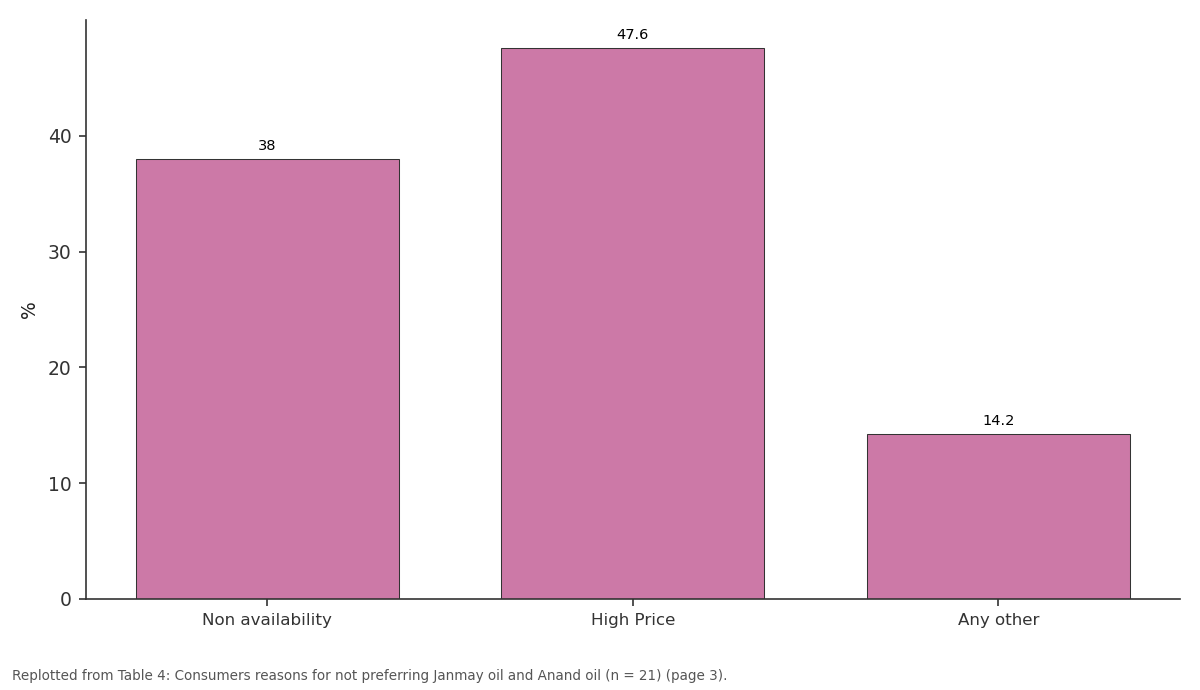
%: Non availability vs High Price vs Any other
Replotted from Table 4 (page 3) of the original paper. Every bar is the paper's own table value.
View source evidence ↗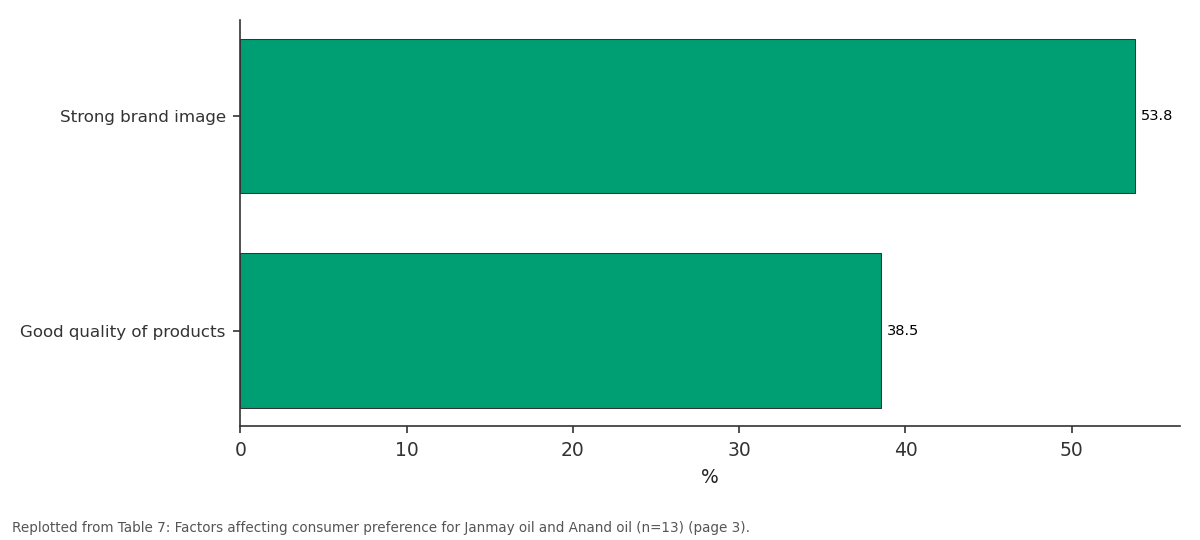
%: Strong brand image vs Good quality of products
Replotted from Table 7 (page 3) of the original paper. Every bar is the paper's own table value.
View source evidence ↗Figures & tables
From the original paper Table 1
 Table 2
 Table 3
 Table 4
 Table 5
 Table 6
 Table 7
Introduction
Edible oil consumption has been changed in recent years in many states of India due to several socio-economic and policy changes. As most of the respondents change their oil for better health, very strong brand loyalty is not displayed for oil. In every business, one of the important components of the decisions related to marketing is consumer preference so it is essential to study consumer preference to remain in the oil market. The present study was undertaken to understand the consumption pattern in the edible oil category by using a market survey. This study will give an idea regarding consumers' behaviour and the parameters they compare while purchasing edible oil. This study will also help to carry out the comparative analysis of Janmay oil with other brands. Several research studies have shown that consumers are more concerned about the brand not only in urban but also in rural areas. Most of the people both from illiterate & literate groups prefer branded products with the belief that quality was assured as the manufacturers were reputed companies.
Primary data Collection
The primary data for the study were collected through a set of questionnaires. For this purpose, a questionnaire for oil consumers was prepared and responses were collected from the respondents. The piece of information was collected through verbal communication with the industry people. Sample design: The survey was conducted in the Anand & Vadodara city market. For a comparative study, a visit to the oil processing plant of Anand Regional Co-operative Oilseeds Union Limited at Anand was undertaken. Sampling method: Selection of respondents was based on simple random sampling Sample size: we covered a total of 178 respondents. (Anand: 103 respondents, Vadodara: 75 respondents) through Questionnaires.
Secondary data Collection
Secondary data was collected from the official websites of the companies, annual reports of the organizations, government publications, and other related sources.
Results and Discussion
Janmay Oil was launched on the 48th Foundation Day of GCMMF, Janmay oil range is available in five variants. As demand for branded & packed oil was increasing in the pandemic time, launch of Janmay oils offered an option to consumers as trusted & pure brand. Through a "value for many" and "value for money" based business philosophy, the launch of Janmay oils aimed to serve both the raw material suppliers (in this case, 3.6 million farmer owners of GCMMF) and millions of consumers in equal measure. It was launched through Amul outlet and retail counters in Gujarat and Rajasthan. 1 shows that only 18.8 percent of the 180 respondents were aware of Janmay oil, and 81.1 percent were not even aware that it exists. Before a consumer decides to purchase a brand, they must be made aware of it. For brand attitudes and purchasing intentions to emerge, brand awareness was required. Therefore, the company needs to concentrate on marketing and advertising initiatives so that customers become aware that GCMMF's Janmay oil is offered in the market.
Results
Results
Consumer Awareness about Janmay Oil
Consumer Awareness about Janmay Oil
Respondents Source of awareness About Janmay
Customers can obtain information about Janmay oil through five channels: Amul outlets, product displays, any person, the internet, and advertising. The majority of respondents got information about Janmay oil from the Amul outlet. Given that Janmay oil was exclusively sold at APO (Amul Preferred Outlet) locations, it was evident from table 2 that 67 per cent of respondents came to know about the oil from Amul outlet because it was only available at APO. According to earlier research, over 83.8 percent of consumers buy edible oil from wholesale stores and D-Mart. As a result, the company needs to expand its presence in these and other locations. In addition, 42.8 percent of respondents also got information from advertisements, so that the promotional activity of Janmay oil should be increased.
| Sr. No. | Source of Information | Anand (n = 100) | — | Vadodara (n = 80) | — | Total | — | — | — |
|---|---|---|---|---|---|---|---|---|---|
| Janmay Oil | Anand Oil | Janmay Oil | Anand Oil | Janmay Oil | % | Anand Oil | % | ||
| 1 | Amul outlet | 15 | - | 8 | - | 23 | 67 | - | |
| 2 | Product display | 2 | 18 | 2 | 11 | 4 | 11.7 | 29 | 23 |
| 3 | Friends/Relative | 2 | 20 | 2 | 15 | 4 | 11.7 | 35 | 27.7 |
| 4 | Internet | 2 | 3 | 0 | 5 | 2 | 5.8 | 8 | 6.3 |
| 5 | Advertisements | 1 | 34 | 0 | 20 | 1 | 2.9 | 54 | 42.8 |
| 22 | 75 | 12 | 51 | 34 | 100 | 126 | 100 |
Table text extracted from the original PDF; superscript letters are shown inline. The original table image is below.
View original table image
Consumption of Janmay Oil by Respondents
Currently, the Indian edible oil market is expanding due to factors such as rising income levels, changing consumer lifestyles and food consumption patterns, improved health and wellness, and rising trends of using non-traditional oils like soya bean oil and rice bran oil. In the study consumption pattern of branded oils Janmay oil and Anand oil were analysed. Table 3 shows that, from a total of 34 respondents, only 13 respondents (38.2%), tried Janmay oil. While 21 respondents (61.7%) were aware of it but have not tried it yet. The consumption of Janmay oil was lower among respondents in Anand and Vadodara because consumer knowledge of it was much lower than that of other oils, and it was also less readily available because it was exclusively sold at Amul parlours.
| Sr. No. | Consumption of about Oil | Anand | — | Vadodara | — | Total | — | — | — | — |
|---|---|---|---|---|---|---|---|---|---|---|
| Yes | No | Yes | No | Yes | % | No | % | Total | ||
| 1. | Janmay Oil | 7 | 15 | 6 | 6 | 13 | 38.2 | 21 | 61.7 | 34 |
Table text extracted from the original PDF; superscript letters are shown inline. The original table image is below.
View original table image
Factors Responsible for Low Preference of Janmay
There were numbers of factors listed in the table below that were responsible for low usage of Janmay oil. 4, it can be inferred that 47.6 per cent of respondents had never tried Janmay oil due to its higher price when compared to other brands, and 38 percent have never tried Janmay oil due to its unavailability at a local market.
Satisfaction Level of Consumers with Respect to Janmay
Oil: The satisfaction level of customers of Janmay oil is given in the following table. A customer who liked Janmay oil told that he/she was highly satisfied from all aspects, while the other scales were satisfied, neutral, dissatisfied, and highly dissatisfied. Source: Primary data Table 5 shows that 53.8 percent of the 13 respondents who tried Janmay oil at least once were satisfied with it, 23 per cent were neutral, and 23 per cent were dissatisfied with it. Only 8 percent of the respondents were highly satisfied with Janmay oil. So that firm has to find the reason for the negative behaviour and try to improve it so that they can create more market for Janmay oil.
| Sr. No. | Opinion regarding not trying Janmay oil | No. of Respondents from Anand | No. of Respondents Vadodara | Total Respondents | — |
|---|---|---|---|---|---|
| Janmay Oil | Janmay Oil | Janmay Oil% | |||
| 1. | Highly satisfied | 0 | 1 | 1 | 7.7 |
| 2. | Satisfied | 3 | 3 | 6 | 46.1 |
| 3. | Neutral | 3 | 1 | 3 | 23 |
| 4. | Dissatisfied | 1 | 0 | 1 | 7.6 |
| 5. | Highly dissatisfied | 0 | 2 | 2 | 15.3 |
| 13 |
Table text extracted from the original PDF; superscript letters are shown inline. The original table image is below.
View original table image
Loyalty of Consumers with Respect to Janmay Oil
A majority of respondents change their oil for improved health, there wasn't a lot of brand loyalty shown when it comes to using oil. Not only health considerations but also price were important parameters when customers switch brands. 6 shows that only 7 of the 34 knowledgeable respondents used Janmay oil on a daily basis and were satisfied with the product. It was difficult to present a genuine, acceptable product to a buyer without understanding them. Customer brand awareness, customer brand attitudes, and consumer perceptions of brand ethics were the three key sub drivers of brand equity.
Factors Affecting Respondents Preference for Janmay Oil
Factors responsible for purchase of Janmay oil are classified into respected brand name, good quality of product, low price, high nutritional value, and good taste. Table no 7 shows factors affecting the purchase of Janmay oil. Good taste 0 0 0 0 13 Source: Primary data Table 7 reveals that, out of the total 13 Janmay oil consumers, around 7 (54%) consumers purchase Janmay oil because of the respected brand name, total 5 (38%) respondents purchase Janmay oil because they think Janmay oil has good quality and 1 (8%) respondent purchase Janmay oil because of its high nutritional value. There were many different brands of edible oil on the market right now during study period. Every oil brand was distinct from its rivals. Customers have different attitudes towards pricing, quality, packing, quantity, and other factors; thus, manufacturers must offer better products to customers in order to retain and increase market share for a long time.
| Sr. No. | Factors affecting the purchase of Janmay oil | Anand | Vadodara | Total | — |
|---|---|---|---|---|---|
| Janmay Oil | Janmay Oil | Janmay Oil | % | ||
| 1. | Strong brand image | 6 | 1 | 7 | 53.8 |
| 2. | Good quality of products | 3 | 2 | 5 | 38.5 |
Table text extracted from the original PDF; superscript letters are shown inline. The original table image is below.
View original table image
Conclusion
This research was done to analyse consumer buying behaviour towards Non Dairy Amul Products and its awareness. According to the results of this study, it was found that consumer awareness of Janmay oil is very low in the selected cities Anand & Vadodara. Overall, only 19% of the respondents were aware of the presence of Janmay oil in the market. The Majority of the aware respondents came to know about Janmay oil from Amul Preferred outlets (APO) (66%). Further majority of the aware respondents said that they avoided Janmay oil mainly because of its High Price (48%) and also because there was a significant lack of its availability in local markets.
Figures and tables from the paper
| Sr. No. | Awareness about Oil | Anand | — | — | Vadodara | — | — | Total | — | — | — | — |
|---|---|---|---|---|---|---|---|---|---|---|---|---|
| Yes | No | Total | Yes | No | Total | Yes | % | No | % | Total | ||
| 1 | Janmay Oil | 22 | 78 | 100 | 12 | 68 | 80 | 34 | 18.8 | 146 | 81.1 | 180 |
Table text extracted from the original PDF; superscript letters are shown inline. The original table image is below.
View original table image
| Sr. No. | Opinion regarding not trying Janmay oil | Anand | Vadodara | Total | — |
|---|---|---|---|---|---|
| Janmay Oil | Janmay Oil | Janmay Oil | % | ||
| 1. | Non availability | 3 | 5 | 8 | 38.0 |
| 2. | High Price | 6 | 4 | 10 | 47.6 |
| 3. | Any other | 2 | 1 | 3 | 14.2 |
| 21 |
Table text extracted from the original PDF; superscript letters are shown inline. The original table image is below.
View original table image
| Sr No. | Loyal consumers of Edible Oil | No. of Respondents from Anand | — | No. of Respondents from Vadodara | — | Total | — | — |
|---|---|---|---|---|---|---|---|---|
| Yes | No | Yes | No | Yes | % | Total | ||
| 1. | Janmay Oil | 4 | 18 | 3 | 12 | 7 | 53.8 | 13 |
| 2. | Anand Oil | 19 | 47 | 12 | 36 | 31 | 27.1 | 114 |
Table text extracted from the original PDF; superscript letters are shown inline. The original table image is below.
View original table image
References
1 in the original paper- The Economic Times. Cottonseed oil rules the kitchens of Gujarat as cheapest cooking oil [Internet]. 2013 May 1 [cited YYYY MMM DD]. Available from: https://economictimes.indiatimes.com/markets/commod ities/cottonseed-oil-rules-the-kitchens-of-gujarat-ascheapest-cooking-oil/articleshow/19534325.cms