
Research article · 2025 · Full text
International Journal of Agriculture and Food ScienceStudy on consumer buying behaviour towards organic food products in Rayalaseema region of Andhra Pradesh
Volume 7(11) · Pages 360–363 · DOI: 10.33545/2664844x.2025.v7.i11e.976 ↗
Research areasOrganic Food and AgricultureEnvironmental Sustainability in BusinessConsumer Packaging Perceptions and Trends
Abstract
Author-writtenGrowing awareness of food safety, environmental sustainability and health issues is creating demand for organic food products. This trend is rapidly growing throughout India’s many socioeconomic and culturally diversified regions. The present study examines buying behaviour of consumers regarding organic food products in the Rayalaseema region of Andhra Pradesh. A descriptive research method was adopted and the primary data were collected from 250 respondents from five districts Kadapa, Chittoor, Tirupati, Nandyal and Kurnool using a structured questionnaire. The findings showed that most of the consumers are young, female and well educated with employees and students constituting the main occupational categories. The main reasons influencing the choice of buying organic food are its high nutritional content, ability to reduce health problems and good product quality. The majority of consumers choose to purchase organic food items from organic markets and supermarkets where the most preferred products are fresh fruits and vegetables. Insights from this study can help producers, marketers and policymakers to develop strategies that will expand the market and improve the availability of organic food products in this region.
Summary
Source-checkedPlain-language reading of the full paper, prepared with AI and checked against the text. Each point links to the authors' own words.
Why it matters
- Demand for organic food is increasing due to a growing public awareness of health issues, food safety, and environmental sustainability. View evidence ↗
- The preference for organic foods has grown as a reaction to the environmental impact and food safety concerns associated with synthetic fertilizers used during the Green Revolution. View evidence ↗
- Organic foods are defined as plant or animal products produced without the use of genetically modified organisms, antibiotics, growth hormones, or conventional synthetic pesticides and fertilizers. View evidence ↗
The question
- The study aims to examine the buying behavior of consumers regarding organic food products specifically within the Rayalaseema region of Andhra Pradesh. View evidence ↗
What they did
- The researchers employed a descriptive research design to analyze consumer behavior in the target region. View evidence ↗
- Data was collected from 250 respondents (50 from each of the five districts: Kadapa, Chittoor, Tirupati, Nandyal, and Kurnool) using non-probability convenience sampling. View evidence ↗
- Primary data was gathered via a structured questionnaire administered only to consumers who were already aware of organic food products. View evidence ↗
- The analysis of the socio-economic profiles and buying behaviors was performed using descriptive statistics, specifically frequencies and percentages. View evidence ↗
What they found
- The typical organic food consumer in the study is female (57%), aged 20-30 (66%), and holds a graduate degree (61.2%). View evidence ↗
- Students (52%) and employees (32.8%) were the primary occupational categories among the respondents. View evidence ↗
- Organic markets are the most preferred purchase location (54%), followed by supermarkets (26%), general stores (10.8%), and online platforms (9.2%). View evidence ↗
- The majority of consumers (62.8%) purchase organic food products on a weekly basis. View evidence ↗
- Most users are relatively new to organic foods, with 38.8% using them for 6-12 months and 31.2% for up to 6 months. View evidence ↗
- Consumers prioritize fresh and essential organic products over processed organic food products, which are consumed less regularly. View evidence ↗
What it means
- The authors conclude that while organic food usage is rising, expanding the consumer base requires improved availability, targeted promotional strategies, and increased consumer education. View evidence ↗
- The study relied on non-probability convenience sampling, meaning participants were selected based on availability and willingness to respond rather than random selection. View evidence ↗
Visual summary
2 visualsIllustrations explain the paper; charts are replotted from the paper's own table values.
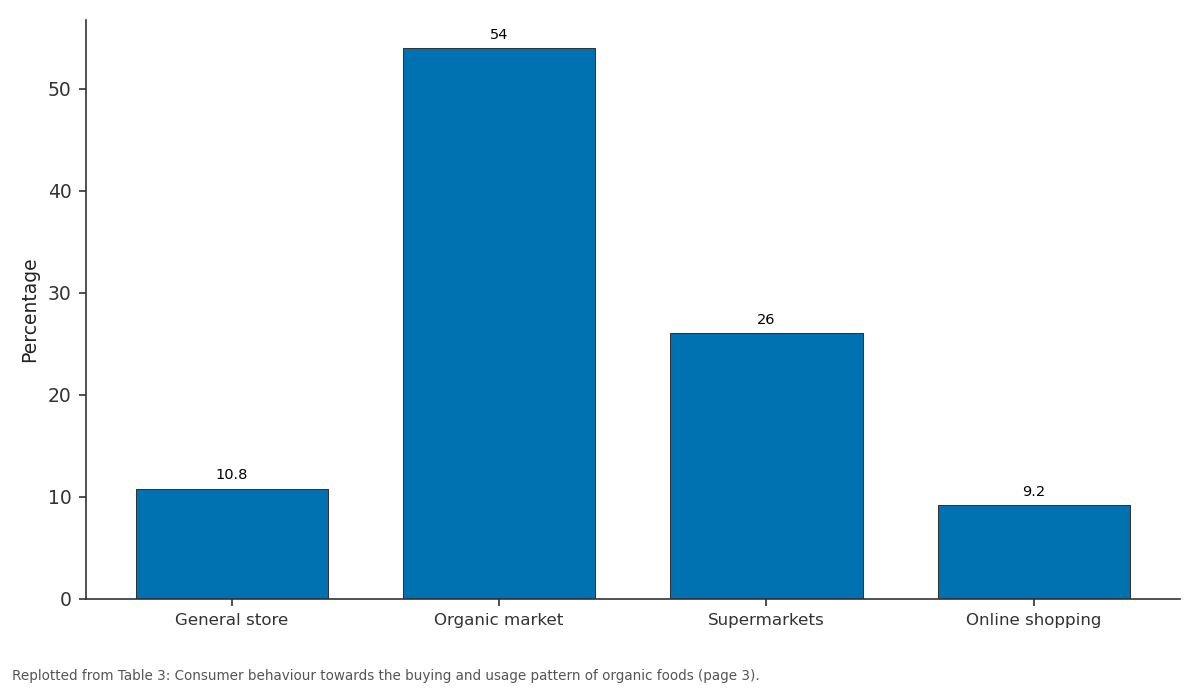
Percentage: General store vs Organic market vs Supermarkets vs Online shopping
Replotted from Table 3 (page 3) of the original paper. Every bar is the paper's own table value.
View source evidence ↗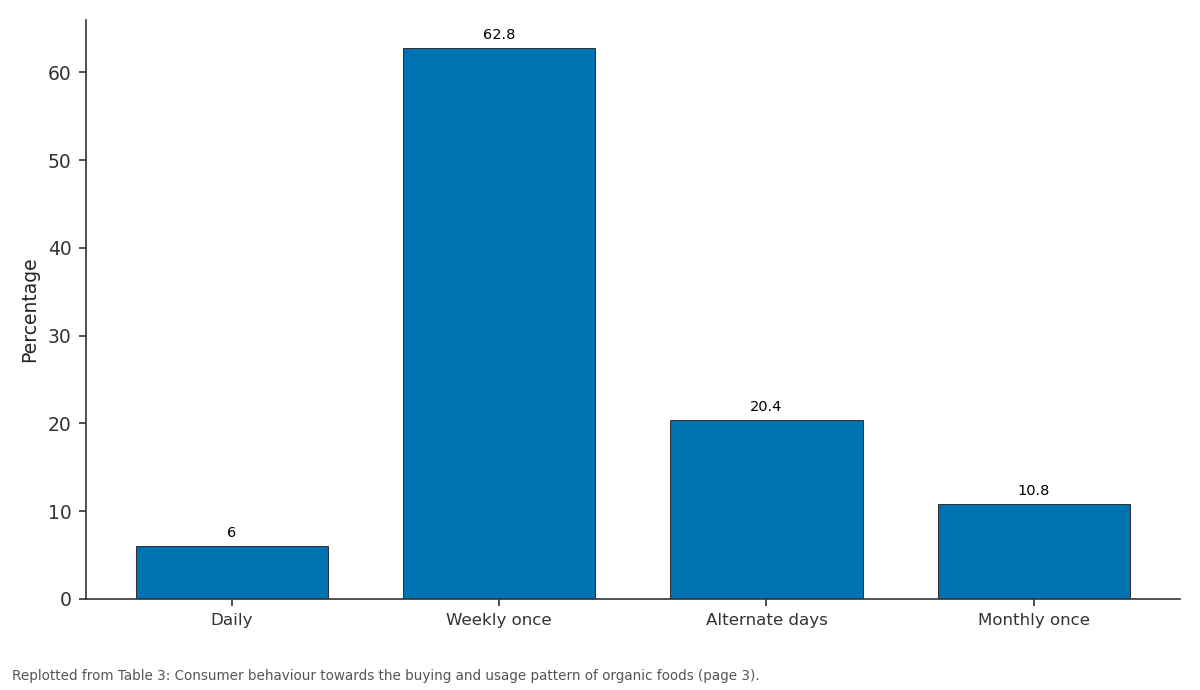
Percentage: Daily vs Weekly once vs Alternate days vs Monthly once
Replotted from Table 3 (page 3) of the original paper. Every bar is the paper's own table value.
View source evidence ↗Figures & tables
From the original paper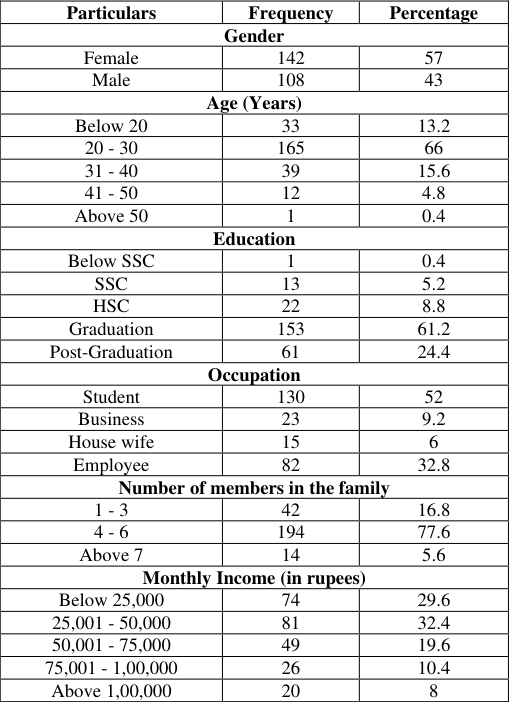 Table 1
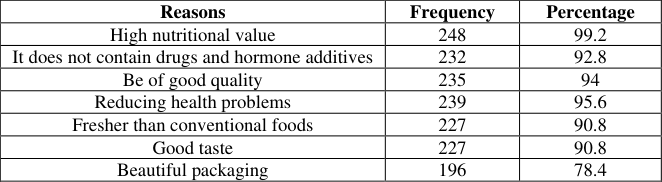 Table 2
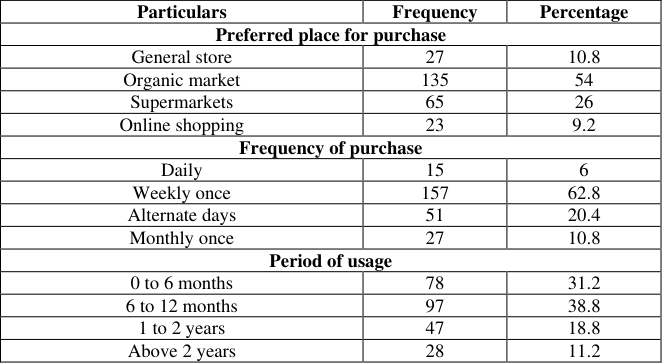 Table 3
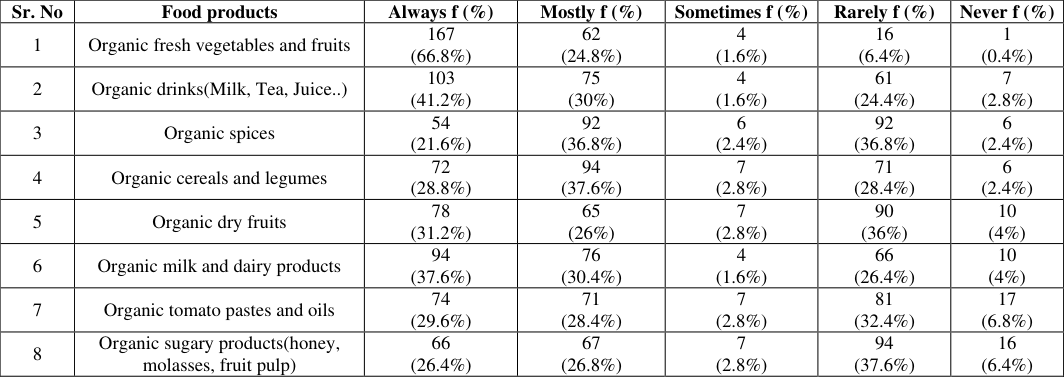 Table 4
Introduction
The rapid growth in the industrial development together with the population explosion is increasing the pressure on the agricultural production methods to improve the yield of the crops (Basha et al., 2015) [3] . The Green Revolution in the agricultural sector had led to the application of synthetic fertilizers to increase yields without concern for environmental impact (Hossain & Lim, 2016) [10] . As a result, rising concerns over food safety and environmental sustainability have encouraged a growing preference for organic food products. The changes in the consumers' lifestyle, tastes and preferences, standard of living as well as purchasing and technical advancement in agriculture and marketing have led to increasing demand for organic food products (Wandel & Bugge, 1997). Kataria et al. (2018) [19, 11] define organic food as a type of plant or animal products that are produced without using growth hormones, antibiotics, conventional synthetic fertilizers and pesticides, or genetically modified organisms. As per the FAO/WHO Codex Alimentarius Commission (2007), organic agriculture is an integrated management system that aims to enhance the health of agro-ecosystems by promoting biodiversity, biological cycles and soil activity. It emphasizes the use of natural inputs, such as minerals and plant-based materials and rejects the application of synthetic fertilizers and pesticides. Organic foods are now creating attention in many developing countries as they can achieve environmental benefits for the public sector as well as international trade exchange for the private sector (Rehber and Turhan, 2002) [16] . The importance of organic food products in the global food industry and consumption trends has increased significantly. Global organic food production is expected to grow rapidly and is classified as one of the biggest growth markets in the food industry (Baker, 2004; Gifford & Bernard, 2005) [1,8] . Demographic factors such as health, education and availability positively affect the consumer's attitude towards purchasing organic food products. Consumers express more satisfaction with organic food than with inorganic food (Paul and Rana 2012) [15] . This study aims to examines the consumer buying behavior towards organic foods in the Rayalaseema region of Andhra Pradesh.
Review of Literature
Mehra and Ratna (2014) [13] found younger consumers and female prefer organic foods. They carefully read labels and compare product information before selecting healthy foods. These consumers are willing to pay more for food that is both tasty and healthy. Harper & Makatouni (2000) and Chinnici et al. (2002) [9,6] found that consumers have positive attitude towards organic products where one of the most commonly mentioned reasons for purchasing them was that consumers perceive organic products as healthier than conventional alternatives. Singh & Verma (2017) [17] found that health consciousness, knowledge, price, subjective norms and availability play an important role in organic food consumption by highlighting the fact that accessibility and affordability are key determinants alongside individual awareness and social pressures. Pandurangarao et al. (2017) [14] found that health, safety, environmental concerns, price and accessibility all were having a significant effect on consumers' choices to purchase organic food. Environmental concern and consumer behaviour were found to be highly related.
Basha & Lal (2019) [2] found that consumer intention about purchase of organic food is influenced by environmental concerns, social norms, safety, trust and convenience. This highlights the importance of ethical and practical factors in organic food purchases. Sreedevi and Katyayani (2021) [18] studied consumer behaviour in Tirupati, Andhra Pradesh found that health, safety, and taste were main motivators. Education and income levels also played a role in preferring organic food products. Boobalan et al. (2022) and Khan et al. (2022) [5,12] found that attitudes, subjective norms, perceived behavioral control, response efficacy, and self-expressive benefits shape consumer decisions. These findings imply that buying organic food is a rational choice made by consumers.
Objectives of the study
This study was carried out with the following objectives: To study the socio-economic profile of consumers of organic food products To study the buying behaviour of consumers towards organic food products
Materials and Methods
Materials and Methods
Research Design
This study follows a descriptive research design, as it aims to analyze consumer buying behaviour towards organic food products in a specific region.
Sample selection
The research was conducted in the Rayalaseema region of Andhra Pradesh from five districts: Kadapa, Chittoor, Tirupati, Nandyal and Kurnool. 50 respondents were selected from each district, making a total of 250 respondents from the study area. The sampling method used was non-probability convenience sampling, where respondents were selected based on their availability and willingness to respond.
Data Collection Instrument
A Structured questionnaire was used in this study to examine consumer buying behaviour towards organic food products. To identify various aspects of consumer behaviour the questionnaire was divided into two parts. The first part of the questionnaire collected socio-demographic information of the respondents. The items related to the reasons for purchasing organic foods and preferred place of purchase were adapted from Baydas et al (2021) [4] , While questions on frequency and period of usage were taken from Yi (2009) [20] .
Data collection
Primary data was collected directly from consumers through a structured questionnaire. Questionnaires were distributed only to those respondents who were aware of organic food products.
Statistical Tools
To assess the socio-economic profile and buying behaviour of respondents, descriptive measures such as frequencies and percentages were used.
Results and Discussion
Results and Discussion
Socio-economic profile of the consumers
The Socio-economic profile of the consumers is presented in With respect to monthly income, 32.4% of the respondents fall within the ₹25,001-₹50,000 income bracket, while 29.6% earn below ₹25,000. Table 2 present the reasons behind consumers purchase of organic food products. It shows that the major reason for purchasing organic food products among consumers is their high nutritional value (99.2%), followed by their ability to reduce health problems (95.6%), good product quality (94.0%) and absence of drugs and hormone additives (92.8%). Other reasons are their freshness compared to conventional foods and good taste. These findings indicate that consumers prefer organic food mainly because of its health benefits, higher quality that reflects an increasing awareness towards health. Table 3 present the consumer preferred place of purchase, period of usage and frequency of purchase of organic food products in the Rayalaseema region of Andhra Pradesh.
| Particulars | Frequency | Percentage |
|---|---|---|
| Preferred place for purchase | ||
| General store | 27 | 10.8 |
| Organic market | 135 | 54 |
| Supermarkets | 65 | 26 |
| Online shopping | 23 | 9.2 |
| Frequency of purchase | ||
| Daily | 15 | 6 |
| Weekly once | 157 | 62.8 |
| Alternate days | 51 | 20.4 |
| Monthly once | 27 | 10.8 |
| Period of usage | ||
| 0 to 6 months | 78 | 31.2 |
| 6 to 12 months | 97 | 38.8 |
| 1 to 2 years | 47 | 18.8 |
| Above 2 years | 28 | 11.2 |
Table text extracted from the original PDF; superscript letters are shown inline. The original table image is below.
View original table image
| Reasons | Frequency | Percentage |
|---|---|---|
| High nutritional value | 248 | 99.2 |
| It does not contain drugs and hormone additives | 232 | 92.8 |
| Be of good quality | 235 | 94 |
| Reducing health problems | 239 | 95.6 |
| Fresher than conventional foods | 227 | 90.8 |
| Good taste | 227 | 90.8 |
| Beautiful packaging | 196 | 78.4 |
Table text extracted from the original PDF; superscript letters are shown inline. The original table image is below.
View original table image
From the results, the maximum respondents (54%), purchased organic foods from organic markets, followed by supermarkets (26%), while a few consumers purchased organic food products from General store (10.8%) and online platforms (9.2%). Regarding frequency of purchase, majority of the consumers purchase organic foods on a weekly basis (62.8%). With respect to the duration of organic food product usage 38.8% of respondents have been using them for 6-12 months, whereas 31.2% of respondents used them for up to 6months. From the findings, consumers have developed a regular purchasing behaviour and stated that they prefer organized markets while buying organic products, reflecting their increasing acceptance and trust in organic food products. 4 shows the frequency of purchases made by consumers in the Rayalaseema region of Andhra Pradesh on a variety of organic food products. It is found that that organic fruits and vegetables are purchased most frequently, followed by organic milk and dairy products. Some consumers purchase organic cereals and legumes regularly with spices, dry fruits, tomato paste, oils and sugar products being purchased less often.These findings shows that consumers mostly rely on the consumption of organic fresh and essential food products regularly, while processed organic food products are consumed less regularly.
Conclusion
This study indicates an increasing preference for organic food products in the Rayalaseema area of Andhra Pradesh. Key findings show that age, occupation, and education as socio-economic characteristics are affecting consumer buying behaviour. The main reasons for purchasing organic food products are its nutritional value, ability to reduce health problems and quality. Fresh vegetables and fruits are the most commonly purchased organic products, which are mostly bought in organic markets and supermarkets. Even though the usage of organic foods is increasing, awareness and availability should be improved to expand the consumer base. The results suggest that targeted promotional strategies and consumer education can significantly enhance the reach of organic food products. The study provides important implications for producers, marketers and policymakers that promote sustainable consumption behaviours and growth of organic food sector in the region.
Figures and tables from the paper
| Particulars | Frequency | Percentage |
|---|---|---|
| Gender | ||
| Female | 142 | 57 |
| Male | 108 | 43 |
| Age (Years) | ||
| Below 20 | 33 | 13.2 |
| 20 - 30 | 165 | 66 |
| 31 - 40 | 39 | 15.6 |
| 41 - 50 | 12 | 4.8 |
| Above 50 | 1 | 0.4 |
| Education | ||
| Below SSC | 1 | 0.4 |
| SSC | 13 | 5.2 |
| HSC | 22 | 8.8 |
| Graduation | 153 | 61.2 |
| Post-Graduation | 61 | 24.4 |
| Occupation | ||
| Student | 130 | 52 |
| Business | 23 | 9.2 |
| House wife | 15 | 6 |
| Employee | 82 | 32.8 |
| Number of members in the family | ||
| 1 - 3 | 42 | 16.8 |
| 4 - 6 | 194 | 77.6 |
| Above 7 | 14 | 5.6 |
| Monthly Income (in rupees) | ||
| Below 25,000 | 74 | 29.6 |
| 25,001 - 50,000 | 81 | 32.4 |
| 50,001 - 75,000 | 49 | 19.6 |
| 75,001 - 1,00,000 | 26 | 10.4 |
| Above 1,00,000 | 20 | 8 |
Table text extracted from the original PDF; superscript letters are shown inline. The original table image is below.
View original table image
| Sr. No | Food products | Always f (%) | Mostly f (%) | Sometimes f (%) | Rarely f (%) | Never f (%) |
|---|---|---|---|---|---|---|
| 1 | Organic fresh vegetables and fruits | 167 (66.8%) | 62 (24.8%) | 4 (1.6%) | 16 (6.4%) | 1 (0.4%) |
| 2 | Organic drinks(Milk, Tea, Juice..) | 103 (41.2%) | 75 (30%) | 4 (1.6%) | 61 (24.4%) | 7 (2.8%) |
| 3 | Organic spices | 54 (21.6%) | 92 (36.8%) | 6 (2.4%) | 92 (36.8%) | 6 (2.4%) |
| 4 | Organic cereals and legumes | 72 (28.8%) | 94 (37.6%) | 7 (2.8%) | 71 (28.4%) | 6 (2.4%) |
| 5 | Organic dry fruits | 78 (31.2%) | 65 (26%) | 7 (2.8%) | 90 (36%) | 10 (4%) |
| 6 | Organic milk and dairy products | 94 (37.6%) | 76 (30.4%) | 4 (1.6%) | 66 (26.4%) | 10 (4%) |
| 7 | Organic tomato pastes and oils | 74 (29.6%) | 71 (28.4%) | 7 (2.8%) | 81 (32.4%) | 17 (6.8%) |
| 8 | Organic sugary products(honey, molasses, fruit pulp) | 66 (26.4%) | 67 (26.8%) | 7 (2.8%) | 94 (37.6%) | 16 (6.4%) |
Table text extracted from the original PDF; superscript letters are shown inline. The original table image is below.
View original table image
References
20 in the original paper- Baker S. Mapping the values driving organic food choice: Germany vs the UK. Eur J Mark. 2004;38(8):995-1012.
- Basha MB, Lal D. Indian consumers' attitudes towards purchasing organically produced foods: An empirical study. J Clean Prod. 2019;215:99-111.
- Basha MB, Mason C, Shamsudin MF, HI, Salem MA. Consumers' attitude towards organic food. Procedia Econ Finance. 2015;31:444-52.
- Baydas A, Yalman F, Bayat M. Consumer attitude towards organic food: determinants of healthy behaviour. Mark Menedz Innov. 2021;(1):96-111.
- Boobalan K, Sivakumaran B, Susairaj M. Organic food preferences: A comparison of American and Indian consumers. Food Qual Prefer. 2022;104627.
- Chinnici G, D'Amico M, Pecorino B. A multivariate statistical analysis on the consumers of organic products. Br Food J. 2002;104(3/4/5):187-99.
- FAO, WHO. Codex Alimentarius: Organically Produced Food. 3rd ed. 2007. Available from: http://www.codexalimentarius.org/standards/thematiccompilations/en/
- Gifford K, Bernard JC. Influencing consumer purchase likelihood of organic food. Int J Consum Stud. 2005;30(2):155-63.
- Harper GC, Makatouni A. Consumer perception of organic food production and farm animal welfare. Br Food J. 2002;104(3/4/5):287-99.
- Hossain MTB, Lim PX. Consumers' buying behavior towards organic foods: Evidence from the emerging market. Malays Manag Rev. 2016;51(2):7-25.
- Kataria YS, Krishna HG, Tyagi VK, Vashishat T. Consumer buying behavior of organic food products in India through the lens of planned behavior theory. Res J Humanit Soc Sci. 2019;10(1):60-7.
- Khan Y, Hameed I, Akram U. What drives attitude, purchase intention and consumer buying behavior toward organic food? A self-determination theory and theory of planned behavior perspective. Br Food J. 2022;125(7).
- Mehra S, Ratna PA. Attitude and behaviour of consumers towards organic food: An exploratory study in India. Int J Bus Excell. 2014;7(6):677-99.
- Pandurangarao D, Chiranjeevi K, Rao S. Factors affecting consumers to buy organic food products in Hyderabad and Secunderabad. Int J Bus Manag Invention. 2017;6(3):24-30.
- Paul J, Rana J. Consumer behaviour and purchase intention for organic food. J Consum Mark. 2012;29:412-22.
- Rehber E, Turhan S. Prospects and challenges for developing countries in trade and production of organic food and fibers: The case of Turkey. Br Food J. 2002;104(3/4/5):371-90.
- Singh A, Verma P. Factors influencing Indian consumers' actual buying behaviour towards organic food products. J Clean Prod. 2017;167:473-83.
- Sreedevi S, Katyayani J. Consumer buying behaviour on organic foods in Tirupathi, Chittoor district, Andhra Pradesh State, India. Turk Online J Qual Inq. 2021;12(6).
- Wandel M, Bugge A. Environmental concern in consumer evaluation of food quality. Food Qual Prefer. 1997;8:19-26.
- Yi LK. Consumer behaviour towards organic food consumption in Hong Kong: An empirical study. Unpublished Honours Degree Project. Hong Kong: Hong Kong Baptist University; 2009.