
Research article · 2025 · Full text
International Journal of Advanced Chemistry ResearchMicrowave-assisted synthesis and characterization of bioactive Benzimidazole-Oxadiazole Hybrids
Volume 7(11) · Pages 19–23 · DOI: 10.33545/26646781.2025.v7.i11a.328 ↗
Research areasSynthesis and biological activityMicrowave-Assisted Synthesis and ApplicationsMulticomponent Synthesis of Heterocycles
Abstract
Author-writtenA series of new heterocyclic derivatives containing benzo[d]imidazole scaffolds was synthesized through a multi-step reaction procedure. Initially, ethyl 2-(1H-benzo[d]imidazol-1-yl) acetate was obtained from benzimidazole and ethyl 2-chloroacetate in ethanol. Subsequent treatment with hydrazine hydrate afforded 2-(hydrazinyloxy)-2-oxoethyl-1H-benzo[d]imidazole, which was converted to 2-(1H-benzo[d]imidazol-1-yl) acetohydrazide. The hydrazide was then condensed with benzaldehyde to give the corresponding Schiff base, (E)-2-(1H-benzo[d]imidazol-1-yl)-N-benzylideneacetohydrazide. Further cyclization under microwave irradiation in the presence of chloramine-T as a catalyst furnished 2-((1H-benzo[d]imidazol-1-yl) methyl)-5-phenyl-1, 3, 4-oxadiazole. This multistep microwave-assisted synthetic procedure providing an accelerated and sustainable approach with improved reaction efficiency. This synthetic route provides an efficient and convenient strategy for the preparation of bioactive benzimidazole-oxadiazole hybrids (T1-T5), which are of potential interest in medicinal chemistry due to their diverse pharmacological properties. Characterisation of synthesized compound (T1-T5) were confirmed by using IR (KBr), H-1 NMR spectral data, and reaction completion was monitor by using TLC.
Summary
Source-checkedPlain-language reading of the full paper, prepared with AI and checked against the text. Each point links to the authors' own words.
Why it matters
- Benzimidazoles are important heterocycles in medicinal chemistry due to their proven antimicrobial, antiviral, anticancer, and anti-inflammatory effects. View evidence ↗
- Combining benzimidazole and oxadiazole moieties into a hybrid scaffold is a useful strategy to create molecules with synergetic biological activity. View evidence ↗
The question
- The study aims to synthesize a series of benzimidazole-oxadiazole conjugates (T1-T5) using a simple multistep process. View evidence ↗
What they did
- The synthesis followed a four-step route: esterification, hydrazide formation, Schiff base condensation, and final cyclization using microwave irradiation and a chloramine-T catalyst. View evidence ↗
- The first step involved reacting 6.0 g of benzimidazole with 4.2 mL of ethyl chloroacetate and 4.0 g of potassium carbonate in 30 mL of ethanol under microwave irradiation for 6-8 minutes. View evidence ↗
What they found
- Compound T1 was synthesized as an off-white solid with a molecular weight of 276.30, a melting point of 198 °C, and a yield of 75% over a reaction time of 8-10 minutes. View evidence ↗
- Compound T2 was obtained as a yellow solid with a molecular weight of 292.30, a melting point of 148 °C, and the highest yield of 85% in 7-8 minutes. View evidence ↗
- Compound T5 was synthesized as a yellow solid with a molecular weight of 321.30, a melting point of 168 °C, and a yield of 65% in 8-10 minutes. View evidence ↗
- Microwave irradiation significantly reduced the reaction time from hours (conventional heating) to minutes. View evidence ↗
What it means
- The authors conclude that chloramine-T catalyzed microwave-assisted cyclization significantly improves reaction time and yields compared to traditional heating. View evidence ↗
- The synthesized library of hybrids is expected to exhibit diverse pharmacological activities, providing a basis for further drug discovery research. View evidence ↗
Visual summary
1 visualsIllustrations explain the paper; charts are replotted from the paper's own table values.
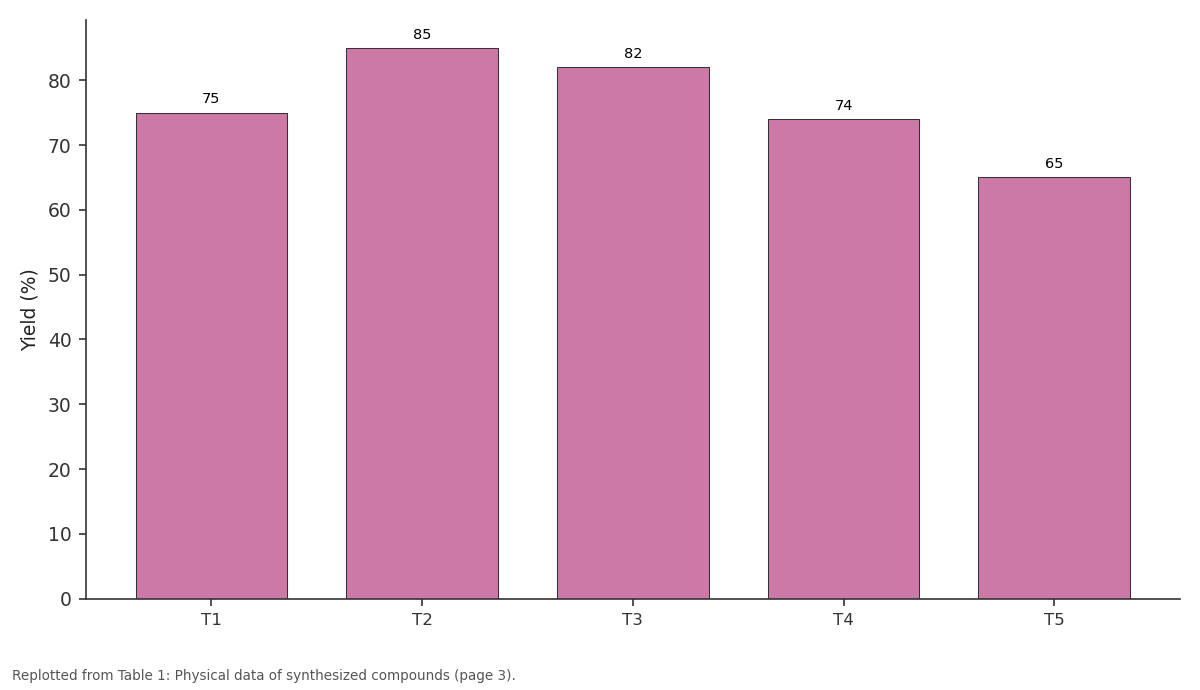
Yield (%): T1 vs T2 vs T3 vs T4 vs T5
Replotted from Table 1 (page 3) of the original paper. Every bar is the paper's own table value.
View source evidence ↗Figures & tables
From the original paper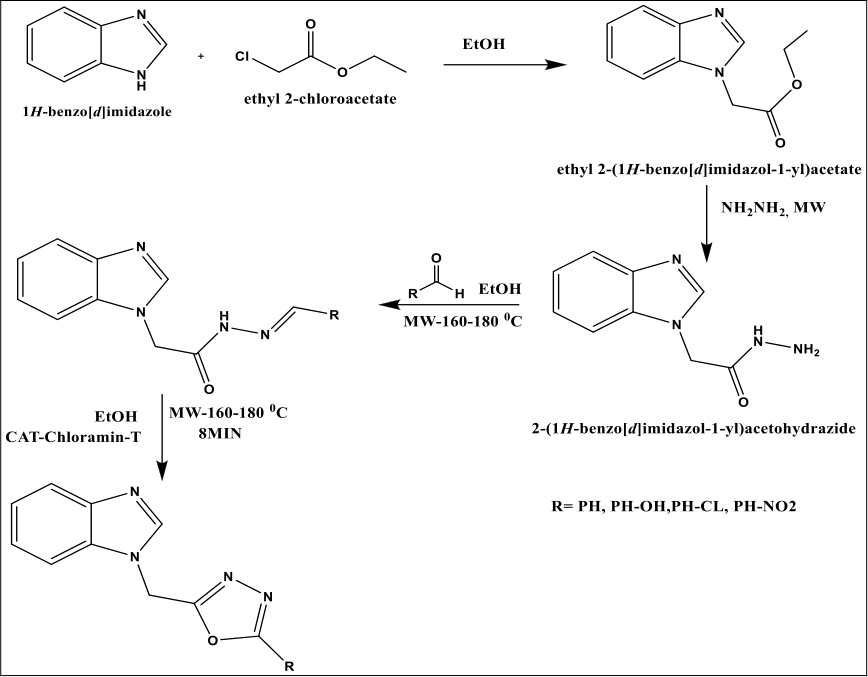 Figure 1
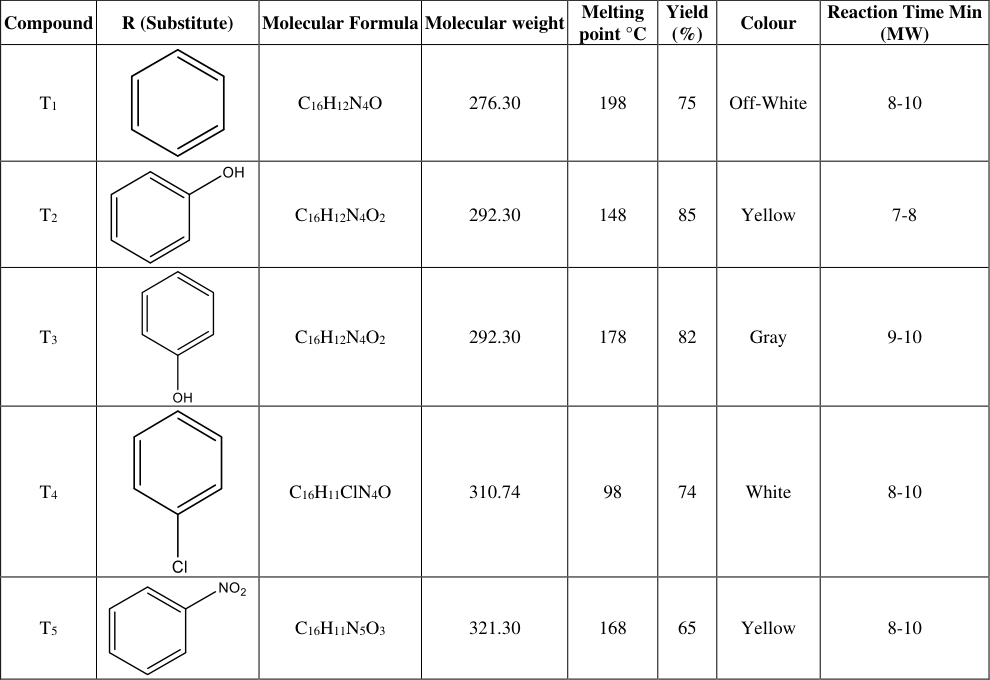 Table 1
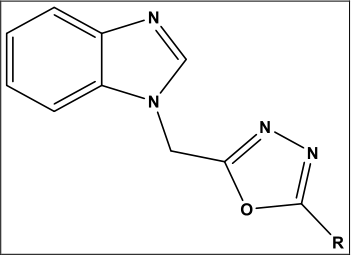 Figure 2
Introduction
The heterocyclic compounds have become an essential part of the medicinal chemistry because of their prevalence in the bioactive molecules [1] . Benzimidazoles form a significant group of heterocycles that already has a proven pharmacological effects, such as antimicrobial, antiviral, anticancer, and anti-inflammatory effects [2] . Omeprazole, albendazole and mebendazole are examples of drugs containing benzimidazole as their pharmacophore [4,3] . The 1, 3, 4-oxadiazoles are also versatile heterocyclic compounds used in pharmaceuticals, agrochemicals and materials science. They exhibit anti-inflammatory, antifungal, antibacterial, analgesic and anticancer activity, and frequently serve as bioisosteres to esters and amides where they enhance metabolic stability [2,8] . The fact that these two moieties can be combined to produce a hybrid scaffold gives a useful approach to producing molecules containing synergetic activity. It has been shown that benzimidazole-oxadiazole derivatives have antimicrobial activity [7] , anticancer activity [4] and enzyme-inhibitory activity [6] . In this paper, we describe the synthesis of a benzimidazole-oxadiazole conjugate, 2-((1H-benzo[d]imidazol-1-yl) methyl)-5-phenyl-1, 3, 4-oxadiazole (T 1 -T 5 ), by a simple multistep process. Oxidative cyclization using microwave irradiation and chloramine-T allows the reaction to take place in a short period and with high yield [6] , which is in line with the concept of green chemistry.
Materials and Methods
Materials and Methods
Chemicals and Reagents
The synthesis involved the use of various chemicals, including and its substituted Benzimidazole, Ethyl 2-chloroacetate, Hydrazine hydrate Derivatives along with ethyl chloroacetate, phenyl iso-thiocynate, NaOH Common solvents such as ethanol, methanol, glacial acetic acid, acetone, Benzaldehyde, Chloramine-T, Ethanol, methanol, and other standard solvents and dimethyl sulfoxide were also utilized.
General Synthesis of Ethyl 2-(1H-benzo[d]imidazol-1-yl) acetate
Benzimidazole (6.0 g, 0.05 mol), ethyl chloroacetate (4.2 mL, 0.04 mol), and potassium carbonate (4.0 g, 0.029 mol) were suspended in 30 mL of ethanol. The reaction mixture was subjected to microwave irradiation at medium power for 6-8 min. Progress of the reaction was monitored by thinlayer chromatography (TLC) using ethyl acetate: hexane (3:1) as the mobile phase. Upon completion, the mixture was poured onto crushed ice, and the precipitate obtained was collected by vacuum filtration. The crude product was washed with cold water, dried under oven, and recrystallized from hot ethanol to give the pure White crystalline solid compound. Yield: 4.3 g (70%), Melting point: 180 °C.
Preparation of 2-(1H-[d]imidazol-1-yl)acetohydrazide
The ester (Ethyl 2-(1H-benzo[d]imidazol-1-yl) acetate (4.2gm, 0.01mol) was reacted with hydrazine hydrate (80%, 5 mL) in ethanol. This reaction proceeded through microwave irradiation for 6-9 to minutes. The mixture was poured onto crushed ice cold water, and the precipitate obtained was collected by vacuum filtration. The crude product was washed with cold water, dried in an oven, and recrystallized from hot ethanol to give the pure corresponding hydrazide Yield: 3.3 g (78%), Melting point: 160-185 °C.
Formation of Schiff Base (E)-2-(1H-benzo[d]imidazol-1yl)-N-benzylideneacetohydrazide
Hydrazide (1.09gm, 1 mmol) was condensed with benzaldehyde (1.06 gm, 1 mmol) in ethanol with a few drops of acetic acid, then subjected to microwave irradiation for 8-10 minutes at medium power. Afterward, the mixture was poured into a beaker with ice-cold water and refrigerated overnight.
Results and Discussion
The synthetic route was accomplished in four steps. The ester and hydrazide intermediates were obtained in moderate to good yields. Schiff base formation proceeded smoothly, as evidenced by the disappearance of the hydrazide NH2 signal and the appearance of the imine (-CH=N-) stretch at ~1620 cm⁻¹ in the IR spectrum. Cyclization to the oxadiazole was confirmed by the absence of the imine band and the appearance of characteristic oxadiazole ring absorptions in IR (~1540-1560 cm⁻¹). ^1H NMR spectra showed the disappearance of the imine proton and the presence of signals consistent with the oxadiazole framework. Mass spectrometry further confirmed the molecular ion peak corresponding to the target compound. The use of microwave irradiation significantly reduced reaction time compared to conventional heating [6] (minutes vs. hours), while chloramine-T served as an efficient, mild oxidizing agent for ring closure. The final product, bearing both benzimidazole and oxadiazole pharmacophores, represents a promising scaffold for further biological evaluation. Literature supports its potential as an antimicrobial, anticancer, or antiinflammatory activitie [12,14] . Similarly, as shown in Figure 1, we synthesized another substituted Benzimidazole-Oxadiazole (T 1 -T 5 ) hybrid using the synthetic route scheme 1. And table no. 1 shows Physical data of synthesized compounds
Conclusion
In short, we have built a compact, microwave-accelerated, and sustainable synthetic method of the efficient reagent preparation of a sequence of benzimidazole-oxadiazole hybrids (T 1 -T 5 ). The multistep process-starting with readily accessible benzimidazole, through the steps of esterification, formation of hydrazide, Schiff base condensation and finally cyclization-gives the target heterocycles in high overall yield and good purity as evidenced by IR, 1H NMR and TLC. The chloramine-T catalyzed rapid microwave-assisted cyclization has a significant impact on the reaction time and yields that are significantly shorter in time in comparison with the traditional heating conditions. The resultant library of benzimidazole-oxadiazole hybrids are expected to show diverse pharmacological activities and thereby have scope for further research and potential discovery of new drugs.
Figures and tables from the paper
| Compound | R (Substitute) | Molecular Formula | Molecular weight | Melting point °C | Yield (%) | Colour | Reaction Time Min (MW) |
|---|---|---|---|---|---|---|---|
| T1 | C16H12N4O | 276.30 | 198 | 75 | Off-White | 8-10 | |
| T2 | C16H12N4O2 | 292.30 | 148 | 85 | Yellow | 7-8 | |
| T3 | C16H12N4O2 | 292.30 | 178 | 82 | Gray | 9-10 | |
| T4 | C16H11ClN4O | 310.74 | 98 | 74 | White | 8-10 | |
| T5 | C16H11N5O3 | 321.30 | 168 | 65 | Yellow | 8-10 |
Table text extracted from the original PDF; superscript letters are shown inline. The original table image is below.
View original table image
References
16 in the original paper- Tupe AP, Pawar PY, Mane BY, Magar SD. Synthesis, analgesic and anti-inflammatory activity of some 2substituted 3-acetic acid benzimidazole derivatives. RJPBCS. 2013;4(2):928.
- Akhtar T, et al. Synthesis and biological evaluation of benzimidazole derivatives. Eur J Med Chem. 2017;126:853-64.
- Ramanpreet, et al. Benzimidazole derivatives-An overview. J Res Pharm Chem. 2011;1(3):1-8.
- Rashid M, et al. Synthesis and evaluation of benzimidazole analogs. Eur J Med Chem. 2012;58:392400.
- Goswami B, et al. Pharmacological activities of benzimidazole derivatives-Overview. USID. 2012;2(1):121-36.
- Ramanpreet, et al. Benzimidazole derivatives: An overview. LJRPC. 2011;1(3):1-8.
- Manna K, Aggarwal Y. Microwave assisted synthesis of new indophenazine 1,3,5-trisubstituted pyrazoline derivatives of benzofuran and their antimicrobial activity. Bioorg Med Chem Lett. 2009;19:2688-92.
- Shukla. Synthesis and biological screening of benzimidazole derivatives. IJPSR. 2012;3(3):922-7.
- Ansari KF, Lal C. Synthesis and biological activity of some heterocyclic compounds containing benzimidazole and β-lactam moiety. J Chem Sci. 2009;121(6):1017-1025.
- Al-Ebaisat HS. Synthesis and biological activities of some benzimidazoles derivatives. J Appl Sci Environ Manage. 2011;15(3):451-454.
- Chimi A, et al. Synthesis and biological activity of novel 1/7,3-thiazolo[3,4-a]benzimidazoles: Nonnucleoside HIV-1 reverse transcriptase inhibitors. Antivir Chem Chemother. 2000;10:211-217.
- Shingare MS, Mane DV, Shinde DB, Thore SN, Bhawsar SB. Synthesis of Mannich bases of possible antiviral agents. Asian J Chem. 1996;8(2):225-228.
- Sreena K, et al. Synthesis and anthelmintic activity of benzimidazole derivatives. HYGEIA. 2009;1(1):1-6.
- Cakır B, Yildirim E, Ercanli T, Erol K, Sahin MF. Synthesis and anticonvulsant activity of some (2,4substituted) benzaldehyde (2-oxobenzothiazolin-3-yl) acetohydrazones. Farmaco. 1999;54:842-845.
- Kalyankar TM, Pekamwar SS, Wadher SJ, Tiprale PS, Shinde GH. Review on benzimidazole derivative. Int J Chem Pharm Sci. 2012;3(4).
- Kapuriya K, Ganure A, Davda S, Kitawala M, Topiya H. Benzimidazole: A promising lead for anticancer drug design. UJP. 2013;2(3):57-62.