
Research article · 2025 · Full text
International Journal of Horticulture and Food ScienceEthics of food production and consumption: An environmental concerns
Volume 7(11) · Pages 06–09 · DOI: 10.33545/26631067.2025.v7.i11a.422 ↗
Research areasAgriculture Sustainability and Environmental ImpactReligion, Ecology, and EthicsFood Waste Reduction and Sustainability
Abstract
Author-writtenThis paper aims at establishing environmental concerns through the practices of fasting and feasting, group habits, modern food production in the context of a certain ethical understanding. Food carries powerful emotions and its production and dissemination entails an aspect of environmental ethical issue, resulting in nearly zero food waste. Food goes in tandem with culture and emotions, as well as trust in terms of constraints. The paper expands on these ideas by introducing the concept of ecological footprint. It includes spaces needed for crop production, the efficient use of resources as well and having a rationale in decision making regarding purchase of services beneficial for the environment. Food has multiple dimensions including social, cultural and religious dimensions, all of which linked to public’s health and individual health. The latter is taken care of by means of personalised diet and functional foods that are both nutritive and positive. Public health is concerned with groups and population-level intervention to reduce harmful consumption, as we are facing the issue of global warming, increase of population, environmental pollution and the question of food quality. In this paper we argue for ‘food’ having a positive relation with both ‘emotions’ and ‘economic constraints’ under which it is produced even when the three variables are widely dissimilar. The positive impact of health and well-being on a community is directly reflected, making it a collective ideal i.e., a matter of public health. The economic constraints can be viewed through the prism of moral perception, as the economic issues have ethical implications. In the domain in which food and ethics intersect, the paper intends to look into the possible role of ethics in the contemporary system of food production (through its various approaches and concepts), despite the vast number of ethical dilemmas concerning food. The fundamental issue for investigation in this paper is the significance of ethics that we can expect for a sustainable ecological concern in examining critically the practices of food production and the moral issues governed. The paper, therefore, delves deeper into the ecological solutions that are offered by the concept of ecological footprints in the works of various contemporary thinkers.
Summary
Source-checkedPlain-language reading of the full paper, prepared with AI and checked against the text. Each point links to the authors' own words.
Why it matters
- The Indian food system is currently facing significant sustainability challenges, including issues with food quality, malnutrition, and faulty procurement. View evidence ↗
- Current food systems in India are described as 'broken' because they cannot end malnutrition without causing environmental damage. View evidence ↗
- Higher-income households in India tend to have larger environmental footprints due to increased consumption of dairy products. View evidence ↗
The question
- The paper investigates how ethics can contribute to sustainable ecological concerns by critically examining food production practices and their governing moral issues. View evidence ↗
What they did
- The authors analyze environmental concerns by examining the ethical contexts of fasting, feasting, group habits, and modern food production. View evidence ↗
- The study utilizes the concept of ecological footprints and the works of contemporary thinkers to explore potential ecological solutions. View evidence ↗
What they found
- Modern fasting practices, particularly those involving processed and packaged foods, are found to be harmful to both the body and the physical environment while hindering zero-food waste goals. View evidence ↗
- Modern feasting, characterized by restaurant dining and over-production, leads to food waste and over-eating, which negatively impacts the body and the biotic environment. View evidence ↗
- Industrialized food production prioritizes maximum yield and minimal labor over ecological goals, utilizing pesticides and fertilizers to manipulate the land. View evidence ↗
- Ethical trust between consumers and food providers is essential for individuals to make ecologically responsible decisions regarding food consumption and disposal. View evidence ↗
- The authors argue that ethically harmful food consumption increases as the intensity of emotional responses (such as moral dilemmas) and economic constraints increase. View evidence ↗
- The perception of lacking resources creates a moral dilemma that can lead to harmful eating habits, resulting in either under-eating or over-eating. View evidence ↗
What it means
- The authors conclude that moral perception is the driving force for ethical food production and consumption, requiring individuals to form opinions based on creativity, trust, and intuition. View evidence ↗
- The authors state that ethical theories are insufficient without concrete actions, such as the implementation of zero-waste food packaging in grocery stores. View evidence ↗
Visual summary
1 visualsIllustrations explain the paper; they do not show study data.
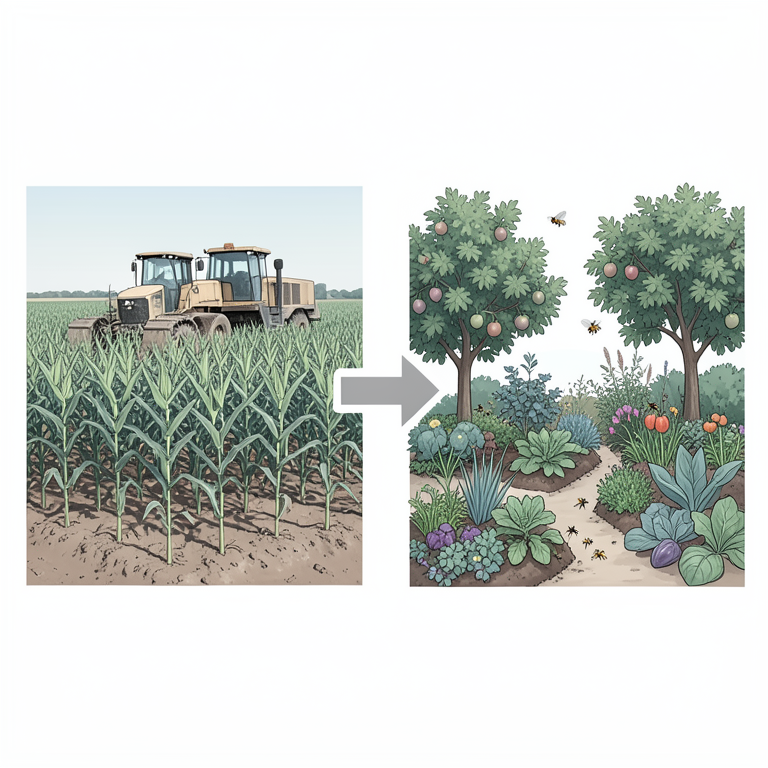
Study overview
AI-generated conceptual illustration (industrial farmland and diverse natural food sources). It explains the idea and does not show study data.
View source evidence ↗Introduction
A sustainable food system must have ethics at the heart especially in the Indian polity. India's food system faces severe sustainability challenges in the form of food quality under malnutrition, faulty procurement of food, and, certain socioeconomic and environmental factors. [1] India consists of multiple food systems with environmental variations. Food systems are currently broken, in India, as they fail to provide outcomes related to ending malnutrition with no or minimum environmental impacts. [2] Indian diets have become diverse with an increase in economic benefits of a family or individual. The diets' environmental footprints (or area of crop production) are higher in high-earnings households with an extra amount of dairy products consumption. A holistic environmental understanding is needed to fix the brokenness of the food systems. Food ethics allows us to interpret what 'should' happen in the food system. It involves a form of enquiry or critical reflection on ethical issues related to food. It allows us to redirect our thinking to define our values (the good) and principles (the right).
Environmental Concerns in Food Ethics
The purchase of food items and choice of what to ultimately consume, has a significant impact on the environment. From vegetables to meat, and everything in between, the footprint that the food creates, cannot be avoided by way of production, procurement and dissemination. [3] The worse is that modern farming is polluting air and water and encroaching upon environmentally-significant bio-habitats. After production of food from the crop land, it is the food packaging that eventually ends up in a landfill site which is a matter of grave concern. Fasting offers a way of lifestyle wherein environmental misgivings can be kept under check with individual responsible action. Differences upon environmental impacts can be found through both orthodox and modern ways of fasting. Where the Indian orthodox or religious way of fasting induces a more calming and purifying effect on the mind, body and soul of the individual, it's the modern fasting that is more hazardous to the body environment. Modern ways of fasting include not only intermittent fasting leading to long spans of prolonged hunger but also wrongful methods of fasting involving consumption of packaged and processed food unhealthy for the body environment and physical environment as they not only inhibit the zero-food waste policy but also induce a negative psychological effect on the mind. Feasting, on the other hand, proves as an opposite way of creating hazard to the body and the physical environment by means of over-production of food and individuals being subjected to obesity. Orthodox feasting, by way of celebrating a festivity or an event of religious importance leads to creation of prasad-like food items which are more or less always consumed and never wasted. Such a type of feasting is environment-friendly and also leads to a holistic way of being in a community since its produced in a limited quantity. Modern sense of feasting involves parties and eating at restaurants where food is served in larger quantities than required. It necessarily involves over-eating and wastage of food which is both harmful to the body and physical/biotic environment. Similarly, group habits can be understood by the local food movements of the country or the staple diets of the citizens both rural and urban. One can clearly see a rise in the local farmers' markets, community-supported agriculture projects such as the cooperatives functioning in the country. Such a community control inhabits a group habit that accumulates the common beliefs of certain communities and food production then becomes an ethical act of closely knit individualistic tendencies based on collective harmony and dietary pluralism. Modern food production has become highly industrialized in order to reliably produce the largest amount of plant and animal product possible while minimizing labor inputs. [4] The modern system manipulates the land to make it useful for industrial processes through chemicals in pesticides and fertilizers. At the heart of the food production is the realization of greatest possible quantity of agricultural produce rather than more ecological goals of ethical and aesthetical values as well as norms necessary for the better development of a society. Modern food consumption also goes beyond merely taking 3 terrapass.com 4 Keller and Brummer, "Putting Food Production in Context: Toward a Post mechanistic Agricultural Ethic", p. 265. in morsels of food. It consists of various behavioral and ecological challenges faced by the young and in some cases the old of our culture. The ethical issues emanating from food consumption and production are many in the name of gender inequality, body image and "healthy" eating. Dieting has become the most common food insecurity issue popular among the youth of our country. There is shame associated to people who stick to their familial food habits in alien cultures. These issues need deep ecologically influenced and socially responsible acts of honor, dignity and moral character.
Food and Emotion
Ecological social responsibility may be understood from the following statement, 'If our food is delicious and nutritious, why should we care how it was made and where it came from?' [5] Contrary to popular belief, many do and should care about questions of environmental concerns. To avoid progressive environmental damage, we must cease our unsustainable food practices and resort to sustainable ways of food policy. Environmental philosophers have not been concentrating on food culture designed from the roots of production on farmlands. When the focus arises from grassroots level then the waste generation from the food production can also be minimized seen from an alternative perspective. Our food practices changed historically with the focus of agriculture shifting from 'nature' to 'culture'. Diversity in our country is plenty and dietary pluralism has to be accompanied when dealing with food production and consumption. Food invokes strong emotions and they get amplified in the abundance of culture. One such emotion to be discussed is that of 'trust' which is necessary to be adopted/developed by different cultures for one another in order to function well as a harmonious community and promote individual and collective health. The food and health sectors are mutually intertwined. This raises many questions such as the implication of public trust in food and health issues. [6] Trust becomes important to have a robust understanding about food and health which leads us to make ecologically ethical decisions while choosing and discarding items of food etc. An individual primarily relies on others before making a food related purchase. That is precisely why trust must develop ethically between individuals and food branding corporations. An average individual cannot assess all aspects of food consumption and, therefore, relies on others (individuals/groups/brandings) etc. The concept of trust cannot be taken for granted. It is necessarily a matter of dealing with uncertainty and uncontrollable individualistic situations. [7] Food labelling done ethically becomes an important activity in this regard. Thus, trust in food products and health products is often based upon a long history of clear patterns as well as routines followed by many who possessed trust-worthiness from the eyes of the trust-seeking decision-makers/individuals.
Ecological Footprints for Public Health
The method of farming and food production amidst land-use is a highly post-mechanistic agricultural ethic. Agriculture is important because it marks a transition from a nomadic existence to an urban lifestyle. [8] No other human activity has transformed earth's land as much as farming has. Environmental philosophy and ethics are important to farming because they address the effects of the values assigned to wilderness as opposed to cultivated land. Derived from the mechanical view of nature is the belief that natural systems are understandable, predictable and manipulatable. Connected with the idea of metaphysics of mechanism is the idea that nature as a machine has no intrinsic value and is manifested in religion, philosophy and science. Some religions hold nature to be subject to man's desires. But it is agreeable to understand nature (land) as having both quantitative (physical) properties and qualitative (sensory) properties which are necessary to be harnessed for public health, namely, bodily and mental fitness arising from food production through nutrients and aroma, taste etc. There is a rift between economic and ecological models of farming as given by Aldo Leopold, where, the economic model considers the value of land to be its resources or productive potential, and, the ecological model considers the land a living thing, including soil, plants and animals living on it as well as the water and energy flowing through it. Thus, rethinking agricultural practices within a post-mechanistic (quantitative plus qualitative attributes) framework will provide the basis for having sustainable ecological footprints. The ecological footprints in urban areas such as cities amount to being certain green spaces which are said to have a positive impact on public health. Public health can be defined as "the collective action by a community or society to protect and promote the health and welfare of its members" (Schroeder, 2007: 247) [5] . It goes beyond the food we take in terms of having a social, structural and psychological angle, which is met by green spaces infrastructure in the name of parks, gardens, squares, planted strips, outdoor museums, environmental and recreational areas. The ethical challenge lies in successfully implementing green spaces without creating a community structure that facilitates global warming, pollution or affects negatively the food quality index of crop produced.
Moral Perception for Emotional Response and Economic Constraints on Consumption
Any genuine knowledge of the physical ecological footprint depends fundamentally on perception and in the case of food ethics upon moral perception. It is to be understood outside of inference, reasoning processes and analysis because it depends upon emotion and is, thus, outside the framework of intellectualism or belief formation but is rather direct or intuionist. Intellectuality is different from rationality and the moral perception is rational (Audi, 2013: 3) [1] . Therefore, it is required to examine cross-cultural communication for a befitting food ethics around society's collective emotional response and the polity's economic constraints to food.
Food consumption is directly proportional to emotional response (intensity of moral emotions such as dilemma) and economic constraints (monetary expenditure aggravating dilemma). More the intensity of emotional response and 8 Keller and Brummer, "Putting Food Production in Context", p. 264. more the propensity of economic constraints, more will be the ethically harmful food consumption. It is the dilemma of food that is the primary moral perceptional emotion that guides food habits. The three arguments around moral perception to understand this hypothesis are:
Argument from the Lack of Resources in Food Consumption
Moral perception of lack of resources leads to increased dilemma on food consumption. This can either be in a negative or a positive way leading to harmful consumption of eating less or more than necessary, respectively. For example, for a food item to be prepared some ingredients might not be available owing to several agronomic reasons. In such a case there arises a bigger morally perceived dilemma and even acute emotional response that triggers one's hunger and the will to eat that item not if in small quantity then in bad quality. Such is the nature of human moral perception in relation to food.
Argument from the Lack of Expertise in Food Ethics
Earlier in the paper it was mentioned that food ethics allows us to interpret what 'should' happen in food systems. It redirects our thinking to understand our values and principles or what is good and right. A lack of expertise in such matters reflects a lack of understanding of the moral perception of the good and the right. Many thinkers would say that moral knowledge of food systems is not perceptual and perception is relevant to ethics only for non-moral facts. Thus, it becomes important to understand India's food system in moral capacity. India's transformation of its food system from a highly deficit one to self-reliant became possible with infusion of new technologies, innovation and right incentives. All the three factors when seen through the lens of food ethics highlight matters of trust, creativity and principles of ethical concerns. The problem of feeding India's growing population can be dealt with by food ethical incentives such as growing food in compliance with people's growing modern needs of alternative meat consumption and altered mindset regrading feasting and fasting. Cultural communicational links need to be set up between food systemic brands grassroots agronomic practices. For example, colored labels on food packaging prove to be highly innovative and essential in choosing the set of food products that invoke in us the right emotional response especially under economic constraints. Food ethics, then, becomes beneficial in deciding and trusting one's own ability to choose the right products whenever in dilemma.
Argument from the Lack of Creativity in Food Production
Creativity is required in having a modern system of food policy. This creativity can be understood by moral imagination, coined by Audi (2013) [1] , which is a nexus of intuition, emotion and perception. Intuition is reaching at a conclusion of a premise over-passing the inherent inference involved between the propositions. Emotion, mostly guides into reaching at intuitive conclusions. Perceptual activity is a constant in intuitive and/or emotive understanding of methods of creative food production. According to Audi, the term moral imagination is not to be construed in the most natural way, in terms of moral character of a process, rather is to be understood as imagination in the moral sphere.
Imagination outlines the future methods to be undertaken in sustainable food culture, much as memory does in preserving the past. For example, greener solutions to waste management, as well as, food culture of avoiding to get food delivered in plastic cutlery amounts to a creative and an imaginative way of preserving ethical norms surrounding the environment.
Conclusion
The paper, thus, finds a framework environmentally ethical in position taking into accounts of food systems from an emotive and culturally-communicated way of processing and consuming food. In this regard, moral perception becomes vital as it is meant to be the driving force among ethical issues of food consumption and production when seen through perceptually rather than through regular perceptivity. Moral perception, therefore, is more perceptual (where one forms opinions) in nature than being perceptive (where one identifies already set opinions about a thing). It is perceptual in the sense that it is on the individuals and sets of individuals in a community to perceive food ethically and form opinions and treat methods guided by the principles of creativity, trust and intuition. The paper also amplifies the role of emotions in decision-making of the right kind of food item to buy and discard, surrounding emotional response and economic constraints. None of the ethical theorizing will be sufficient unless necessary responsible actions are taken such as grocery stores that sell zero-waste producing food packaging. To make certain actions a reality, communities have to come forward and resort to methods of, say, creatively handle waste by means of DIY (do-it-yourself) recycling or creating recreational parks and roads construction out of materials that are no longer useful for further production of food. Thus, as Audi would have put it, without an emotional element, much intuition would not engage our food systems ethically, and without emotion, our decisions would be deprived of a major source of their trusting ability created in one-another.
References
6 in the original paper- Audi R. Moral perception. Princeton: Princeton University Press; 2013. p. 1-220.
- Dawson A. Food and the public's health. Journal of Agricultural and Environmental Ethics. 2007;20(3):225-229.
- Keller DR, Brummer EC. Putting food production in context: toward a postmechanistic agricultural ethic. BioScience. 2002;54(3):265-272.
- Meijboom FL. Trust, food and health: questions of trust at the interface between food and health. Journal of Agricultural and Environmental Ethics. 2007;20(3):231-245.
- Schroeder D. Public health, ethics, and functional foods. Journal of Agricultural and Environmental Ethics. 2007;20(3):247-259.
- Wolf C. Sustainable agriculture, environmental philosophy, and the ethics of food. In: The Oxford Handbook of Food Ethics. Oxford: Oxford University Press; 2018. p. 1-20.