
Research article · 2025 · Full text
International Journal of Agriculture and NutritionStudies on physical, chemical and microbial properties of sweet potato chips (Ipomoea batatas L.)
Volume 7(11) · Pages 28–30 · DOI: 10.33545/26646064.2025.v7.i11a.311 ↗
Research areasFood and Agricultural SciencesFood composition and propertiesFood Science and Nutritional Studies
Abstract
Author-writtenThe present investigation was carried out to study physicochemical composition of Sweet Potato Chips. The different physicochemical properties of Sweet Potato Chips viz., moisture, fat, protein, carbohydrates, ash and were determined. Result obtained for proximate composition of Sweet Potato Chips revealed that moisture content was 4.0%, fat 27.5%, protein 4.3%, carbohydrates 57.3%, crude fibre 4.85%, and ash 3.0%. Physical composition shown that the shape was circular, colour was golden yellow to light brown, diameter 4.2 cm, thickness 0.1cm, weight 0.16 gm, circumference 13.29 cm and hardness measured was 20 N. The nutritional value of Sweet Potato Chips can have better suitability in value addition of food products. Sweet potatoes are rich in dietary fibre, vitamins, minerals, and antioxidants, making them a healthier choice for consumers seeking both taste and nutrition.
Summary
Source-checkedPlain-language reading of the full paper, prepared with AI and checked against the text. Each point links to the authors' own words.
Why it matters
- Sweet potato (Ipomoea batatas L.) is a tuber crop grown extensively in tropical and subtropical regions, including India, China, Africa, and America. View evidence ↗
- The tubers are nutritionally significant, containing carbohydrates, dietary fiber, vitamins A, C, and B6, minerals like iron and calcium, and antioxidants. View evidence ↗
- Sweet potato chips are considered a healthier alternative to standard potato chips due to their higher fiber, vitamin, and antioxidant content. View evidence ↗
The question
- The study aimed to investigate the physicochemical composition of sweet potato chips. View evidence ↗
What they did
- The researchers developed a ready-to-eat snack using sweet potato, sunflower oil, and spice seasoning. View evidence ↗
- Fresh, mature sweet potatoes were sourced locally, peeled, and sliced into pieces approximately 2-3 mm thick. View evidence ↗
- All chemical property determinations were performed in triplicate, with results reported as average values. View evidence ↗
- Standard AOAC (2005) methods were used to determine moisture, crude fat (via Soxhlet apparatus), and protein content. View evidence ↗
What they found
- The physical analysis showed the chips were circular in shape and light yellow to orange in color. View evidence ↗
- The average physical dimensions of the chips were 0.5 g per slice, 5.4 cm in diameter, 0.2 cm in thickness, and 16.96 cm in circumference. View evidence ↗
- Proximate analysis revealed the chips contained 4.0% moisture, 27.5% crude fat, 4.3% protein, 57.3% carbohydrates, 4.85% crude fiber, and 3.0% ash. View evidence ↗
- Microbial analysis showed Total Plate Count (TPC) increased from 3.1 × 10² CFU/g on day 1 to 7.0 × 10² CFU/g on day 24, remaining well below the desirable limit of 5.0 × 10⁴ CFU/g. View evidence ↗
What it means
- The authors conclude that sweet potato chips are a promising value-added snack due to their desirable physical, chemical, and sensory qualities. View evidence ↗
- The study suggests that these chips can serve as a nutritious and convenient alternative to conventional potato chips. View evidence ↗
Visual summary
2 visualsIllustrations explain the paper; charts are replotted from the paper's own table values.
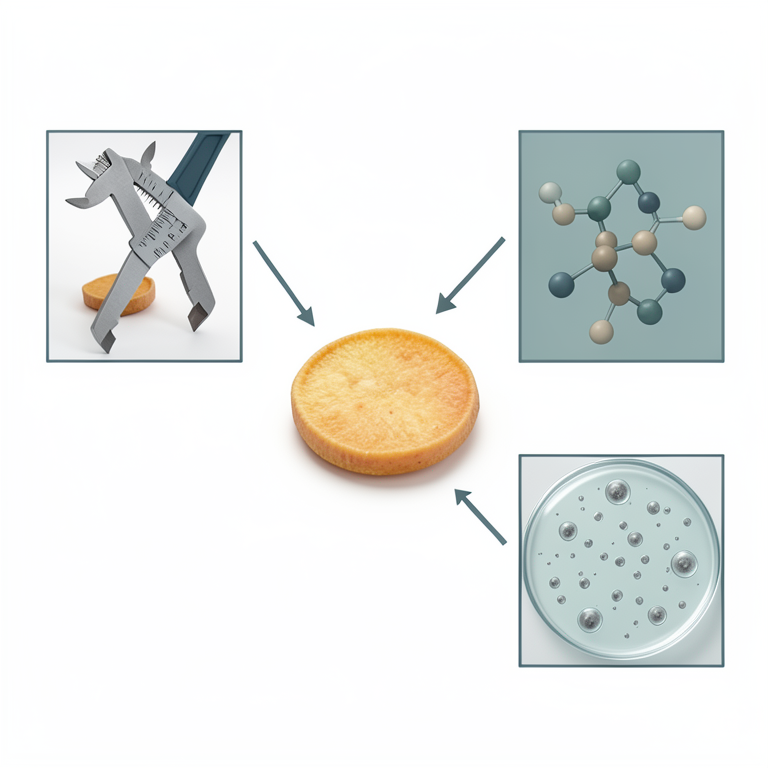
Analysis Framework
AI-generated conceptual illustration (sweet potato chips (Ipomoea batatas L.)). It explains the idea and does not show study data.
View source evidence ↗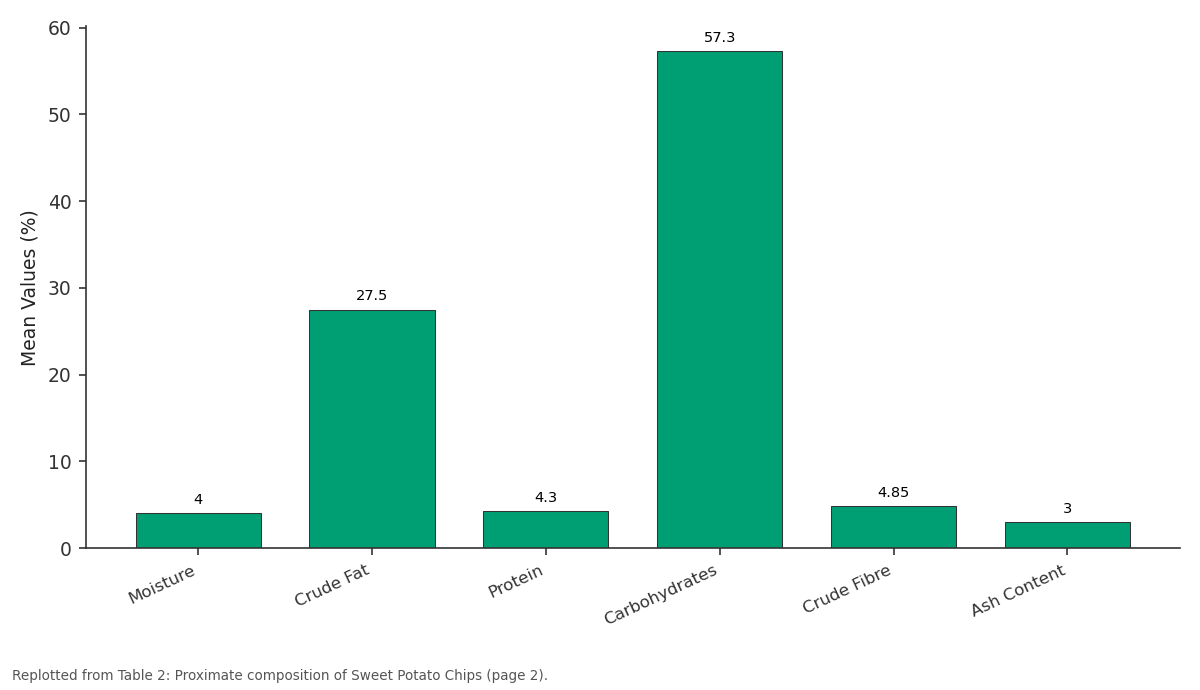
Mean Values*: Moisture vs Crude Fat vs Protein vs Carbohydrates vs Crude Fibre
Replotted from Table 2 (page 2) of the original paper. Every bar is the paper's own table value.
View source evidence ↗Figures & tables
From the original paper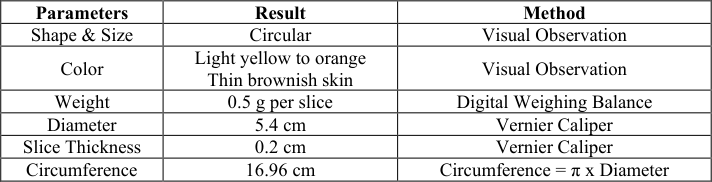 Table 1
 Table 2
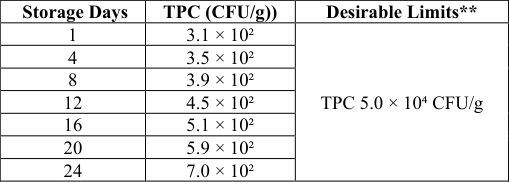 Table 3
Introduction
Sweet potato (Ipomoea batatas L.) is a tuber crop belonging to the family Convolvulaceae, widely cultivated in tropical and subtropical regions of the world such as India, China, and several parts of Africa and America (Woolfe, 1992) [13] . It is an important root vegetable valued for its high nutritional and economic significance. Sweet potato tubers are rich in carbohydrates, dietary fibre, vitamins (A, C, and B6), minerals such as calcium and iron, and natural antioxidants (Burri, 2011) [1] . The presence of beta-carotene provides the characteristic orange or yellow color and contributes to its role in improving vision and enhancing immunity (Laurie et al., 2012) [4] . In India, sweet potato is grown mainly in the states of Odisha, Uttar Pradesh, Bihar, and Maharashtra (Nedunchezhiyan et al., 2012) [5] . Traditionally, it is consumed in boiled, roasted, or baked form, but in recent years, there has been increasing interest in developing value-added products to enhance its utilization and market potential. Among these, sweet potato chips have emerged as a promising snack product due to their unique natural sweetness, crisp texture, and high nutritional content (Shah et al., 2016) [9] . Sweet potato chips serve as a healthier alternative to conventional potato chips as they are rich in fibre, vitamins, and antioxidants, and contain relatively low fat when prepared under optimized frying or baking conditions (Ellong et al., 2014) [2] . Moreover, the use of sweet potato in snack production helps in diversifying food products and reducing post-harvest losses of the crop (Padmaja, 2009) [7] . The growing demand for nutritious and convenient snack foods provides a strong basis for the development and commercialization of sweet potato chips as a functional and appealing product for health-conscious consumers (Singh et al., 2015) [10] .
Materials and Methods
The study was conducted in the Department of Food Plant Operation, Food Chemistry and Nutrition, Food Microbiology at K. K. Wagh College of Food Technology, affiliated with Mahatma Phule Krishi Vidyapeeth, Rahuri, Maharashtra. The research focused on the development of a novel ready-to-eat snack, sweet potato chips, prepared using sweet potato, sunflower, spices seasoning.
All raw materials were purchased from local market of Nashik and were analysed for the nutrients namely moisture, protein, fat, ash, crude fibre carbohydrate content. Fresh, mature sweet potatoes (Ipomoea batatas L.) of uniform size and good quality were bought from the local market (Nedunchezhiyan et al., 2012) [5] . The tubers were washed properly under clean running water to remove dirt and soil. They were then peeled using a stainless-steel knife and sliced into thin, even pieces about 2-3 mm thick with the help of a slicer (Padmaja, 2009) [7] .
Proximate Analysis
Different chemical properties of samples were analysed for moisture content, ash, fat, protein and total carbohydrate. All the determinations were done in triplicate and the results were expressed as the average value. (Talpade et al., 2018) [11] .
Moisture Content
Moisture content was determined adopting (AOAC, 2005) method as following: Fat (AOAC, 2005) Method using Soxhlet apparatus was used to determined crude fat content of the sample. The percent of crude fat was expressed as follows:
Protein: Protein content was determined using (AOAC, 2005) method. Percentage of nitrogen and protein calculated by the following equation:
Where, Ts = Titre volume of the sample (ml), TB = Titre volume of Blank (ml), 0.014= M eq. of N2. % Protein = Nitrogen × 6.25
Total carbohydrate
Total carbohydrate content of the samples were determined as total carbohydrate by difference, that is by subtracting the measured protein, fat, ash and moisture from 100 phenol sulphuric acid method as given by (AOAC, 2005).
Ash
Drying the sample at 100 0 C and churned over an electric heater. It was then ashes in muffle furnace at 550 0 C for 5 hrs. It was calculated using the following formula:
Where, AW = Weight of Ash and IW= Initial weight of dry matter
Results and Discussion Physical properties of Sweet Potato Chips
Various physical properties of Sweet Potato Chips were determined and results obtained are presented in Table 1. The data given in Table 1 shows the different physical characteristics of sweet potato chips. Colour plays an important role in deciding how appealing a product looks. The colour of sweet potato chips was observed to be light yellow to orange with a thin brownish skin and circular in shape. Each chip slice weighed around 0.5 g, with an average diameter of 5.4 cm, circumference of 16.96 cm, and a slice thickness of 0.2 cm. These results were quite similar to those reported by Falade and Omojola (2010) [3] and Shittu et al. (2015) for sweet potato chips.
| Parameters | Result | Method |
|---|---|---|
| Shape & Size | Circular | Visual Observation |
| Color | Light yellow to orange Thin brownish skin | Visual Observation |
| Weight | 0.5 g per slice | Digital Weighing Balance |
| Diameter | 5.4 cm | Vernier Caliper |
| Slice Thickness | 0.2 cm | Vernier Caliper |
| Circumference | 16.96 cm | Circumference = π x Diameter |
Table text extracted from the original PDF; superscript letters are shown inline. The original table image is below.
View original table image
Graph 1: Graphical Representation of Proximate analysis
The chemical composition of the sample was analysed for major nutritional constituents, including moisture, fat, protein, carbohydrates, ash, and crude fibre. Revealed the moisture content was 4.0%, fat 27.5%, protein 4.3%, carbohydrates 57.3%, crude fibre 48.5%, and ash 3.0%.
Conclusion
The present study on sweet potato chips revealed that the product possesses desirable physical, chemical, and sensory qualities, making it a promising value-added snack. The chips were found to have an appealing light yellow to orange colour with a crisp texture and pleasant taste. Proximate analysis showed a good balance of nutrients, with moderate fat and carbohydrate content, along with appreciable amounts of protein and fibre. The microbial analysis indicated that the chips were within safe consumption limits during the storage period. These results suggest that sweet potato chips can serve as a nutritious and convenient snack alternative to conventional potato chips. Hence, the development and promotion of such products can enhance the utilization of sweet potatoes and contribute to food diversification and nutritional security.
Figures and tables from the paper
| Parameters | Mean Values* | SE± @5% | CD± @5% | Method Reference |
|---|---|---|---|---|
| Moisture | 4.0% | 0.058 | 0.25 | AOAC (2000), IS:1155 |
| Crude Fat | 27.5% | 0.058 | 0.25 | AOAC (2000), IS:1011 |
| Protein | 4.3% | 0.058 | 0.25 | AOAC (2000), IS:7219 |
| Carbohydrates | 57.3% | 0.058 | 0.25 | AOAC (2000), IS:1656 |
| Crude Fibre | 4.85% | 0.058 | 0.25 | AOAC (2000), IS:10226 |
| Ash Content | 3.0% | 0.058 | 0.25 | AOAC (2000), IS:13654 |
Table text extracted from the original PDF; superscript letters are shown inline. The original table image is below.
View original table image
| Storage Days | TPC (CFU/g)) | Desirable Limits** |
|---|---|---|
| 1 | 3.1 × 10² | TPC 5.0 × 10⁴ CFU/g |
| 4 | 3.5 × 10² | |
| 8 | 3.9 × 10² | |
| 12 | 4.5 × 10² | |
| 16 | 5.1 × 10² | |
| 20 | 5.9 × 10² | |
| 24 | 7.0 × 10² |
Table text extracted from the original PDF; superscript letters are shown inline. The original table image is below.
View original table image
References
13 in the original paper- Burri BJ. Evaluating sweet potato as an intervention food to prevent vitamin A deficiency. Compr Rev Food Sci Food Saf. 2011;10(2):118-130.
- Ellong EN, Billard C, Adenet S, Rochefort K. Comparison of physicochemical, organoleptic, and nutritional characteristics of ten sweet potato (Ipomoea batatas L.) varieties. Food Nutr Sci. 2014;5(2):196-211.
- Falade KO, Omojola BS. Effect of processing methods on physical, chemical, rheological, and sensory properties of sweet potato chips. J Food Process Preserv. 2010;34(1):16-28.
- Laurie SM, Faber M, Adebola P, Belete A. Biofortification of sweet potato for food and nutrition security in South Africa. Food Res Int. 2012;49(1):2430.
- Nedunchezhiyan M, Byju G, Jata SK. Sweet potato agronomy. Fruit Veg Cereal Sci Biotechnol. 2012;6(Special Issue 1):1-10.
- Oluwole OB, Karim RO, Balogun SA. Production and quality evaluation of sweet potato chips and flour. Niger Food J. 2013;31(2):91-96.
- Padmaja G. Uses and nutritional data of sweet potato. In: The Sweet Potato. Dordrecht: Springer; 2009. p. 301-331.
- Ravindran V, Sivakanesan R. Total and phytate phosphorus contents of tropical tuber and root crops. J Food Compos Anal. 1995;8(3):328-336.
- Shah FU, Sharif MK, Bashir S, Iqbal Z. Development and quality evaluation of sweet potato chips. Pak J Food Sci. 2016;26(4):213-220.
- Singh S, Riar CS, Saxena DC. Effect of incorporating sweet potato flour to wheat flour on quality characteristics of cookies. Food Nutr Sci. 2015;6(5):447-456.
- Talpade K, Deshmukh S, Patil R, Jadhav P. Study on physicochemical properties of sweet potato-based products. Int J Curr Microbiol Appl Sci. 2018;7(5):3352-3360.
- Teye E, Quartey ET. Physicochemical and sensory evaluation of vacuum-fried sweet potato chips. Int J Food Sci Nutr Eng. 2018;8(3):49-56.
- Woolfe JA. Sweet Potato: An Untapped Food Resource. Cambridge: Cambridge University Press; 1992. p. 1643.