
Research article · 2025 · Full text
International Journal of Agriculture and Food ScienceA Study on Resource Use Efficiency of Dragon Fruit Cultivation in Latur District, Maharashtra
Volume 7(11) · Pages 128–130 · DOI: 10.33545/2664844x.2025.v7.i11b.951 ↗
Research areasFisheries and Aquaculture StudiesInnovations in Aquaponics and Hydroponics SystemsBotanical Research and Applications
Abstract
Author-writtenThe present investigation was carried out during the agricultural year 2024-25 in Latur district of Maharashtra with an objective to assess the resource use efficiency in dragon fruit (Hylocereus Spp.) production. The study was based on primary data collected from a sample of 60 dragon fruit growers selected through a multistage random sampling technique. Latur district was purposively chosen due to its growing importance in dragon fruit cultivation and favorable agro-climatic conditions. The data were analyzed using tabular analysis and the Cobb-Douglas production function to estimate the contribution of various inputs to production and determine their efficiency. The regression analysis revealed that the sum of regression coefficients exceeded unity, indicating increasing returns to scale in dragon fruit cultivation. The coefficient of determination (R² = 2.09) indicated a strong explanatory power of the model. The Marginal Value Product to Factor Cost (MVP/FC) ratios were greater than unity for manure, irrigation, and plant protection chemicals, confirming that these inputs can be increased to enhance productivity.
Summary
Source-checkedPlain-language reading of the full paper, prepared with AI and checked against the text. Each point links to the authors' own words.
Why it matters
- Dragon fruit is a promising commercial crop because it adapts well to semi-arid regions, requires little water, and provides high economic returns. View evidence ↗
- The Marathwada region of Maharashtra is a leading area for dragon fruit cultivation due to its black cotton soils, favorable climate, and irrigation access. View evidence ↗
- Many dragon fruit growers lack technical guidance on optimal input use, and imbalanced resource application can lower both productivity and profitability. View evidence ↗
The question
- The study aimed to assess the resource use efficiency of dragon fruit production in the Latur district of Maharashtra during the 2024-25 agricultural year. View evidence ↗
What they did
- Researchers used a multistage random sampling technique to collect primary data from 60 dragon fruit growers with actively fruit-bearing orchards. View evidence ↗
- The study employed tabular analysis and the Cobb-Douglas production function to determine the efficiency and contribution of various production inputs. View evidence ↗
- The analyzed inputs included cultivated area, human and machine labor, seedlings, manure, fertilizers, plant protection chemicals, and irrigation charges. View evidence ↗
What they found
- Regression analysis showed that the sum of coefficients was greater than one, which indicates increasing returns to scale for dragon fruit cultivation. View evidence ↗
- While expanding the cultivated area initially increases production (coefficient 0.50), the MVP/price ratio of 1.88 indicates that land is currently overutilized. View evidence ↗
- Human labor is underutilized (ratio 1.10, coefficient 0.11), suggesting that increasing labor for tasks like harvesting and pruning could improve results. View evidence ↗
- Machine labor is overutilized relative to farm size, as indicated by a negative coefficient of -0.07 and an MVP/price ratio of -4.44. View evidence ↗
- Both seedlings and fertilizers are being overused, with negative elasticities of -0.22 and -0.01, respectively. View evidence ↗
- Manure, plant protection chemicals, and irrigation are significantly underutilized, with high MVP/price ratios of 8.03, 2.19, and 5.73, respectively. View evidence ↗
What it means
- The authors conclude that while organic and water management inputs are used below their economic optimum, land, machine labor, seedlings, and fertilizers are applied beyond profitable levels. View evidence ↗
- To promote sustainable and efficient cultivation, the authors recommend farmer training in input management, demonstration programs, and capacity building. View evidence ↗
Visual summary
1 visualsIllustrations explain the paper; they do not show study data.
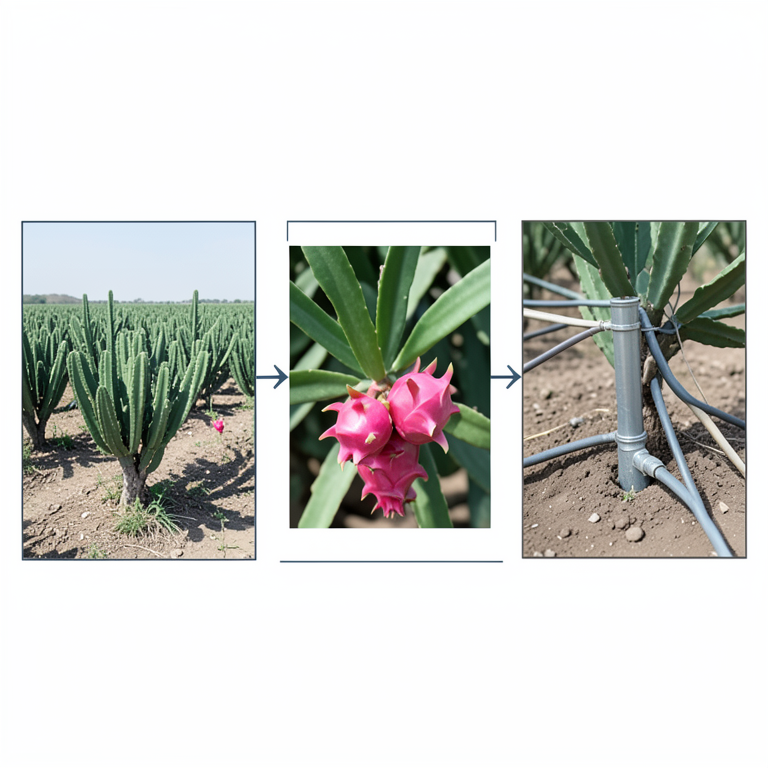
Study overview
AI-generated conceptual illustration (dragon fruit plants in an orchard). It explains the idea and does not show study data.
View source evidence ↗Introduction
India's agriculture is gradually diversifying toward high-value horticultural crops that offer better income stability and market opportunities for farmers. Among these, dragon fruit (Hylocereus spp.) has recently emerged as a promising commercial crop due to its high economic returns, low water requirement, and adaptability to semi-arid regions. Maharashtra, particularly the Marathwada region, has become one of the leading states in dragon fruit cultivation because of its favourable climate, black cotton soils, and availability of irrigation facilities. The Latur district has witnessed rapid adoption of dragon fruit cultivation as farmers shift from traditional field crops to more profitable horticultural enterprises. Despite this expansion, many growers still lack technical guidance on the optimal use of production inputs such as labour, fertilizers, manures, and irrigation. Imbalanced resource use not only affects productivity but also reduces farm profitability. Therefore, assessing the resource use efficiency in dragon fruit cultivation is essential for ensuring sustainable and economically viable production. The present study was undertaken to evaluate the productivity and efficiency of key resources employed in cultivation. Using the Cobb-Douglas production function and marginal value product (MVP) analysis, the study aims to identify under and overutilized resources and suggest measures for optimizing input use to maximize returns from dragon fruit farming.
Materials and Methods
Materials and Methods
Selection of Area
Latur district in the Marathwada region of Maharashtra was purposively selected due to its increasing acreage under dragon fruit cultivation and the rising interest among farmers in this high-value horticultural crop. The study included all ten talukas of Latur district: Ahmadpur, Ausa, Chakur, Deoni, Jalkot, Latur, Nilanga, Renapur, Shirur Anantpal, and Udgir. A total of 60 dragon fruit growers were selected to ensure broad representation across the district. Only farmers with fruit-bearing orchards were considered to ensure the relevance of data to production and marketing phases.
Sampling Procedure
A multistage simple random sampling technique was employed. Maharashtra state was selected as it is one of India's prominent regions for dragon fruit cultivation. Latur district was chosen based on its emerging prominence in dragon fruit farming. Sixty (60) dragon fruit growers were randomly selected from across the district. To maintain the applicability of findings only those farmers whose orchards were actively bearing fruit were selected. Farmers in the early plantation stage were excluded from the study.
Data Collection
The study utilized both primary and secondary data sources. Primary data were collected through personal interviews using pre-tested structured schedules. These interviews captured detailed information on socio-economic background, orchard characteristics, costs of cultivation, yield data, marketing channels and farmer perceptions. Interviews were also conducted with local market intermediaries and traders to supplement the farmer data. Secondary data were obtained from government records, agriculture department reports, research articles, and published documents to provide context on area under cultivation, yield trends and market performance of dragon fruit in the region.
Analytical Methods
The collected data were processed, tabulated, and analyzed using suitable statistical and econometric tools to meet the study's objectives. The Cobb-Douglas production function was employed to estimate the relationship between output and resource inputs, and to determine the resource use efficiency.
Cobb-Douglas Production Function
Y = a .X1 b1 .X2 b2 .X3 b3 .X4 b4 .X5 b5 .X6 b6 .X7 b7 . X8 b8 . e u
In this functional form 'Y' is dependent variable, 'X' are independent resource variables, 'a' is the constant representing intercept of the production function and 'bi' are the regression coefficients of the respective resource variables. The regression coefficient obtained from this function directly represent the elasticities of production, which remain constant throughout the relevant ranges of inputs. The sum of coefficient that is 'bi' indicates the nature to return of scale. This function can easily be transformed into a linear form by making logarithmic transformation. After logarithmic transformation, the function was:
Result and Discussion
Result and Discussion
Productivity Analysis
The regression coefficients and resource efficiency indicators derived from the production function are presented in Table 1. The coefficient of determination (R² = 2.09) revealed that the selected inputs explained a substantial portion of variation in dragon fruit yield, indicating a strong model fit. Area under cultivation (X1) showed a significant positive coefficient (0.50), indicating that expansion of cultivated area enhances production up to a point, but the MVP/price ratio (1.88) indicated overutilization, suggesting diminishing returns beyond the optimum level. Human labour (X2) showed a positive coefficient (0.11) with a ratio of 1.10, signifying underutilization indicating scope to increase labour, particularly for manual tasks such as pruning, training, and harvesting. Machine labour (X3) had a negative coefficient (-0.07) and MVP/price ratio (-4.44), suggesting excessive mechanization relative to farm size. Seedlings (X4) and fertilizers (X6) also exhibited negative elasticities (-0.22 and -0.01), implying overuse. Conversely, manure (X5), plant protection chemicals (X7), and irrigation charges (X8) showed positive and significant effects (0.03, 1.60, and 0.15 respectively) with MVP/price ratios of 8.03, 2.19, and 5.73, indicating underutilization. Enhancing these inputs would substantially improve productivity and profitability.
Economic Interpretation
The analysis reveals that organic and water management inputs (manure, irrigation, plant protection) have high marginal productivity but are used below their economic optimum. Conversely, land, machine labour, seedlings, and fertilizers are being applied beyond profitable levels. Thus, efficient resource allocation reducing excess inputs and increasing deficient ones could improve returns per hectare and overall sustainability.
Conclusion
The study concludes that dragon fruit production in Latur district is economically viable but characterized by resource use inefficiencies. Optimization of input use particularly increasing organic manure and irrigation while controlling mechanization and fertilizer usage can significantly enhance profitability. Capacity building, demonstration programs, and input management training for farmers are recommended to promote economically efficient and environmentally sustainable dragon fruit cultivation in Maharashtra.
References
5 in the original paper- Barwal P, Sharma S, Bali D, Laishram C, Kashyap P. Resource use efficiency and constraint analysis of mango cultivation in Kangra district of Himachal Pradesh. Indian Journal of Ecology. 2022;49(5):17361742.
- Mehta A, Lamichhane P, Khatiwada R, Mandal A, Chaudhary P, Aryal S. Dragon fruit cultivation, profitability, and production efficiency in Southern Terai, Nepal. International Journal of Horticultural Science and Technology. 2024;11(4):469-480.
- Surwase RV, Kshirsagar PJ, Talathi JM, Malave DB, Gore GT. Resource use efficiency of sapota in Thane district of Maharashtra. International Research Journal of Agricultural Economics & Statistics. 2015;6(1):5761.
- Thanki PM, Mungalpara KU, Thumar VM, Shrivastava A, Hiremath DB. Resource use efficiency of banana cultivation in Bharuch district of South Gujarat. Journal of Pharmacognosy and Phytochemistry. 2019;SP2:161164.
- Zore RV, Khunt AK, Amale AJ. Resource use efficiency in pomegranate (Punica granatum L.) production in Maharashtra. International Journal of Recent Scientific Research. 2019;10(7):33642-33644.