
Research article · 2025 · Full text
International Journal of Biology SciencesBiological risk management in agricultural supply chains
Volume 7(9) · Pages 01–03 · DOI: 10.33545/26649926.2025.v7.i9a.468 ↗
Research areasFood Safety and Hygiene
Abstract
Author-writtenBiological risks are a fundamental concern in agricultural production systems, affecting both the quality and quantity of agricultural outputs. In agricultural supply chains, these risks can significantly disrupt the continuity of production, distribution, and market supply. This paper explores the concept of biological risk management within agricultural supply chains, focusing on key risks such as pests, diseases, and climatic variations. It also investigates strategies for managing these risks effectively, including integrated pest management (IPM), genetic resistance, and advanced forecasting technologies. The study emphasizes the importance of collaborative efforts among farmers, policymakers, and supply chain stakeholders in minimizing the impacts of biological risks and enhancing food security. Furthermore, the role of innovative technologies and sustainable practices in mitigating these risks is discussed, along with the potential future directions in biological risk management.
Summary
Source-checkedPlain-language reading of the full paper, prepared with AI and checked against the text. Each point links to the authors' own words.
Why it matters
- Biological risks are a primary concern in agriculture because they impact both the quality and the quantity of the outputs produced. View evidence ↗
- These biological risks can cause significant disruptions across the entire agricultural supply chain, including production, distribution, and market supply. View evidence ↗
- The inherent vulnerability of agriculture to pests, diseases, and environmental stressors often leads to substantial economic losses. View evidence ↗
The question
- The paper aims to examine biological risks in agricultural supply chains, assess current mitigation strategies, and recommend ways to improve risk management. View evidence ↗
What they did
- The authors conducted a review focusing on key biological risks, specifically pests, diseases, and climatic variations. View evidence ↗
- The study investigates the effectiveness of management strategies such as Integrated Pest Management (IPM), genetic resistance, and forecasting technologies. View evidence ↗
What they found
- Pests like aphids, caterpillars, and root-knot nematodes cause severe crop damage by feeding on tissues, weakening plants, and transmitting diseases. View evidence ↗
- Specific biological threats, such as Fusarium Wilt and the Chilli Leaf Curl Virus, have been found to significantly reduce the yield of chilli crops. View evidence ↗
- Climate change, characterized by higher temperatures and extreme weather like floods and droughts, creates favorable conditions for pests such as the Bollworm. View evidence ↗
- Integrated Pest Management (IPM) can maintain pest populations at acceptable levels while significantly reducing the use of pesticides. View evidence ↗
- Climate-smart agriculture (CSA) practices, including integrated water management and conservation tillage, have significantly improved yields during fluctuating climate conditions. View evidence ↗
- The use of satellite data and remote sensing for monitoring disease progression and pest outbreaks improves decision-making in pest management. View evidence ↗
- The use of genetically modified cotton resistant to the Bollworm has led to a dramatic reduction in the need for chemical pesticides. View evidence ↗
- Climate modeling and satellite-based monitoring are utilized to predict the spread of diseases, such as Rust in wheat. View evidence ↗
What it means
- The authors conclude that producers can mitigate the impacts of environmental stresses, diseases, and pests by adopting integrated strategies that combine technological, cultural, and biological approaches. View evidence ↗
- Collaboration between industry stakeholders, policymakers, and farmers is considered crucial for addressing biological risk challenges. View evidence ↗
- Over-reliance on chemical control methods creates a significant challenge due to the potential for pesticide resistance. View evidence ↗
Visual summary
1 visualsIllustrations explain the paper; they do not show study data.
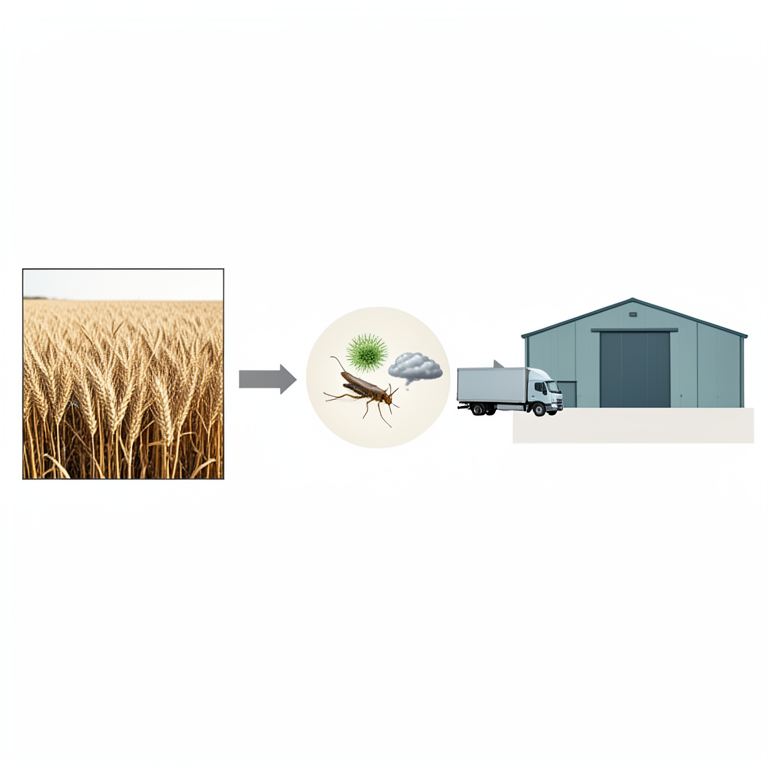
Agricultural Supply Chain Risk Flow
AI-generated conceptual illustration (Agricultural supply chain from wheat fields to a distribution warehouse). It explains the idea and does not show study data.
View source evidence ↗Introduction
Agriculture is inherently vulnerable to a variety of biological risks, including pests, diseases, and environmental stressors, which can cause substantial economic losses. These risks are often exacerbated by climate change, which increases the unpredictability of weather patterns, creating an additional layer of uncertainty for agricultural producers. The impact of these biological risks is not only felt at the farm level but extends throughout the agricultural supply chain, affecting distribution, storage, processing, and consumer markets. Biological risk management is the process of identifying, assessing, and mitigating these risks in order to protect agricultural production systems, ensure the sustainability of supply chains, and maintain food security. Effective management of biological risks is crucial in maintaining agricultural productivity, minimizing losses, and ensuring the quality of food products. This paper explores the various biological risks that affect agricultural supply chains and evaluates the strategies and practices used to manage these risks.
Main Objective
The main objective of this paper is to examine the various biological risks that influence agricultural supply chains, assess the existing strategies for mitigating these risks, and provide recommendations for enhancing risk management practices in agricultural systems. Specifically, the paper aims to: Analyze the impact of pests, diseases, and climatic factors on agricultural production and supply chains. Evaluate the effectiveness of various biological risk management strategies, such as Integrated Pest Management (IPM), genetic resistance, and forecasting technologies. Propose measures that can improve biological risk management in agricultural supply chains, with a focus on sustainability and food security.
Hypothesis
The hypothesis of this study is that the effective management of biologic al risks in agricultural supply chains can significantly improve the sustainability and resilience of agricultural production systems. Specifically, the hypothesis posits that:
The implementation of integrated pest management (IPM) strategies, genetic resistance in crops, and the use of advanced forecasting technologies can reduce the impact of pests and diseases. Climate-resilient agricultural practices can mitigate the adverse effects of climate change, thus improving crop yields and the stability of the agricultural supply chain. Collaborative efforts between farmers, policymakers, and other stakeholders are essential in creating a resilient agricultural system that can withstand biological risks and maintain food security.
Review of Literature
The review of literature in this paper focuses on previous studies and findings related to biological risk management in agricultural supply chains, with an emphasis on the types of risks faced, their impact on agriculture, and strategies used to mitigate these risks. Pests and diseases are the most prevalent biological risks that affect crops. According to Latham and Young (2020), pests such as aphids, caterpillars, and root-knot nematodes can cause severe damage to crops by feeding on plant tissues, transmitting diseases, and weakening plants. In a study by, it was found that the Chilli Leaf Curl Virus and Fusarium Wilt significantly reduce the yield of chilli crops, demonstrating how specific pests and diseases can decimate entire crops. Similarly, climate change has been identified as a major driver of pest and disease outbreaks. According to Hall, higher temperatures and more frequent extreme weather events, such as droughts and floods, can create favorable conditions for pests like the Bollworm, which thrives in warmer climates. This exacerbates the problem of pest control, as it leads to longer breeding seasons and increased pest populations. Integrated Pest Management (IPM) is widely regarded as an effective strategy for managing biological risks in agriculture. In their study, Smith et al. (2020) [4] demonstrated that IPM, which combines biological, cultural, and chemical control methods, can significantly reduce pesticide use while managing pest populations at acceptable levels. The study highlighted how crop rotation, the use of resistant varieties, and the application of beneficial microorganisms can help control pests effectively. Furthermore, a study by Gupta and Patel emphasized the importance of educating farmers on IPM techniques. Their research showed that when farmers were trained on IPM strategies, pest control was more efficient, and the reliance on chemical pesticides was reduced, leading to environmental sustainability. Climate change poses an additional layer of biological risk to agriculture. A comprehensive review by Stevens et al.
(2020) indicated that the increasing unpredictability of weather patterns-such as irregular rainfall, temperature spikes, and droughts-significantly affects crop yields. In response, climate-smart agriculture (CSA) practices have been developed to improve resilience. CSA includes measures such as the use of drought-resistant crop varieties, improved water management techniques, and agroforestry. According to Singh and Bhatia (2021) [5] , CSA has the potential to reduce the vulnerability of crops to climate stress and improve food security. Their study focused on wheat and rice crops in India, where CSA practices such as conservation tillage and integrated water management significantly improved yields under fluctuating climate conditions.
The integration of technology into biological risk management has proven to be highly effective. In a study by Singh et al. (2021) [5] , the use of remote sensing and satellite data to monitor pest outbreaks and disease progression was found to improve decision-making in pest management. These technologies, along with advanced data analytics, allow for better prediction of pest and disease occurrences, giving farmers and supply chain actors the tools they need to take preemptive actions. Machine learning algorithms and AI-based models are also being used to forecast pest outbreaks. In a recent paper by Yadav, AI models successfully predicted the spread of aphid populations in North America, demonstrating how technology can enhance risk management.
Biological Risks in Agricultural Supply Chains 2.1 Pests and Diseases
Pests and diseases are the most direct and significant biological risks to agriculture. These include insects, bacteria, fungi, viruses, and nematodes that attack crops at different stages of growth. The introduction and spread of these biotic stresses can lead to crop failures, reduced yields, and the contamination of food products, significantly disrupting the supply chain. For instance, the Chilli Leaf Curl Virus in red chilli production, as well as fungal diseases such as Fusarium wilt in banana plantations, are prime examples of how biological risks can severely affect crop quality and yield. The global movement of agricultural goods further exacerbates the spread of pests and diseases, as infected plants or plant materials can be unknowingly transported across regions, facilitating the dissemination of these risks. Thus, managing pests and diseases requires a comprehensive approach that involves surveillance, early detection, and coordinated responses across regions and countries.
Climate Change and Environmental Stress
Climate change is increasingly recognized as a significant factor influencing biological risks in agriculture. Changes in temperature, rainfall patterns, and extreme weather events such as droughts or floods create favorable conditions for certain pests and diseases to thrive, further endangering crop production systems. For example, warmer temperatures may extend the breeding seasons of pests such as the Aphid, leading to increased pest pressure. Similarly, erratic rainfall patterns can foster the development of fungal diseases like Downy Mildew in crops like grapes and lettuce.
Soil and Water Contamination
Soil and waterborne diseases, including those caused by pathogens such as Phytophthora and Pythium, are another form of biological risk. These pathogens often affect crops indirectly through contaminated irrigation water or poor soil health, which leads to root rot and other diseases that can devastate entire crops. Proper water management and soil health monitoring are crucial for preventing the spread of these pathogens within agricultural supply chains.
Biological Risk Management Strategies 3.1 Integrated Pest Management (IPM)
Integrated Pest Management (IPM) is a holistic approach to pest and disease management that combines biological, chemical, cultural, and mechanical control methods. The core principle of IPM is to manage pest populations at an economically and environmentally sustainable level, using a combination of control strategies. This includes the use of biological control agents, such as natural predators, beneficial insects, and microorganisms that target specific pests, alongside chemical treatments used selectively and as a last resort Dewi RK et al. (2023) [6] . IPM also includes cultural practices such as crop rotation, proper irrigation practices, and the selection of diseaseresistant varieties, all of which help reduce the susceptibility of crops to pests and diseases. Training farmers in IPM techniques, supported by research and extension services, plays a key role in reducing pest-induced damage and minimizing the use of harmful chemicals in agriculture.
Genetic Resistance
Another crucial strategy for biological risk management is the development and use of genetically resistant crop varieties. Advances in plant breeding, including genetic modification and gene editing technologies, have led to the creation of crops that are more resistant to specific pests and diseases. For example, genetically modified (GM) cotton resistant to the Bollworm has dramatically reduced the need for chemical pesticides in cotton farming.
In addition to genetic modification, traditional breeding methods continue to be effective in developing pest and disease-resistant cultivars. The integration of these resistant varieties into farming systems is an essential part of managing biological risks over the long term.
Early Warning Systems and Forecasting Technologies
Advancements in technology have enabled the development of early warning systems and forecasting tools that help predict the occurrence of pest outbreaks and disease incidences. By analyzing weather patterns, pest life cycles, and disease progression, these tools provide farmers and supply chain actors with critical information on when and where pest management interventions should be implemented.
For example, satellite-based monitoring and climate modeling are now used to predict the potential spread of diseases like Rust in wheat, allowing farmers to take preemptive action. Additionally, data-driven approaches using machine learning and artificial intelligence are increasingly being employed to analyze large datasets and improve risk forecasting accuracy.
Biosecurity Measures and Quarantine Protocols
The implementation of biosecurity measures is crucial in managing the risk of pests and diseases entering and spreading within agricultural supply chains. These measures include quarantine protocols that prevent the movement of potentially infected plant materials across regions and countries. The establishment of border controls and the screening of imported agricultural products help reduce the risk of introducing foreign pests and pathogens that could disrupt local production systems.
Challenges in Biological Risk Management
Despite the progress made in biological risk management strategies, several challenges remain. The increasing complexity of global agricultural supply chains, coupled with the growing threat of climate change, makes it more difficult to predict and control biological risks. Furthermore, the limited availability of financial resources, especially in developing countries, hampers the widespread adoption of advanced pest management technologies.
In addition, the potential for pesticide resistance, especially in the case of over-reliance on chemical control methods, poses a significant challenge. Resistance management, therefore, needs to be an integral part of any pest management strategy to ensure long-term sustainability.
Conclusion
Biological risk management is an essential aspect of ensuring the resilience and sustainability of agricultural supply chains. By adopting integrated strategies that combine biological, cultural, and technological approaches, agricultural producers can mitigate the impact of pests, diseases, and environmental stresses on their crops. The continued development of innovative solutions, such as genetic resistance and early warning systems, will be vital in enhancing the ability of farmers and supply chain actors to manage biological risks effectively. Moreover, fostering collaboration among farmers, policymakers, and industry stakeholders is crucial in addressing the challenges posed by biological risks. With the support of scientific research, extension services, and international cooperation, biological risk management can be further strengthened, ensuring the continued stability of agricultural supply chains and the long-term security of food production systems.
References
8 in the original paper- Boateng P. Integrated pest management in horticultural crops. Int J Agric Sustain. 2021;29(5):541-556.
- Kannan A, Rajesh R. Impact of climate change on pest and disease incidence in crops. Environ Manag Agric. 2020;47(3):243-259.
- Jones GB, Fand S. Biological risks in the agricultural supply chain: A global overview. Food Saf Qual Assur. 2019;17(4):312-325.
- Smith L, Jenkins M. Managing biological risks in agricultural systems: Innovations in pest control and crop protection. Agric Risk Manag. 2022;5(2):89-104.
- Singh R, Sharma P. Biosecurity and quarantine in agricultural supply chains. J Agric Secur. 2021;8(1):5671.
- Agarwal D, Devra SJ, Tiwari A, Siddharajsinh RR. Probability and probability distribution as decision making tool in agriculture: A review. Int J Stat Appl Math 2024;9(5):208-213. DOI: 10.22271/maths.2024.v9.i5c.1862
- Dewi RK, Parining N, Harsojuwono BA. Mitigation of red chilli supply chain risks in Bali, Indonesia. Int J Agric Food Sci. 2023;5(2):103-112.
- Prakash G, Pandey V. Development and quality evaluation of cookies fortified with spirulina. Int J Agric Food Sci. 2023;5(1):162-166.