
Research article · 2025 · Full text
International Journal of Agriculture and Food ScienceStudies on quality attributes of basmati rice
Volume 7(8) · Pages 258–260 · DOI: 10.33545/2664844x.2025.v7.i8d.620 ↗
Research areasRice Cultivation and Yield ImprovementGABA and Rice ResearchFood composition and properties
Abstract
Author-writtenThe objective of the study was to analyse the physical properties of basmati PS 4. The physical parameters such as length (l), breadth (b), and thickness (t) of the shelled paddy kernels were measured by digital vernier caliper. Each time, three replications were carried out and average of them was recorded. The paddy was procured from the department of Plant Breeding and Genetics, Jawaharlal Nehru Krishi Vishwa Vidyalaya, Jabalpur, India. The gravimetric properties such as thousand grain weight of each sample were determined by randomly selecting and counting thousand grain kernels from the lot and weighing it by the digital balance (least count 0.001). The bulk density and true density were determined by placing the sample in measuring cylinder and calculated by volume displacement method. The size, shape, sphericity, porosity was also calculated. All these parameters play an important role during milling and storage of the grains. The study showed that the average length of the kernel was found to be 9.44 mm with width 2.02 mm and thickness of 1.64 mm with average L/B ratio of 4.67 resembling it as a superfine variety of rice. The average size and sphericity of the kernels were calculated as 3.15 and 33.36% respectively. The average bulk density, true density and porosity of the kernels were found to be 481.68 kg/mm3, 1097.16 kg/mm3, and 56.1% respectively. The husk content was recorded to be 24.4%. The test weight was found 28.4 g.
Summary
Source-checkedPlain-language reading of the full paper, prepared with AI and checked against the text. Each point links to the authors' own words.
Why it matters
- Rice is a critical cereal crop for India, which accounts for 25.27% of global production and 95% of India's total cereal exports. View evidence ↗
- Analyzing physical properties like grain size, bulk density, and weight is necessary to design storage bins that protect grains from insects and mold. View evidence ↗
- Physical parameters of rice grains are important factors during the milling and storage processes. View evidence ↗
The question
- The study aimed to analyze the physical properties of the basmati rice variety PS 4. View evidence ↗
What they did
- The researchers used cleaned and graded basmati paddy variety PS 4 obtained from JNKVV, Jabalpur. View evidence ↗
- A digital vernier caliper with a least count of 0.01 mm was used to measure the length, breadth, and thickness of the kernels. View evidence ↗
- True density was measured using the toluene displacement method with a 250 ml measuring cylinder containing 30 ml of toluene. View evidence ↗
- The results are presented as mean values and their corresponding standard deviations. View evidence ↗
What they found
- The average length-to-breadth (L/B) ratio was 4.67, which characterizes the rice as a superfine variety. View evidence ↗
- The kernels exhibited an average size of 3.15 and a sphericity of 33.36%. View evidence ↗
- The average bulk density was 481.68 kg/mm³, true density was 1097.16 kg/mm³, and porosity was 56.1%. View evidence ↗
- The husk content of the rice was recorded at 24.4%. View evidence ↗
- The test weight (thousand grain weight) was 28.4 g, classifying it as an extra heavy variety of paddy. View evidence ↗
Visual summary
1 visualsIllustrations explain the paper; charts are replotted from the paper's own table values.
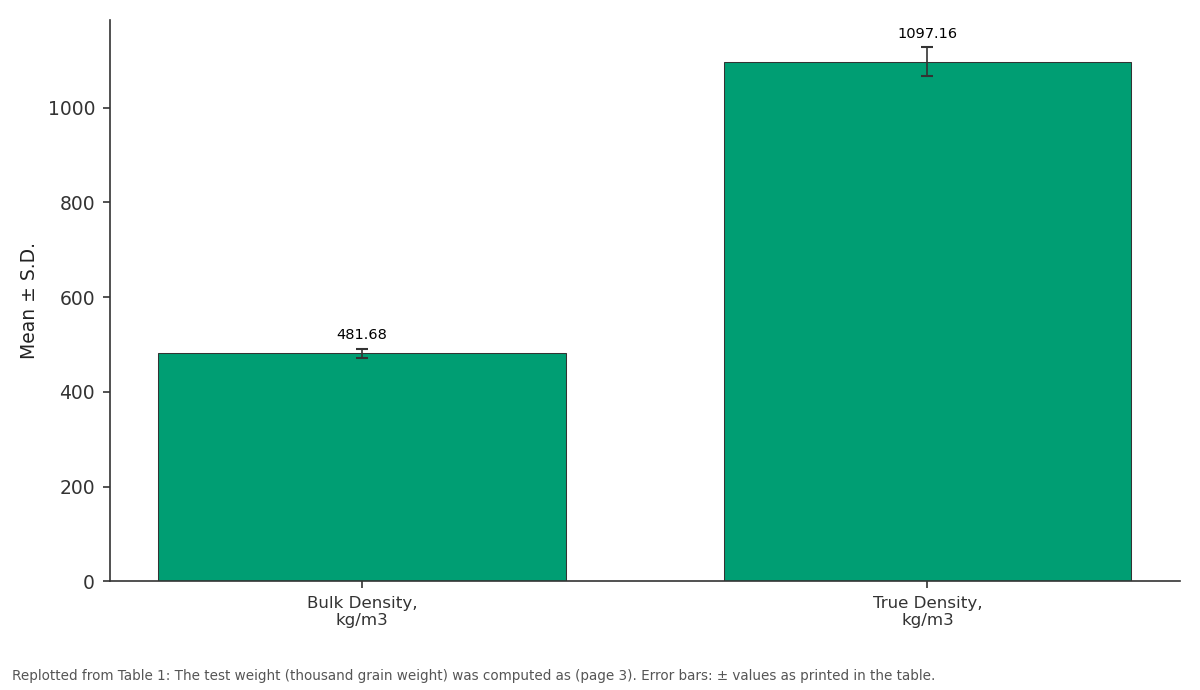
Mean ± S.D.: Bulk Density, kg/m3 vs True Density, kg/m3
Replotted from Table 1 (page 3) of the original paper. Every bar is the paper's own table value.
View source evidence ↗Figures & tables
From the original paper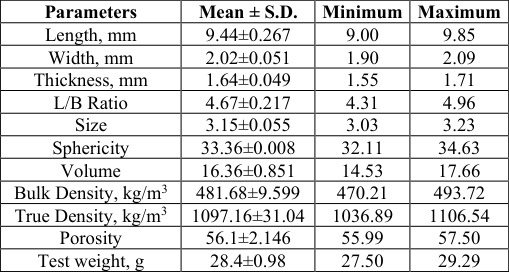 Table 1
Introduction
Rice (Oryza sativa L.) is first mentioned in the Yajurveda and then frequently referred to in Sanskrit texts. It has been traditionally considered for the Gods and used for religious offerings. Rice is directly associated with prosperity and fertility (Tiwari V. K. et al., 2012). Since rice is a major cereal grain, the highest priority is thus given to the physiochemical, nutritional, and cooking qualities of rice (Tan et al. 1999) [8] . Rice is one of the most important cereal crops of India contributing to the 25.27% of the total rice grain production in the world with 95% of the total cereal export from India. The areas of Basmati Rice production in India are the states of J & K, Himachal Pradesh, Punjab, Haryana, Delhi, Uttarakhand, and western Uttar Pradesh. Punjab ranks first in terms of production with production levels 3.84 lakh MT accounting for 42.7% of total production whereas Haryana is the second largest producer of Basmati Rice with production 3.67 million MT and a share of 40.87% and UP is third largest producer of Basmati Rice with production 2.0 million MT and a share of 22.8% in 2022-23. India is the leading exporter of Basmati Rice to the global market. The country has exported 5.242 Mil T of basmati rice to the world during the year 2023-24 2 (APEDA). Rice grains are encased into an inedible layer called as husk that forms 20% of the whole grain. After husk layer, there is another layer present on the surface of the grain known as bran layer, that forms 5% of whole grain and consists of pericarp, seed coat, and nucleus. The bran layer contains lipid and protein and is rich in oil or in other terms most of the nutrients of the kernel are contained in this bran layer. Rice contains starch (77%), protein (8%), and minerals (0.176%). The oil content of brown rice is 2 to 3% and almost the entire oil is present within and outer thin layer. Since rice is a major cereal grain, the highest priority is thus given to the physiochemical, nutritional, and cooking qualities of rice (Tan et al., 1999) [8] . Recommended model for grading system in International trade (FAO/WHO) -1) SIZE (according to length of kernel -L) -Extra-long (L>=7.0 mm), Long (L=6.0-6.99 mm), Medium (L=5.0-5.99 mm) &Short (L3.0), Medium -slender or Fine (bold) (L/B=2.0-3.0) & Short-slender or Common (round) (L/B25 gm), Heavy (test wt.= 20 25 gm) and Moderately heavy (test wt.<20gm). Basmati is one such variety of rice known for its extra-long, slender grains that elongate to at least twice their original size when cooked. It offers a distinctive soft and fluffy texture, delicious taste, superior aroma, and a distinct flavour that sets it apart from other aromatic long-grain rice varieties. Its esteemed reputation and unparalleled characteristics have made Indian Basmati rice a preferred choice among chefs and food enthusiasts worldwide, solidifying its status as a symbol of quality and luxury in global cuisine (Rumandla et al., 2023) [3] . The physicochemical properties like grain weight and size, including the length, breadth, and length: breadth ratio, damaged rice, moisture, ash, protein, starch, and amylose content, have a significant impact on the marketing value of rice. Grain size and shape are the properties that vary with the variety of grain under consideration. Determination of the physical properties of the grain, including dimensional analysis, bulk density and thousand grains weight, is essential for the design and development of storage bins that help prevent spoilage by molds and insect infestation.
Materials and Methods
The cleaned and graded paddy variety PS 4 (basmati) was procured from the Department of Genetics and Plant breeding JNKVV, Jabalpur. The moisture content of the paddy at the time of procurement was 14% (d.b.).
Determination of moisture content
The standard procedure of hot air oven method was used. In this method of moisture content determination, a weighed sample (5 g) of material is placed in a dried and preweighed petri dish and dried in a hot air oven at 100 °C. It was then cooled in desiccator. This heating and cooling process is performed, until a constant weight is established. The dry material in the cooled petri dish is then weighed:
Where Ww is the weight of water Wd is the weight of the material
Dehusking of paddy
The husk of paddy was removed by the rubber roll sheller (Indosaw, Rice Miller, Mc Gill type -0.5 hp, 230V) to obtain the shelled rice (brown rice) at the Rice Milling Laboratory of Post Harvest Process and Food Engineering Department. The machine is equipped with two rollers rotating at different speeds in opposite direction which creates a shearing force on the grain resulting in the dehusking of paddy grains.
Physical Properties
The physical properties include the length, width, thickness, size, shape, sphericity, bulk density, true density, porosity, volume. However, the thousand grain weight and husk content of the variety were also determined. The dimensional parameters such as grain length (L) and breadth (B) of milled rice were measured with vernier calipers. The measurement was performed by using 10 grains in each sample; thus, averages of 10 grains were recorded. The ratio of length and breadth (L/B) ratio, was also determined for milled rice.
Dimensions
For each sample, the size and shape of randomly picked 20 kernels (brown rice) was measured. Three major linear dimensions, namely: length (l), breadth/width (b) and thickness (t) were determined using a digital vernier caliper (least count -0.01 mm). The intercept was measured as length, breadth, and thickness of the kernel: length was found to be the largest intercept of the kernel at resting position, breadth was the highest intercept perpendicular to length and thickness was the intercept perpendicular to length and breadth (Dayma et al., 2017) [6] .
L/B Ratio
The length to breadth ratio was determined for categorization of rice for commercial and export purpose i.e., long, slender, and short grain.
Size
Size and shape of the grains plays an important role during various unit operations like processing, material handling, storage and machine designing which was obtained by: Size = (length x width x thickness) 1/3 Size = (l x b x t) 1/3 Sphericity Sphericity(ϕ) is defined as the ratio of the surface area of the sphere, which has the same volume as that of the solid, to the surface area of the solid. Higher values of sphericity and roundness indicate that the object's shape is closer being spherical. The shape of the grain is expressed in terms of sphericity and aspect ratio. Accordingly, the sphericity was calculated as:
Volume
The following relationship was used to compute the volume of the brown rice grains Where V is the unit volume in mm 2
Thousand grain weight
Thousand grain weight is an important constraint in handling and processing of grains. The thousand grain weight gives a reasonable approximation of the size of the grain size, which can deviate according to growing conditions and maturity, including for the same variety of a particular crop. The thousand grain weight is computed by weighing 1000 rice grains.
Density
The knowledge of the density of the grains is useful for design of chute, storage (bins, silos), feed hopper, separators and cleaning and grading equipment. Cereal grains have a specific bulk density determined as the weight of a defined volume of the grain. The sample of the grain is transferred to a measuring cylinder. Simply, the bulk density is the measured mass of the grain package divided by the volume of the container which contains the sample.
The true density of the grains is expressed as the density of the grains where there are no voids remains. Toluene displacement method was used to determine the true density of the sample. A measuring cylinder of 250 ml capacity was used in which 30 ml toluene is filled. The same mass of sample as taken for bulk density determination was put in the cylinder containing toluene. The difference in the level of toluene increased after putting the sample was noted down and the true density was calculated as follows:
Porosity Porosity is the ratio of the void spaces present in the bulk grain. It is determined by using the values of bulk density and true density as follows:
Preparation of the sample For the thousand grain weight, one thousand sound paddy grains were selected at random to get milled brown rice kernels by hand pounding method with caution causing minimum damage to the bran layer of the kernel. The milled kernels were then weighed to obtain the thousand grain weight.
Statistical Analysis
In this study, the mean values (Avg) and their standard deviation (S.D.) from the mean values of the parameters are used to depict the results.
Results and Discussion
For a certain type of rice to be accepted by consumers, it is important to grade the grains based on physical traits including length, breadth, sphericity, density, and porosity. The values of the major dimensions (length, breadth, thickness) of randomly picked grains were measured. The average values and their standard deviation of these dimensions are show in Table 1. Accordingly, the length of the brown rice kernels varied from 9.01 to 9.89 mm with the width and thickness ranging from 1.90 to 2.09 mm and 1.55 to 1.71 mm respectively. The standard deviation was computed as±0.267 for length,±0.051 for width and±0.049 for thickness. Results similar to this were also observed in previous studies. The Length was determined as the dimension with maximum value indicating the extra long grain. Rice grains are generally classified according to the length to breadth ratio (L/B ratio). The values of L/B ratio were found to lie between the range of 4.31 to 4.96 with standard deviation ±0.217, indicating the slender shape of the grains (L/B ratio > 3) having the size ranged between 3.03 to 3.23.
| Parameters | Mean ± S.D. | Minimum | Maximum |
|---|---|---|---|
| Length, mm | 9.44±0.267 | 9.00 | 9.85 |
| Width, mm | 2.02±0.051 | 1.90 | 2.09 |
| Thickness, mm | 1.64±0.049 | 1.55 | 1.71 |
| L/B Ratio | 4.67±0.217 | 4.31 | 4.96 |
| Size | 3.15±0.055 | 3.03 | 3.23 |
| Sphericity | 33.36±0.008 | 32.11 | 34.63 |
| Volume | 16.36±0.851 | 14.53 | 17.66 |
| Bulk Density, kg/m3 | 481.68±9.599 | 470.21 | 493.72 |
| True Density, kg/m3 | 1097.16±31.04 | 1036.89 | 1106.54 |
| Porosity | 56.1±2.146 | 55.99 | 57.50 |
| Test weight, g | 28.4±0.98 | 27.50 | 29.29 |
Table text extracted from the original PDF; superscript letters are shown inline. The original table image is below.
View original table image
The sphericity of the milled kernels varied from 32.11% to 34.65% with standard deviation of±0.008. As the value of the sphericity is less than 70% it is therefore not to be considered spherical. The bulk density and true density were computed as 481.68 kg/m 3 and 1097.16 kg/m 3 respectively with standard deviation±9.59. The porosity was found to be 56.1% as shown in Table 1.
References
9 in the original paper- Yadav R, Khurana S, Kumar S. Comparative study of properties of basmati and non-basmati rice cultivars. Ukrainian Food J. 2023;12(1):51-64.
- Agricultural and Processed Food Products Export Development Authority (APEDA). Basmati rice. New Delhi: APEDA; [cited 2024 Oct 26]. Available from: https://apeda.gov.in/BasmatiRice.
- Tiwari VK, Haldkar P, Rumandla SK. Studies on physical properties of rice varieties. Int J Stat Appl Math. 2023;SP-8(6):422-426.
- Ojha P, Chaudhary O, Subedi U, Dongol DMS. Milling, Nutritional, Physical and Cooking Properties of Four Basmati Rice Varieties. J Nepal Agric Res Counc. 2018;4:18-24. doi:http://dx.doi.org/10.3126/jnarc.v4i1.19686
- Sandhu RS, Singh N, Kaler RSS, Kaur A, Shevkani K. Effect of degree of milling on physicochemical, structural, pasting and cooking properties of short and long grain Indica rice cultivars. Food Chem. 2018;260:231-238. doi:10.1016/j.foodchem.2018.03.092
- Tiwari VK, Dayma V, Sharma HL. A Note on the Studies of Physical Properties of Brown Rice. Int J Sci Dev Res. 2017;2(1):1-4.
- Tiwari VK. Studies on blending whole brown rice for nutrient enrichment of rice based extrudates through extrusion cooking technology [dissertation]. Jabalpur: JNKVV, College of Agricultural Engineering, Department of Post-Harvest Process and Food Engineering; 2011.
- Tan YF, Li IX, Yu SB, Xing YZ, Xn CG. The three important traits for cooking and eating quality of rice grains are controlled by a single locus in an elite rice hybrid, Shanyou 63. Theory Appl Genet. 1999;99:642648.
- Mohsenin NN. Physical properties of plant and animal materials. Vol. 1, Physical characteristics and mechanical properties. Gordon and Breach Science Publishers; 1986.