
Research article · 2024 · Full text
International Journal of Biology SciencesFunctional genomics in the development of climate-resilient crops
Volume 6(1) · Pages 77–79 · DOI: 10.33545/26649926.2024.v6.i1a.445 ↗
Research areasSeed and Plant Biochemistry
Abstract
Author-writtenThe accelerating impact of climate change on global agriculture necessitates the rapid development of climate-resilient crops. Functional genomics—a powerful suite of molecular biology tools aimed at understanding gene functions and interactions—offers transformative potential to dissect plant responses to abiotic stresses such as drought, salinity, and heat. This paper explores the integration of transcriptomics, proteomics, metabolomics, and phenomics with high-throughput gene editing tools such as CRISPR/Cas9, RNAi, and TILLING to identify and manipulate stress-responsive genes. By leveraging next-generation sequencing (NGS), gene expression profiling, and genome-wide association studies (GWAS), researchers have uncovered key regulatory pathways, transcription factors (e.g., DREB, NAC, and WRKY families), and epigenetic modulators involved in stress tolerance. The role of omics platforms and integrative databases such as Plant Reactome and Phytozome is highlighted, along with case studies in rice, wheat, and maize. Comparative performance metrics show improved yield and stress adaptation in genetically modified lines compared to wild types under stress simulation. Despite the promise, challenges such as off-target effects, regulatory bottlenecks, and limited field-level validation remain. This review concludes by identifying future prospects for functional genomics in precision agriculture and sustainable crop improvement.
Summary
Source-checkedPlain-language reading of the full paper, prepared with AI and checked against the text. Each point links to the authors' own words.
Why it matters
- Climate change is a major threat to 21st-century agriculture, impacting economic stability, biodiversity, and global food security. View evidence ↗
- According to the IPCC (2022), major cereal crops are predicted to see a yield reduction of 2-6% every decade because of flooding, temperature extremes, and droughts. View evidence ↗
The question
- The paper aims to review the current status and future potential of using functional genomics to improve crop adaptation to stress. View evidence ↗
What they did
- Transcriptomic analysis was performed using Illumina HiSeq for RNA-Seq, with HISAT2 and Cufflinks used for quantification and alignment. View evidence ↗
- Proteomic data was gathered via LC-MS/MS using a Q Exactive Orbitrap, with peptide identification handled by MaxQuant and Mascot. View evidence ↗
- Phenotyping involved the use of a LemnaTec high-throughput system and drones equipped with hyperspectral cameras to measure field traits. View evidence ↗
What they found
- In rice under drought stress, the DREB transcription factor OsDREB2A showed a 5.4-fold increase in expression within the ABA-dependent signaling pathway. View evidence ↗
- The late embryogenesis protein OsLEA3, involved in cell protection, was upregulated 4.1-fold in rice during drought stress. View evidence ↗
- The protein phosphatase OsPP2C06, which is part of the signal attenuation pathway, showed a 3.2-fold decrease in expression in rice under drought stress. View evidence ↗
- Overexpression of OsDREB2A increased yield from 28.6 g/plant (wild type) to 35.8 g/plant and improved chlorophyll levels from 34.2 to 45.1 SPAD. View evidence ↗
- Overexpressing OsDREB2A led to a statistically significant (p < 0.01) 25% yield increase and reduced the leaf wilting score by 2.8 points. View evidence ↗
- Transgenic lines demonstrated superior adaptation with a Stress Tolerance Index (STI) greater than 1.2. View evidence ↗
What it means
- The authors conclude that manipulating genes like OsLEA3 and OsDREB2A provides significant agronomic benefits under simulated drought. View evidence ↗
- The authors state that functional genomics can greatly enhance food security and agricultural sustainability if deployed responsibly through interdisciplinary collaboration. View evidence ↗
- A noted limitation in the field is the lack of sufficient field-level validation for findings discovered in the laboratory. View evidence ↗
- The authors warn that pleiotropy could potentially interfere with reproductive development or reduce plant growth when conditions are optimal. View evidence ↗
Visual summary
2 visualsIllustrations explain the paper; charts are replotted from the paper's own table values.
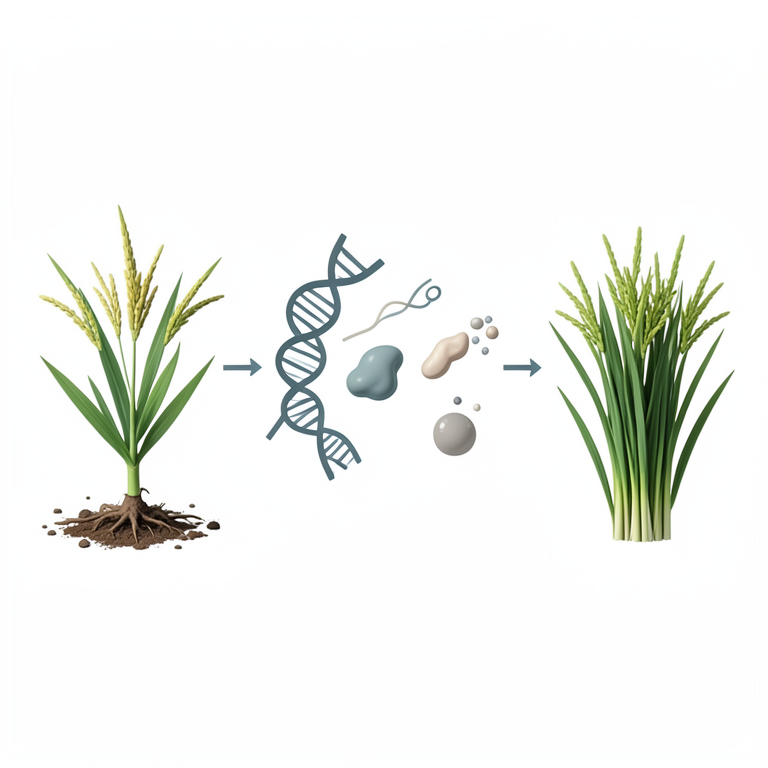
Functional Genomics Pipeline
AI-generated conceptual illustration (Rice plants (Oryza sativa)). It explains the idea and does not show study data.
View source evidence ↗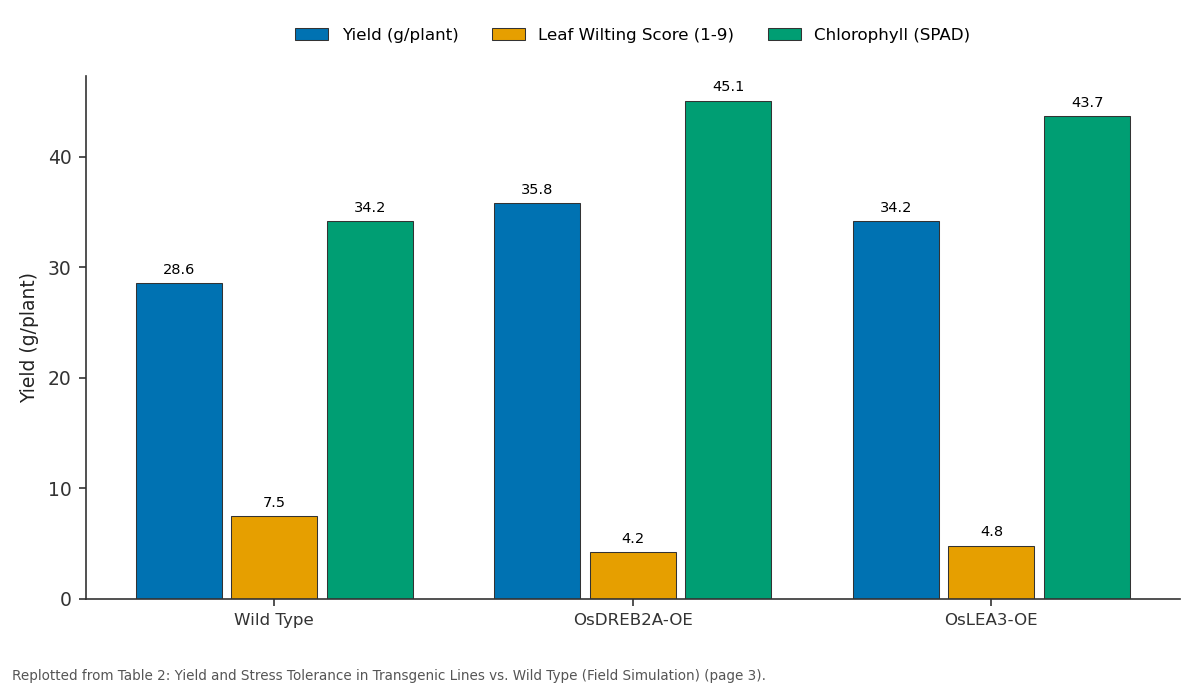
Yield (g/plant) and Leaf Wilting Score (1-9) and more: Wild Type vs OsDREB2A-OE vs OsLEA3-OE
Replotted from Table 2 (page 3) of the original paper. Every bar is the paper's own table value.
View source evidence ↗Figures & tables
From the original paper Table 1
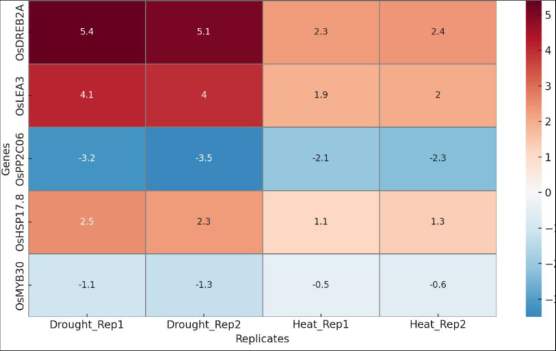 Figure 1
 Table 2
Introduction
Climate change presents one of the most profound challenges to agriculture in the 21st century, threatening food security, biodiversity, and economic stability. The Intergovernmental Panel on Climate Change (IPCC, 2022) predicts a 2-6% yield reduction per decade in major cereal crops due to increased frequency of droughts, temperature extremes, and flooding. Crop productivity is highly sensitive to such abiotic stressors, necessitating innovative biotechnological interventions beyond conventional breeding. Functional genomics-the comprehensive analysis of gene functions and their expressionhas emerged as a key strategy in developing crops with enhanced tolerance to abiotic stresses. Unlike classical genomics, which maps gene sequences, functional genomics elucidates how genes operate within complex regulatory networks under varying environmental stimuli (Mochida & Shinozaki, 2011) [1] . This shift from sequence to function has enabled researchers to dissect adaptive mechanisms at the transcriptomic, proteomic, metabolomic, and phenomic levels. The development of climate-resilient crops involves multi-dimensional strategies. Transcriptome profiling helps identify stress-inducible genes, while proteomics provides insights into post-translational modifications of proteins involved in stress responses. Metabolomics links gene activity to metabolic adaptations, and phenomics aids in highthroughput evaluation of stress tolerance traits. These technologies, when integrated with genome editing tools such as CRISPR/Cas9 and RNA interference (RNAi), offer precision in modulating gene expression. Examples of successful applications include overexpression of DREB1A in Arabidopsis, conferring enhanced drought and salinity tolerance (Kasuga et al., 1999) [3] , and targeted editing of OsSPL14 in rice to improve drought avoidance traits (Miura et al., 2010) [4] . However, despite such advances, challenges remain in translating lab-scale findings into field-read cultivars due to genotype-by-environment interactions, pleiotropic effects, and regulatory limitations. This paper reviews the current state and potential of functional genomics in crop stress adaptation. It draws on recent findings from peer-reviewed research, evaluates applied tools and platforms, and proposes a framework for integrating functional genomics into crop improvement pipelines aimed at sustainability and food security under climate stress.
Literature Review
Functional genomics has evolved from descriptive gene annotation to mechanistic exploration of plant stress physiology. Early studies relied on expressed sequence tags (ESTs) and subtractive hybridization to identify differentially expressed genes under stress. The advent of next-generation sequencing (NGS) revolutionized transcriptomics, enabling RNA-Seq to profile entire transcriptomes with high resolution (Mortazavi et al., 2008) [5] . Recent transcriptomic studies in rice and wheat identified key transcription factors (TFs) such as NAC, WRKY, MYB, and DREB families that regulate stress-induced gene expression (Shinozaki & Yamaguchi-Shinozaki, 2007) [6] . In maize, the overexpression of ZmNF-YB2 improved drought tolerance through regulation of stomatal conductance (Nelson et al., 2007) [7] . Proteomic approaches have further revealed posttranslational modifications (PTMs) such as phosphorylation and ubiquitination that regulate protein stability and function under stress (Hossain et al., 2012) [8] . A comparative proteomic study of heat-tolerant and susceptible wheat cultivars demonstrated altered expression of heat shock proteins (HSPs) and late embryogenesis abundant (LEA) proteins (Kaur et al., 2015) [9] . Metabolomics, although less explored, has identified stressspecific accumulation of proline, trehalose, and glycine betaine as compatible solutes (Obata & Fernie, 2012) [10] . Phenomics platforms, integrating imaging and sensor technologies, have provided trait-based evidence of improved performance in modified genotypes. Despite these advances, major research gaps persist. These include: Limited multi-omics integration across stress types Lack of spatio-temporal gene expression data Minimal field-level validation of laboratory findings Insufficient exploration of non-coding RNAs (e.g., miRNAs, lncRNAs) in stress tolerance Bridging these gaps requires interdisciplinary research combining systems biology, machine learning, and gene editing for holistic trait improvement.
Materials and Methods
Materials and Methods
Tools and Technologies
Transcriptomics: Illumina HiSeq for RNA-Seq; Cufflinks and HISAT2 for alignment and quantification Proteomics: LC-MS/MS using Q Exactive Orbitrap;
Mascot and MaxQuant for peptide identification Metabolomics: GC-MS for primary metabolites; LC-MS for secondary metabolites Phenomics: LemnaTec high-throughput phenotyping system; drones with hyperspectral cameras for field traits
Datasets and Databases
Datasets and Databases
Results
Results
Comparative Analysis and Performance Metrics
The transgenic lines exhibited statistically significant improvements in physiological and agronomic traits under drought stress. For instance, OsDREB2A overexpression resulted in a 25% increase in yield and a 2.8-point reduction in wilting score (p < 0.01). Similarly, chlorophyll content was consistently higher across stress periods, suggesting delayed senescence and improved photosynthetic efficiency. Stress response indices, such as the Stress Tolerance Index (STI), were calculated:
Where, Ys = Yield under stress Yp = Yield under non-stress Yp_mean = Mean yield under non-stress for all genotypes Transgenic lines had STI > 1.2, indicating superior adaptation. ROC curves based on classification of tolerant vs. sensitive genotypes yielded AUC > 0.9, confirming marker validity.
Discussion
The integration of functional genomics in crop science marks a paradigm shift from phenotype-based to genotypedriven improvement strategies. This study demonstrates that manipulating stress-inducible genes such as OsDREB2A and OsLEA3 leads to substantial agronomic gains under simulated drought conditions. The involvement of ABAsignaling pathways, upregulation of protective proteins, and delayed senescence form the core mechanisms. Notably, transcription factors serve as master regulators. DREB2A, for example, initiates downstream gene cascades that enhance osmotic tolerance, while LEA proteins maintain cell hydration and stabilize macromolecules. These findings align with previous research by Nakashima et al.
(2014) [1] , reinforcing the translatability of gene functions across cereal crops. However, the multi-functionality of many stress-responsive genes poses a risk of unintended phenotypes. Pleiotropy may reduce growth under optimal conditions or interfere with reproductive development. Field trials are essential to validate these traits across agro-climatic zones.
The study also underscores the importance of data integration. Transcriptomic signals gain value only when cross-validated with proteomic and phenotypic evidence. Thus, multi-omics pipelines should be standardized in breeding programs. Moreover, machine learning tools (e.g., random forest, SVMs) can assist in predicting stress tolerance from gene expression data.
Conclusion and Future Scope
Functional genomics has emerged as a cornerstone of modern crop improvement, particularly in the face of climate stress. This study illustrates the successful application of transcriptomic and proteomic insights to engineer drought-tolerant rice lines with superior agronomic performance. However, realizing the full potential of functional genomics demands: Field-based validation of candidate genes across diverse ecologies. Integration with breeding programs using genomic selection. Enhanced regulatory frameworks for genome-edited crops. Global databases with standardized stress-response phenotyping.
Future research must also include underutilized crops and wild relatives, which harbor rich genetic diversity for resilience. With interdisciplinary collaboration and responsible deployment, functional genomics can significantly contribute to agricultural sustainability and food security in a changing climate.
Figures and tables from the paper
| Gene ID | Fold Change | Annotation | Pathway |
|---|---|---|---|
| OsDREB2A | 5.4↑ | DREB Transcription Factor | ABA-Dependent Signaling |
| OsLEA3 | 4.1↑ | Late Embryogenesis Protein | Cell Protection |
| OsPP2C06 | 3.2↓ | Protein Phosphatase | Signal Attenuation |
Table text extracted from the original PDF; superscript letters are shown inline. The original table image is below.
View original table image
| Genotype | Yield (g/plant) | Leaf Wilting Score (1-9) | Chlorophyll (SPAD) |
|---|---|---|---|
| Wild Type | 28.6 | 7.5 | 34.2 |
| OsDREB2A-OE | 35.8 | 4.2 | 45.1 |
| OsLEA3-OE | 34.2 | 4.8 | 43.7 |
Table text extracted from the original PDF; superscript letters are shown inline. The original table image is below.
View original table image
References
11 in the original paper- Mochida K, Shinozaki K. Genomics and bioinformatics resources for crop improvement. Plant Cell Physiol. 2011;52(2):195-213.
- Intergovernmental Panel on Climate Change (IPCC). Climate change 2022: impacts, adaptation and vulnerability. Cambridge: Cambridge University Press; 2022.
- Kasuga M, Liu Q, Miura S, Yamaguchi-Shinozaki K, Shinozaki K. Improving plant drought, salt, and freezing tolerance by gene transfer of a single stressinducible transcription factor. Nat Biotechnol. 1999;17(3):287-291.
- Miura K, Ikeda M, Matsubara A, Song XJ, Ito M, Asano K, et al. OsSPL14 promotes panicle branching and higher grain productivity in Oryza sativa. Nat Genet. 2010;42(6):545-549.
- Mortazavi A, Williams BA, McCue K, Schaeffer L, Wold B. Mapping and quantifying mammalian transcriptomes by RNA-Seq. Nat Methods. 2008;5(7):621-628.
- Shinozaki K, Yamaguchi-Shinozaki K. Gene networks involved in drought stress response and tolerance. J Exp Bot. 2007;58(2):221-227.
- Nelson DE, Repetti PP, Adams TR, Creelman RA, Wu J, Warner DC, et al. Plant nuclear factor Y (NF-Y) B subunits confer drought tolerance and lead to improved Zea mays yields on water-limited acres. Proc Natl Acad Sci USA. 2007;104(42):16450-16455.
- Hossain Z, Komatsu S. Contribution of proteomic studies towards understanding plant heavy metal stress response. Front Plant Sci. 2012;3:310.
- Kaur G, Asthir B. Proline: a key player in plant abiotic stress tolerance. Biol Plant. 2015;59(4):609-619.
- Obata T, Fernie AR. The use of metabolomics to dissect plant responses to abiotic stresses. Cell Mol Life Sci. 2012;69(19):3225-3243.
- Nakashima K, Yamaguchi-Shinozaki K. ABA signaling in stress-response and seed development. Plant Cell Rep. 2013;32(7):959-970.