
Research article · 2025 · Full text
International Journal of Agriculture and Food ScienceStudies on seed dormancy and effect of antioxidants on growth, seed yield and quality in quinoa (Chenopodium quinoa willd)
Volume 7(8) · Pages 97–100 · DOI: 10.33545/2664844x.2025.v7.i8b.595 ↗
Research areasSeed and Plant Biochemistry
Abstract
Author-writtenA study on dormancy breaking methods in quinoa was conducted in the laboratory of Department of Seed Science and Technology, College of Agriculture, University of Agricultural Sciences, GKVK, Bengaluru during 2022-23. The experiment comprises of different treatments viz., control, potassium nitrate (KNO3) @ 0.2%, 0.5%, 1% for 12 hr, Gibberellic Acid (GA3) @ 100 ppm, 200 ppm, 500 ppm, for 12 hr, Thiourea @ 1%, 2% for 12 hr and kinetin @ 50 ppm, 100 ppm, 200 ppm for 12 hr, Among treatments highest germination (87.25 %), mean seedling length (9.80 cm), mean seedling dry weight (8.96 mg), seedling vigour index-I (855), seedling vigour index-II (782) were recorded in treatment KNO3 @ 1 % for 12 hr and lowest (28.50 %, 7.80 cm, 6.94 mg, 222 and 198, respectively) were recorded in control. It is concluded that treatment KNO3 @ 1 % for 12 hr can break the dormancy in quinoa.
Summary
Source-checkedPlain-language reading of the full paper, prepared with AI and checked against the text. Each point links to the authors' own words.
Why it matters
- Quinoa is a gluten-free pseudo-cereal recognized as a 'super food' because it contains higher levels of protein, dietary fiber, and vitamins than common cereals like wheat or rice. View evidence ↗
- Quinoa seeds are more prone to rapid viability loss than cereals due to a porous seed coat that makes them sensitive to moisture changes. View evidence ↗
- Seed dormancy is an internal state that prevents quinoa seeds from germinating even when environmental conditions are favorable. View evidence ↗
The question
- The study aimed to evaluate various dormancy-breaking treatments to improve the poor germination rates of quinoa seeds. View evidence ↗
What they did
- The research was conducted at the University of Agricultural Sciences in Bengaluru, India, between 2022 and 2023. View evidence ↗
- The study used seeds from the 'himshakti' variety of quinoa. View evidence ↗
- The experiment tested several treatments for 12 hours: potassium nitrate (0.2%, 0.5%, 1%), Gibberellic Acid (100, 200, 500 ppm), Thiourea (1%, 2%), and kinetin (50, 100, 200 ppm). View evidence ↗
- The researchers measured seed quality using germination percentage, mean seedling length, mean seedling dry weight, and two seedling vigour indices. View evidence ↗
What they found
- Potassium nitrate (KNO3) at 1% produced the highest germination rate (87.25%), significantly outperforming the control group (28.50%). View evidence ↗
- The maximum mean seedling length was 9.80 cm in the 1% KNO3 treatment, compared to 7.80 cm in the control. View evidence ↗
- The 1% KNO3 treatment resulted in the highest mean seedling dry weight (8.96 mg), while the control had the lowest (6.94 mg). View evidence ↗
- Seedling vigour index-I was highest for the 1% KNO3 treatment (855) and lowest for the control (222). View evidence ↗
- Seedling vigour index-II reached its maximum (782) with 1% KNO3 and its minimum (198) in the control group. View evidence ↗
What it means
- The authors conclude that treating quinoa seeds with 1% potassium nitrate (KNO3) for 12 hours is an effective method for breaking seed dormancy. View evidence ↗
Visual summary
3 visualsIllustrations explain the paper; charts are replotted from the paper's own table values.
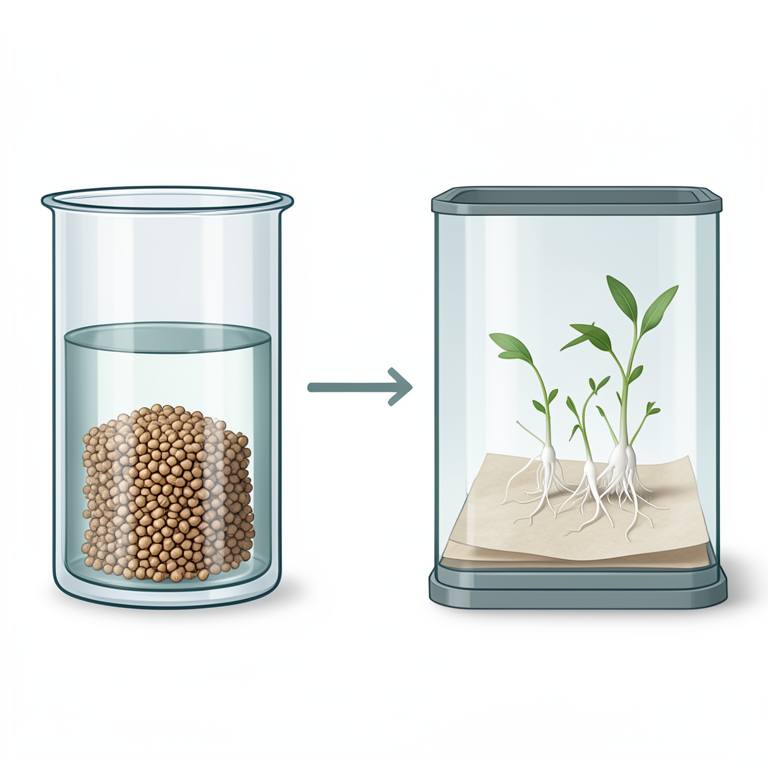
Dormancy Breaking Treatment Setup
AI-generated conceptual illustration (quinoa seeds (Chenopodium quinoa)). It explains the idea and does not show study data.
View source evidence ↗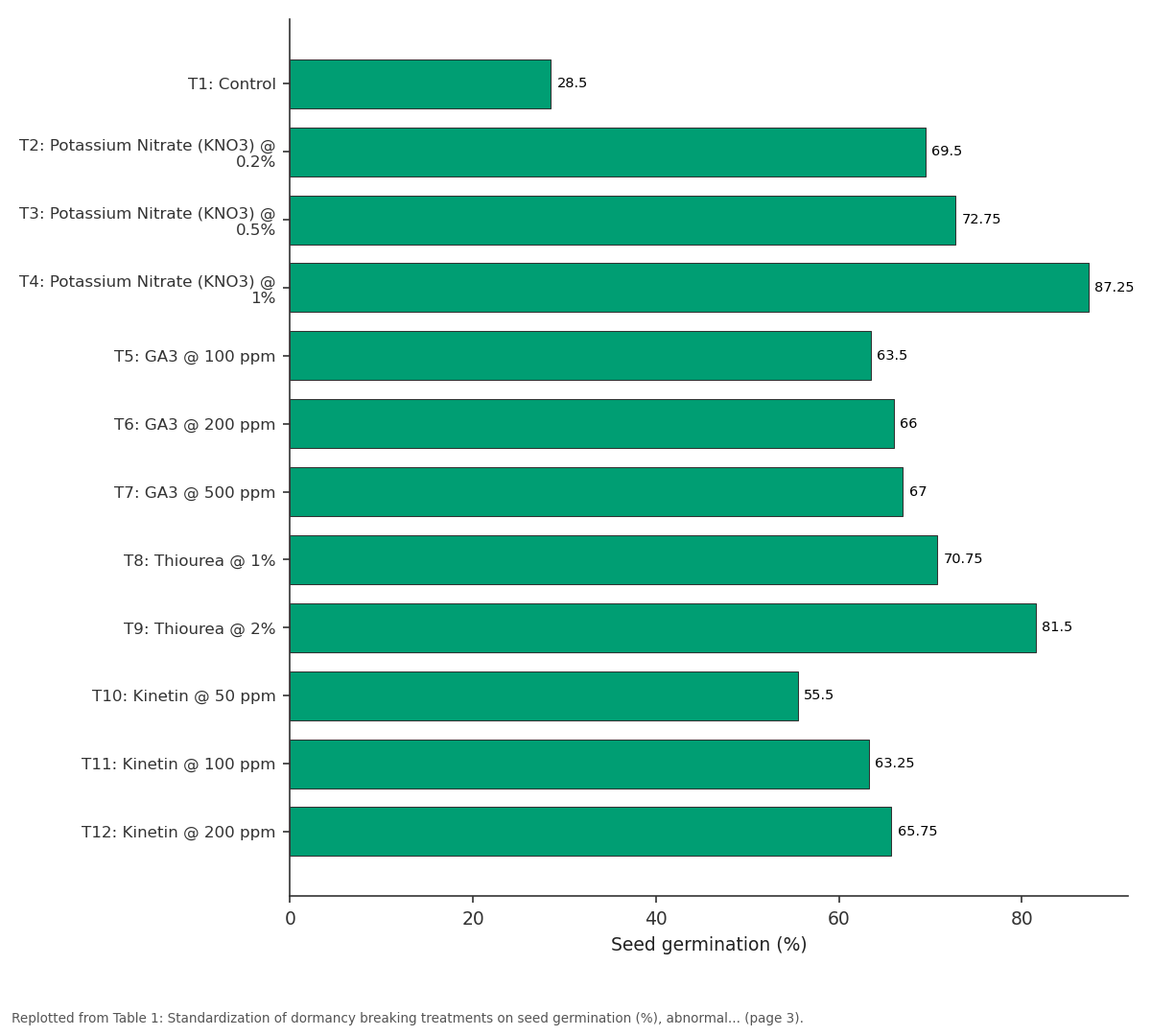
Seed germination (%): T1: Control vs T2: Potassium Nitrate... vs T3: Potassium Nitrate... vs T4: Potassium Nitrate... vs T5: GA3 @ 100 ppm
Replotted from Table 1 (page 3) of the original paper. Every bar is the paper's own table value.
View source evidence ↗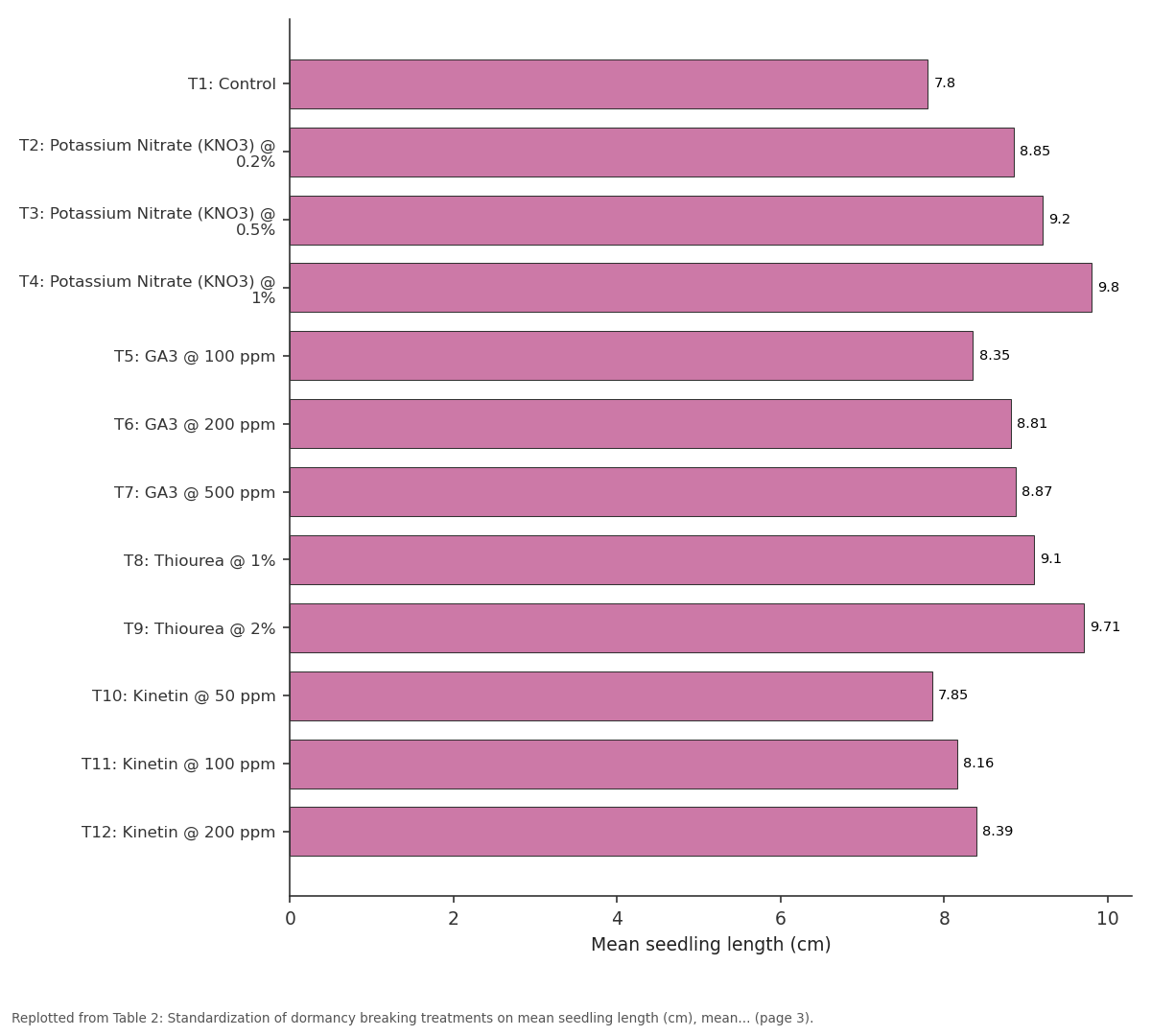
Mean seedling length (cm): T1: Control vs T2: Potassium Nitrate... vs T3: Potassium Nitrate... vs T4: Potassium Nitrate... vs T5: GA3 @ 100 ppm
Replotted from Table 2 (page 3) of the original paper. Every bar is the paper's own table value.
View source evidence ↗Figures & tables
From the original paper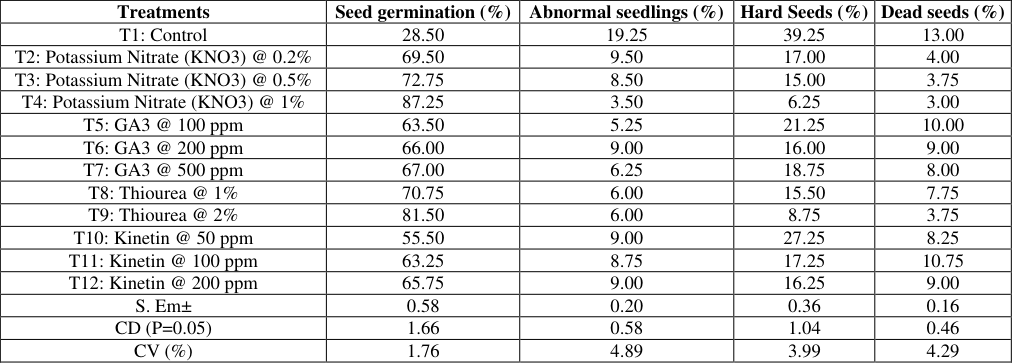 Table 1
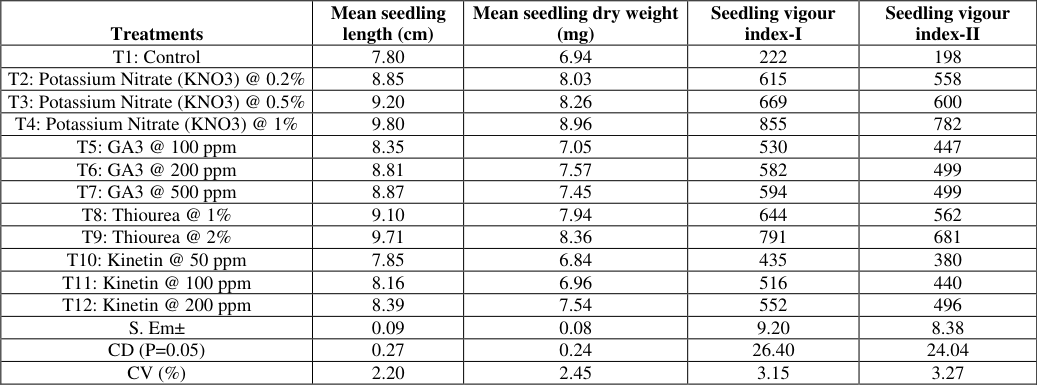 Table 2
Introduction
Quinoa (Chenopodium quinoa willd.) is a allo tetraploid grain crop of the Amaranthaceae family having chromosomes number (2n = 4x = 36) with the impressive drought tolerance. Dicotyledonous annual plant grown as a grain crop primarily for its edible seeds. It is botanically a pseudo cereal, commonly called kinwa, parka, dawe, and chuppah in different regions of the world. It provides dietary minerals, dietary fibre, protein and vitamin B rich amounts above those of wheat, corn, rice or oats. It is gluten free and have low glycaemic index (GI) excellent for diabetic people. Recent years, increasing recognition of importance of quinoa and trying to substitute as major cereals. Now its gaining popularity and recognized as a "super food" for its health benefits. FAO nominated Globally 2013 as the "International year of quinoa" (Bhargava et al., 2006) [5] . Quinoa grain is used for human consumption and used in several food preparations like upma, breakfast, make flour, soup. While the flour is utilized in making biscuits, bread and processed food. It also provides protection against cancer and heart related diseases and also rich in minerals and nutrients. In addition, quinoa consists of higher concentration of amino acids like lysine (5.1-6.6 %), isoleucine (6.4 %), glycine (5.2 %), threonine (4.8 %), histidine (2.7 %), cysteine (2.4 %) and methionine (2.4 %) in seed (Van etten et al., 1963) [13] . that are deficient in cereals. About 70 thousand tons were produced in the Andean area in 2009 of which, about 40 thousand tonnes were produced by Peru, 28 thousand tons by Bolivia and 746 tons by Ecuador. Bolivia and Peru are the principal quinoaproducing nations in the world. Both of them occupy 90 % of the world's quinoa production (Anon., 2013) [2] . In India, quinoa was grown on 440 hectares of land with an average yield of 1.053 tonnes / hectare (Srinivasa Rao, 2015) [12] . However, quinoa seeds lose viability more rapidly than cereals because of the porosity in the integument, which allows a seed to easily gain or lose moisture and may initiate germination in the panicle. Quinoa seed quality is influenced by the low germination rate and reduced vigor (Hernandez et al., 2020) [7] . Dormancy is defined as an internal condition that prevents seed germination under favorable conditions. Seeds with relatively low dormancy germinate in a wider range of conditions than those with relatively high levels of dormancy and only a limited amount of information about seed dormancy in Chenopodium species is available. Some literature refers to seed coat importance in dormancy maintenance. Quinoa seeds undergo a natural dormancy phase, a biological mechanism crucial for its survival. Seed dormancy is a protective mechanism that prevents premature germination, ensuring the seeds remain viable until favorable conditions for growth and reproduction are met. Quinoa seeds exhibit varying levels of dormancy, influenced by genetic, environmental, and physiological factors. Understanding the intricate processes underlying quinoa dormancy is essential for agricultural practices, aiding farmers in optimizing germination methods and ensuring sustainable crop production. Delving into the complexities of quinoa dormancy unveils insights that contribute significantly to global food security and agricultural advancements. Now a days seed industry needs as they are facing difficulty in immediate marketing of quinoa and there is no reliable recommended seed treatment to break the dormancy. However, in reality the potentiality of this crop is not fully exploited. So, farmers are more interested to cultivate this crop, since it is poor germination because of dormancy, the experiment is to understand the details of dormancy by utilizing different dormancy breaking treatments.
Material and methods
The present investigation was carried out in the Department of Seed Science and Technology, University of Agricultural Sciences, GKVK, Bengaluru during the year 2022 to 2023. The seeds of quinoa variety himshakti were collected from AICRP on potential crop, UAS, GKVK, Bengaluru. For seed dormancy breaking treatments viz., potassium nitrate (KNO3) @ 0.2%, 0.5%, 1% for 12 hr, Gibberellic Acid (GA3) @ 100 ppm, 200 ppm, 500 ppm, for 12 hr, Thiourea @ 1%, 2% for 12 hr and kinetin @ 50 ppm, 100 ppm, 200 ppm for 12 hr treatments were employed in the experiment for standardization of seed dormancy breaking treatments. The seeds were put to germination in top paper by using blotters. The germination test was carried out in walk in seed germinator. Seed quality parameters viz., germination, mean seedling length, mean seedling dry weight, seedling vigour index-I and II were evaluated.
The germination test was conducted by using top of the paper method as per the ISTA rules. One hundred seeds from each treatment were drawn at random in four replicates and seed sample were incubated in a germination chamber maintained at 25±1 °C and 90 per cent relative humidity. Germinated seedlings were evaluated on 8 th day as final count and percentage germination was expressed based on number of normal seedlings. (Anon., 2021) [3] .
X 100 Total number of seeds used for the test
Ten normal seedlings were selected randomly from each treatment on the day of final count and seedling length was measured from the tip of shoot to root tip and the mean length was recorded and expressed as mean seedling length in centimeters.
Ten normal seedlings used for measuring shoot and root length will be taken in a butter paper and dried in hot air oven maintained at 80 0 C temperatures for 24 h, Then the seedlings will be removed and allowed to cool in desiccators for 45 minutes before weighing on an electrical balance. The average will be calculated and expressed as mean seedling dry weight in milligram (mg) (Anon., 2021) [3] .
Seedling vigour index-I
The seedling vigour index-I was computed by multiplying per cent germination and mean seedling length (cm) and expressed as a whole number (Abdul-Baki and Anderson, 1973) [1] . Seedling vigour index-I = Germination (%) x Mean seedling length (cm)
Seedling vigour index-II
Seedling vigour index-II was determined by multiplying per cent germination with total seedling dry weight (Abdul Baki and Anderson, 1973) [1] Seedling vigour index-II = Germination (%) x Mean seedling dry weight (mg)
Results and discussion
Below are the experimental findings obtained after conducting a statistical analysis on the seed quality parameters of quinoa under different treatments. The significance of the results has been tested using standard statistical methods, and they have been comprehensively discussed in the context of the available situations.
The data on percentage of germination was influenced by different dormancy breaking treatments in quinoa seeds are represented in the Table 4.1. There was a significant variation in germination percentage among different dormancy breaking treatments. The seeds treated with potassium nitrate (KNO3) @ 1% (T4) recorded maximum (87.25 %) germination followed by seeds treated with thiourea at 2 per cent T9 (81.50 %). Whereas, the control (T1) showed significantly minimum (28.50 %) germination. The germination per cent of normal seedlings was recorded (87.25 %) when seeds were treated with potassium nitrate (KNO3) @ 1%. The KNO3, which increases the germination of photo-dormant seeds. According to Bewley and Black (1982) [4] , KNO3 raises the ambient oxygen level available for citric acid cycle. Similar results were reported in Panicum maximum by Previero et al. (1996) [11] . KNO3 may be helpful for reactivation of metabolic process of seeds. This compound may cause biosynthesis of auxin, which ultimately triggers the growth of embryo (Khan et al., 1999) [8] . Nitrites promotes seed germination by inhibition of H2O2 decomposition by catalase and help in the leakage of abscisic acid (Hendricks and Taylorson, 1974) [6] .
Data on mean seedling length as influenced by different dormancy breaking treatments are presented in Table 4.2. Seeds treated with potassium nitrate (KNO3) @ 1% (T4) showed significantly maximum (9.80 cm) mean seedling length which was on par with thiourea 2 per cent T9 (9.71 cm). However, minimum (7.80 cm) mean seedling length was observed in control (T1). This might be due to KNO3 had a very favourable effect on increasing seed germination, seedling growth and increased activity of nitrate reductase, catalase, alkaline lipase, and phosphatase enzymes, more auxin biosynthesis, elongation in cambium cells and increased division of root cells, subsequent increase of seedling length causing increased embryo growth (Kwon et al., 2020; Lara et al., 2014) [9,10] .
Data related to mean seedling dry weight differed significantly by the impact of different dormancy breaking treatments are presented in Table 4.2. Among different dormancy breaking treatments seeds treated with potassium nitrate (KNO3) @ 1% (T4) showed highest (8.96 mg) mean seedling dry weight followed by thiourea 2 per cent T9 (8.36 mg). However, control (T1) recorded lowest (6.94 mg) mean seedling dry weight. Seedling dry weight increased due to increase in root length, shoot length and total seedling length.
Seedling vigour index-I
Data pertaining to seedling vigour index-I as influenced by different dormancy breaking treatments are presented in the Table 2. Different dormancy breaking methods significantly influence the seedling vigour index-I. Among them, seeds treated with potassium nitrate (KNO3) @ 1% (T4) showed highest (855) seedling vigour index-I followed by thiourea 2 per cent T9 (791). However, control (T1) reported lowest (222) seedling vigour index-I. This might be due to enhancement of germination and seedling length.
| Treatments | Mean seedling length (cm) | Mean seedling dry weight (mg) | Seedling vigour index-I | Seedling vigour index-II |
|---|---|---|---|---|
| T1: Control | 7.80 | 6.94 | 222 | 198 |
| T2: Potassium Nitrate (KNO3) @ 0.2% | 8.85 | 8.03 | 615 | 558 |
| T3: Potassium Nitrate (KNO3) @ 0.5% | 9.20 | 8.26 | 669 | 600 |
| T4: Potassium Nitrate (KNO3) @ 1% | 9.80 | 8.96 | 855 | 782 |
| T5: GA3 @ 100 ppm | 8.35 | 7.05 | 530 | 447 |
| T6: GA3 @ 200 ppm | 8.81 | 7.57 | 582 | 499 |
| T7: GA3 @ 500 ppm | 8.87 | 7.45 | 594 | 499 |
| T8: Thiourea @ 1% | 9.10 | 7.94 | 644 | 562 |
| T9: Thiourea @ 2% | 9.71 | 8.36 | 791 | 681 |
| T10: Kinetin @ 50 ppm | 7.85 | 6.84 | 435 | 380 |
| T11: Kinetin @ 100 ppm | 8.16 | 6.96 | 516 | 440 |
| T12: Kinetin @ 200 ppm | 8.39 | 7.54 | 552 | 496 |
| S. Em± | 0.09 | 0.08 | 9.20 | 8.38 |
| CD (P=0.05) | 0.27 | 0.24 | 26.40 | 24.04 |
| CV (%) | 2.20 | 2.45 | 3.15 | 3.27 |
Table text extracted from the original PDF; superscript letters are shown inline. The original table image is below.
View original table image
Seedling vigour index-II
Data on seedling vigour index-II significantly influenced by different dormancy breaking treatments are presented in Table 2. Among them, seeds treated with potassium nitrate (KNO3) @ 1% (T4) recorded highest (782) seedling vigour index II followed by seeds treated with thiourea 2 per cent T9 (681). Whereas, the lowest (198) seedling vigour index-II was found in control (T1). This might be due to increase in percent germination and seedling dry weight.
Figures and tables from the paper
| Treatments | Seed germination (%) | Abnormal seedlings (%) | Hard Seeds (%) | Dead seeds (%) |
|---|---|---|---|---|
| T1: Control | 28.50 | 19.25 | 39.25 | 13.00 |
| T2: Potassium Nitrate (KNO3) @ 0.2% | 69.50 | 9.50 | 17.00 | 4.00 |
| T3: Potassium Nitrate (KNO3) @ 0.5% | 72.75 | 8.50 | 15.00 | 3.75 |
| T4: Potassium Nitrate (KNO3) @ 1% | 87.25 | 3.50 | 6.25 | 3.00 |
| T5: GA3 @ 100 ppm | 63.50 | 5.25 | 21.25 | 10.00 |
| T6: GA3 @ 200 ppm | 66.00 | 9.00 | 16.00 | 9.00 |
| T7: GA3 @ 500 ppm | 67.00 | 6.25 | 18.75 | 8.00 |
| T8: Thiourea @ 1% | 70.75 | 6.00 | 15.50 | 7.75 |
| T9: Thiourea @ 2% | 81.50 | 6.00 | 8.75 | 3.75 |
| T10: Kinetin @ 50 ppm | 55.50 | 9.00 | 27.25 | 8.25 |
| T11: Kinetin @ 100 ppm | 63.25 | 8.75 | 17.25 | 10.75 |
| T12: Kinetin @ 200 ppm | 65.75 | 9.00 | 16.25 | 9.00 |
| S. Em± | 0.58 | 0.20 | 0.36 | 0.16 |
| CD (P=0.05) | 1.66 | 0.58 | 1.04 | 0.46 |
| CV (%) | 1.76 | 4.89 | 3.99 | 4.29 |
Table text extracted from the original PDF; superscript letters are shown inline. The original table image is below.
View original table image
References
13 in the original paper- Abdul-Baki AA, Anderson JD. Vigor determination of soybean seeds by multiple criteria. Crop Sci. 1973;13:630-633.
- Anonymous. Quinoa area and production in the world 2013 http://www.fao.org
- Anonymous. International Rules for Seed Testing (ISTA). Seed Sci Technol. 2021;24:307-335.
- Bewley JD, Black M. Physiology and biochemistry of seeds in relation to germination, viability, dormancy and environmental control. UK: Springer Verlag; 1982. 2(5):51-60.
- Bhargava A, Sudhir S, Deepak O. Chenopodium quinoa Willd. An Indian perspective. Ind Crops Prod. 2006;23:73-87.
- Hendricks SB, Taylorson RB. Promotion of seed germination by nitrate, nitrite, hydroxylamine and ammonium salts. Plant Physiol. 1974;54:304-309.
- Hernandez EHM, Coronado ACM, Ardila WLR. Seed quality of 22 quinoa materials (Chenopodium quinoa Willd.) from the department of Boyaca. Revista Ceres. 2020;67:306-314.
- Khan J, Rauf M, Ali Z, Rashid H, Khattack MS. Different stratification techniques on seed germination of pistachio. Pak J Biol Sci. 1999;2:1412-1414.
- Kwon H, Shin S, Kim Y, Kim S. Effects of temperature, gibberellic acid, and KNO₃ treatments on seed germination of the wild plant Maesa japonica. Seed Sci Technol. 2020;48:65-72.
- Lara TS, Lira JMS, Rodrigues AC, Rakocevi M, Alvarenga AA. Potassium nitrate priming affects the activity of nitrate reductase and antioxidant enzymes in tomato germination. J Agric Sci. 2014;6:72-80.
- Previero CA, Martins L, Fonseca RHA, Groth D. Effect of storage of guinea grass (Panicum maximum Jacq.) on treatment to break dormancy. Revista Brasileira de Semetes. 1996;18(1):143-148.
- Srinivasa Rao K. Sari kotha pantha quinoa. Sakhi News Paper. 2015 Aug 11;page 10.
- Van Etten CH, Miller RW, Wolff IA, Jones Q. Amino acid composition of seeds from 200 angiosperm plants. J Agric Food Chem. 1963;11:399-410.