
Research article · 2025 · Full text
International Journal of Agriculture and Food ScienceExploring the impact of different rooting media on the growth and development of protray grown papaya (Carica papaya L.) var. Red Lady
Volume 7(7) · Pages 319–322 · DOI: 10.33545/2664844x.2025.v7.i7d.524 ↗
Research areasPlant Growth and Agriculture TechniquesPapaya Research and ApplicationsPineapple and bromelain studies
Abstract
Author-writtenThis study investigates the effect of various rooting substrates on the growth and development of Pro-tray grown papaya (Carica papaya L). var. Red Lady under nursery conditions. The objective was to screen the most suitable rooting media in seedlings for better vigour, uniform growth and high survival percentage after transplantation, which will ultimately provide an advantage for higher productivity and early fruiting. Five different rooting medium constitutions, viz., cocopeat + vermicompost, cocopeat + vermicompost + Trichoderma asperellum and soil + sand + farmyard manure (FYM), were applied to the plots laid out in a Complete randomized design with four replications. Compared with other media, the highest seedling height, stem diameter, and root length were observed in cocopeat + vermicompost + Trichoderma asperellum. This medium provided the best aeration and water retention as well as the highest nutrient accessibility required for early and aggressive root establishment. The control (soil + sand + FYM), on the other hand, gave less uniform root development, having probably become compacted and non-uniform in moisture content. These results can be useful to commercial papaya growers and nursery managers for choosing rooting media that will improve seedling quality.
Summary
Source-checkedPlain-language reading of the full paper, prepared with AI and checked against the text. Each point links to the authors' own words.
Why it matters
- Papaya is a tropical fruit crop of significant economic importance because of its commercial, medicinal, and nutritional value. View evidence ↗
- The 'Red Lady' cultivar is preferred among papaya varieties due to its superior fruit quality, high yields, and ability to fruit early. View evidence ↗
- Rooting media are critical for seedling growth as they provide physical support and essential nutrients, air, and water. View evidence ↗
The question
- The study aimed to identify the most effective rooting media to ensure uniform growth, better vigour, and higher survival rates for papaya seedlings after they are transplanted. View evidence ↗
What they did
- The research was carried out at the SRM College of Agricultural Science nursery in Tamil Nadu, India. View evidence ↗
- The study used a complete randomized design with five different treatment groups, each repeated four times. View evidence ↗
- The five treatments tested varied combinations of red soil, cocopeat, vermicompost, and farmyard manure (FYM), with T4 and T5 additionally including the fungus Trichoderma asperellum. View evidence ↗
- Seeds were pre-treated with 200 ppm of gibberellic acid (GA3) for 12 hours before being sown. View evidence ↗
- The researchers measured several growth parameters, including germination percentage, days to sprout, seedling height at 45 days, girth, leaf count, and the fresh and dry weights of roots and shoots. View evidence ↗
What they found
- Treatment T4 achieved the highest germination rate at 96%, while T3 and T5 had the lowest at 88%. View evidence ↗
- The tallest seedlings were found in T5 (19.75 cm), significantly exceeding the control group (15.25 cm). View evidence ↗
- Seedlings in T4 had a significantly larger girth (2.48 mm) than those in the control group (1.66 mm). View evidence ↗
- T4 and T5 produced the most leaves per seedling (7.6), compared to 6.2 leaves in the control group. View evidence ↗
- T4 resulted in the highest biomass, with a fresh shoot weight of 1.74 g, dry shoot weight of 0.44 g, and root weights of 0.16 g (fresh) and 0.12 g (dry). View evidence ↗
- Despite having a lower germination rate, T5 achieved the highest seedling vigour index of 1738.00%. View evidence ↗
What it means
- The authors concluded that T4 and T5 were the most effective rooting media for improving the growth, vigour, and overall characteristics of 'Red Lady' papaya seedlings. View evidence ↗
Visual summary
3 visualsIllustrations explain the paper; charts are replotted from the paper's own table values.
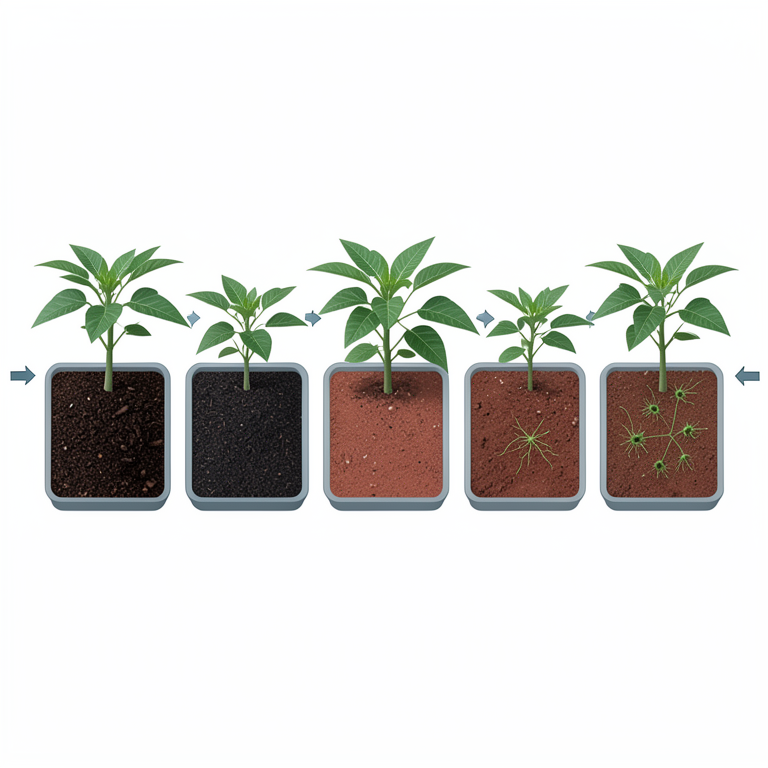
Rooting Media Composition
AI-generated conceptual illustration (papaya plants (Carica papaya L. var. Red Lady) in seedling trays). It explains the idea and does not show study data.
View source evidence ↗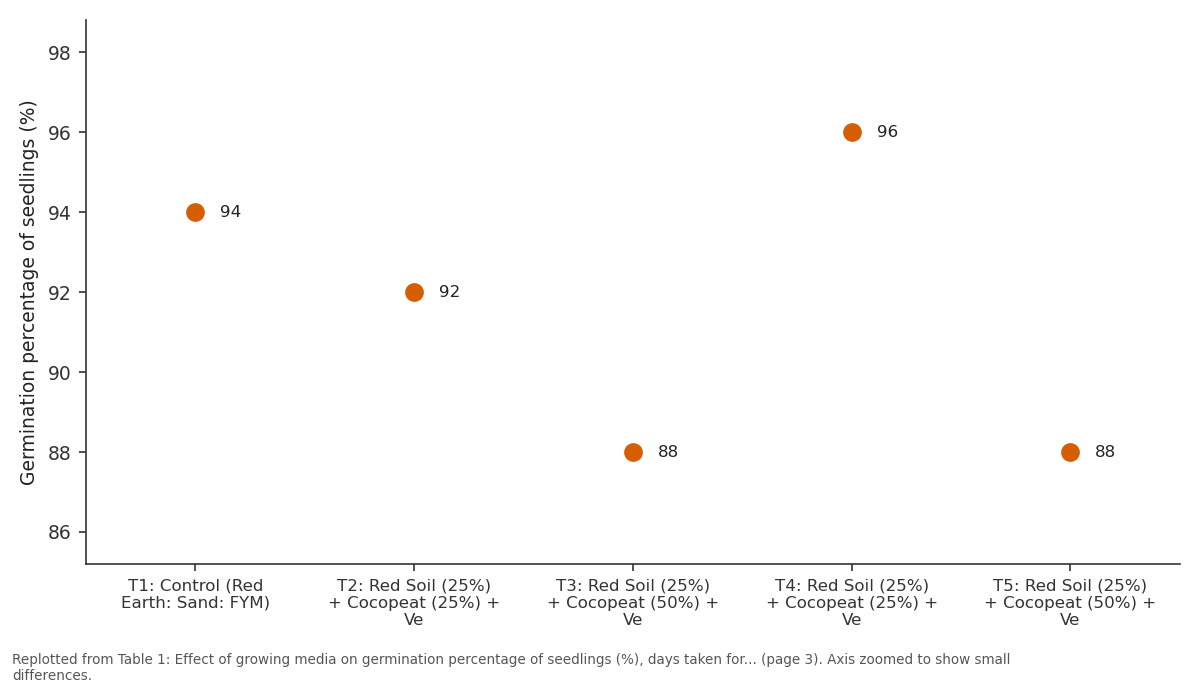
Germination percentage of seedlings (%): T1: Control (Red Earth:... vs T2: Red Soil (25%) +... vs T3: Red Soil (25%) +... vs T4: Red Soil (25%) +... vs T5: Red Soil (25%) +...
Replotted from Table 1 (page 3) of the original paper. Every bar is the paper's own table value.
View source evidence ↗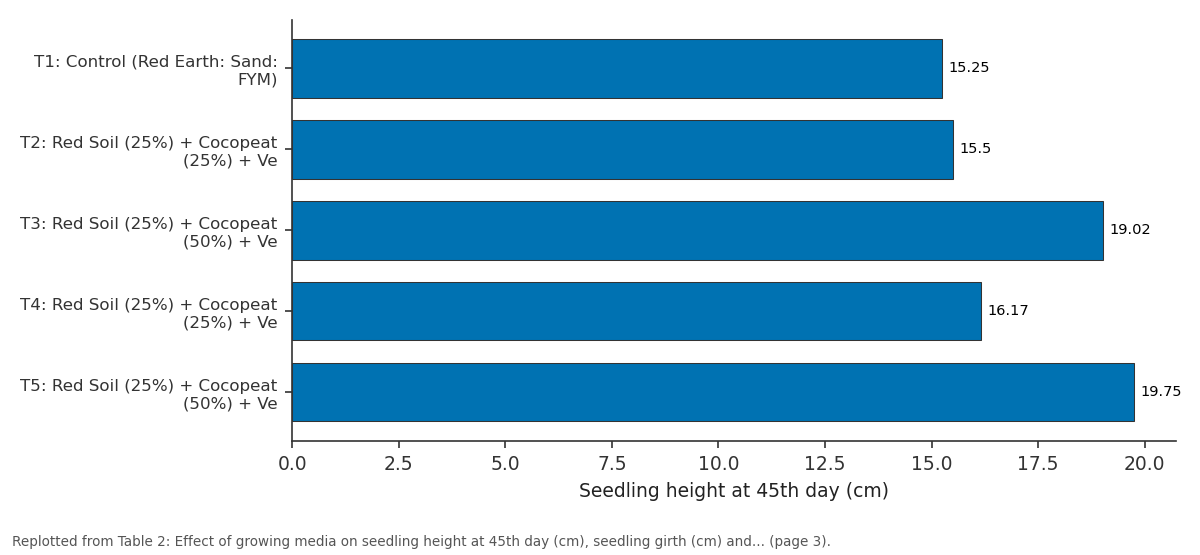
Seedling height at 45th day (cm): T1: Control (Red Earth:... vs T2: Red Soil (25%) +... vs T3: Red Soil (25%) +... vs T4: Red Soil (25%) +... vs T5: Red Soil (25%) +...
Replotted from Table 2 (page 3) of the original paper. Every bar is the paper's own table value.
View source evidence ↗Figures & tables
From the original paper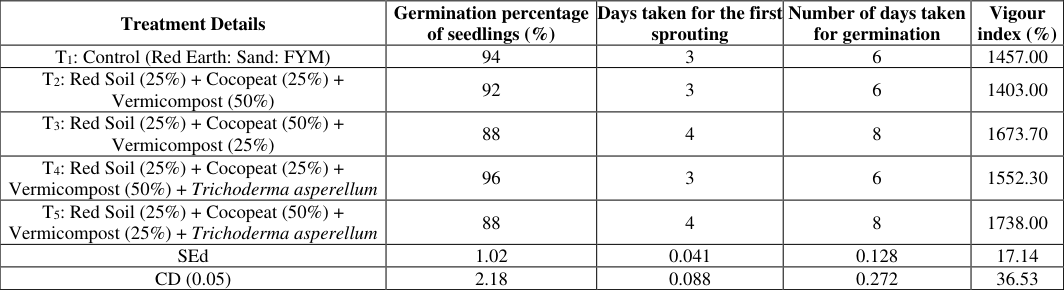 Table 1
 Table 2
 Table 3
Introduction
Papaya (Carica papaya L.) is an economically important tropical fruit crop due to its nutritional, medicinal and commercial value. Among the different cultivars of papaya, the Red Lady is considered to be preferred with better offering of early fruiting, high yielding and superior fruit quality. Nevertheless, healthy seedling transplants are necessary to achieve successful production, and this is strongly influenced by the nursery stage, especially the type of rooting medium. Rooting media not only supports the seedling physically, but it also provides water, air and nutrients necessary to get a uniform and vigorous growth of seedlings (Pant and Verma, 2022) [11] . From the old school nursery beds to today's practice of pro-tray, the journey for the production of uniform, pest-free seedlings has been truly revolutionary. Pro-trays, along with scientifically developed root media, can be a useful tool for enhancing the survival of transplants in the nursery as well as early field establishment (Suthar and Gairola, 2021) [18] . Cocopeat is a popular medium amongst other media because of its high water holding capacity and high porosity. It is usually mixed with other inert or organic amendments such as perlite, vermiculite, or vermicompost to increase nutrient retention, aeration and microbial activity (Abad et al., 2001) [1] . The choice and optimisation of these media combinations are important for prompt root initiation, vigorous shoot growth, and their overall seedling vigour. Growing media not only acts as a growing place but also as a source of nutrients for seedling growth (Gopu et al., 2022) [4] . Other researchers have pointed out that substrate composition is an essential factor for seedling performance in varying species of crops. Similarly, Singh et al. (2014) [14] , papaya seedlings that were raised in based media performed better than those raised in normal soil media. Nevertheless, there have been few systematic investigations conducted on papaya var. Red Lady under nursery conditions of pro-tray, particularly incorporating quantitative [14] observed improvements in germination percentage, seedling height, and roots due to the use of cocopeat-based media in papaya. The authors recommended the use of cocopeat in conjunction with vermicompost rather than soil-based media, citing the former's superior aeration and water retention capabilities. However, the findings of Kumar and Rani (2016) [7] reported that in high humidity conditions, cocopeat resulted in excessive retention of moisture, leading to root rot and poor seedling vigour, indicating the necessity of media selection under the context of climate. Patel et al. (2019) [12] proved that the biomass accumulation and root-to-shoot ratio of Red Lady papaya seedlings were higher when the medium of a mixture of cocopeat, vermicompost and perlite soil in a ratio of 1:1:1, under greenhouse conditions. Nevertheless, Ravi et al. (2020) [13] reported that these blends are costlier and therefore may not be affordable for smallholder farmers even if such blends are effective. Pro-trays, along with light aerated media, were recommended to reduce transplanting shock in the papaya (Kumar and Jaya, 2024) [6] . Srinivas and Mohan (2024) [16] reported that field soil acclimatization is more effective when seedlings are cultivated in a partially soil-based medium, resulting in lowered post-transplant mortality. Against this background, any beneficial effects of rooting media will help to narrow down the gap and thus constitute an incentive for this study, which assessed the influence of various rooting media on the growth and development of pro-tray raised papaya cv. Red Lady.
Materials and Methods
The experiment was conducted at the nursery of SRM College of Agricultural Science, located in the peaceful area of Vendhar Nagar, Baburayanpettai, Chengalpattu, Tamil Nadu. The primary aim of this study was to investigate the effects of different growing media on seed germination, growth, and development of pro-tray-grown papaya var. Red Lady. To achieve reliable and valid results, a complete randomized design was utilised, featuring five distinct treatment groups, each replicated four times. This design allowed for a thorough analysis of each treatment's impact while minimising biases. For each replication, a pro-tray was employed for seedling cultivation. The treatments explore various media compositions are T 1 : Control -Red Earth (50%) + Sand (25%)+ FYM (25%), T 2 : Red Soil (25%) + Cocopeat (25%) + Vermicompost (50%), T 3 : Red Soil (25%) + Cocopeat (50%) + Vermicompost (25%), T 4 : Red Soil (25%) + Cocopeat (25%) + Vermicompost (50%) + Trichoderma asperellum, T 5 : Red Soil (25%) + Cocopeat (50%) + Vermicompost (25%) + Trichoderma asperellum. Before sowing the seeds into the pro-tray, they were treated with gibberellic acid (GA 3 ) at a concentration of 200 ppm for 12 hours. The mixing of the growing media followed precise guidelines: each component was measured according to the specified ratios and thoroughly combined to ensure homogeneity. This mixture was then carefully filled into the pro-tray one day before planting. The seed sowing was done in January (2025) about 1 cm deep in a pro-tray as per the treatments. These protrays are watered immediately after sowing with the help of a rose can and maintained medium moisture level throughout the study period. Observation on germination parameters was recorded. The days taken for first sprouting, number of days taken for germination, germination percentage of seedlings, seedling height at 45 th day (cm), seedling girth (mm), number of leaves, fresh weight of shoot (g), fresh weight of root (g), dry weight of shoot (g), dry weight of root (g) and vigour index (%) were recorded. The results from the experiment were statistically analyzed using the General R-Based Analysis Platform Empowered by Statistics (GRAPES), developed by the Department of Agricultural Statistics, Kerala Agricultural University, Kerala (www.kaugrapes.com). Analysis of Variance (ANOVA) was performed to compare the means, using a significance level of P ≤ 0.05.
Results and Discussion
In this study, the data presented in Tables 1 to 3 unequivocally demonstrate the significant impact of various observations, on growth parameters such as seedling height, girth, number of leaves, fresh weight of shoots and roots, dry weight of shoots and roots, germination percentage, vigour index, number of days to germination and days until first sprouting. The investigation decisively evaluated the effects of different growing media combinations, including the beneficial fungus Trichoderma asperellum, on the seedling performance of papaya cv. Red Lady. The results indicate significant differences among the treatments for all observed parameters, emphasising the essential role of organic amendments and microbial inoculants in enhancing seedling growth.
In the present study, the highest germination percentage (96%) was recorded in T 4 , followed by the control (94%), while T 3 and T 5 recorded the lowest germination percentage (88%) (Table 1.). It might have provided more uniform and congenial conditions for seed germination. The T 4 treatments, Red Soil (25%) + Cocopeat (25%) + Vermicompost (50%) + Trichoderma asperellum combinations, provide a uniform physical structure that ensures close contact between seeds and media, increases balanced moisture supply, and facilitates better germination when compared with other treatments. Similar results were also reported by Bhardwaj (2014), Arvind et al. (2015) and Pant and Verma (2022) [3 , 2 , 11] in papaya seedlings. Among the different treatments, the lowest days taken for first sprouting and the number of days taken for germination were recorded as T 4 , T 2 and T 1 . However, the treatments T 3 and T 5 recorded the maximum days (Table 1). Better germination traits could be attributed to less evaporation of moisture from the protrays ultimately provides congenial conditions for fast germination. Similar results were obtained by Pant and Verma (2022) [11] in papaya cv. Red Lady. It is observed that the highest number of days for the first sprouting and the number of days taken for germination are recorded in the cocopeat (50%) combinations. So, excess cocopeat in the media combinations delayed the germination. Although the treatment T 5 had relatively lower germination, its seedling vigour index was highest, indicating superior seedling quality. The significant increase in vigour index under Trichoderma treatments suggests its role in promoting overall seedling health, as previously observed by Montalvao et al. (2020) [10] in tomato seedlings. These results indicate that integrating Trichoderma and organic media components creates favourable conditions for early growth stages. Effect of growing media on seedling height at 45 th day (cm), seedling girth (cm) and number of leaves in papaya cv. Red Lady A critical factor in enhancing seedling growth attributes is plant nutrition (Suresh et al., 2023) [17] . The maximum seedling height (19.75 cm) was observed in T 5 (Red Soil 25% + Cocopeat 50% + Vermicompost 25% + Trichoderma asperellum), followed by T 3 (19.02 cm), which contained a similar substrate composition without Trichoderma. The control (T 1 ) recorded 15.25 cm, indicating that media enriched with cocopeat and vermicompost significantly improved the seedling height. It suggests that cocopeat played a major role in vertical height. These findings align with Kumawat and Topno (2024) [8] , who reported that cocopeat and vermicompost combinations enhance water retention and aeration, resulting in better seedling elongation. Seedling girth was significantly higher in T 4 (2.48 mm), where Trichoderma asperellum was incorporated, compared to the control (1.66 mm). This suggests that Trichoderma inoculation improves nutrient uptake and promotes cell expansion, consistent with the work of Maurya et al. (2020) [9] in tomato seedlings, who emphasised the role of beneficial microbes in boosting seedling growth robustness. This indicates the role of nutrient-rich compost and better microflora for improving the structural components of the plants. The number of leaves per seedling was highest in T 4 and T 5 (7.6 leaves), significantly higher than the control (6.2 leaves). Increased number of leaves under Trichoderma treatments may be due to improved root activity and nutrient availability (Pant and Verma, 2022) [11] . Effect of growing media on fresh weight of shoot (g), fresh weight of root (g), dry weight of shoot (g) and dry weight of root (g) in papaya cv. Red Lady Regarding biomass, the treatment T 4 showed the highest fresh shoot weight (1.74 g) and dry shoot weight (0.44 g), along with increased root biomass (0.16 g fresh and 0.12 g dry weight). These findings support earlier reports by Singh et al. (2016) [15] in pea, highlighting the growth-promoting effects of Trichoderma through enhanced root development and soil health improvement. These findings align with the research findings of Hazarika et al. (2023) and Bhardwaj (2014) [5 , 3] in papaya for the use of cocopeat and vermicompost media combinations.
| Treatment Details | Germination percentage of seedlings (%) | Days taken for the first sprouting | Number of days taken for germination | Vigour index (%) |
|---|---|---|---|---|
| T1: Control (Red Earth: Sand: FYM) | 94 | 3 | 6 | 1457.00 |
| T2: Red Soil (25%) + Cocopeat (25%) + Vermicompost (50%) | 92 | 3 | 6 | 1403.00 |
| T3: Red Soil (25%) + Cocopeat (50%) + Vermicompost (25%) | 88 | 4 | 8 | 1673.70 |
| T4: Red Soil (25%) + Cocopeat (25%) + Vermicompost (50%) + Trichoderma asperellum | 96 | 3 | 6 | 1552.30 |
| T5: Red Soil (25%) + Cocopeat (50%) + Vermicompost (25%) + Trichoderma asperellum | 88 | 4 | 8 | 1738.00 |
| SEd | 1.02 | 0.041 | 0.128 | 17.14 |
| CD (0.05) | 2.18 | 0.088 | 0.272 | 36.53 |
Table text extracted from the original PDF; superscript letters are shown inline. The original table image is below.
View original table image
Conclusion
This investigation systematically examined the influence of different rooting substrates on the growth and development of papaya var. Red Lady is produced in a pro-tray system. Based on the experiment, it is concluded that treatments T 4 and T 5 were the most effective, enhancing growth parameters such as germination percentage, vigour index, and root and shoot characteristics. Among the treatments, T 4 and T 5 demonstrated the best overall performance in promoting seedling growth and establishment of protrays grown papaya cv. Red Lady.
Figures and tables from the paper
| Treatment Details | Seedling height at 45th day (cm) | Seedling girth (mm) | Number of leaves |
|---|---|---|---|
| T1: Control (Red Earth: Sand: FYM) | 15.25 | 1.66 | 6.2 |
| T2: Red Soil (25%) + Cocopeat (25%) + Vermicompost (50%) | 15.50 | 2.14 | 7.2 |
| T3: Red Soil (25%) + Cocopeat (50%) + Vermicompost (25%) | 19.02 | 1.78 | 6.8 |
| T4: Red Soil (25%) + Cocopeat (25%) + Vermicompost (50%) + Trichoderma asperellum | 16.17 | 2.48 | 7.6 |
| T5: Red Soil (25%) + Cocopeat (50%) + Vermicompost (25%) + Trichoderma asperellum | 19.75 | 1.88 | 7.6 |
| SEd | 0.290 | 0.130 | 0.070 |
| CD (0.05) | 0.617 | 0.277 | 0.150 |
Table text extracted from the original PDF; superscript letters are shown inline. The original table image is below.
View original table image
| Treatment Details | Fresh weight of shoot (g) | Fresh weight of root (g) | Dry weight of shoot (g) | Dry weight of root (g) |
|---|---|---|---|---|
| T1: Control (Red Earth: Sand: FYM) | 1.14 | 0.10 | 0.10 | 0.05 |
| T2: Red Soil (25%) + Cocopeat (25%) + Vermicompost (50%) | 1.58 | 0.15 | 0.33 | 0.09 |
| T3: Red Soil (25%) + Cocopeat (50%) + Vermicompost (25%) | 1.20 | 0.11 | 0.14 | 0.09 |
| T4: Red Soil (25%) + Cocopeat (25%) + Vermicompost (50%) + Trichoderma asperellum | 1.74 | 0.16 | 0.44 | 0.12 |
| T5: Red Soil (25%) + Cocopeat (50%) + Vermicompost (25%) + Trichoderma asperellum | 1.23 | 0.11 | 0.16 | 0.06 |
| SEd | 0.015 | 0.002 | 0.005 | 0.002 |
Table text extracted from the original PDF; superscript letters are shown inline. The original table image is below.
View original table image
References
18 in the original paper- Abad M, Noguera P, Bures S. National inventory of organic wastes for use as growing media for ornamental potted plant production: case study in Spain. Bioresour Technol. 2001;77(2):197-200.
- Arvind RK, Patel KM, Upadhyay NV. Effect of different growing media and containers on germination and establishment of seedlings of papaya (Carica papaya L.) cv. Madhubindu. Trends Biosciences. 2015;8(1):227-230.
- Bhardwaj RL. Effect of growing media on seed germination and seedling growth of papaya cv. Red Lady. Afr J Plant Sci. 2014;8(4):178-184.
- Gopu B, Mathankumar R, Kumaresh R, Kanimozhi C. Standardization of Growing Media for Palak (Beta vulgaris var. bengalensis) var. Arka Anupama under Shade Net Conditions. Eco Env Cons. 2022;28(August Suppl. Issue):S315-S319.
- Hazarika B, Gogoi S, Das RT, Bordoloi A. Studies on seed germination, growth and vigour of papaya seedlings cv. 'Sapna' as influenced by growth regulators and propagation media. Pharma Innovation J. 2023;12(11):2387-2391.
- Kumar A, Jaya R. Effectiveness of light rooting media in reducing transplant shock in papaya pro-trays. Hortic Technol. 2024;6(1):21-29.
- Kumar S, Rani P. Influence of growing media on papaya seedling growth under humid tropical conditions. Int J Agric Sci. 2016;8(1):23-28.
- Kumawat M, Topno SE. Effect of different growing media on seed germination, seedling growth and establishment of papaya (Carica papaya L.) cv. Red Lady. J Adv Biol Biotechnol. 2024;27(5):962-967.
- Maurya S, Rai D, Rai B, Dubey S. Growth promotion effect of Trichoderma isolates on tomato seedlings. 2019. p. 115-118.
- Montalvao SCL, Marques E, Silva JBT, Silva JP, Mello SCM. Trichoderma activity in seed germination, promoting seedling growth and rhizocompetence in tomato plants. J Agric Sci. 2020;12(10):252.
- Pant P, Verma MK. Standardization of media and container for improving seed and seedling growth in papaya (Carica papaya) cv. Red Lady. Indian J Agric Sci. 2022;92(3):329-33.
- Patel D, Sharma H, Singh R. Optimization of media components for vigorous growth of papaya seedlings under greenhouse conditions. J Hortic Res. 2019;27(1):89-94.
- Ravi P, Kumari L. Economic viability of using locally available nursery media for papaya cultivation. J Agric Ecol. 2020;11(2):112-119.
- Singh A, Kumar V, Mishra RK. Effect of different growing media on germination and seedling growth of papaya under a net house. Asian J Hortic. 2014;9(2):314-316.
- Singh V, Upadhyay RS, Sarma BK, Singh HB. Seed bio-priming with Trichoderma asperellum effectively modulates plant growth promotion in pea. Int J Agric Environ Biotechnol. 2016;9(3):361-365.
- Srinivas R, Mohan S. Role of soil-based nursery substrates in improving field establishment of papaya seedlings. Open Agric J. 2024;14(1):58-65.
- Suresh V, Kousalya R, Gopu B, Kabariel J, Rajkumar A. Standardization of organic manures on growth of winter cherry (Withania somnifera). Res J Pharm Tech. 2023;16(12):5593-5596.
- Suthar M, Gairola S. Application of different rooting media on plant propagation: a review. J Plant Nutr. 2021;44(8):1194-1205.
Cited by 1
From OpenAlex, OpenCitations and reference lists read by Scinovex
- Integrated application of organic manures and rhizosphere bioinoculants enhances yield in white-fleshed dragon fruit (Selenicereus undatus)
A Bojan, B. Gopu, V. Gopi, R. Angelin Silviya · International Journal of Horticulture and Food Science · 2025
The study of standardization of organic amendments for dragon fruit (Selenicereus undatus) cultivation under Chengalpattu conditions this research was conducted at the farmer field at Vadamanipakkam Village on Chengalpattu district, Tamil Nadu during 2024-2025, the experiment trail have been conducted in RBD with 3 replication using 9 different treatments viz., T1 = Control, T2 = 100 per cent N through poultry manure, T3 = 100 per cent N through poultry manure + AM fungi @ 25 g/pillar, T4 = 100 per cent N through poultry manure + PSB @ 10 ml/pillar, T5 = 100 per cent N through poultry manure +