
Research article · 2025 · Full text
International Journal of Agriculture and Food ScienceEffects of fertilizer types on growth and bulb yield of garlic (Allium sativum L.) varieties in Ogbomoso, Nigeria
Volume 7(7) · Pages 14–17 · DOI: 10.33545/2664844x.2025.v7.i7a.488 ↗
Research areasGarlic and Onion StudiesFlowering Plant Growth and Cultivation
Abstract
Author-writtenGarlic (Allium sativum L.) is an economically and nutritionally valuable crop widely consumed for its culinary and medicinal benefits. However, its productivity in Nigeria remains low, largely due to suboptimal agronomic practices and limited information on appropriate fertilizer types and varietal differences. This study was therefore conducted to evaluate the influence of different fertilizer types and garlic varieties on the growth, and bulb yield of garlic in Ogbomoso. The treatment consisted of two garlic varieties (Sokoto local and Pretty garlic) and six fertilizer treatments: F1 (No fertilizer), F2 (100% NPK 15-15-15), F3 (100% Compost), F4 (50% NPK + 50% Compost), F5 (75% NPK + 25% Compost), and F6 (75% Compost + 25% NPK). The 2 × 6 factorial experiment was arranged in a Completely Randomized Design (CRD), replicated four times. Data were collected on growth, yield and yield parameters. Data collected were subjected to Analysis of variance (ANOVA) and treatment means were separated using Duncan’s Multiple Range Test at a 5% significance level. Results showed that Pretty garlic was significantly higher (p≤0.05) in all growth and yield parameters than Sokoto local variety. Although, Sokoto local variety demonstrated more vigorous early growth, with higher numbers of leaves, tillers, clove count per bulb, and greater bulb firmness. Among the fertilizer treatments, 100% compost significantly enhanced (p≤0.05) vegetative growth, while the combination of 50% NPK + 50% compost resulted in the highest bulb yield (138.67 kg/ha). A significant interaction (p≤0.05) was observed between variety and fertilizer type for all data collected, indicating that the response of garlic to fertilizer application is variety-dependent. In conclusion, pretty garlic variety fertilized with integrated application of 100 kg/ha NPK 15:15:15 + 5 tons/ha Tithonia compost were recommended for optimum production of garlic in the study area.
Summary
Source-checkedPlain-language reading of the full paper, prepared with AI and checked against the text. Each point links to the authors' own words.
Why it matters
- Garlic is a high-value crop valued for its nutritional, culinary, and medicinal properties. View evidence ↗
- Garlic productivity in Nigeria is currently low because of poor agronomic practices and a lack of data on the best fertilizer types and varieties. View evidence ↗
- Compared to onions, garlic cultivation in Nigeria is limited by low yields, poor soil fertility, and a lack of specific fertilizer recommendations for the region. View evidence ↗
The question
- The study aimed to evaluate how different garlic varieties and fertilizer types affect the growth and bulb yield of garlic in Ogbomoso, Nigeria. View evidence ↗
What they did
- The experiment tested two garlic varieties (Pretty garlic and Sokoto garlic) across six fertilizer treatments, including a control, pure NPK, pure compost, and various integrated combinations. View evidence ↗
- Garlic cloves were primed for 14 hours and planted at a depth of 2cm in 30x27 cm polypots containing 5kg of topsoil. View evidence ↗
- Researchers measured various growth and yield parameters, including plant height, leaf and tiller numbers, bulb dimensions, weight, firmness, and rotting percentage. View evidence ↗
What they found
- Pretty garlic (V2) was consistently taller than Sokoto local (V1), with a significant difference starting at 4 weeks after planting (24.26 cm vs 17.5 cm). View evidence ↗
- The 100% compost treatment (F3) produced the highest number of leaves, reaching a peak of 10.12 leaves at 8 weeks after planting. View evidence ↗
- Pretty garlic (V2) outperformed Sokoto local (V1) in bulb diameter (4.37 cm), plant weight (11.78 g), dry matter (3.99 g), and bulb yield (0.6 g/plant). View evidence ↗
- Sokoto local (V1) showed better results for clove number (2.20 per bulb) and bulb firmness (4.11) than the Pretty garlic variety. View evidence ↗
- The integrated 50% NPK and 50% compost treatment (F4) resulted in the best bulb diameter (7.23 cm), firmness (4.75), and overall yield (1.04 g/plant). View evidence ↗
- The highest overall bulb yield of 138.67 kg/ha was achieved using the 50% NPK and 50% compost combination. View evidence ↗
- Bulb rotting was most severe in the F4 treatment and lowest in the control (F1), indicating that high nutrient levels may increase decay susceptibility. View evidence ↗
- There was a significant interaction between variety and fertilizer type for all measurements, meaning the effect of fertilizer depends on the garlic variety used. View evidence ↗
What it means
- The authors recommend using the Pretty garlic variety with a 50% NPK and 50% compost fertilizer mix to maximize yield and quality in Ogbomoso. View evidence ↗
- The authors state that further research is needed to determine the economic viability and long-term effects on soil health of these fertilizer combinations in field settings. View evidence ↗
Visual summary
3 visualsIllustrations explain the paper; charts are replotted from the paper's own table values.
Experimental Matrix
AI-generated conceptual illustration (garlic plants (Allium sativum L.)). It explains the idea and does not show study data.
View source evidence ↗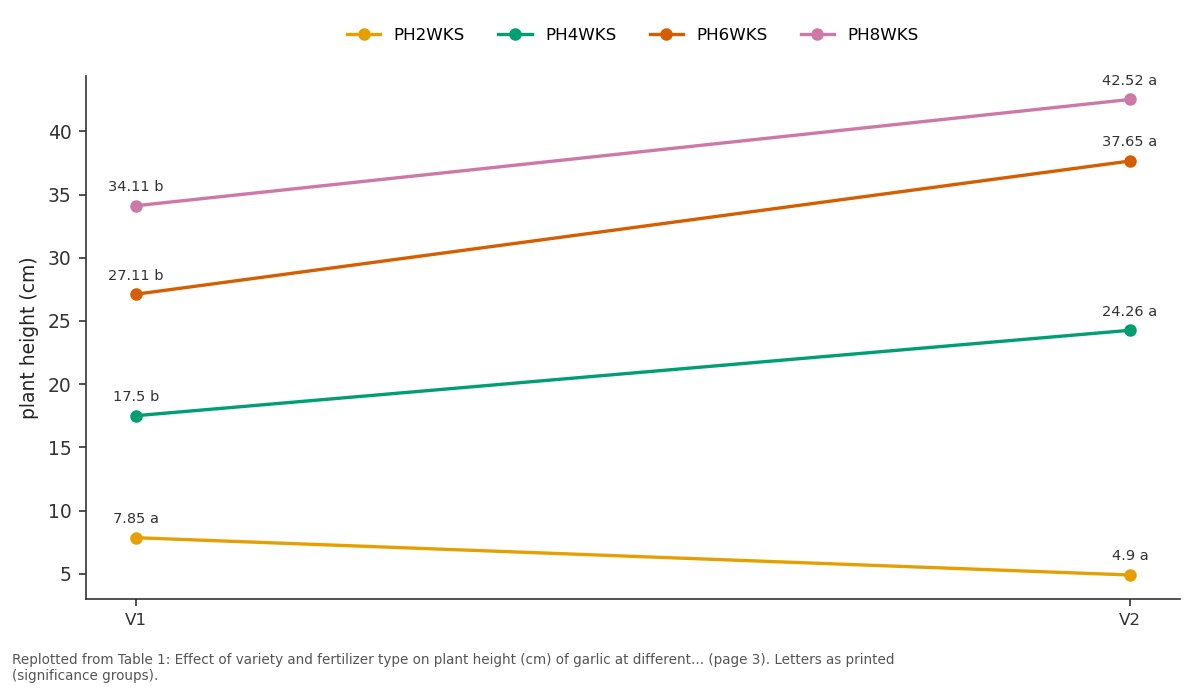
PH2WKS and PH4WKS and more: V1 vs V2
Replotted from Table 1 (page 3) of the original paper. Every bar is the paper's own table value.
View source evidence ↗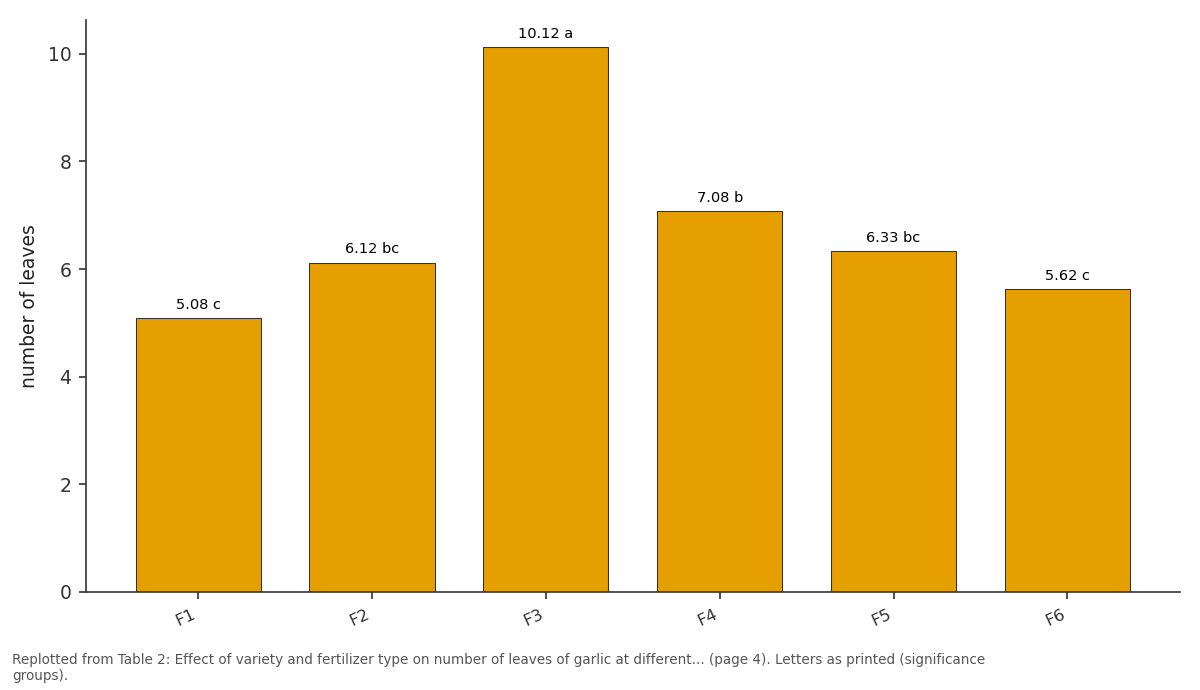
NL8WKS: F1 vs F2 vs F3 vs F4 vs F5
Replotted from Table 2 (page 4) of the original paper. Every bar is the paper's own table value.
View source evidence ↗Figures & tables
From the original paper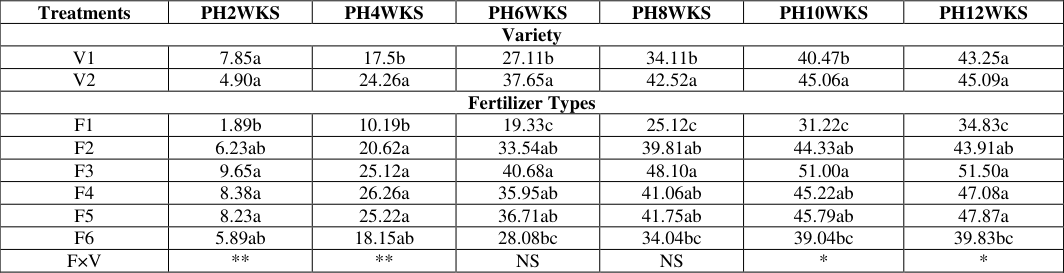 Table 1
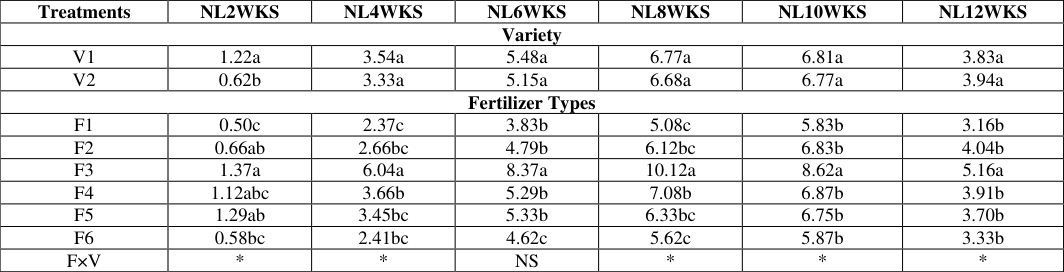 Table 2
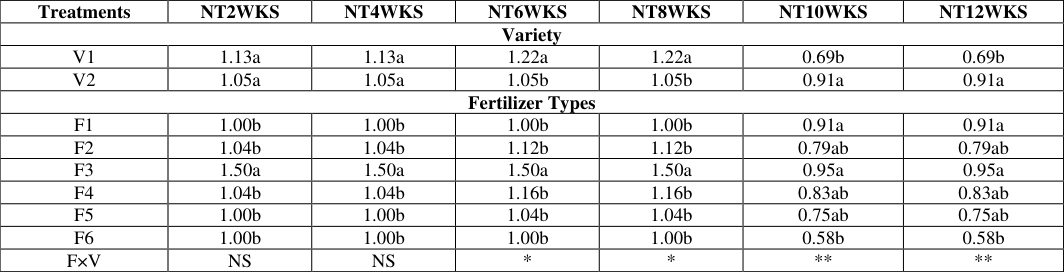 Table 3
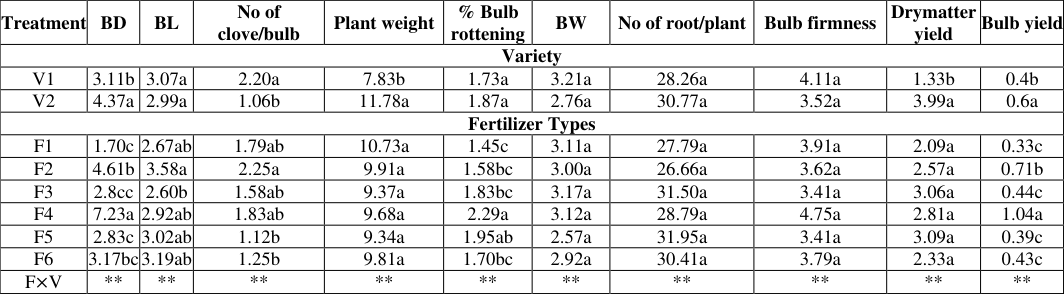 Table 4
Introduction
Garlic (Allium sativum L.), a member of alliaceae family and second most widely cultivated spice bulb crop after onion. It originated from central Asia. It is a high-value horticultural crop known for its culinary, medicinal, and nutritional benefits. It belongs to the family Amaryllidaceae and is widely grown for its bulbs, which contain bioactive compounds such as allicin, with antibacterial, antifungal, and antihypertensive properties (Ayoola et al., 2023) [2] . Garlic exhibits significant genetic variability in morphological and physiological traits, which directly influence its growth and yield potential. The selection of suitable varieties is critical, as garlic is a vegetative propagated crop with limited genetic recombination, making clonal selection the primary means of varietal improvement (Kumar et al., 2022) [3] . Differences among varieties can result in notable variations in plant height, leaf number, bulb size, clove number, and total yield, influenced by both genetic makeup and environmental interactions (Singh and Verma, 2023) [5] . Soil fertility management is one of the most crucial factors influencing crop growth and productivity. Fertilizer application plays a vital role in enhancing the growth attributes and bulb yield of garlic. However, the type of fertilizer used whether organic (e.g., poultry manure), inorganic (e.g., NPK formulations), or integrated can have varying impacts on plant performance and soil health (Yusuf et al., 2023) [6] . Inorganic fertilizers, while promoting rapid growth, may lead to soil degradation over time if used indiscriminately. In contrast, organic fertilizers improve soil structure and microbial activity but may release nutrients more slowly (Adebayo and Ojo, 2021) [1] . Despite its potential for garlic cultivation, there is a lack of empirical data on the optimal fertilizer strategies for different garlic varieties in this region. In Nigeria, garlic cultivation is still limited compared to other Allium crops like onion, partly due to low yield, poor soil fertility, and the absence of locationspecific fertilizer recommendations (Olatunji and Fasasi, 2022) [4] . Therefore, this study aims to evaluate the effects of different fertilizer types on the growth and bulb yield of garlic varieties in Ogbomoso.
Materials and Methods
Materials and Methods
Experimental site
The pot experiment was conducted to determine the effects of fertilizer types on growth and bulb yield of garlic (allium sativum l.) varieties in Ogbomoso, Nigeria at
Results and Discussion
Results and Discussion
Plant height
Plant height in garlic was significantly influenced by both variety and fertilizer type across most stages of growth, with notable varietal differences beginning at 2 weeks after planting (WAP) and persisting through 12 WAP. The interaction between variety and fertilizer (F × V) was also statistically significant at 2, 4, 10, and 12 WAP, indicating that the response to fertilizer varied between the garlic varieties at specific stages. Variety V2 consistently produced taller plants than V1, with a significant difference emerging from 4 WAP onward (V2: 24.26 cm, V1: 17.5 cm), and maintained this advantage through 12 WAP (V2: 45.09 cm, V1: 43.25 cm). This suggests that V2 has a more vigorous vertical growth habit, potentially due to greater genetic adaptability or nutrient use efficiency, as supported by similar findings from Kumar et al. (2022) [3] and Singh and Verma (2023) [5] . Fertilizer application had a pronounced impact on plant height, with F3 (100% Compost) consistently producing the tallest plants at all growth stages (51.50 cm at 12 WAP), followed closely by F4 and F5. These treatments likely provided a balanced and sustained nutrient supply, possibly combining organic and inorganic components. The control (F1) and F6 showed the poorest performance, especially from 6 WAP onward, suggesting limited or slow nutrient availability. The significant F × V interaction at both early and late stages implies that specific fertilizer-variety combinations (V2 with F3) enhanced growth more effectively. During mid-growth stages (6 and 8 WAP), the interaction was not significant, possibly due to uniform vegetative expansion. Generally, plant height increased from 2 to 10 WAP, with a slight plateau by 12 WAP, reflecting garlic's natural growth pattern as it transitions to the bulbing phase.
Number of leaves
The number of leaves in garlic was significantly affected by both variety and fertilizer type across the growing period. At 2 weeks after planting (WAP), variety V1 exhibited a significantly higher leaf count (1.22) than V2 (0.62), indicating superior early vegetative vigor. However, from 4WAP to 12WAP, varietal differences were no longer statistically significant, as both genotypes showed comparable leaf numbers. By 12WAP, V2 slightly surpassed V1 (3.94 vs. 3.83), though this difference remained non-significant. This pattern suggests that varietal influence on leaf proliferation is most prominent during early growth stages, consistent with Singh and Verma (2023) [5] , who noted that early seedling vigor plays a key role in early development and establishment.
Fertilizer application had a more consistent and pronounced effect on leaf number across all stages. F3 (100% Compost) recorded the highest leaf counts throughout, peaking at 10.12 leaves at 8WAP and gradually declining thereafter, indicative of its role in supporting vigorous vegetative growth. In contrast, F1 (no fertilizer) consistently produced the fewest leaves, while moderate responses were observed in F2, F4, and F5. F6 also underperformed, similar to F1. The interaction between variety and fertilizer (F × V) was significant at most growth stages ( [3,6] .
Number of tillers
The number of tillers (NT) in garlic was significantly affected by both variety and fertilizer type, particularly from 6 weeks after planting (WAP) onward. At early growth stages (2 and 4 WAP), both varieties showed similar tillering capacity (V1: 1.13; V2: 1.05), indicating no statistical difference. However, from 6 to 8 WAP, V1 produced significantly more tillers than V2, suggesting early vegetative vigor. By 10 and 12 WAP, the trend reversed, with V2 surpassing V1 in tiller number (V2: 0.91; V1: 0.69), indicating sustained tillering into the reproductive phase. These varietal differences align with the findings of Kumar et al. (2022) [3] , who attributed such variation to genotype-specific growth habits and hormonal regulation, where early-maturing genotypes exhibit early tillering and late-maturing types sustain vegetative activity longer. Fertilizer treatments also had a pronounced impact on tiller production. F3 consistently recorded the highest tiller numbers across all growth stages (1.50 (2023) [6] , highlight the importance of matching appropriate fertilizer types with garlic varieties to optimize vegetative growth and potential yield
Yield and yield components
The study revealed significant effects of garlic variety, fertilizer type, and their interaction (p<0.01) on key morphological, yield, and quality traits.
Recommendation
The findings from this study clearly demonstrate that both garlic variety and fertilizer type significantly influenced the growth, and yield of garlic under the agro-ecological conditions of Ogbomoso, Nigeria. Pretty garlic (V2) showed superior performance in plant height, biomass accumulation, dry matter yield, and final bulb yield, whereas Sokoto local (V1) had advantages in early-stage vegetative traits such as leaf number, tiller count, and clove number per bulb. Fertilizer application, particularly F4 (50% NPK + 50% Compost), produced the highest yield and bulb quality attributes, while F3 (100% Compost) consistently enhanced vegetative growth and root development. The significant interaction between variety and fertilizer type across all measured parameters emphasizes the importance of matching specific varieties with appropriate nutrient sources to optimize growth and productivity.
Based on these results, it is recommended that garlic farmers in Ogbomoso and similar agro-ecological zones adopt Pretty garlic variety in combination with F4 fertilizer treatment (50% NPK + 50% Compost) to maximize bulb yield and market quality. Where the focus is on early growth vigor or clove production, Sokoto local variety with 100% Compost (F3) may be more suitable. Extension services should promote integrated nutrient management strategies that combine organic and inorganic fertilizers tailored to specific garlic varieties to enhance sustainable production. Further research is encouraged to evaluate long-term soil health impacts and economic viability of these fertilizer combinations under field conditions.
Figures and tables from the paper
| Treatments | PH2WKS | PH4WKS | PH6WKS | PH8WKS | PH10WKS | PH12WKS |
|---|---|---|---|---|---|---|
| Variety | ||||||
| V1 | 7.85a | 17.5b | 27.11b | 34.11b | 40.47b | 43.25a |
| V2 | 4.90a | 24.26a | 37.65a | 42.52a | 45.06a | 45.09a |
| Fertilizer Types | ||||||
| F1 | 1.89b | 10.19b | 19.33c | 25.12c | 31.22c | 34.83c |
| F2 | 6.23ab | 20.62a | 33.54ab | 39.81ab | 44.33ab | 43.91ab |
| F3 | 9.65a | 25.12a | 40.68a | 48.10a | 51.00a | 51.50a |
| F4 | 8.38a | 26.26a | 35.95ab | 41.06ab | 45.22ab | 47.08a |
| F5 | 8.23a | 25.22a | 36.71ab | 41.75ab | 45.79ab | 47.87a |
| F6 | 5.89ab | 18.15ab | 28.08bc | 34.04bc | 39.04bc | 39.83bc |
| F×V | ** | ** | NS | NS | * | * |
Table text extracted from the original PDF; superscript letters are shown inline. The original table image is below.
View original table image
| Treatments | NL2WKS | NL4WKS | NL6WKS | NL8WKS | NL10WKS | NL12WKS |
|---|---|---|---|---|---|---|
| Variety | ||||||
| V1 | 1.22a | 3.54a | 5.48a | 6.77a | 6.81a | 3.83a |
| V2 | 0.62b | 3.33a | 5.15a | 6.68a | 6.77a | 3.94a |
| Fertilizer Types | ||||||
| F1 | 0.50c | 2.37c | 3.83b | 5.08c | 5.83b | 3.16b |
| F2 | 0.66ab | 2.66bc | 4.79b | 6.12bc | 6.83b | 4.04b |
| F3 | 1.37a | 6.04a | 8.37a | 10.12a | 8.62a | 5.16a |
| F4 | 1.12abc | 3.66b | 5.29b | 7.08b | 6.87b | 3.91b |
| F5 | 1.29ab | 3.45bc | 5.33b | 6.33bc | 6.75b | 3.70b |
| F6 | 0.58bc | 2.41bc | 4.62c | 5.62c | 5.87b | 3.33b |
| F×V | * | * | NS | * | * | * |
Table text extracted from the original PDF; superscript letters are shown inline. The original table image is below.
View original table image
| Treatments | NT2WKS | NT4WKS | NT6WKS | NT8WKS | NT10WKS | NT12WKS |
|---|---|---|---|---|---|---|
| Variety | ||||||
| V1 | 1.13a | 1.13a | 1.22a | 1.22a | 0.69b | 0.69b |
| V2 | 1.05a | 1.05a | 1.05b | 1.05b | 0.91a | 0.91a |
| Fertilizer Types | ||||||
| F1 | 1.00b | 1.00b | 1.00b | 1.00b | 0.91a | 0.91a |
| F2 | 1.04b | 1.04b | 1.12b | 1.12b | 0.79ab | 0.79ab |
| F3 | 1.50a | 1.50a | 1.50a | 1.50a | 0.95a | 0.95a |
| F4 | 1.04b | 1.04b | 1.16b | 1.16b | 0.83ab | 0.83ab |
| F5 | 1.00b | 1.00b | 1.04b | 1.04b | 0.75ab | 0.75ab |
| F6 | 1.00b | 1.00b | 1.00b | 1.00b | 0.58b | 0.58b |
| F×V | NS | NS | * | * | ** | ** |
Table text extracted from the original PDF; superscript letters are shown inline. The original table image is below.
View original table image
| Treatment | BD | BL | No of clove/bulb | Plant weight | % Bulb rottening | BW | No of root/plant | Bulb firmness | Drymatter yield | Bulb yield |
|---|---|---|---|---|---|---|---|---|---|---|
| Variety | ||||||||||
| V1 | 3.11b | 3.07a | 2.20a | 7.83b | 1.73a | 3.21a | 28.26a | 4.11a | 1.33b | 0.4b |
| V2 | 4.37a | 2.99a | 1.06b | 11.78a | 1.87a | 2.76a | 30.77a | 3.52a | 3.99a | 0.6a |
| Fertilizer Types | ||||||||||
| F1 | 1.70c | 2.67ab | 1.79ab | 10.73a | 1.45c | 3.11a | 27.79a | 3.91a | 2.09a | 0.33c |
| F2 | 4.61b | 3.58a | 2.25a | 9.91a | 1.58bc | 3.00a | 26.66a | 3.62a | 2.57a | 0.71b |
| F3 | 2.8cc | 2.60b | 1.58ab | 9.37a | 1.83bc | 3.17a | 31.50a | 3.41a | 3.06a | 0.44c |
| F4 | 7.23a | 2.92ab | 1.83ab | 9.68a | 2.29a | 3.12a | 28.79a | 4.75a | 2.81a | 1.04a |
| F5 | 2.83c | 3.02ab | 1.12b | 9.34a | 1.95ab | 2.57a | 31.95a | 3.41a | 3.09a | 0.39c |
| F6 | 3.17bc | 3.19ab | 1.25b | 9.81a | 1.70bc | 2.92a | 30.41a | 3.79a | 2.33a | 0.43c |
| F×V | ** | ** | ** | ** | ** | ** | ** | ** | ** | ** |
Table text extracted from the original PDF; superscript letters are shown inline. The original table image is below.
View original table image
References
6 in the original paper- Adebayo LO, Ojo AO. Comparative effects of organic and inorganic fertilizers on soil fertility and crop performance in Nigeria: A review. J Agron Soil Sci. 2021;14(2):112-119.
- Ayoola RT, Adeyemo SO, Bakare OA. Nutritional and phytochemical properties of garlic (Allium sativum): a review. Niger J Hortic Sci. 2023;28(1):45-52.
- Kumar A, Singh R, Sharma P. Growth and yield response of garlic (Allium sativum L.) to different nutrient regimes and varieties. J Hortic Sci. 2022;17(3):145-152.
- Olatunji OO, Fasasi RA. Constraints and prospects of garlic cultivation in Nigeria. Afr J Agric Res. 2022;17(9):120-128.
- Singh B, Sharma HR, Impa HR. Effect of integrated nutrient management on growth, yield and quality in garlic (Allium sativum L.). 2023.
- Yusuf AM, Ibrahim H, Lawal RA. Growth and yield response of garlic (Allium sativum L.) to different organic and inorganic fertilizer regimes in Northern Nigeria. Niger J Soil Environ Res. 2023;21(1):85-92.