
Research article · 2025 · Full text
International Journal of Biology SciencesComparative analysis of chlorophyll content in polluted and non-polluted grape (Vitis vinifera) and guava (Psidium guajava) plants
Volume 7(6) · Pages 246–249 · DOI: 10.33545/26649926.2025.v7.i6d.384 ↗
Research areasHorticultural and Viticultural ResearchPsidium guajava Extracts and Applications
Abstract
Author-writtenChlorophyll, the green pigment responsible for photosynthesis, is a vital indicator of plant health. Environmental pollution can significantly impact chlorophyll content, affecting plant growth and productivity. This study aimed to estimate and compare the chlorophyll content in grape (Vitis vinifera) and guava (Psidium guajava) plants grown in polluted and non-polluted areas. Leaf samples from both plant species were collected from polluted (industrial and urban) and non-polluted (rural and forest) sites. Chlorophyll content was estimated using spectrophotometry and expressed as mg/g fresh weight. The results revealed significant differences in chlorophyll content between polluted and non-polluted plants of both species. Grape plants from polluted areas showed a decrease in chlorophyll content compared to those from non-polluted areas. Similarly, guava plants from polluted areas exhibited a reduction in chlorophyll content. These findings suggest that environmental pollution can adversely affect chlorophyll content, potentially impacting plant growth and productivity. This study contributes to our understanding of the effects of pollution on plant health and highlights the need for sustainable environmental practices.
Summary
Source-checkedPlain-language reading of the full paper, prepared with AI and checked against the text. Each point links to the authors' own words.
Why it matters
- Chlorophyll is the green pigment that enables photosynthesis and serves as a critical indicator of a plant's overall health. View evidence ↗
- Pollution in the environment can reduce chlorophyll levels, which in turn may negatively affect how plants grow and their productivity. View evidence ↗
- Measuring changes in leaf chlorophyll content allows researchers to gain information about the physiological state of the plant. View evidence ↗
The question
- The study aimed to measure and compare the chlorophyll levels of grape and guava plants grown in polluted versus non-polluted environments. View evidence ↗
What they did
- Leaf samples were gathered from industrial and urban areas (polluted) as well as rural and forest sites (non-polluted). View evidence ↗
- The extraction process involved homogenizing three grams of fresh leaves in 100% acetone (50 ml per gram) at 1000 rpm for one minute. View evidence ↗
- A UV-visible spectrophotometer was used to take absorbance readings at 663, 640, 510, and 480 nm to determine the concentrations of chlorophyll a, chlorophyll b, and total chlorophyll. View evidence ↗
- The concentrations of chlorophyll a, chlorophyll b, and carotenoids were calculated as milligrams of pigment per gram of fresh leaf weight. View evidence ↗
What they found
- In grape plants (Vitis vinifera), chlorophyll a decreased from 0.270 mg/fresh wt. in non-polluted areas to 0.052 mg/fresh wt. in polluted areas. View evidence ↗
- Grape plants showed a reduction in chlorophyll b (0.163 to 0.034 mg/fresh wt.) and carotenoids (0.051 to 0.003 mg/fresh wt.) when grown in polluted areas. View evidence ↗
- In guava plants (Psidium guajava), chlorophyll a remained the same at 0.049 mg/fresh wt. in both polluted and non-polluted areas. View evidence ↗
- Guava plants exhibited a decrease in chlorophyll b (0.045 to 0.015 mg/fresh wt.) and carotenoids (0.024 to 0.01 mg/fresh wt.) in polluted areas. View evidence ↗
- Roadside dust caused a significant decrease in chlorophyll content for both species, and this decrease was negatively correlated with the plants' growth rate. View evidence ↗
- Plants in polluted areas showed a reduction in total chlorophyll content, as well as a decrease in the number of leaves and overall plant length. View evidence ↗
What it means
- The authors conclude that roadside dust pollution is a key ecological factor that degrades the environment and harms economically important crop plants. View evidence ↗
- The authors suggest that analyzing how dust affects vegetation can help identify plants suitable for use as screens to reduce dust and improve air quality. View evidence ↗
Visual summary
2 visualsIllustrations explain the paper; charts are replotted from the paper's own table values.
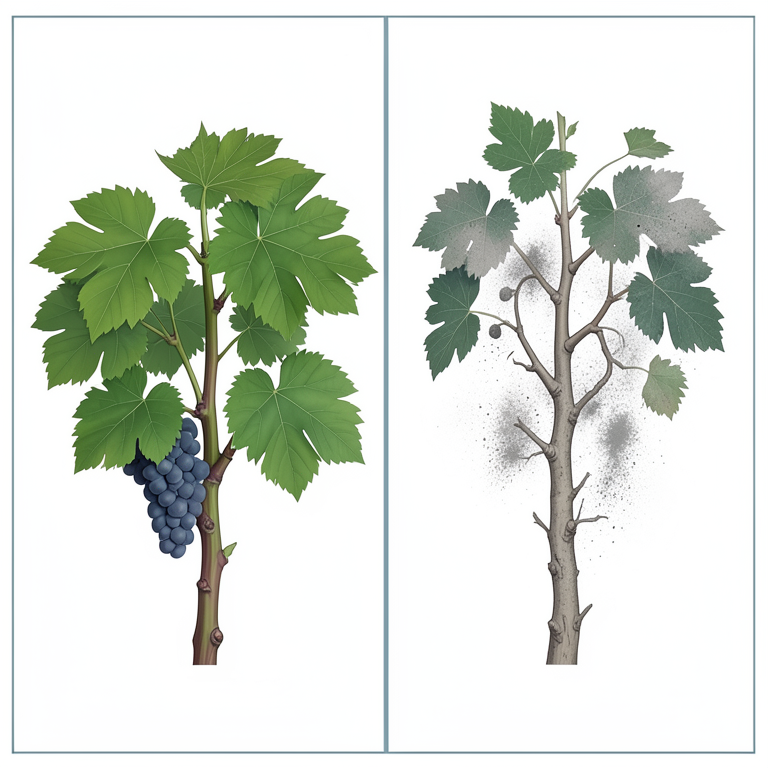
Effect of Roadside Dust on Plant Health
AI-generated conceptual illustration (Grape (Vitis vinifera) and guava (Psidium guajava) plants). It explains the idea and does not show study data.
View source evidence ↗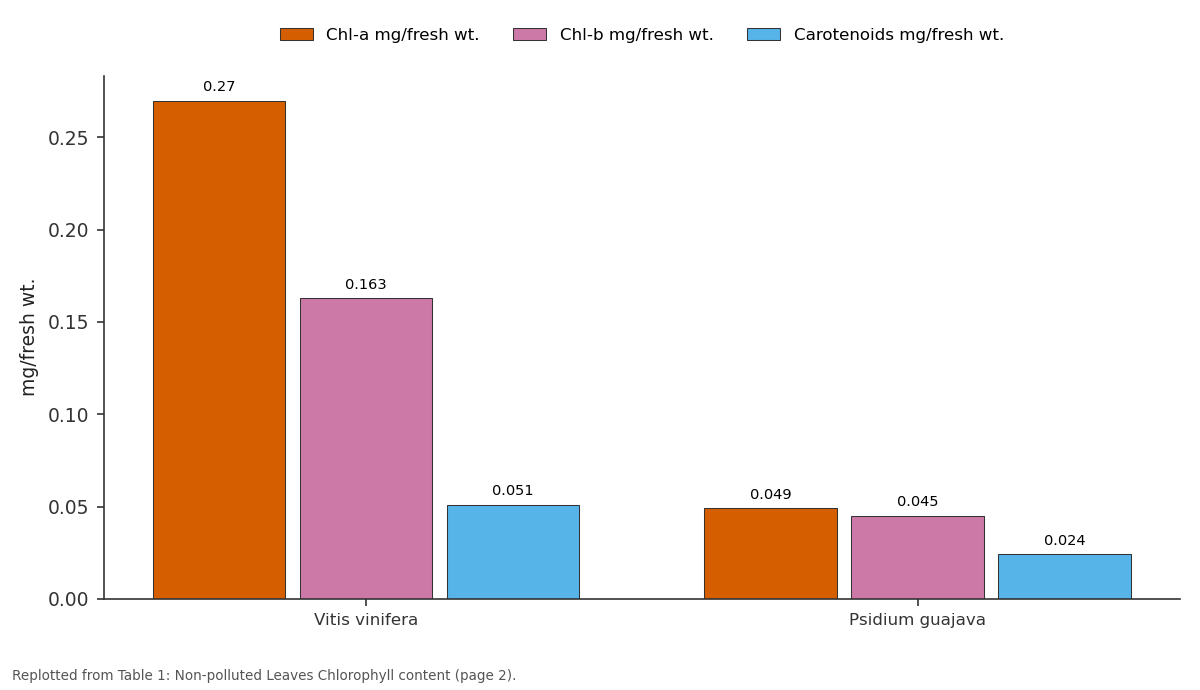
Chl-a mg/fresh wt. and Chl-b mg/fresh wt. and more: Vitis vinifera vs Psidium guajava
Replotted from Table 1 (page 2) of the original paper. Every bar is the paper's own table value.
View source evidence ↗Figures & tables
From the original paper Table 1
 Table 2
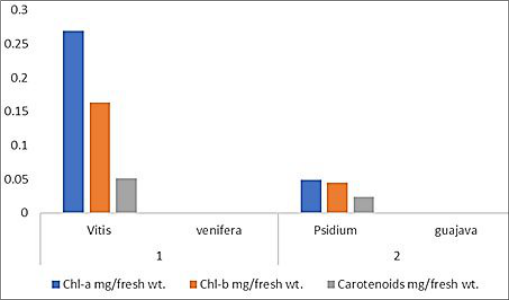 Figure 1
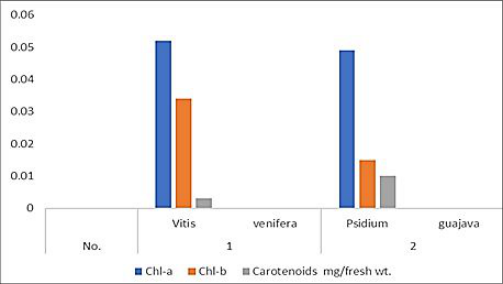 Figure 2
Introduction
Leaf chlorophyll concentration is an important parameter that is regularly measured as an indicator of chloroplast content, photosynthetic mechanism and of plant metabolism. Chlorophyll is an antioxidant compounds which are present and stored in the chloroplast of green leaf plants and Mainly it is present in the green area of leaves, stems, flowers and roots (Srichaikul et al., 2011) [6] . However, the chlorophyll production is mainly depended on penetration of Sun light and it is the main source of energy for plant (Srichaikul et al., 2011) [6] . In the laboratory it is Commonly determined by using mortar and pestle to Extract the pigments using an organic solvent such as acetone or dimethyl formamide (Arnon 1949) [3] . Chlorophyll a and Chlorophyll b are essential pigments of the plant photosystems (Richardson et al., 2002) [4] . Moreover the chlorophyll a is the primary photosynthetic pigment play important role in plant physiology and it can be act as nutrition in decline blood sugar conditions, detoxification, digestion, excretion and decreasing allergens (Srichaikul et al., 2011) [6] . Pigment in plants which helps to produce energy in plant (Srichaikul et al., 2011) [6] . However the chlorophyll a concentration is 2-3 times higher than that of secondary chlorophyll b in plants (Srichaikul et al., 2011) [6] . To obtain ratio of chlorophyll a and b the readings should be takenthe wavelength of 650nm, which was in between the absorption maxima of both (Arnon 1949) [3] . Green plants have different characters because of the presence of various pigments like chlorophyll, carotenoid, other pigments and water content which together constitute the spectral characters of a plant body. However the chlorophyll content has medicinal qualities. The chlorophyll is also plays important role in plant physiology and it can be act as nutrition in decline blood sugar conditions, detoxification, digestion, excretion and decreasing allergens (Srichaikul et al., 2011) [6] . However, in using modern technique like satellite remote sensing technology being used for analysis of leaf chlorophyll concentration can also be measured. Variation in leaf chlorophyll content can provide information about the physiological condition of a leaf or plant. Grapes are is basically a subtropical crop. However, in India, grapes are cultivated for their excellence also under tropical conditions. In India, Grapes are cultivated in an area of 111.4thousand ha with a total production 1234.9 thousand tons and productivity of 11. in grape leaves when the pigment content is less than 300 mg m-2. Above that level, however, the accuracy of the instrument diminished considerably. Psidium guajava L is a fruit-bearing tree commonly known as guava, which belongs to the family Myrtaceae. The French call it goyave or goyavier; the Dutch, guyaba, goeajaaba; the Surinamese, guaveor goejaba; and the Portuguese, goiaba or goaibeira. Hawaiians call it guava or kuawa. In Guam, it is a base. In Malaya, it is generally known either as guava or jambu batu. Guava grows nearly throughout India up to 1500 m in height and is cultivated commercially in almost all states, the total estimated area being 50,000 hectares. Stone studied in pre-columbium times Psidium guajava grow in all tropical and subtropical areas would, adapts to different climatic conditions but prefers dry climates. Wealth of India (2003) [7] research on leaves and bark of guava tree have a long history of medicinal uses in decreases dysentery, vomiting and sore throats and to regulate menstrual cycles. Manosroi et al., (2006) [5] study on leaves of guava showed anti-proliferative activity, which was 4.37 times more than vincristine. Tea made from the guava leaves or its extract in a cup of warm water can help to empty the bowel easily. Journal of smooth Muscle research in 2008 published an article in which some researcher tested the effect of guava leaves on the peristalsis castor oil-induced diarrhoea.
Materials and Methods
Material: Fresh leaf of plant, Mortar and pestle, Muslin cloth, Whatman filter paper No.1, Standard instrument like spectrophotometer.
Photosynthetic Pigment Analysis: Three grams of fresh leaves were put in 100% acetone (50 ml for each gram), homogenized at 1000 rpm for 1 min. The homogenate was then filtered through double layered muslin cloth and again centrifuged at 2500 rpm for 10 min. The extract was removed in a 10 ml graduated cylinder. Clear leaf extract (supernatant) was transferred with a pipette to a 1 cm path length cuvette and absorbance readings taken against a solvent blank in UV-visible spectrophotometer at 663, 640, 510, 480 nm wavelength to determine the concentrations of photosynthetic pigments like chlorophyll 'a', chlorophyll 'b' and total chlorophyll content. The amount of Chl-a, Chl-b, and Carotenoid were calculated in the term of Magnesium pigment/gm of fresh leaves by using the following formula (Duxbury and Yentsch, 1956 and Maclachlam and Zalik 1963) [1,2] .
Formula for calculation
Chl. a (mg/ fresh weight) = 12.3 D663-0. 86 D645 d×1000×W
Chl. b (mg/ fresh weight) = 19.3D645-3. 6 D66 d×1000×W
Carotenoids (mg/ fresh weight) = 7.6 D480-1. 49D510 d×1000×W External morphology: Grapes are is basically a subtropical crop. However, in India, grapes are cultivated for their excellence also under tropical conditions. In India, Grapes are cultivated in an area of 111.4thousand ha with a total production 1234.9 thousand tons and productivity of 11.1 tons/ha. In India top Grapes producing states including states include Maharashtra, Karnataka, Tamil Nadu, Andhra Pradesh and Mizoram. The most grown variety of grapes is Thompson Seedless and clones. The grapes plant shoot carries the nodes from which the leaves and clusters of grapes will grow. Leaf is breathing organs of the grapevine which also serves to nourish it. Bud or node is either leaf or fruit. Bearing shoot will develop. Tendrils are the climbing organs of the grapevine.
Uses
• Fresh fruit eaten or into wine raisins juice, with some cultivars adapted for the canning industry. Guava is a fast-growing evergreen shrub or small tree that can grow to a height of 3-10m.Guava produces low drooping branched from the roots. The trunk is slender, 20cm in diameter, convert with a smooth green to red brown bark that peels of in thin flakes.
Uses
• Guava is an edible fruit and can be eaten raw or cooked.
• The processing of the fruits yield by-product that can be fed to livestock. • The leaves can also be used as fodder.
• The entire fruit is a key ingredient in punch and the juice is often used in culinary source (hot or cold), candies, dried Snacks, fruit bars and desserts or dipped in chamoy. • Red guava can be used as the base of salted products such, substitution for tomatoes, especially to minimize activity. • A drink may be made from an infusion of guava fruits and leaves. • Tea of guava tree leaves is considered medicinal.
Results
chlorophyll a content of non-polluted leaves of Vitis vinifera (0.270mg/ fresh wt.) and chlorophyll b content the non-polluted leaves (0.163mg/ fresh wt.) and the Carotenoids that content of non-polluted leaves were (0.051mg/fresh et. wt.). Chlorophyll content of Polluted Leaves of Vitis vinifera (0.052mg/ fresh wt.) and chlorophyll b content the polluted leaves (0.034mg/ fresh et wt.) and the Carotenoids that content of polluted leaves were (0.003mg/ fresh et wt.). The chlorophyll a content of non-polluted leaves of Psidium guajava (0.049mg/ fresh et wt.) and chlorophyll b content the non-polluted leaves (0.045mg/ fresh et wt.) and the Carotenoids that content of non-polluted leaves were (0.024mg/ fresh et wt.). The chlorophyll a content of polluted leaves of Psidium guajava (0.049mg/ fresh et wt.) and chlorophyll b content the polluted leaves (0.015mg/ fresh et wt.) and the Carotenoids that content of polluted leaves were a (0.01mg/ fresh et wt.). Vitis vinifera and Guava guajava showed a significant decrease in its chlorophyll content due to road side dust and result also indicate that there was negative correlation between the chlorophyll content and growth rate during investigation. The study also reveals that reduction in plant length, number of leaves and total chlorophyll content in polluted areas. Dust accumulation altered the chlorophyll content in Vitis vinifera and Guava guajava. Greater decrease in chl-a, chl-b and carotenoid content observed at Vitis vinifera shows that value is (0.052, 0.034, 0.003) and Psidium guajava shows the value is (0.049, 0.015, 0.01) respectively. While the plant growth also gradually decreased with increased dust concentration.
Discussion
Road side pollutant had a significant effect on chlorophyll content of Vitis vinifera and Guava guajava compared with plant from non polluted area. Total chlorophyll content of Vitis vinifera and Guava guajava showed that the losses are generally attributed to the road side dust which contained mixture of toxic metals. This dust is falling on the soil caused a shift in pH to the alkaline side, but favourable to pasture grasses. Reduction of plant length might be due to the decreases in phytomass, net primary production and chlorophyll content in response to the road side dusts. Darley demonstrated that dust deposited on bean leaves in the presence of free moisture interfered with rate of carbon dioxide exchange, but no measurement of starch was made. The decreased in chlorophyll contents in the leaves of Vitis vinifera and Guava guajava might be due to long time accumulation of dust on plant leaves that interrupt the sunlight to reach the leaf. observed reduction of pigment content in plant species due to dust accumulation.
Conclusion
On the basis of this study, it could be concluded that the phonological behaviour of Vitis vinifera and Guava guajava was found to be highly affected. It is clear tat road side dust pollution is an operative ecological factor causing deterioration in the quality of our environment and economically important crop plants. The experimental analysis of the effect of dust on vegetation help to recommended plant for use as screens in order to mitigate dust and improve air quality.
Figures and tables from the paper
| Sr. No. | Name of plants | Chl-a mg/fresh wt. | Chl-b mg/fresh wt. | Carotenoids mg/fresh wt. |
|---|---|---|---|---|
| 1. | Vitis vinifera | 0.270 | 0.163 | 0.051 |
| 2. | Psidium guajava | 0.049 | 0.045 | 0.024 |
Table text extracted from the original PDF; superscript letters are shown inline. The original table image is below.
View original table image
| Sr. No. | Name of plants | Chl-a mg/fresh wt. | Chl-b mg/fresh wt. | Carotenoids mg/fresh wt. |
|---|---|---|---|---|
| 1. | Vitis vinifera | 0.052 | 0.034 | 0.003 |
| 2. | Psidium guajava | 0.049 | 0.015 | 0.01 |
Table text extracted from the original PDF; superscript letters are shown inline. The original table image is below.
View original table image
References
17 in the original paper- Duxbury HJ, Yentsch CS. 1956.
- Maclachlan GH, Zalik S. 1963.
- Arnon DI. Copper enzymes in isolated chloroplasts. Chlorophyll a. Plant Physiol. 1949;24(1):1-15.
- Richardson A, et al. Chlorophyll b are essential pigments of the plant photosystem. 2002.
- Monagas M, Hernandez-Ledesma B, Gomez-Cordoves C, et al. Commercial dietary ingredients from Vitis vinifera L. leaves and grape skins: antioxidant and chemical characterization. J Agric Food Chem. 2006;54(2):319-27.
- Srichaikul K, et al. Pigment in plants which helps to produce energy in plants. 2011.
- Wealth of India. Research in the leaves and bark of guava tree: medicinal uses to decrease dysentery, vomiting, sore throats, and regulate menstrual cycles. 2003.
- Athavale M. Fruit myths: Basket of wrong beliefs. 2011.
- Ha KS, Jo SH, Mannam V, Kwon YI, Apostolidis E. Stimulation of phenolics, antioxidant and α-glucosidase inhibitory activities during barley (Hordeum vulgare L.) seed germination. Plant Foods Hum Nutr. 2016;71(3):211-7.
- Hitayezu R, Baakdah MM, Kinnin J, Henderson K, Tsopmo A. Antioxidant activity, avenanthramide and phenolic acid contents of oat milling fractions. J Cereal Sci. 2015;63:35-40.
- Ashraf A, Sarfraz RA, Rashid MA, Shahid M. Antioxidant, antimicrobial, antitumor, and cytotoxic activities of an important medicinal plant (Euphorbia royleana) from Pakistan. J Food Drug Anal. 2015;23(1):109-15.
- Yadav SA, Ramalingam S, Jebamalairaj A, Subban R, Sundaram KM. Biochemical fingerprint and pharmacological applications of Barleria noctiflora Lf leaves. J Complement Integr Med. 2016;13(4):365-76.
- Zhang Z, Kong F, Ni H, Mo Z, Wan JB, Hua D, et al. Structural characterization, α-glucosidase inhibitory and DPPH scavenging activities of polysaccharides from guava. Carbohydr Polym. 2016;144:106-14.
- Widyawati PS, Budianta TD, Gunawan DI, Wongso RS. Evaluation of antidiabetic activity of various leaf extracts of Pluchea indica Less. Int J Pharm Pharm Res. 2015;7(1):597-603.
- Muredzi ED. Food is Medicine-An Introduction to Nutraceuticals. London: Academic Press; 2013.
- Mishra A, Mishra AK, Jain SK. Anticonvulsant activity of Cleome viscosa seed extracts in Swiss albino mice. Int J Pharm Pharm Res. 2010;2(1):177-81.
- Trease GE, Evans WC. Textbook of Pharmacognosy. London: Academic Press; 1989.