
Research article · 2025 · Full text
International Journal of Agriculture and Food ScienceFormulation and physicochemical analysis of newly developed omega-3 enriched biscuit by using pearl millet whole (Pennisetum glaucum)
Volume 7(6) · Pages 249–252 · DOI: 10.33545/2664844x.2025.v7.i6d.461 ↗
Research areasPlant-Derived Bioactive CompoundsMeat and Animal Product Quality
Abstract
Author-writtenThe study focuses on the formulation and physiochemical analysis of an innovative biscuit enriched with omega-3 fatty acids using pearl millet whole (Pennisetum glaucum) as a primary ingredient. The objective is to develop a nutritionally enhanced bakery product that caters to the increasing demand for functional foods. The biscuits were formulated using a blend of whole pearl millet flour, flaxseed powder, and chia seeds as natural omega-3 sources. Various formulations were developed and analyzed for proximate composition, physical properties, sensory evaluation. Results indicate that the incorporation of omega-3 sources improved the nutritional quality without compromising sensory attributes.
Summary
Source-checkedPlain-language reading of the full paper, prepared with AI and checked against the text. Each point links to the authors' own words.
Why it matters
- Pearl millet is a nutritionally superior, gluten-free alternative to refined wheat flour due to its high levels of antioxidants, minerals, and fiber. View evidence ↗
- Adding omega-3 fatty acids from sources like chia seeds or flaxseed powder can improve the lipid profile of snacks to meet the demand for heart-healthy options. View evidence ↗
- There is an increasing consumer demand for functional foods, driving the need for nutritionally enhanced bakery products. View evidence ↗
The question
- The study aims to develop a healthy biscuit using whole pearl millet flour enriched with plant-based omega-3 fatty acids. View evidence ↗
What they did
- Gas Chromatography-Mass Spectrometry (GC-MS) was used to accurately measure the concentration of omega-3 fatty acids in the biscuits. View evidence ↗
- Sensory evaluation was conducted by 20 semi-trained panel members using a 9-point Hedonic scale to rate color, taste, texture, aroma, and overall acceptability. View evidence ↗
What they found
- Moisture content decreased significantly from 7.20% in the control (T0) to 6.10% in the T3 formulation (p < 0.01). View evidence ↗
- Fat content increased significantly from 12.50% in the control to 15.40% in T3 (p < 0.001) due to the addition of omega-3 rich ingredients. View evidence ↗
- Protein levels rose significantly from 8.10% in the control to 9.50% in T3 (p < 0.001). View evidence ↗
- Omega-3 content increased drastically from 32.00 mg/100g in the control to 225.00 mg/100g in T3 (p < 0.001). View evidence ↗
What it means
- The authors conclude that formulation T3 is the most nutritionally superior option, providing the highest omega-3 (225 mg/100g) and protein (9.5%) levels while remaining sensorially acceptable. View evidence ↗
- The study suggests that pearl millet-based omega-3 enriched biscuits are viable functional foods for addressing dietary deficiencies and meeting the demand for healthy snacks. View evidence ↗
Visual summary
2 visualsIllustrations explain the paper; charts are replotted from the paper's own table values.
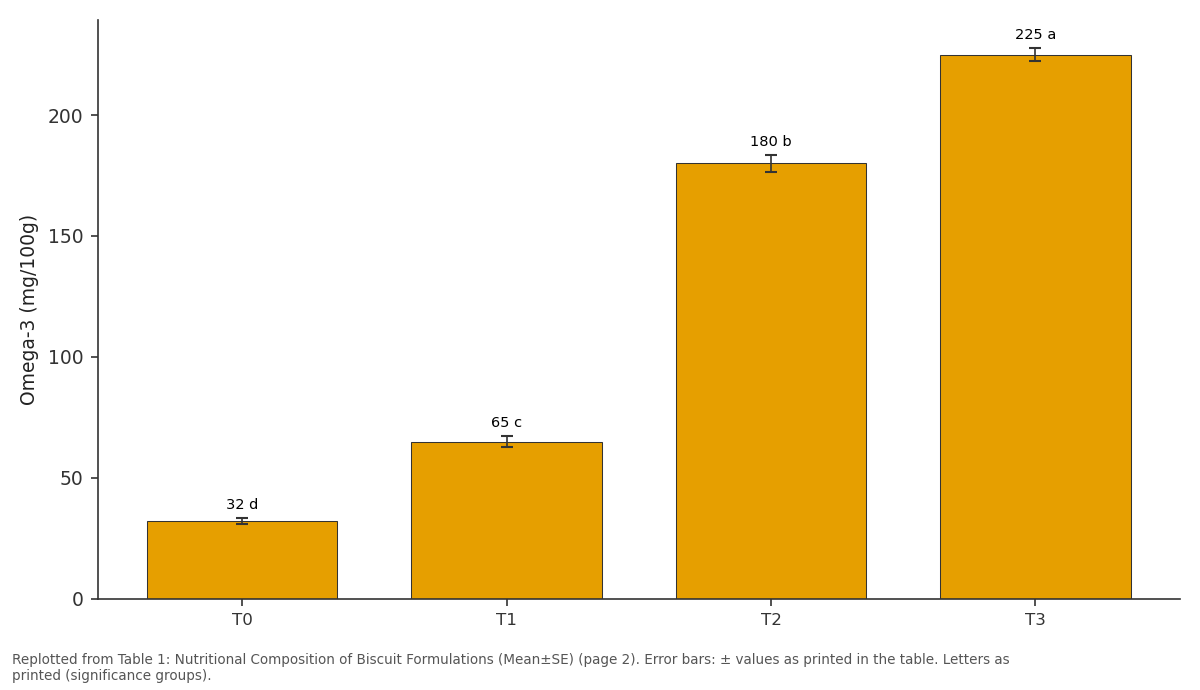
Omega-3 (mg/100g): T0 vs T1 vs T2 vs T3
Replotted from Table 1 (page 2) of the original paper. Every bar is the paper's own table value.
View source evidence ↗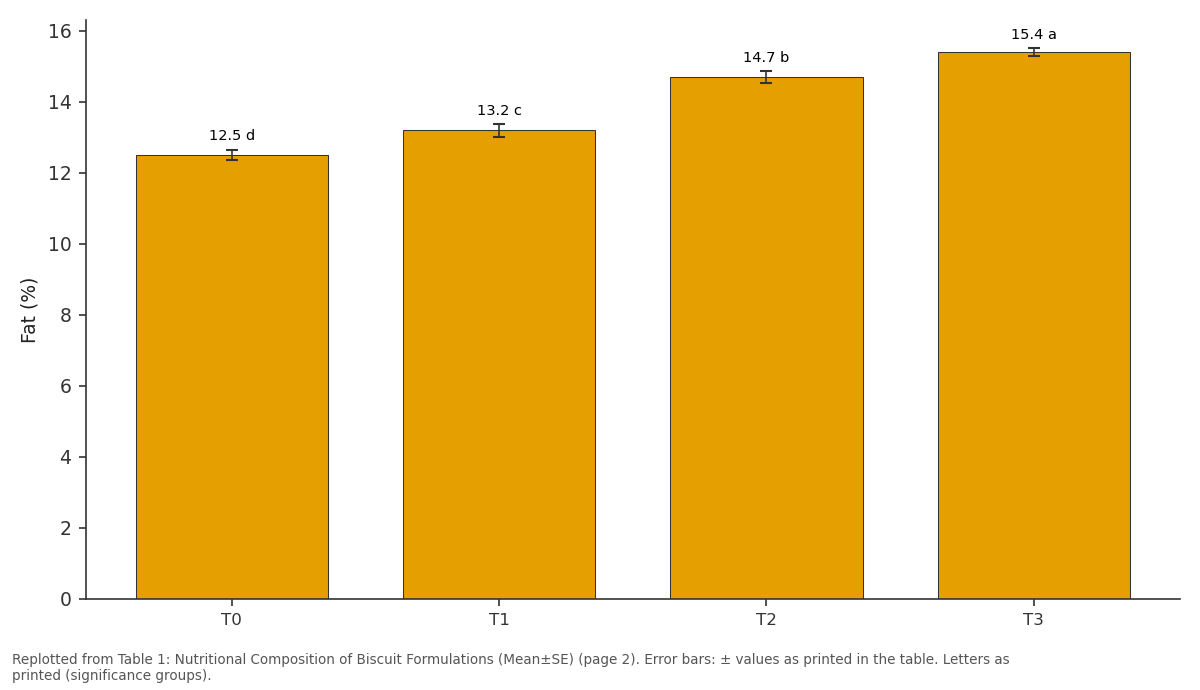
Fat (%): T0 vs T1 vs T2 vs T3
Replotted from Table 1 (page 2) of the original paper. Every bar is the paper's own table value.
View source evidence ↗Figures & tables
From the original paper Table 1
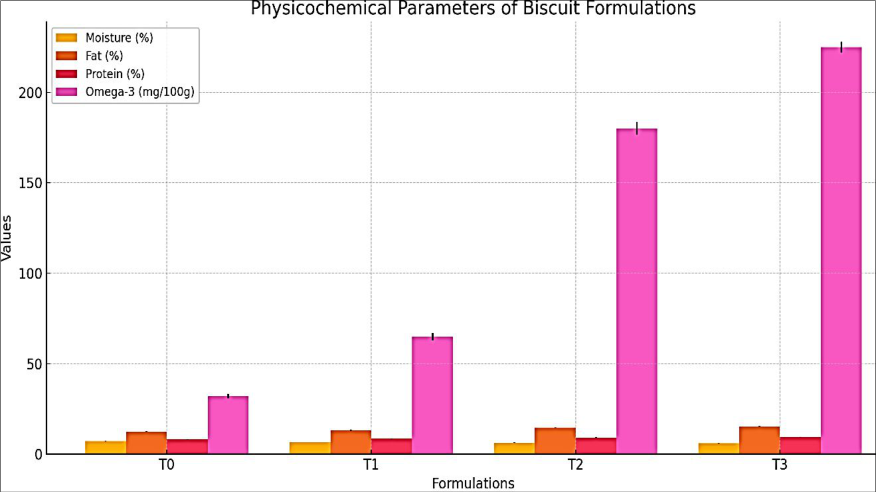 Figure 1
 Table 2
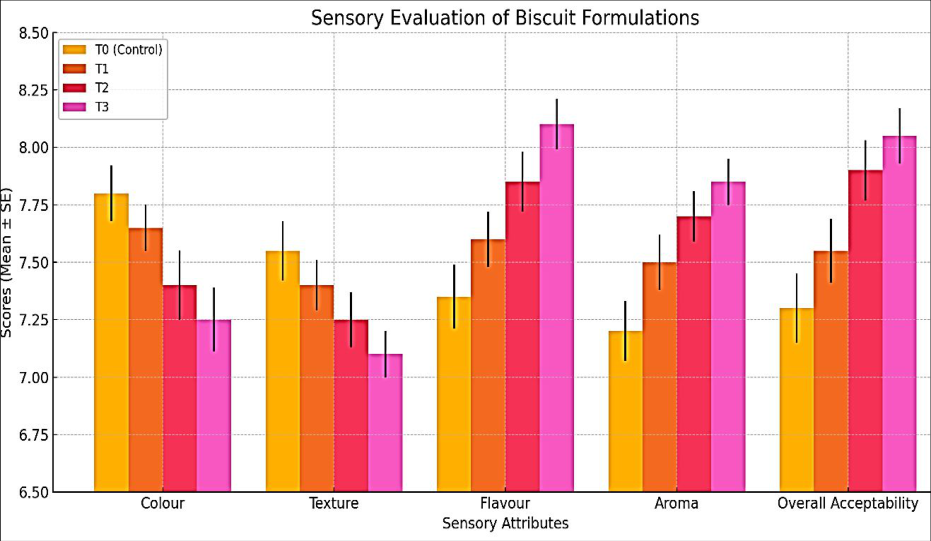 Figure 2
Introduction
The formulation and physicochemical analysis of a newly developed omega-3 enriched biscuit using whole pearl millet involves a comprehensive approach to functional food innovation, aiming to combine nutritional enhancement with consumer acceptability (Kouamé et al., 2023) [5] . Pearl millet (Pennisetum glaucum), known for its rich content of fibre, minerals, and antioxidants, serves as the primary flour base, replacing refined wheat flour to offer a gluten-free and nutritionally superior alternative (Asrani et al., 2023; Tewari et al., 2023) [1,17] . The incorporation of omega-3 fatty acids-sourced from ingredients like flaxseed powder, chia seeds, or fish oil microcapsules-enhances the lipid profile of the biscuits, targeting the growing demand for heart-healthy snacks (Vijaykrishnaraj et al., 2024) [15] . The formulation process includes optimizing the proportion of pearl millet flour with binding agents such as eggs or plant-based gums, natural sweeteners, and leavening agents to achieve the desired texture and palatability (Rajagopal et al., 2024) [11] . Physicochemical analysis plays a critical role in evaluating the quality and stability of the developed product (Zhou, 2009) [16] . Parameters such as moisture content, water activity, ash value, fat content, protein levels are measured to ensure nutritional adequacy (Pojić et al., 2015) [9] . Texture profile analysis (TPA) is used to assess hardness, cohesiveness, and crunchiness, which are crucial for consumer satisfaction (Rahman et al, 2021) [10] . Colour analysis and sensory evaluation further ensure the product's market readiness. The omega-3 content is quantified using gas chromatography, confirming the functional benefit of the biscuit. The results indicate that the newly developed biscuit is not only nutritionally superior but also meets the organoleptic standards required for consumer acceptance. Such innovative products represent a step forward in addressing nutrient deficiencies and promoting health through everyday dietary choices. This study aims to utilize whole pearl millet flour in the development of a healthy biscuit product enriched with plant-based omega-3 fatty acids.
Materials and Methods
Materials and Methods
Ingredients
The formulation of omega-3 enriched biscuits was based on the incorporation of nutrientdense and functional ingredients. Pearl millet whole flour served as the primary base, International Journal of Agriculture and Food Science https://www.agriculturaljournals.com known for its high fibre, mineral, and antioxidant content.
To enhance the omega-3 fatty acid profile, flaxseed powder and chia seeds were incorporated due to their richness in alpha-linolenic acid (ALA), a plant-based omega-3 source. Whole wheat flour was used in the control formulation to provide a comparative standard. Additional ingredients including baking powder, sugar, salt, and unsalted butter were utilized to ensure desirable texture, flavour, and leavening properties in the biscuit formulations. The careful selection and combination of these ingredients aimed to achieve both nutritional enhancement and acceptable sensory qualities in the final product.
Formulation
Four formulations were prepared Control (T0): 100% whole wheat flour T1: 50% pearl millet + 50% whole wheat T2: 70% pearl millet + 20% whole wheat + 10% flaxseed T3: 70% pearl millet + 20% whole wheat + 5% flaxseed + 5% chia seeds
Physicochemical Analysis:
The physicochemical properties of the omega-3 enriched biscuits were analyzed using standard analytical methods to assess their nutritional quality and stability. Moisture content was determined according to the AOAC (2016). Ash content was measured to estimate the total mineral composition. Crude fat was extracted using the Soxhlet method, while protein content was quantified through the Kjeldahl method. Crude fibre content, important for digestive health, was also determined. Total carbohydrates were calculated by difference, subtracting the sum of moisture, ash, fat, protein, and fibre from 100%. The concentration of omega-3 fatty acids, a key functional component, was measured using Gas Chromatography-Mass Spectrometry (GC-MS) to ensure enrichment accuracy. Additional ingredients such as baking powder, sugar, salt, and unsalted butter were incorporated in standard quantities to maintain the structure, flavour, and palatability of the biscuit formulations.
Physical Properties
Diameter, thickness, and spread ratio Texture analysis (hardness, fracturability) using a texture analyzer
Sensory Evaluation
A panel of 20 semi-trained members evaluated the biscuits for colour, taste, texture, aroma, and overall acceptability using a 9-point Hedonic scale. The results presented in Table 1 demonstrate significant differences (p<0.05) in the nutritional composition of the biscuit formulations (T 0 -T 3 ), highlighting the impact of incorporating omega-3-rich sources and whole pearl millet into the product. The moisture content decreased significantly from 7.20% in T0 (control) to 6.10% in T3, which could be attributed to the hydrophobic nature of lipid-based omega-3 ingredients and the lower water-holding capacity of pearl millet flour compared to refined wheat flour. Similar findings have been reported by Patel et al.
| Parameter | T0 | T1 | T2 | T3 | p-value |
|---|---|---|---|---|---|
| Moisture (%) | 7.20±0.12ᵃ | 6.50±0.10ᵇ | 6.30±0.08ᵇ | 6.10±0.09ᵇ | <0.01 |
| Fat (%) | 12.50±0.15ᵈ | 13.20±0.18ᶜ | 14.70±0.16ᵇ | 15.40±0.12ᵃ | <0.001 |
| Protein (%) | 8.10±0.11ᵈ | 8.60±0.10ᶜ | 9.20±0.13ᵇ | 9.50±0.14ᵃ | <0.001 |
| Omega-3 (mg/100g) | 32.00±1.20ᵈ | 65.00±2.10ᶜ | 180.00±3.40ᵇ | 225.00±2.80ᵃ | <0.001 |
Table text extracted from the original PDF; superscript letters are shown inline. The original table image is below.
View original table image
Results and Discussion
(2018) [8] , who observed reduced moisture content in functional biscuits supplemented with flaxseed powder due to its oil content and dense matrix (Patel et al., 2018) [8] .
Fat content showed a progressive and significant increase from 12.50% in T0 to 15.40% in T3 (p<0.001). This is expected due to the deliberate fortification with omega-3rich ingredients like chia seeds or flaxseed, which are known for their high lipid content. Biscuits enriched with flaxseed and other polyunsaturated fatty acid (PUFA) sources have shown similar trends, as documented by Sudha et al. (2007) [14] , where flaxseed flour inclusion increased the total fat content in baked products.
Protein content also increased significantly across the formulations, ranging from 8.10% in the control to 9.50% in T3. The rise in protein can be attributed to the nutritional contribution of both whole pearl millet and omega-3 carriers such as flaxseed or chia, which are also moderate sources of protein. Studies by Khan et al. (2020) [4] on pearl milletbased composite flours in cookies confirmed similar improvements in protein content, enhancing the overall nutritional profile (Khan et al., 2020) [4] . Most notably, the omega-3 content increased drastically from 32.00 mg/100g in T0 to 225.00 mg/100g in T 3 (p<0.001), clearly reflecting the successful incorporation of omega-3 sources. This increase aligns with earlier work by Kaur and Singh (2016) [3] , who demonstrated that the addition of chia seeds in bakery products could significantly elevate omega-3 fatty acid levels without negatively impacting sensory characteristics (Kaur and Singh, 2016) [3] . Overall, the nutritional improvements in T 1 to T 3 formulations confirm the effectiveness of using whole pearl millet and omega-3-rich ingredients to develop functional biscuits with superior health benefits. These enhancements meet the growing consumer demand for nutritious, hearthealthy snack options and align with global trends in functional food development. The sensory evaluation data presented in Table 2 provide critical insights into the acceptability of omega-3 enriched biscuit formulations using whole pearl millet, in comparison to the control (T0). The sensory attributes assessed-colour, texture, flavour, aroma, and overall acceptabilitydemonstrate statistically significant differences (*p<0.05) among the formulations, suggesting that the enrichment process and ingredient modifications impacted the sensory characteristics of the product. Colour scores showed a slight decline from T0 (7.80±0.12) to T3 (7.25±0.14), which may be attributed to the natural darkening effect of pearl millet and added omega-3 rich components such as flaxseed and chia seeds. This observation is consistent with the findings of Singh et al.
| Attribute | T0 (Control) | T1 | T2 | T3 | Significance |
|---|---|---|---|---|---|
| Colour | 7.80±0.12ᵃ | 7.65±0.10ᵃᵇ | 7.40±0.15ᵇ | 7.25±0.14ᵇ | * |
| Texture | 7.55±0.13ᵃ | 7.40±0.11ᵃᵇ | 7.25±0.12ᵇ | 7.10±0.10ᵇ | * |
| Flavour | 7.35±0.14ᵇ | 7.60±0.12ᵃᵇ | 7.85±0.13ᵃ | 8.10±0.11ᵃ | * |
| Aroma | 7.20±0.13ᵇ | 7.50±0.12ᵃᵇ | 7.70±0.11ᵃ | 7.85±0.10ᵃ | * |
| Overall Acceptability | 7.30±0.15ᵇ | 7.55±0.14ᵃᵇ | 7.90±0.13ᵃ | 8.05±0.12ᵃ | * |
Table text extracted from the original PDF; superscript letters are shown inline. The original table image is below.
View original table image
(2020) [13] , who noted that the inclusion of whole grain flours and functional ingredients can affect the visual appeal due to Maillard browning and pigment interactions during baking (Singh, 2020) [13] .
Texture ratings decreased progressively from T0 to T3, with T 3 showing the lowest score (7.10±0.10), indicating that increased levels of fibre and oil content might have interfered with the desired crispness. This is aligned with findings by Rekha and Vijayalakshmi (2016) [12] , who reported that high fibre content in millet-based baked products can influence hardness and cohesiveness due to
International Journal of Agriculture and Food Science https://www.agriculturaljournals.com water-binding capacity (Rekha, M. R., & Vijayalakshmi, 2016) [12] . Flavour, in contrast, significantly improved in the enriched formulations, with T 3 scoring the highest (8.10±0.11). This enhancement may be linked to the nutty and earthy notes imparted by the flaxseed and chia seeds, which are wellreceived in baked goods. A similar improvement in flavour was reported by Patel and Naik (2019) [7] in omega-3 enriched cookies, where flaxseed addition enhanced flavour profiles without overpowering the product (Patel and Naik, 2019) [7] . Aroma followed a similar trend, with T 3 (7.85±0.10) achieving a significantly higher score than the control. This could be due to the volatile oils present in omega-3 sources, which contribute positively to the aroma profile. Goyal et al.
(2014) [2] documented comparable results, where the inclusion of functional ingredients like flaxseed improved the aromatic quality of biscuits (Goyal, 2014) [2] .
The overall acceptability increased from T0 (7.30±0.15) to T3 (8.05±0.12), reflecting that the improved flavour and aroma of the enriched formulations outweighed minor compromises in colour and texture. This supports the feasibility of incorporating functional ingredients into traditional snack formulations to enhance nutritional value without compromising consumer acceptance. Such findings are corroborated by Kumar et al. (2021), who emphasized that consumer-driven innovations in functional foods must balance nutrition and sensory quality for successful market adoption (Kumar, 2021) [6] . In summary, the sensory evaluation underscores that the omega-3 enriched biscuits using whole pearl millet are not only nutritionally advantageous but also organoleptically acceptable, with the potential for commercial application in the health snack segment.
Conclusion
The present study successfully demonstrated the development and evaluation of omega-3 enriched biscuits using whole pearl millet as the primary flour base, combined with functional ingredients such as flaxseed powder and chia seeds. The formulated biscuits exhibited significantly improved nutritional profiles, particularly in terms of omega-3 fatty acids, protein, and fat content, without compromising consumer acceptability. Among the various formulations, T 3 (70% pearl millet + 20% whole wheat + 5% flaxseed + 5% chia seeds) emerged as the most nutritionally superior, with the highest enrichment of omega-3 fatty acids (225 mg/100g), along with enhanced protein content (9.5%) and acceptable sensory attributes. Physicochemical analyses confirmed the nutritional enhancement and product stability, while sensory evaluation indicated high acceptability in terms of flavour, aroma, and overall palatability. Although slight changes in colour and texture were observed due to the inclusion of functional ingredients, these did not adversely affect consumer preference. This research highlights the potential of pearl millet-based omega-3 enriched biscuits as a functional food product capable of addressing dietary deficiencies and meeting the rising demand for health-promoting snacks. The study supports the feasibility of incorporating underutilized grains and plant-based omega-3 sources in mainstream bakery products, contributing to both nutritional security and value addition in food innovation.
Figures and tables from the paper
References
16 in the original paper- Asrani P, Ali A, Tiwari K. Millets as an alternative diet for gluten-sensitive individuals: A critical review on nutritional components, sensitivities and popularity of wheat and millets among consumers. Food reviews international. 2023;39(6):3370-3399.
- Goyal A. Flaxseed: A potential functional food source. Journal of Food Science and Technology. 2014;51(9):1633-1653.
- Kaur M, Singh N. Studies on functional and nutritional properties of chia (Salvia hispanica L.) incorporated biscuits. Journal of Food Processing and Preservation. 2016;40(6):1178-1186.
- Khan A, Kumar R, Chauhan GS. Development and quality evaluation of pearl millet based biscuits. Journal of Food Science and Technology. 2020;57(1):161-167.
- Kouamé KJEP, Bora AFM, Liu Y, Yu X, Sun Y, Hussain M, et al. Development and characterization of omega-3-rich flaxseed oil microcapsules and evaluation of its stability and release behavior in probiotic millet yogurt. Powder Technology. 2023;427:118739.
- Kumar R. Consumer acceptability and nutritional benefits of functional biscuits: A review. Trends in Food Science & Technology. 2021;110:203-213.
- Patel A, Naik R. Development and quality evaluation of omega-3 enriched cookies using flaxseed. International Journal of Chemical Studies. 2019;7(3):1523-1526.
- Patel RM, Naik SN. Functional properties of flaxseed: A review. Journal of Food Science and Technology. 2018;55(3):1009-1016.
- Rahman MS, Al-Attabi ZH, Al-Habsi N, Al-Khusaibi M. Measurement of instrumental texture profile analysis (TPA) of foods. In: Techniques to Measure Food Safety and Quality: Microbial, Chemical, and Sensory. 2021. p. 427-465.
- Rajagopal V, Vincent H, Anand T, Dekka S. Value addition of grains. In: Unit Operations in Food Grain Processing. Academic Press; 2024. p. 453-472.
- Rekha MR, Vijayalakshmi D. Effect of dietary fibre incorporation on the quality characteristics of functional biscuits. Food Science Research Journal. 2016;7(1):712.
- Singh R. Sensory and nutritional evaluation of biscuits developed using whole grain flours. Journal of Food Science and Technology. 2020;57(5):1783-1790.
- Sudha ML, Vetrimani R, Leelavathi K. Influence of fibre from different cereals on the rheological characteristics of wheat flour dough and on biscuit quality. Food Chemistry. 2007;100(4):1365-1370.
- Vijaykrishnaraj M, Kumar PK, Karthik P. Polyunsaturated Fatty Acid Fortification. In: Food Fortification. CRC Press; 2024. p. 329-354.
- Zhou D. Understanding physicochemical properties for pharmaceutical product development and manufacturing II: physical and chemical stability and excipient compatibility. Journal of Validation Technology. 2009;15(3):36-42.
- Tewari S, Pattanayak A, Zanwar S, Vaishnav S. Physico-chemical analysis of newly prepared prebiotic chocolates by using Galacto Oligosaccharides (GOS). Journal of Survey in Fisheries Sciences. 2023;10(4S):1752-1763.