
Research article · 2024 · Full text
International Journal of Biology SciencesNew distributional record of Lissemys punctata (Family Trionychidae) from Naryan Sarovar WLS, Gujarat
Volume 6(2) · Pages 257–259 · DOI: 10.33545/26649926.2024.v6.i2d.306 ↗
Research areasFish Biology and Ecology StudiesIdentification and Quantification in FoodParasite Biology and Host Interactions
Abstract
Author-writtenIndian flap shell turtle Lissemys punctata (Lacepede, 1788) is recorded for first from the sanctuary. Lissemys punctata (Lacepede, 1788) is new addition to the reptilian fauna under order testudines and family trionychidae from the sanctuary. Specimens were recorded in fairly good number from the Naryan Sarovar Lake during the study period. However, due to large algal blooms and water plants the lake is facing the problem of eutrophication.
Summary
Source-checkedPlain-language reading of the full paper, prepared with AI and checked against the text. Each point links to the authors' own words.
Why it matters
- The Naryan Sarovar Wildlife Sanctuary is a protected area located in the Indian Desert biogeographic zone within the Kachchh district of Gujarat. View evidence ↗
- The Indian flap shell turtle is ecologically significant because it helps maintain ecosystem health and reduce water pollution and eutrophication by feeding on dead organic matter. View evidence ↗
- These turtles face threats from habitat loss and the overexploitation of adults and eggs for food. View evidence ↗
The question
- The study aimed to document the presence of the Indian flap shell turtle (Lissemys punctata) within the Naryan Sarovar Wildlife Sanctuary. View evidence ↗
What they did
- The research was conducted between 2018 and 2019 as part of a faunal survey of the Naryan Sarovar Wildlife Sanctuary. View evidence ↗
- Researchers used 50×10 Nikon binoculars to observe turtle species in the Naryan Sarovar Lake. View evidence ↗
What they found
- The study provides the first record of Lissemys punctata in the sanctuary, with multiple individuals observed between April 2019 and March 2020. View evidence ↗
- A fairly good number of specimens were recorded in the Naryan Sarovar Lake during the study. View evidence ↗
- Lissemys punctata is distinguished from other species by seven well-developed callosities on the plastron and marginal bones on the posterior side of the carapace. View evidence ↗
- The turtle features an olive green carapace with black-bordered yellow spots and a light-yellow marginal rim, and a short olive brown tail. View evidence ↗
- The Indian flap shell turtle can reach a shell length of approximately 37 cm. View evidence ↗
- The Naryan Sarovar Lake is currently experiencing eutrophication caused by large water plants and algal blooms. View evidence ↗
- The lake is under threat from human-induced stresses, including vehicular transportation and algal blooms. View evidence ↗
What it means
- The authors conclude that Lissemys punctata is a new addition to the known reptilian fauna of the sanctuary. View evidence ↗
- The species is recognized as Vulnerable by the IUCN and is protected under Schedule I of the Indian Wildlife (Protection) Act and CITES Appendix II. View evidence ↗
Visual summary
1 visualsIllustrations explain the paper; they do not show study data.
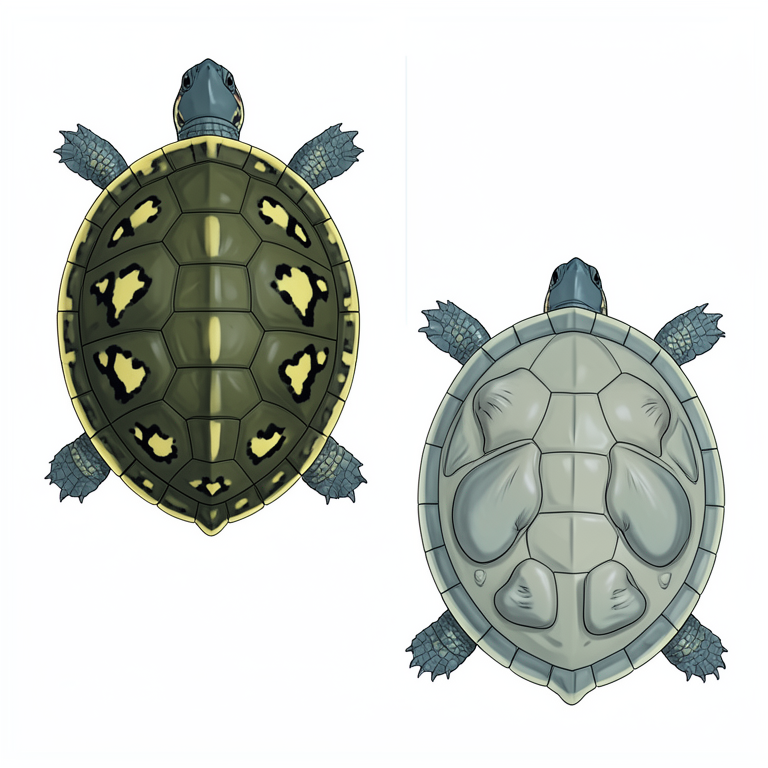
Morphological Features of Lissemys punctata
AI-generated conceptual illustration (Indian flap-shelled turtle (Lissemys punctata)). It explains the idea and does not show study data.
View source evidence ↗Figures & tables
From the original paper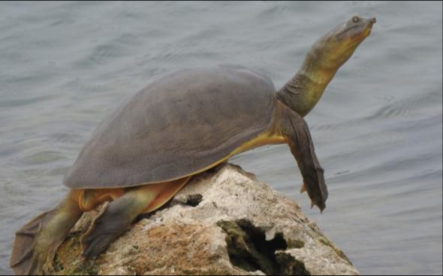 Figure 1
Introduction
Naryan Sarovar WLS is located in Lakhpat taluka of Kachchh district in State of Gujarat. Kachchh is one of the largest districts in India and encompasses four protected area that cover 12,906 km 2 land area and 6.58% area of the forests of the state. Naryan Sarovar Wildlife Sanctuary is one the protected area in the district of Kachchh and lies in the Biotic Province-3A Kachchh Biogeographic Zone-The Indian Desert (Champion and Seth, 1968) [4] . It is positioned between Latitude 23°27' to 23°42' N and Longitude 68°30' 68°57' E. It was notified in 1981 with an area of 767.79 km 2 and subsequently in 1995 the area of the sanctuary was reduced for the industrial development in the area; henceforth presently the sanctuary comprises an area of 444.23 km 2 . The sanctuary area has one of its unique kinds of habitats since it is bordered by Kori Creek and mangrove forest on the north-west and west respectively. The area is characterized by scrub vegetation, seasonal wetlands, savana and open grassland with scattered trees. The desert forest in the sanctuary is known to be only of its kind in India. Naryan Sarovar Lake located in the sanctuary area is one of the five scared lakes in India. It is known that Sarasvati River has an opening into the sea i.e. present day Naryan Sarovar Lake, as a result the lake is filled with holy water of Sarasvati. Various works have been undertaken on the reptile fauna of Gujarat/Kachchh district viz. Stoliczka, (1872) [12] , McCann, (1938) [12] , Bhaskar, (1978) [3] , Sharma, (1982) [12] , Webb, (1982) [17] , Tikader and Sharma (1985) [13] , Akhtar and Tiwari (1991) [1] , Vijaykumar (1997) [14] , Vyas (1998) [16] ,Sharma, (1998) ) [10] , Gayan (1999) [7] . However, (Vyas, 2002) [16] reported 19 species of reptiles referable to 16 genera and 10 families. During present studies, Lissemys punctata (Lacepede, 1788) is one of the additions to the reptilian fauna under order testudines and family trionychidae. Lissemys punctata (Lacepede, 1788) -Indian flap shell turtle has been recorded from the Naryan Sarovar Lake during the surveys of the Sanctuary. Good number of Indian flap shell turtle were observed and they are well secluded as due to religious reasons. However, lake is under threat due to various anthropogenic stresses viz. algal blooms, vehicular transportation etc.
Materials and Methods
The studies have been undertaken during 2018 to 2019 under the Research programme of Faunal Survey of the Narayan Sarovar WLS, Gujarat by DRC, Jodhpur. The identification of the species has been done at the site of the Naryan Sarovar Lake and photographs (Fig. ) and video recordings were undertaken by Nikon Coolpix-P90 & Nikon D-90 camera for the further authentication of the species.
Results and Discussion
During field surveys of the sanctuary, observed a turtle species from Naryan Sarovar Lake with the help of 50×10 binoculars (Nikon). Our observation represented the first record of Lissemys punctata (Lacepede, 1788) in the sanctuary and various individuals were observed in the lake near the Naryan Sarovar WLS during surveys conducted from April 2019 to March 2020. Therefore, this is addition to the reptilian fauna under order testudines and family trionychidae. trionychidae is a turtle family and is known as soft shell turtles. They have spiny soft shell and their carapaces lack horny scutes (Scales) and thus known as soft shell. The carapace is flexible along the sides and central part has a layer of the solid bone. The light and flexible shell of the turtles makes them easy to swim in water as well as move with speed on land. They are well adapted to aquatic life and mostly are underwater to gulp their food. They have elongated neck in comparison to their body size, which is helpful them to breath air from the surface when they are submerged in water. The feet are webbed and three clawed and thus name of family i.e. trionychidae. Lissemys punctata (Lacepede, 1788) is commonly known as "Indian flap shell turtle" is a fresh water species. The flapshelled name originated due to the presence of femoral flaps found on the plastron and these flaps of skin cover the limbs when they withdraw into the shell. Turtles are known to survive more than 220 million years ago and are one of the oldest animals in this earth. They are important part of food chain and play an important role to maintain health of ecosystem. It has key role to lower/control the pollution in any Ecosystem as thy feeds on various deceased insects/animals, plants and helpful to reduce the eutrophication of water body. Plastron is with soft semicircular flaps which hold the hind feet to be hidden completely. Anterior portion of the plastron is very flexible and thus allow opening and closing of the anterior shell quite efficiently. This species is differentiated from other species by occurrence of marginal bones in the posterior side of the carapace and seven well developed callosities in the plastron. Limbs are webbed with three claws on each foot. Tail is short olive brown above and carapace is olive green with black bordered yellow spots and with a light-yellow marginal rim.
Systematic account of species
Distribution: India: Rajasthan, Gujarat, Sikkim and Andaman Island; Elsewhere: Bangladesh, Burma, Nepal, Pakistan, Sri Lanka.
Habit/Habitat
They are amphibious creatures and inhabits in the stagnant water of streams, lakes, tanks, marshes and adapted to marine life. It prefers water with shallow muddy bottom and basks at the bank of water bodies on big boulders and floating vegetation. They are well adapted to dry conditions as the retracted legs which are covered with femoral flaps are helpful to survive in the dry conditions. They burrow during summer and goes under aestivation during the summer period and their maximum aestivation period is 160 days (Sharma, 2000) [11] . They are omnivorous in feeding habits and are very important for the aquatic health of the water body as they feed on dead animals of the water and thus helpful to overcome the pollution of water body.
Remarks
Turtles with morphologically intermediate patterns on the head and carapace generally occur (Ganga River drainage) across the Northern India. Intergrades between L.p. andersoni and L.p. vittata have been reported from the states of Bihar, West Bengal, Orissa and Rajasthan (Webb, 1982) [17] , Madhya Pradesh (Das, 1991) [5] and the Kathiwar peninsula, Gujarat (Frazier and Das, 1994) [6] . They are under threat due to habitat destruction, ruthless killing and overexploitation of adults and their eggs for protein rich food (Sharma, 1982) [9] . Conservation Status: IUCN: Vulnerable (VU); Indian Wildlife (Protection) Act: Schedule I; CITES: Appendix II.
Acknowledgement
AcknowledgementsAuthor is Grateful to Dr. Dhriti Banerjee, Director, Zoological Survey of India, Kolkata for providing the facilities and encouragement for the present work. Forest Department of Gujarat is greatly acknowledged for the necessary permission to conduct the surveys of the Naryan Sarovar Wildlife sanctuary.
Figures and tables from the paper
References
11 in the original paper- Akhtar AS, Tiwari JK. Extension of range of the Black Cobra Naja naja oxiana. J Bombay Nat Hist Soc. 1991;88(1):123.
- Auffenberg W, Rehman H, Iffat F, Perveen Z. Notes on the biology of Varanus griseus konieczngi Mertens, Sauria: Varanidae. J Bombay Nat Hist Soc. 1990;87:2636.
- Bhaskar S. Notes from the Gulf of Kutch. Hamadryad. 1978;4(1):3-6.
- Frazier JG, Das I. Some notable records of Testudines from the Indian and Burmese subregions. Hamadryad. 1994;19:47-66.
- Gayan NC. A synopsis of the reptiles of Gujarat, western India. Hamadryad. 1999;24(1):1-22.
- McCann C. The reptiles and amphibia of Kutch. J Bombay Nat Hist Soc. 1938;40:425-427.
- Sharma RC. Taxonomic and ecological studies on the reptiles of Gujarat. Rec Zool Surv India. 1982;80:85108.
- Stoliczka F. Notes on the reptilian and amphibian fauna of Kutchh (Cutch). Proc Asiatic Soc Bengal. 1872, 7185.
- Vyas R. The reptiles of Gujarat State: updated distribution. Tiger Paper. 1998;25(1):8-14.
- Vyas R. Preliminary Survey of Herpetofauna of Narayan Sarovar sanctuary, Gujarat. Zoos' Print J. 2002;17(6):812-814.
- Webb RG. Taxonomic notes concerning the trionychid turtle Lissemys punctata (Lacepede). AmphibiaReptilia. 1982;3:179-184.