
Research article · 2025 · Full text
International Journal of Horticulture and Food ScienceReview on weed management studies in Allium
Volume 7(3) · Pages 12–16 · DOI: 10.33545/26631067.2025.v7.i3a.273 ↗
Research areasGarlic and Onion Studies
Abstract
Author-writtenThe various bulb\r\ncrop, Onion & garlic is a dicotyledonous, belongs to the own family\r\nAlliaceae. they\'re highly export oriented crop and earns a treasured forex for\r\nthe usa. Low productivity of Allium is probably the ensuing of quite a number\r\nof factors like Weed, negative yielding genotypes, non-availability of\r\nexcellent seeds and bad agronomic practices. among the agronomic factors,\r\nproper weed management may be an extreme issue. Weeds compete with Allium crop\r\nfor vitamins, soil moisture, area, light and substantially reduce the bulb\r\nyield, quality and value of the crop through improved production and harvesting\r\nexpenses. seeking to the yield losses, it is essential to manage the weeds\r\nthroughout preliminary boom ranges. The method of integration of physical,\r\nmechanical and chemical methods related to mulching, hand weeding and use of\r\nherbicides, respectively appear higher and effective alternative to the\r\nconventional hand weeding. as a result, a brief evaluates changed into offered\r\nto discover the effect of various weed control approach in onion.
Summary
Source-checkedPlain-language reading of the full paper, prepared with AI and checked against the text. Each point links to the authors' own words.
Why it matters
- Onion and garlic are critical export vegetables for India, which leads the world in cultivation area and ranks second in production. View evidence ↗
- Allium crops are highly susceptible to weed competition because of their slow growth, slender leaves, and shallow root systems. View evidence ↗
- Weeds reduce the yield, quality, and economic value of Allium crops by competing for essential resources like nutrients, light, and moisture. View evidence ↗
The question
- The objective of this review was to identify the most effective and economically viable combination of cultural and chemical weed management practices for onion. View evidence ↗
What they did
- The authors conducted a literature review focusing on associated weed species, competition dynamics, yield losses, the impact of various control methods, and the economics of these practices. View evidence ↗
What they found
- In garlic, Chenopodium murale was identified as a dominant dicot weed at 60.6%, while Eleusine indica was a primary monocot weed at 8.9%. View evidence ↗
- Weed infestation can lead to significant bulb yield losses ranging from 40% to 80% in both garlic and onion. View evidence ↗
- Optimal bulb and weed management was achieved using three hand weedings performed at 20, 40, and 60 days after transplanting. View evidence ↗
- The pre-emergence application of oxyfluorfen at 200 g/ha improved bulb yield by effectively controlling weeds during critical growth stages. View evidence ↗
- The highest benefit-cost (B:C) ratio was found in a combination of pre-planting pendimethalin (1875ml/ha), post-emergence oxyfluorfen (950ml/ha), and one hand weeding at 40 days after sowing. View evidence ↗
What it means
- The authors conclude that integrated weed management combining chemical, mechanical, and cultural practices is superior to any single method for maximizing production and profit. View evidence ↗
- The authors recommend that farmers tailor their weed management choices to their specific local conditions, available resources, and crop needs. View evidence ↗
Visual summary
1 visualsIllustrations explain the paper; they do not show study data.
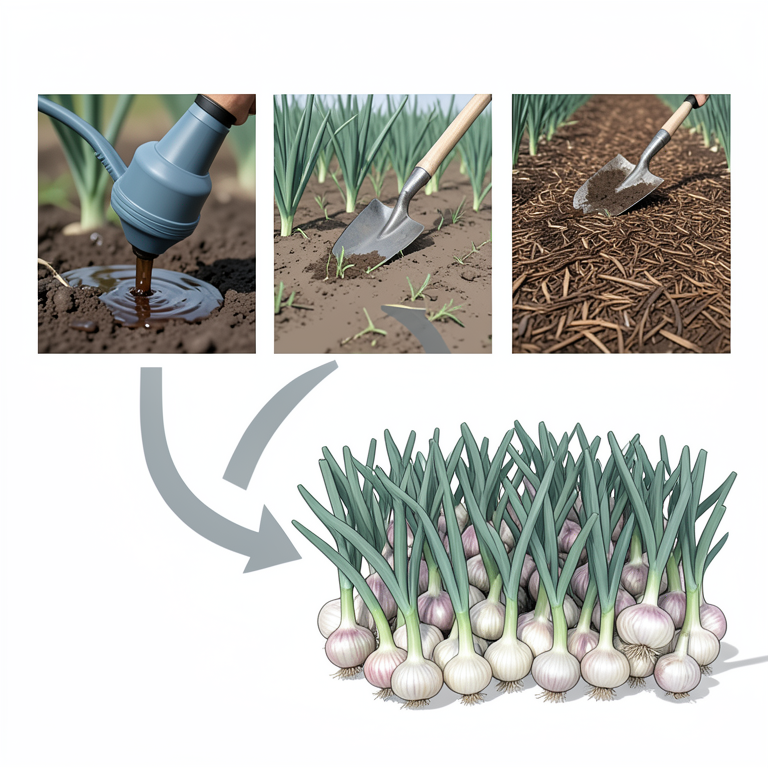
Integrated Weed Management Concept
AI-generated conceptual illustration (Allium plants (onions and garlic)). It explains the idea and does not show study data.
View source evidence ↗Introduction
India has been recognised as "home of Spices" from historical times. Onion and garlic are important export vegetable a few of the cultivated Allium in India. India ranks first in area, 2 nd in manufacturing of onion and garlic within the international. Maharashtra is the leading manufacturer of onion in India and different fundamental onion growing states in our use are Gujarat, Karnataka, Orissa, Uttar Pradesh, Andhra Pradesh, Tamil Nadu and Rajasthan, whereas productiveness is highest in Gujarat. even as garlic developing states are Madhya Pradesh, Gujarat, Orissa, Maharashtra, Uttar Pradesh, Bihar, Rajasthan and Andhra Pradesh. Allium is valued for its bulbs having function odour, flavour and pungency, which is because of the presence allicin (S compound). Being a shallow rooted crop with slender leaves, slow developing, carefully plant and non-branching habit. due to this type of increase habit, they can't compete well with weeds. Their competition with the plant life starts at very early increase stage due to the fact right now after planting, the weed emergence takes place that competes with the soft seedlings. As weeds decrease the profitability of crops, consequently, weed ought to be controlled well in time. Weeds compete for vitamins, soil, moisture, space and mild drastically lowering the yield, first-rate and price through accelerated production and harvesting expenses. conventional techniques of weed control i.e. hand weeding is no doubt powerful however it is time consuming, bulky, expensive and beneath many situations becomes uneconomical. furthermore, weeding at some stage in crucial growth ranges may be very hard because of extended price of human labour and its scarce availability. Spraying of pre-emergence herbicides keeps the crop in weed free situations in the course of early levels. Then, at later levels hand weeding or software of publish emergence herbicides facilitates to reduce the fee of weeding and preserve the weed population below economic threshold stage at some stage in the crop increase length. Mechanical methods required extra labours and in gift scenario paucity of timely availability in addition to high wages leads to pick opportunity choice this situation makes it important to use herbicides for effective and timely manipulate of weeds in this crop. it's far consequently distinctly vital to schedule a appropriate method of weed manage by the utility of different herbicides to enhance profit for the onion growers inside the united states of America therefore, an strive turned into made to discover an appropriate aggregate of cultural and chemical weed management practices for weed manipulate in onion may be almost effective and economically feasible for farmer. [24] reported that predominant weeds in onion was Chenopodium album, Digera arvensis, Cyprus rotandus, Echinochloa colonum and Dactyloctenium aegyptium. Sampat et al., (2014) [25] prominent weed species recorded was Chenopodium album, Chenopodium murale, Amaranthus viridis, Anagallis arvensis, Convolvulus arvensis, Parthenium hysterophorus, Spergula arvensis, Digera arvensis, Cyprus rotundus, Euphorbia hirta and Cynodon dactylon in garlic. Panara et al., (2015) [18] [32] . Chaudhari et al., (2019) [7] reported that the major weeds observed in garlic were Eleusine indica (8.9%), Asphodelus tenuifolius (3.0%), Setaria gluaca (0.92%) and Digitaria sanguinalis (0.92%) in monocot weeds category and Chenopodium murale (60.6%), Chenopodium album (15.5%) and Melilotus indica (5.2%) in dicot weed category. Sangani et al., (2024) reported that weed flora in garlic was monocot weeds viz., Echinochloa colona (11.47%), Brachiaria ramose (10.19%), Eluropus villosus (8.92%), Dactyloctenium aegyptium (8.81%), Asphodelus tenuifolius (5.10%) and; dicot weeds viz., Indigofera glandulosa (8.92%), Chenopodium album (7.64%), Commelina nudiflora (7.01%) Eclipta alba (5.73%), Digera arvensis (2.54%), Parthenium hysterophorus (1.28%), Euphorbia hirta (0.63%), Tridax procumbens (0.63%), Portulaca oleracea (0.63%); and sedge weed viz., Cyperus rotundus (20.39%). Kropff and Joije (1987) concluded that the density of weed species in line with unit area is not the most effective factors which cause the yield loss but also the time of the boom of weeds throughout the developing season might be extra crucial. This ends in flourish the weeds and decrease the bulb yield to the track of 61.77% beneath weedy plots compared handy weeded plots (Singh and Nandal 2002) [29] in garlic. Ved Prakash et al., (2000) [33] pronounced that essential duration of crop-weed opposition in onion lies between 15-60 days after transplanting. Babiker et al., (1987) [3] mentioned that unrestricted weed boom reduced crop yield by means of 98 consistent with cent and onion become more sensitive to weed competition between two to six weeks after its emergence. Weed opposition throughout the crop length on a median brought on eighty two.2 in keeping with cent reduction in bulb yield. Weed infestation prevailed up to 15, 30, 45 and 60 days after transplanting registered 1.2, 39. eight, fifty-six.1 and 69.3 according to cent discount in bulb yield over weedy situation all through the crop. but there has been no vast difference in bulb yield due to weedy situations as much as 60 days and weedy situations all through crop season Tewari. Onion is very touchy to weed opposition all through the entire flower's length, because luxuriant boom of leaves is arrested, which might otherwise cowl inter-rows and prevent weed germination. The aggressive power of onion became the weakest one towards weeds said by way of Kavaliauskaite (2009) [13] .
Crop-weed competition
Crop-weed competition
Losses as a result of weeds
Weed reduces the bulb yield to the diploma of forty to eighty% (Verma and Singh, 1996) [34] in garlic. Channapagoudar and Biradar (2007) [6] that yield loss because of weed infestation in onions to the tune of 40 to 80 according to cent.
Impact of weed manipulate technique on crop increase, yield and excellent
Weed control practices: Weeds can be managed by way of extraordinary methods such as manual, cultural, chemical and mechanical. commonly farmers do no longer remove weeds early sufficient to prevent major damage because of this weed competition.
a) Manual and cultural
Hand weeding is a method that gets rid of competing weeds from crop, letting them get entry to more sunlight, water, and vitamins, selling increase. This ends in elevated plant top and efficient photosynthesis. Additionally, hand weeding ensures better soil nutrient uptake, assisting normal plant increase. Weeds can induce strain on onion plants with the aid of competing for assets and freeing allelopathic chemical compounds, but hand weeding reduces this stress, allowing vegetation to recognition on growth and chlorophyll production. In line with Melander and Hartvig, hoeing close to the row leaving five cm untilled strip, has the potential of saving labour value for hand weeding in non herbicidal growing machine of onion. The better bulb and weed manage performance have been recorded within the weed unfastened treatment followed through three HW on 20, 40 and 60 days after transplanting (Amrutkar et al., 1998) [1] . Bhutia et al., (2005) [5] pronounced considerably higher bulb yield with two times hand weeding at 25 & 45 DAT. Jilani et al., (2007) [12] studied that 3-hand hoeing exercise confirmed the best effects in onion bulb diameter, bulb weight and bulb yield in keeping with ha. three hand hoeing proved to be the great weed manage exercise. Zubiar et al., (2009) [36] discovered that better weed manage was acquired with manual weeding at some point of the crop season. maximum bulb size and yield of onion were recorded in hand weeded plots observed by using pendimethalin compared to weedy test as noticed via Hussain et al., (2008) [11] . Rahman et al., (2012) [22] additionally found manual weeding very effective in crop to control weed biomass. Ganesh et al., (2022) [8] concluded that two hand weeding at 20 and forty DAT recorded better marketable bulb yield, weed control efficiency, and the lowest weed density, weed dry weight, and weed index due to the fact the elimination of weed by means of hand is onerous, high-priced, and time ingesting.
b) Mechanical
Physical harm through burial to 1 cm depth is effective for controlling weeds followed by using slicing on the soil floor as observed by Rajakumar (2008) [23] . consistent with Sathya Priya et al., (2013) pre-emergence application of pendimethalin at 0.75 kg ha-1 + Rotary weeding on 45 DAS recorded decrease gross and internet returns. Mechanical weed control uproots the weeds between the crop rows and preserve the soil floor loose to make sure better water intake capacity and soil aeration (Yadav and Pond, 2007) [35] . In garlic shallow root gadget make mechanical approach of weed manipulate tough and occasionally causes damage to growing bulbs (Lawande et al., 2009) [15] . Sinare in onion noticed that most yield in mechanical weeding treatment might be due to beneficial environment created by clean crop tradition ensuing in greater absorption of sun radiation and plant vitamins ensuing in extra photosynthetic rates and extra dry count accumulation.
c) Chemical (impact of herbicide on crop boom and yield)
Plant peak, number of leaves, sparkling and dry weight have been located to be better below weed free condition and pendimethalin handled plots as mentioned through Sharma and Khandwe (2008) [27] . Taller flora, neck thickness and dry be counted accumulation become found below pendimethalin carried out plots via Patel et al., (2011) [19] . Tripathy et al., (2013) determined that one-of-a-kind weed control practices substantially reduced weed density and increase onion bulb yield with both software of oxyflurofen 23.5EC before planting + one hand weeding at forty-60 days after transplanting (T7) or blended spray of pendimethalin 30EC + quizalofopethyl 5EC at the time of planting and 2d software at 30 days after transplanting (T6). Kumar determined that hand weeding could economies the dose of the herbicides through 50%. Pendimethalin and pendimethalin/metolachlor/oxyflourfen + hand weeding were advanced handy weeding three times in increasing bulb yield of garlic. Sathya Priya and Chinnusamy (2013) [26] said that preemergence utility of oxyfluorfen at 200 g ha-1 recorded better bulb yield because of better manipulate of weeds at vital levels therefore providing favourable environmental condition for higher increase and improvement main to beautify bulb yield). Siddhu noticed that that the application of Oxyfluorfen zero.one hundred fifty kg/ha + Quizalofop ethyl zero.050 kg/ha as post emergence observed powerful in controlling weeds and growing bulb yield of garlic crop. utility of oxyfluorfen and pendimethalin provide effectively manage of weeds in garlic additionally said with the aid of Shashidhar et al. (2013) [28] . The reduction in density of weed in herbicide treatments might be due to broad spectrum herbicidal effect on control of weeds which in the long run pondered in recording decrease dry weight of weeds discovered by means of Sampat et al. (2014) [25] in garlic. Gupta et al., 2019 [9] Suppression of weed opposition by pre and put up emergence herbicide utility become similarly more desirable by integrating hand weeding at forty DAT in weed manage treatments, which gives green and extended weed manage and saved the crop weed free during the critical intervals of opposition.
d) Combination of manual and chemical method
Vedprakash et al., (2000) [33] stated that, bulb yield of onion showed higher overall performance beneath herbicides mixed with hand weeding remedy over herbicides on my own because of effectively manage of weed through herbicides all through initial degree and later on by means of hand weeding. Prasad et al., 2021 [21] concluded that weed loose circumstance turned into extra powerful than other strategies having greater bulb yield and superior nice bulbs. but, use of Pendimethalin @750g a.i. /ha and Oxyflurfen @ 100g a.i./ha+ Hand Weeding at 40 Days after transplanting had been additionally determined to be powerful for buying more yield and superior bulb fine of onion. Singla and Singh (2020) [30] observed nearly convenient and economically viable weed control exercise in onion at Krishi Vigyan Kendra, Patiala. distinctive combos of hand weeding with application of Pendimethalin 30 EC @ 1875ml/ha (pre-planting) and oxyfluorfen 23. five EC @ 950ml/ha (put up emergence) were used in onion variety 'Punjab Naroya'. Weed free check remedy (3 hand weeding at 20, 40 and 60 DAS) recorded extensively lowest weed density, dry weight of weed and higher weed control performance. all of the boom attributes of onion viz., plant peak, neck thickness, bulb weight and bulb diameter have been recorded most in weed unfastened. This remedy additionally recorded highest bulb yield and gross financial go back according to hectare, but most B:C ratio changed into located in remedy pendimethalin 30 EC @1875ml/ha (PP)+ Oxyfluorfen 23.5 EC @ 950ml/ha (POE)+ One hand wedding at 40 DAS. Anarase (2014) [2] reported that maximum bulb yield turned into recorded by way of chemical weed manage remedy Oxyfluorfen @ 0.088 kg a.i./ha + Quizalofop ethyl five% EC 0.0.5 kg a.i. /ha + HW forty-five DAT in rabi onion. Hajebi et al. (2015) [7] said that pre emergence tank-mix software of Pendimethalin @ zero.seventy five kg ha-1 + Imazethapyr @ zero.1/2 kg ha-1 proved superior to all the other herbicide treatments in reducing weed competition (density and dry weight) in garlic crop.
Economics of weed manage in onion
Patel et al. (2011) [19] found out that better net profit (2,sixty nine,422 ha-1 ) in onion crop became obtained with application of pendimethalin at 1.0 kg ha-1 + HW on 40 DAT with the B:C ratio of 7.85 observed by oxyfluorfen at 1.zero kg ha-1 + HW on forty DAT (2,fifty one,910) and weed unfastened control. In onion higher net return (1, eighty-five,600) with B:C ratio of seven.63 became registered with the application of oxyfluorfen. Barla and Upasani (2019) [4] concluded that for harvest of better onion yield software of pendimethalin 1 kg/ha PE oroxyfluorfen zero.25 kg/ha PE or plastic mulch may be practiced for effective weed manage and better economic return. Channappagoudar and Biradar (2007) [6] indicated that the preemergence utility of pendimethalin at 1.00 kg ha-1 supplemented with one hand weeding gave highest net return of Rs. fifty-one,296 ha-1 with most advantage fee ratio of 8.77. Sampat et al. (2014) [25] reported that mixture of Oxadiargyl 90 g/ha pre-emergence plus Quizalofop-ethyl as post-emergence 50 g/ha carried out at 2-3 leaf stage of weeds gave maximum a B: C ratio in massive segmented garlic range. Panara et al., (2015) [18] stated that maximum B:C ratio turned into collected with oxadiargyl 90 g/ha as preemergence fb HW at forty DAS (T2), carefully observed through oxyfluorfen 240 g/ha as preemergence facebook HW at forty DAS (T1) and HW at 30 and 60 DAS (T8). Sampat et al. (2014) [25] observed that the weed free plots resulted in better fee of cultivation and internet returns observed by the treatment mixture of oxadiargyl 90 g/ha pre-emergence quizalofop-ethyl as post-emergence 50 g/ha implemented at 2-three leaf stage of weeds yielding a B: C ratio of five.70 in small segmented and six.seventy three in huge segmented garlic respectively
Conclusion
Instead of adopting single method of weed control, combination of weed control measures could yield better results in terms of both production and profit. Implementing an integrated weed management strategy that combines chemical, mechanical, and cultural practices is essential for effective weed control in Allium crops. This approach not only enhances crop yield and quality but also promotes sustainable agricultural practices. Farmers should consider local conditions, available resources, and specific crop requirements when selecting appropriate weed management techniques.
References
36 in the original paper- Amrutkar SD, Patil BM, Karunakar AP, Sethi HN, Jiotode DJ. Efficacy of herbicides for control of weeds and their effects on yield of onion (Allium cepa L.). Crop Res. 1998;16:372-374.
- Anarase MD. Weed management studies in Rabi onion cv. N-2-4-1. M.Sc. (Agri.) Thesis submitted to Mahatma Phule Krishi Vidyapeeth, Rahuri Maharashtra; 2014.
- Babiker AGT, Khogali M, Osman MNM, Hamada AA. Weed control and management in onions. Rep. Gezira Res. Station and Substations. 1987; pp. 1979-1980.
- Barla S, Upasan RR. Study on different methods of weed management in onion (Allium cepa L.). Curr J Appl Sci Technol. 2019;33(3):1-7.
- Bhutia DT, Maity TK, Ghosh RK. Integrated weed management in onion. J Crop Weed. 2005;1(1):61-64.
- Channappagoudar BB, Biradar NR. Physiological studies on weed control efficiency in direct sown onion. Karnataka J Agric Sci. 2007;20(2):375-376.
- Chaudhari DD, Patel VJ, Patel BD, Patel HK. Integrated weed management in garlic with and without rice straw mulch. Indian J Weed Sci. 2019;51(3):270274.
- Ganesh M, Pandey BR, Kewat ML, Sahu A. Effects of various weed management practices on growth, yield and economics of Rabi onion (Allium cepa L.) cv. Bhima Shakti. The Pharma Innovation J. 2022;11(4):611-615.
- Gupta N, Bhargav KS, Singh M. Effect of Integrated Weed Management on Growth and Yield of Kharif Onion (Allium cepa). J Krishi Vigyan. 2019;7(2):83-87.
- Hajebi A, Das TK, Singh SB, Saha S, Sefidkon F, Lebaschi MH. Effect of planting method and weed management practice on growth and oleoresin yield in garlic (Allium sativum). Pesticide Res J. 2015;27(2):231-236.
- Hussain Z, Marwat KB, Khan MA. Evaluation of different herbicides for weed control in onion. Sarhad J Agric. 2008;24(3):453-456.
- Jilani MS, Ramzan M, Waseem K. Impact of weed management practices on growth and yield of some local genotypes of onion. Pak J Weed Sci Res. 2007;13(3/4):191-198.
- Kavaliauskaite D. Influence of herbicides spraying time and frequency on onion crop weediness. Sci Works Lithuanian Inst Horticulture Lithuanian Univ Agric. 2009;pp. 105-108.
- Kropff MJ, Joije W. Competition between a sugar beet and population of Chenopodium album L. and Stellaria media L. Netherlands Agric Sci. 1987;35:525-528.
- Lawande KE, Khar A, Mahajan V, Srinivas PS, Sankar V, Singh RP. Onion and garlic research in India. J Hort Sci. 2009;4(2):91-119.
- Melander B, Rasmussen. Effect of cultural methods and physical weed control on intra row weed numbers, manual weeding and marketable yield in direct-sown leek and bulb onion. Weed Res. 2001;41:491-508.
- Panse R, Gupta A, Jain PK, Sasode DS, Sharma S. Efficacy of different herbicides against weed flora in onion (Allium cepa Lindeman). J Crop Weed. 2014;10(1):163-166.
- Panara DM, Mathukia RK, Sagarka BK, Shekh MA. 25th Asian-Pacific Weed Science Society Conference on "Weed Science for Sustainable Agriculture, Environment and Biodiversity", Hyderabad, India during 13-16 October, 2015. 2015;pp. 378-379.
- Patel TU, Patel CL, Patel DD, Thanki JD, Patel PS, Jat Ram T. Effect of weed and fertilizers management on weed control and productivity of onion. Indian J Agron. 2011;56(3):267-272.
- Patel TU, Patel CL, Patel DD, Thanki JD, Arvadia MK, Vaidya HB. Performance of onion under weed and fertilizer management. Indian J Weed Sci. 2011;44(3):151-158.
- Prasad M, Meena ML, Kumar S, Maji S, Singh R. Effect of integrated weed management practices on yield and quality of onion (Allium cepa L.). South Asian J Exp Biol. 2021;11(3):300-304.
- Rahman H, Ullah K, Sadiq M, Javaria S, Ullah I, Khan MA. Relationship between manual weeds removal timings and onion yield. Pak J Weed Sci Res. 2012;18(2):201-207.
- Rajakumar D. Study on the effect of nitrogen fertilization, green manure intercropping and weed management in aerobic rice. Ph.D. Thesis, Tamil Nadu Agricultural Uni., Coimbatore, Tamil Nadu, India; 2008.
- Rathod AD, Solanki RM, Modhavadia JM, Padamani DR. Efficacy of pre-and post-emergence herbicides in onion and their carry over effect on the succeeding crops. Ann Agric Res. 2014;35(2):209-216.
- Sampat, Chopra S, Kumar A, Samnotra RK. Chemical weed management in garlic. Indian J Weed Sci. 2014;46(2):146-150.
- Sathya Priya R, Chinnusamy C. Evaluation of new formulation of oxyfluorfen on weed control practices on weed dry weight, nutrient removal and yield of onion. Green Farming. 2013;4(1):72-75.
- Sharma RC, Khandwe R. Response of weed control measures in kharif onion. Res Crops. 2008;9:348-349.
- Shashidhar TR, Dharmatti PR, Angadi CC, Motagi BN, Prashant SJ. Effect of different herbicides on weed growth and yield of garlic (Allium sativum L.). Internet J Plant Protec. 2013;6(1):118-121.
- Singh R, Nandal TR. Studies on weed management in garlic (Allium sativum L.). Indian J Weed Sci. 2002;34(1&2):80-81.
- Singla R, Singh J. Weed Management Studies in Onion (Allium cepa L.). Indian Res J Ext Edu. 2020;20(4).
- Tripathy P, Sahoo BB, Patel D, Dash DK. Weed management studies in onion (Allium cepa L.). J Crop Weed. 2013;9(2):210-212.
- Urraiya P, Jha MK, Jha B. Weed Management Studies in Kharif Onion (Allium cepa L.) on Economy. Int J Pure App Biosci. 2018;6(1):1564-1566.
- Vedprakash A, Pandey K, Singh RD, Mani VP. Integrated weed management in winter onion (Allium cepa L.) under mid hill conditions of north-western Himalayas. Indian J Agron. 2000;45(4):816-821.
- Verma SK, Singh T. Weed control in garlic. Indian J Weed Sci. 1996;28:48-51.
- Yadav R, Pond S. Development and ergonomic evaluation of manual weeder. Agrl Eng Int: CIGR J. 2007;9.
- Zubiar M, Rahman HU, Jailani MS, Kiran M, Waseem MK, Rahim A, et al. Comparison of different weed management practices in onion (Allium cepa L.) under agro-climatic conditions of Dera Ismail Khan, Pakistan. Pak J Weed Sci Res. 2009;15:45-51.