
Research article · 2025 · Full text
International Journal of Horticulture and Food ScienceAssessing packaged food durability using environmental simulation models
Volume 7(3) · Pages 09–11 · DOI: 10.33545/26631067.2025.v7.i3a.272 ↗
Research areasFood Waste Reduction and Sustainability
Abstract
Author-writtenThe equilibrium\\r\\nmoisture content (EMC) of biscuits was determined using the static method at\\r\\nfour distinct temperatures (20 °C, 30 °C, 40 °C, and 50 °C) and five varying\\r\\nrelative humidity levels (ranging from 20.1% to 93.2%). The results indicated\\r\\nthat the equilibrium moisture content of the biscuits ranged from 5.42% to\\r\\n23.57% (on a dry basis) across the experimental conditions of temperature and\\r\\nrelative humidity. Using the developed model, a simulation study was conducted\\r\\nacross five selected storage locations in the country: Visakhapatnam, Barmer,\\r\\nPune, Srinagar, and Leh. These were selected on the basis of climatic\\r\\nconditions. The simulation results showed that the biscuits would remain safe\\r\\nfor approximately 50, 54, 60, 70, and 165 days during the rainy season in Visakhapatnam,\\r\\nBarmer, Pune, Srinagar, and Leh, respectively, when packed in 50 μm LDPE film.\\r\\nThis model can be a valuable tool for selecting the appropriate packaging\\r\\nmaterial based on varying storage environments.
Summary
Source-checkedPlain-language reading of the full paper, prepared with AI and checked against the text. Each point links to the authors' own words.
Why it matters
- The shelf life of packaged foods is critical because it directly impacts the safety and quality of the food. View evidence ↗
- Food deterioration is significantly influenced by environmental factors, including oxygen availability, light, relative humidity, and temperature. View evidence ↗
- Simulation modeling is an effective alternative to real-life experiments for predicting food stability because it is less time-consuming and extensive. View evidence ↗
The question
- The study aims to predict the shelf life of food products when stored under various environmental conditions. View evidence ↗
What they did
- The researchers used a static method to determine the equilibrium moisture content (EMC) of biscuits across five relative humidity levels (20.1% to 93.2%) and four temperatures (20 °C, 30 °C, 40 °C, and 50 °C). View evidence ↗
- To evaluate the impact of location on shelf life, the study selected five Indian locations based on environmental conditions: Poona, Srinagar, Leh, Visakhapatnam, and Barmer. View evidence ↗
- The simulation specifically tested the durability of biscuits packed in 50 μm LDPE film. View evidence ↗
What they found
- Across the tested temperatures and humidity levels, the equilibrium moisture content of the biscuits varied from 5.42% to 23.57% on a dry basis. View evidence ↗
- The time required to reach 5% moisture content (shelf life) was significantly longer in winter than in the rainy season for all locations; for example, Visakhapatnam increased from 50 days in the rainy season to 95 days in winter. View evidence ↗
- Leh exhibited the highest durability in both seasons, with a shelf life of 165 days in the rainy season and 1785 days in winter. View evidence ↗
What it means
- The authors conclude that the current packaging material used by manufacturers is unsuitable for the rainy season in most Indian cities, with the exception of Leh. View evidence ↗
- The developed simulation model is recommended as a valuable tool for choosing packaging materials that suit specific storage environments. View evidence ↗
Visual summary
1 visualsIllustrations explain the paper; charts are replotted from the paper's own table values.
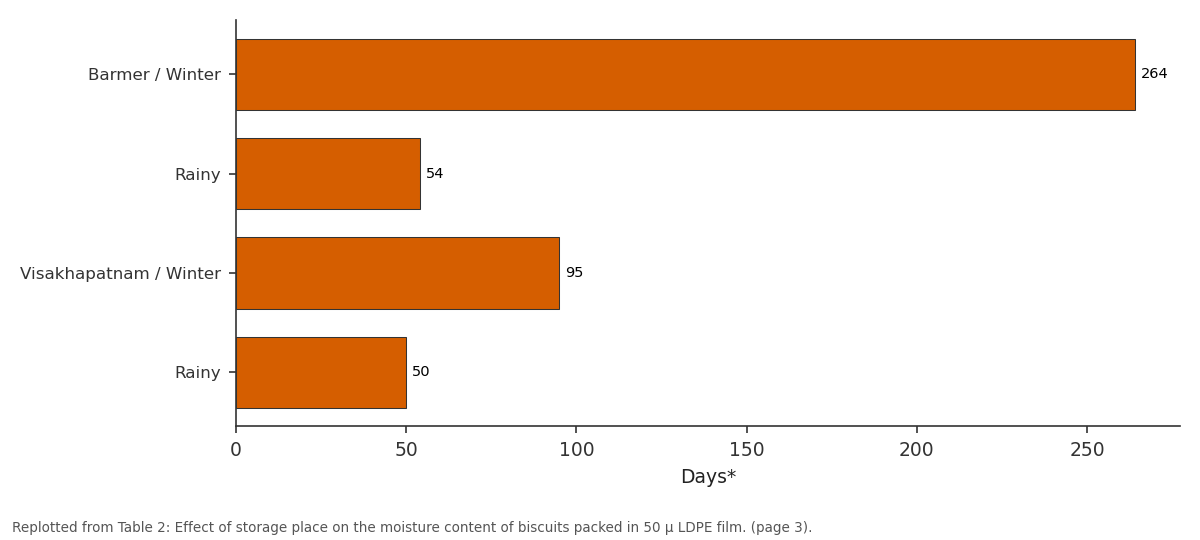
Days*: Barmer / Winter vs Rainy vs Visakhapatnam / Winter vs Rainy
Replotted from Table 2 (page 3) of the original paper. Every bar is the paper's own table value.
View source evidence ↗Figures & tables
From the original paper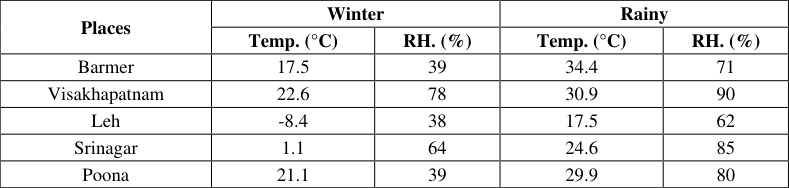 Table 1
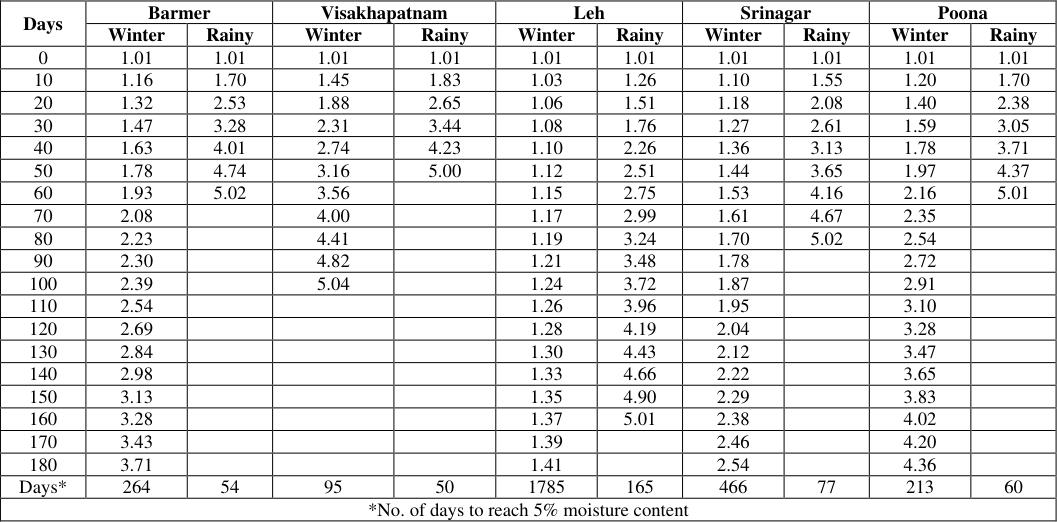 Table 2
Introduction
The shelf life of packaged foods is a vital consideration in food preservation, affecting both food quality and safety. Environmental factors such as temperature, relative humidity, light, and oxygen availability significantly influence the deterioration processes of food. For instance, increased temperatures can accelerate chemical reactions like oxidation, leading to loss of nutrients, flavor, and texture [1] . Similarly, relative humidity impacts moisture absorption, which in turn can lead to microbial growth or texture changes in food [2] . Therefore, understanding these factors and their interaction with different packaging materials is crucial for optimizing food preservation strategies. Advances in simulation modeling have proven to be an effective tool in predicting the shelf life of packaged foods under varying environmental conditions. Simulation approaches offer the advantage of assessing food stability without the need for extensive and time-consuming real-life experiments. These models consider factors such as temperature fluctuations, humidity levels, and packaging characteristics, providing insights into how they impact food quality [3] . Additionally, the integration of artificial intelligence and machine learning into food packaging simulations has further enhanced the accuracy and applicability of these models [4] . Recent studies have focused on the environmental influence of packaging on the shelf life of specific food categories. For instance, [5] explored how different types of packaging materials, when exposed to variable temperature and humidity levels, affect the shelf life of perishable food products such as fruits and vegetables. Their findings highlighted the importance of choosing the appropriate packaging material to maintain food safety under fluctuating environmental conditions. Similarly, [6] investigated the combined effect of light exposure and temperature on the shelf life of dairy products, demonstrating that these factors can significantly alter product stability over time. Protein rich biscuits can be prepared from composite flours, such as wheat flour fortified with soy, cottonseed, peanut or corn germ flours [7] . The rancidity of biscuits is accelerated by ultra-violet radiation as well as high temperature, which can be controlled using suitable packaging materials [8] . Biscuits are manufactured in most countries of the world and although Britain led the industrialization of biscuits and also popularized biscuits at least through her former colonies [9] . On an average, Indians eat 0.48 kg every year, while Americans eat 4.02 kg. The annual sales turn-over of a popular biscuit brand is 179.9 million kg. (Reference: Indian Food Industry [10] . It is generally recognized that these products are cereal based and baked to a moisture content of less than 5% [11] . The cereal components is variously increased with two major ingredients, fat and sugar, but there after the possible composition is almost endless Prediction of shelf life of food product stored under different environmental condition is important. Shelf life depends on the large number of factors such as temperature, equilibrium relative humidity, oxygen partial pressure, light, package permeability and package configuration.
Thus a number of factors affect the shelf life of food product. Sometimes, it becomes difficult to study the effect of many factors experimentally. The process becomes expensive and time consuming. Alternatively, a simulation model can be developed which shall be tested with the experimental data. After validation, the developed model can be used for the prediction of shelf life under different storage environmental conditions.
Materials and Methods
A semi permeable film transports water vapour across its thickness by virtue of vapour pressure difference across the film (Fick's and Henry's Laws). The rate of transport of water is given by rearranging the variable. 5), only known is the internal package water activity, which is a function of material inside the package. The major resistance is in the film and it is assumed that rapidly equilibrates with the food. The internal water activity then is safely determined by water sorption isotherm of the food. Eqn (5) implies that two packages have an identical behaviour as long as the coefficient K remain the same for both packages irrespective of the individual values of the constants. Computer simulation yields the most cost effective packaging design. Later real time storages studies serve the purpose of legal requirements and conformation of predicted results. Difference between predicted and actual result can be used as indices to check initial assumption for example, poor seals will shorten actual shelf life achieved with an otherwise adequate barrier material. In this example the false assumption is that the material value is equivalent to package permeation. Simulated studies extend beyond the one package/one condition study. Parameters can be changed to affect another study. A survey of potential new packaging material can be accompolished without need to retest the product. Only change is material parameter need to be entered to test performance. To see the effect of storage place on the shelf life of biscuit packed in packaging film, five different places in the country were selected on the basis of their environmental condition. The selected places were Barmer, Visakhapatnam, Leh, Srinagar and Poona. The temperature and relative humidity of selected places are presented in Table .1.
Results and Discussion
After validation and the sensitivity analysis of the developed model, the simulation study was carried out. The study was carried out for two extreme weather condition that is winter and the rainy season. The shelf life of product calculated was 50, 54, 60, 70 and 165 days for Visakhapatnam, Barmer, Poona, Srinagar and Leh respectively for the rainy season (Table . 2). It indicates that the present packaging material which is being used by biscuit manufacturer is not suitable for rainy season for most of the cities of the country except Leh. Therefore precaution need to be taken for packaging of biscuit to be distributed in rainy season.
Conclusions
The effect of storage conditions on the shelf life of packed materials was studied in various locations across the country, selected based on their environmental factors. During the rainy season, the shortest shelf life observed was 50 days in Visakhapatnam, while Leh recorded a much longer shelf life of 165 days. In contrast, during the winter season, the minimum shelf life for Visakhapatnam increased to 95 days.
Figures and tables from the paper
| Places | Winter | — | Rainy | — |
|---|---|---|---|---|
| Temp. (°C) | RH. (%) | Temp. (°C) | RH. (%) | |
| Barmer | 17.5 | 39 | 34.4 | 71 |
| Visakhapatnam | 22.6 | 78 | 30.9 | 90 |
| Leh | -8.4 | 38 | 17.5 | 62 |
| Srinagar | 1.1 | 64 | 24.6 | 85 |
| Poona | 21.1 | 39 | 29.9 | 80 |
Table text extracted from the original PDF; superscript letters are shown inline. The original table image is below.
View original table image
| Days | Barmer | — | Visakhapatnam | — | Leh | — | Srinagar | — | Poona | — |
|---|---|---|---|---|---|---|---|---|---|---|
| Winter | Rainy | Winter | Rainy | Winter | Rainy | Winter | Rainy | Winter | Rainy | |
| 0 | 1.01 | 1.01 | 1.01 | 1.01 | 1.01 | 1.01 | 1.01 | 1.01 | 1.01 | 1.01 |
| 10 | 1.16 | 1.70 | 1.45 | 1.83 | 1.03 | 1.26 | 1.10 | 1.55 | 1.20 | 1.70 |
| 20 | 1.32 | 2.53 | 1.88 | 2.65 | 1.06 | 1.51 | 1.18 | 2.08 | 1.40 | 2.38 |
| 30 | 1.47 | 3.28 | 2.31 | 3.44 | 1.08 | 1.76 | 1.27 | 2.61 | 1.59 | 3.05 |
| 40 | 1.63 | 4.01 | 2.74 | 4.23 | 1.10 | 2.26 | 1.36 | 3.13 | 1.78 | 3.71 |
| 50 | 1.78 | 4.74 | 3.16 | 5.00 | 1.12 | 2.51 | 1.44 | 3.65 | 1.97 | 4.37 |
| 60 | 1.93 | 5.02 | 3.56 | 1.15 | 2.75 | 1.53 | 4.16 | 2.16 | 5.01 | |
| 70 | 2.08 | 4.00 | 1.17 | 2.99 | 1.61 | 4.67 | 2.35 | |||
| 80 | 2.23 | 4.41 | 1.19 | 3.24 | 1.70 | 5.02 | 2.54 | |||
| 90 | 2.30 | 4.82 | 1.21 | 3.48 | 1.78 | 2.72 | ||||
| 100 | 2.39 | 5.04 | 1.24 | 3.72 | 1.87 | 2.91 | ||||
| 110 | 2.54 | 1.26 | 3.96 | 1.95 | 3.10 | |||||
| 120 | 2.69 | 1.28 | 4.19 | 2.04 | 3.28 | |||||
| 130 | 2.84 | 1.30 | 4.43 | 2.12 | 3.47 | |||||
| 140 | 2.98 | 1.33 | 4.66 | 2.22 | 3.65 | |||||
| 150 | 3.13 | 1.35 | 4.90 | 2.29 | 3.83 | |||||
| 160 | 3.28 | 1.37 | 5.01 | 2.38 | 4.02 | |||||
| 170 | 3.43 | 1.39 | 2.46 | 4.20 | ||||||
| 180 | 3.71 | 1.41 | 2.54 | 4.36 | ||||||
| Days* | 264 | 54 | 95 | 50 | 1785 | 165 | 466 | 77 | 213 | 60 |
| *No. of days to reach 5% moisture content |
Table text extracted from the original PDF; superscript letters are shown inline. The original table image is below.
View original table image
References
10 in the original paper- Luo Y, Yang Y, Zhang Z, Chen Y. Influence of temperature on the shelf life of packaged foods: A review. Journal of Food Science and Technology. 2023;60(1):1-10. Available from: https://doi.org/10.1007/s11483-023-01956-3
- Liu C, Wang H, Li Y. Impact of relative humidity on food packaging and shelf life: A comprehensive review. Food Packaging and Shelf Life. 2022;31:100822. Available from: https://doi.org/10.1016/j.fpsl.2022.100822
- Mir SA, Sheikh MA, Dar BN. Role of simulation models in shelf-life prediction of food products under dynamic storage conditions. Food Control. 2022;137:108973. Available from: https://doi.org/10.1016/j.foodcont.2022.108973
- Raza MA, Shamsi A, Kumar S. Predicting food shelf life using machine learning: An emerging trend. Computers in Industry. 2023;139:103708. Available from: https://doi.org/10.1016/j.compind.2023.103708
- Saba MA, Usman M, Rahman A. Effect of packaging material on the shelf life of fresh fruits and vegetables: A simulationbased study. International Journal of Food Science and Technology. 2021;56(12):5569-5578. Available from: https://doi.org/10.1111/ijfs.15048
- Oliveira AP, Pires LP, Ferreira V. Combined effect of light and temperature on the shelf life of dairy products: A simulation approach. Food Research International. 2022;155:111002. Available from: https://doi.org/10.1016/j.foodres.2022.111002
- Tsen CC. Regular and protein-fortified cookies from composite flours. Cereal Food World. 1978;21:111-113.
- Matz SA. Cookies and cracker technology. Westport, Connecticut: The AVI Publishing Co. Inc.; 1968.
- Duncon MD. Biscuit, cracker and cookie recipes for the food industry. Cambridge, England: Woodhead Publishing Limited; 2001. p. 297.
- Kumar RK. Shelf life determinant in dry bakery products. Indian Food Industry. 2001;20(3):69-72.