
Research article · 2025 · Full text
International Journal of Agriculture and Food ScienceEnhancing the nutritional value of Indian cottage cheese through the incorporation of Clove and Amla extracts for increased phenolic content
Volume 7(1) · Pages 274–277 · DOI: 10.33545/2664844x.2025.v7.i1d.268 ↗
Research areasFood Science and Nutritional StudiesEssential Oils and Antimicrobial ActivityPhytochemicals and Antioxidant Activities
Abstract
Author-writtenThe increasing demand for functional foods has led to the exploration of natural bioactive compounds to enhance the nutritional and health benefits of traditional foods. This study investigates the incorporation of clove (Syzygium aromaticum) and amla (Emblica officinalis) extracts into Indian cottage cheese (paneer) to enhance its nutritional profile, specifically its phenolic content and antioxidant properties. Clove and amla are rich sources of bioactive phenolic compounds, known for their strong antioxidant, antimicrobial, and health-promoting properties. The extraction of phenol was optimized using suitable solvent-based methods to maximize yield and preserve bioactivity. The extracts were then incorporated into paneer at varying concentrations, and their impact on nutritional composition, sensory attributes, and shelf life was evaluated. Results showed a significant increase in total phenolic content and antioxidant activity in the fortified paneer compared to the control, without compromising taste or texture. This study highlights the potential of utilizing clove and amla extracts to develop functional dairy products, offering health benefits beyond basic nutrition, thereby catering to the growing market for functional and value-added foods.
Summary
Source-checkedPlain-language reading of the full paper, prepared with AI and checked against the text. Each point links to the authors' own words.
Why it matters
- There is a growing demand for functional foods, prompting researchers to find natural bioactive compounds that can improve the health and nutritional benefits of traditional food items. View evidence ↗
- Paneer is a popular Indian cottage cheese produced by acid-coagulating heated milk, but it is characterized by a very short shelf-life. View evidence ↗
- Clove and amla are utilized in this research because they are rich in phenolic compounds, which provide antimicrobial, antioxidant, and health-promoting benefits. View evidence ↗
The question
- The study aims to determine if adding clove and amla extracts to paneer can improve its antioxidant properties and phenolic content. View evidence ↗
What they did
- The researchers compared a control sample of paneer against two trials: Trial 1 containing 2% amla extract and Trial 2 containing 2% clove extract. View evidence ↗
- Citric acid was used at a concentration of 1.6% to facilitate the coagulation of the milk. View evidence ↗
- A Ferric chloride test was used to determine the total phenolic content within the ethanolic extracts. View evidence ↗
What they found
- Clove extract showed a higher phenolic content (80-100 mg GAE/g) than amla extract (40-60 mg GAE/g). View evidence ↗
- Moisture content varied by extract: the control was 57.34%, the 2% amla sample was 58.54%, and the 2% clove sample was 52.76%. View evidence ↗
- Sensory tests revealed that 2% amla had unfavorable aroma and appearance, while 2% clove produced an intense, harsh taste and color with an unpleasant aftertaste. View evidence ↗
What it means
- The authors conclude that amla may be a viable natural alternative to synthetic antioxidants for extending the shelf life of fat-containing foods by preventing peroxide formation. View evidence ↗
Visual summary
2 visualsIllustrations explain the paper; charts are replotted from the paper's own table values.
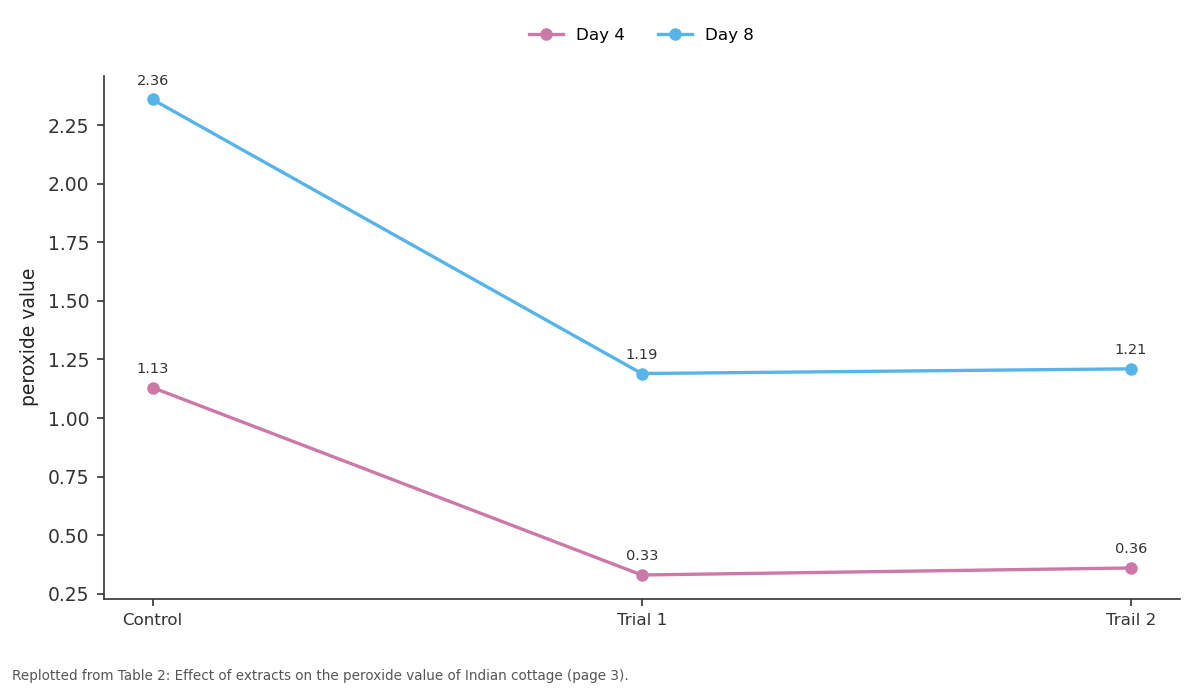
Day 4 and Day 8: Control vs Trial 1 vs Trail 2
Replotted from Table 2 (page 3) of the original paper. Every bar is the paper's own table value.
View source evidence ↗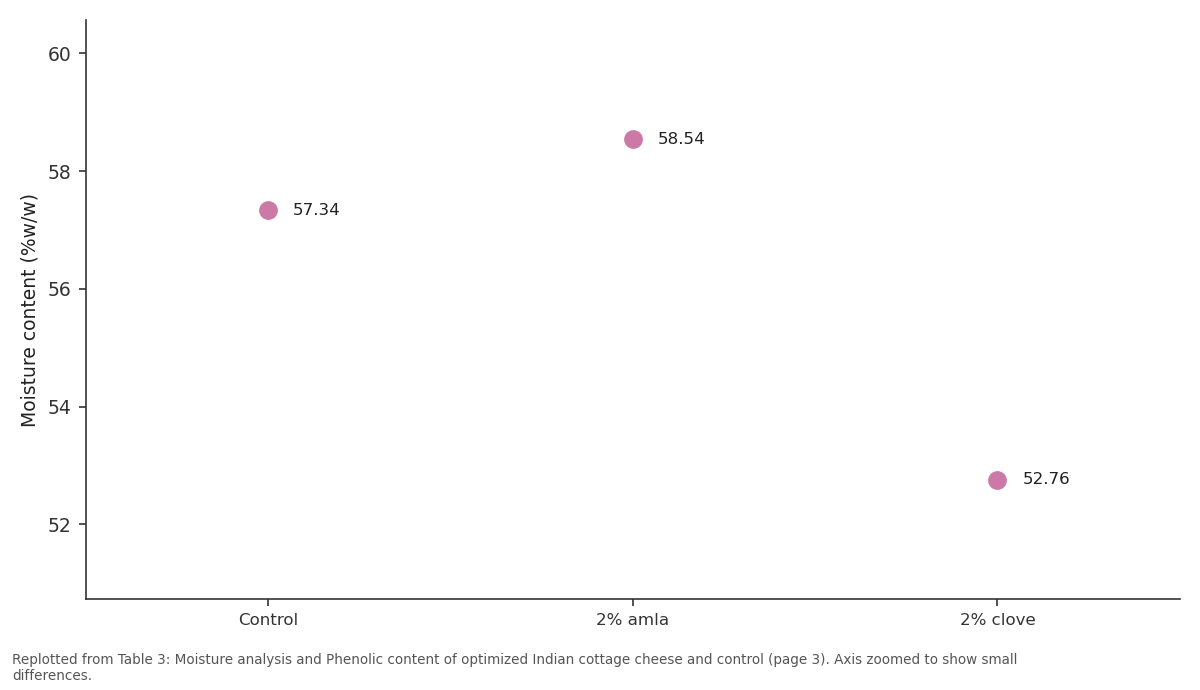
Moisture content (%w/w): Control vs 2% amla vs 2% clove
Replotted from Table 3 (page 3) of the original paper. Every bar is the paper's own table value.
View source evidence ↗Figures & tables
From the original paper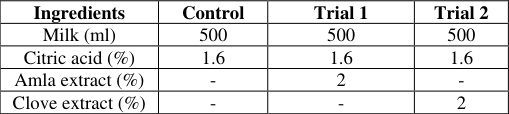 Table 1
 Table 2
 Table 3
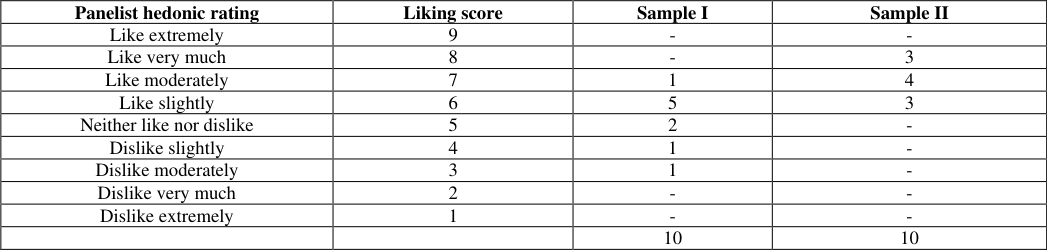 Table 4
Introduction
The majority of the people in India, known as an agrarian nation, follow a vegetarian diet. A significant source of animal protein in their diets comes from milk. India holds the title of being the largest milk producer in the world, with an annual production of 112 million metric tons, indicating a 3.3% growth compared to the previous fiscal year. In addition to consuming milk, various dairy products are made from the surplus milk, such as ghee, curd, butter, khoa, paneer, cheese, channa, ice cream, and milk powders. Paneer, a popular Indian cottage cheese, is a native product made by heating milk and coagulating it with acid, which can include citric acid, lactic acid, tartaric acid, or sour whey. The resulting curd is then filtered and pressed to remove some of the whey. Indian cottage cheese production accounts for approximately 5% of the country's milk production. Preparation of paneer using different types of milk and varied techniques results in wide variation in physico-chemical, microbiological and sensory quality of the product (Khan & Pal, 2011) [7] . Paneer has a very low shelf-life. Hurdles like spices, pH, water activity, temperature, redox potential, packaging etc. can be used to enhance the shelf-life of paneer (Mishra & Bhardwaj, 2016) [8] . paneer prepared with addition of herbal extract during the paneer preparations. Paneer samples was prepared by incorporating cloves (Syzygium aromaticum) and pakhanbedh (Bergenia ciliata) extract mixture each at the rate of 0 to 0.6% of the expected yield of paneer at two different stages. The yield of paneer was found to be affected by the herb extract addition.% yield increased on the samples treated with herb extract directly on milk and moisture retention was found to increase on addition of herb (Khadka, 2021) [6] . Phenolic compounds are a diverse group of plant-derived secondary metabolites that play a significant role in the nutritional and functional quality of foods. They are found abundantly in fruits, vegetables, cereals, legumes, and spices, with notable examples including flavonoids, phenolic acids, tannins, and stilbenes. Studies have reported that foods such as berries, tea, coffee, olive oil, spices (e.g., clove), and herbs contain high amounts of phenols, contributing to their strong antioxidant potential (Shahidi & Ambigaipalan, 2015) [13] .
Soy Fortified Paneer (SFP) samples prepared from blends containing different proportions of buffalo milk of varying fat content and soy milk (7.5 °B) were evaluated organoleptically for assessing the quality attributes like body and texture, flavor and taste, color and appearance and the overall acceptability (Uprit & Mishra, 2002) [14] . Emblica officinalis Gaertn. or Phyllanthus emblica Linn, commonly known as Indian gooseberry or amla, is arguably the most important medicinal plant in the Indian traditional system of medicine, the Ayurveda (Baliga & Dsouza, 2011) [3] . Clove (Syzygium aromaticum) is one of the most valuable spices that has been used for centuries as food preservative and for many medicinal purposes (Cortes & Oliveira, 2014) [4] . The antioxidant/prooxidant activity of phenolics is dependent on such factors as metal-reducing potential, chelating behavior, pH, and solubility characteristics (Decker, 1997) [5] . Phenolic compounds act as powerful antioxidants by scavenging free radicals, chelating metal ions, and inhibiting lipid peroxidation (Chaudhary et al., 2023) [8] . Regular consumption of phenolic-rich foods has been linked to reduced oxidative stress, which is a key factor in the development of chronic diseases such as cardiovascular diseases, diabetes, and cancer (Pandey & Rizvi, 2009) [12] . Phenolic compounds are reactive metabolites in a wide range of plant-derived foods and mainly divided in four groups: phenolic acids, flavonoids, stilbenes and tannins. They work as terminators of free radicals and chelators of metal ions that are capable of catalyzing lipid oxidation (Ozcan & Akpinar, 2014) [11] .
Materials and Methods
Materials and Methods
Raw Materials
Amla, clove, and milk are procured from supermarkets in Chennai, Tamil Nadu. Ethanol, glacial acetic acid, chloroform, distilled water, 0.01N sodium thiosulphate solution, starch solution, 10% aluminum chloride, citric acid, 0.025M potassium iodide, 20% sodium carbonate, gallic acid, potassium chloride, and 1M sodium hydroxide are chemicals employed from the laboratory.
Preparation of Indian cottage cheese with extracts
The full cream milk was heated until it reached a temperature of 100°C and then cooled down to 60 °C, which was determined as the optimal temperature for coagulation. To facilitate coagulation, citric acid was added at a concentration of 1.6%. After a few minutes, the whey water was drained, and the resulting product was filtered using a muslin cloth. Weights were placed on the product to apply pressure and achieve a uniform texture and shape, following the method described by Shahnawaz and Mohammad (2011). A control sample was also prepared without the addition of the amla and clove extracts. Furthermore, different variations were explored, including the addition of amla and clove extracts at level of 2% each. Trial 1 involved samples with 2% amla extract respectively, while Trial 2 included sample with 2% clove extract respectively. The optimization of Indian cottage cheese is presented in Table 1.
| Ingredients | Control | Trial 1 | Trial 2 |
|---|---|---|---|
| Milk (ml) | 500 | 500 | 500 |
| Citric acid (%) | 1.6 | 1.6 | 1.6 |
| Amla extract (%) | - | 2 | - |
| Clove extract (%) | - | - | 2 |
Table text extracted from the original PDF; superscript letters are shown inline. The original table image is below.
View original table image
Determination of total phenolic content
Determine the total phenolic content present in the ethanolic extracts, a Ferric chloride test was adopted. The measurement of total phenolic concentration can serve as a quick method for screening antioxidant activity. To conduct the test, approximately 10ml of the extract was mixed with two to three drops of Ferric chloride solution. The formation of a bluish tint indicates the presence of phenols.
Estimation of peroxide value
The Indian cottage cheese samples, weighing 3 g each, were carefully measured using a dry and clean boiling tube. To the tube, 20 ml of solvent composed of 3 parts glacial acetic acid and 2 parts chloroform were added, along with 2.0 g of powdered potassium iodide. The tube was then filled with the solvent and placed in boiling water, ensuring that the liquid reached boiling point within 30 seconds. A solution of 0.01 N sodium thiosulphate was prepared, and the mixture in the flask was titrated against this solution using starch as an indicator. Simultaneously, a blank titration was conducted using a flask containing 25 ml of boiling water. The procedure described here is in accordance with the AOAC guidelines from 2016. The experiment was repeated, and the subsequent calculations were performed as detailed below.
Peroxide value = ((S -B) × N × 100)/W………………………………………………………… (1)
Where, S, B, N, and W are the volume of titrant of the sample, blank, normality of sodium thiosulphate, and weight of sample respectively.
Moisture Content
Moisture content is an important chemical parameter. It was determined using convection method. Three samples of 10 g each were weighed and placed in an oven. The samples were heated at 105 ±10℃ until constant weight was obtained and then the samples were taken out and cooled in desiccators and weighed in electronic balance (AOAC, 2000). The moisture content on wet basis was calculated using the following equation.
MC% (w.b) = (W1-W2) / (W1) × 100……………………………….……………………… (2)
Where, MC -Moisture content, per cent wet basis W1 -Initial weight of the sample, g W2 -Final weight of the sample, g
Sensory Analysis
The sensory attributes of Indian cottage cheese, including color, odor, flavor, texture, taste, and overall acceptability, were evaluated using a 9-point hedonic scale. A total of 10 semi-trained panelists, consisting of students with prior experience in sensory evaluation of food products, participated in the assessment. The panelists were provided with samples of the cottage cheese, and their responses were recorded. The panelists rated the products on a scale ranging from 9 ('like extremely') to 1 ('dislike extremely'), corresponding to specific descriptive terms associated with each point on the scale.
Results and Discussion Preparation of Indian cottage cheese with extracts
Three variations of Indian cottage cheese were prepared for the study. The control sample was prepared without the addition of any extract. The T1 sample contained amla extract at concentration of 2%, respectively. Similarly, the T2 sample contained clove extract at concentration of 2%, respectively. The different extract samples used in the study are also depicted in Figure 1. In this study, the antioxidants were in a soluble form and were added in small amounts ranging from 1% to 2% to the Indian cottage cheese samples.
Effect of extracts on the peroxide value of Indian cottage cheese
The impact of antioxidants on the peroxide value of Indian cottage cheese samples during an 8-day storage period is summarized in Table 2. The peroxide value of each sample increased as the storage time progressed. Initially, the peroxide value of the control and all samples was 0.08, showing no significant difference at a significance level of p≤0.05. However, this value gradually increased during storage. On the 8th day of storage, the maximum peroxide values observed were 2.63 for the control sample. For samples T1 and T2 at a concentration of 2%, the peroxide values were 1.19 and 1.21 respectively. The ability to prevent peroxide formation was higher at a concentration of 2% due to the higher concentration of antioxidant extracts. Amla extract demonstrated a greater ability to prevent peroxide formation compared to clove extract. This is attributed to the higher antioxidant activity of amla, making it more effective in preventing peroxide formation in Indian cottage cheese samples.
| Samples | Day 4 | Day 8 |
|---|---|---|
| Control | 1.13 | 2.36 |
| Trial 1 | 0.33 | 1.19 |
| Trail 2 | 0.36 | 1.21 |
Table text extracted from the original PDF; superscript letters are shown inline. The original table image is below.
View original table image
Phenolic activity of the extracts
Both the amla and clove extracts exhibited a bluish color, indicating the presence of phenolic compounds as determined by the ferric chloride test. Clove extract exhibited a significantly higher phenolic content (80-100 mg GAE/g) compared to amla extract (40-60 mg GAE/g), consistent with its rich composition of eugenol and other polyphenols. The addition of ferric chloride resulted in a dark green color for clove, indicating a strong reaction with phenolics, while amla displayed a yellowish-brown color as in table 3. These results highlight the antioxidant potential of clove and amla, with clove showing a higher capacity due to its denser phenolic composition.
| Sample | Moisture content (%w/w) | Observation | Phenolic content (mg GAE/g) | Observation |
|---|---|---|---|---|
| Control | 57.34% | Smooth, homogenous texture | Not detected | - |
| 2% amla | 58.54% | Soft, moist and slightly sticky texture | 80-100 | Dark green |
| 2% clove | 52.76% | Dry, slightly brittle texture | 40-60 | Yellowish brown |
Table text extracted from the original PDF; superscript letters are shown inline. The original table image is below.
View original table image
Moisture analysis
In Table 03, the moisture content of 2% clove and amla samples revealed distinct differences due to their physical properties and processing methods. Clove, being a dried spice, showed low moisture content characterized by a dry and brittle texture. In contrast, amla retained significantly higher moisture content owing to its natural composition as a fresh or minimally dried fruit, resulting in a soft and moist texture. These variations highlight the differences in their preservation and usage, with clove being stable for longterm storage and amla being more perishable without further drying or processing
Sensory analysis
In Table 04, the Indian cottage cheese underwent a sensory acceptability test. Antioxidant extracts of amla and clove were added to the sample in small amounts of 2% and these were compared with that of the control sample. The texture of all Indian cottage cheese samples was acceptable. Amla at 2% concentration was found to have an unfavorable aroma and appearance. Whereas clove 2% had an intense and harsh taste, flavor, and color that was not justifiable at a consumable level since it also gave unpleasant aftertaste.
Conclusion
Natural extracts from Amla and clove were obtained and evaluated for their phenolic content. These extracts were incorporated into Indian cottage cheese at concentration of 2%. The peroxide value, a measure of oxidative deterioration, was monitored every 2 days, and it was observed that the sample with 2% extract addition exhibited a lower peroxide value. The results from the phenolic content test, peroxide value analysis, and sensory evaluation collectively indicated that Amla extract possessed higher antioxidant activity compared to clove extract. Moisture content demonstrated that the Indian cottage cheese aligned with market samples. Based on these findings, it can be inferred that Amla, with its high antioxidant activity and phenolic content, may serve as a favorable alternative to synthetic antioxidants in extending the shelf life of food products by preventing peroxide formation in fat and oilcontaining products. Additionally, natural antioxidants are considered safe and offer health benefits to consumers.
Figures and tables from the paper
| Panelist hedonic rating | Liking score | Sample I | Sample II |
|---|---|---|---|
| Like extremely | 9 | - | - |
| Like very much | 8 | - | 3 |
| Like moderately | 7 | 1 | 4 |
| Like slightly | 6 | 5 | 3 |
| Neither like nor dislike | 5 | 2 | - |
| Dislike slightly | 4 | 1 | - |
| Dislike moderately | 3 | 1 | - |
| Dislike very much | 2 | - | - |
| Dislike extremely | 1 | - | - |
| 10 | 10 |
Table text extracted from the original PDF; superscript letters are shown inline. The original table image is below.
View original table image
References
11 in the original paper- Baliga MS, Dsouza JJ. Amla (Emblica officinalis Gaertn), a wonder berry in the treatment and prevention of cancer. Eur J Cancer Prev. 2011;20(3):225-239.
- Cortés-Rojas DF, de Souza CRF, Oliveira WP. Clove (Syzygium aromaticum): a precious spice. Asian Pac J Trop Biomed. 2014;4(2):90-96.
- Decker EA. Phenolics: prooxidants or antioxidants? Nutr Rev. 1997;55(11):396-398.
- Khan SU, Pal MA. Paneer production: A review. J Food Sci Technol. 2011;48(6):645-660.
- Chaudhary M, Garg AP. Bioactive compounds from plants and animals: A review. Int. J. Adv. Biochem. Res. 2023;7(1):105-117.
- Mishra D, Rao KJ, Bhardwaj R, Sutariya H, Kavitkar RS, Subhash WS. Effect of pH on sensory, textural, microbial quality and shelf-life of paneer. Int J Food Ferment Technol. 2016;6(2):405-414.
- Mohammed AH, Aguilar-Pérez CF, Ayala-Burgos AJ, Bottini-Luzardo MB, Solorio-Sánchez FJ, Ku-Vera JC. Evaluation of milk composition and fresh soft cheese from an intensive silvopastoral system in the tropics. Dairy Sci Technol. 2016;96:159-72.
- Ozcan T, Akpinar-Bayizit A, Yilmaz-Ersan L, Delikanli B. Phenolics in human health. Int J Chem Eng Appl. 2014;5(5):393-396.
- Pandey KB, Rizvi SI. Plant polyphenols as dietary antioxidants in human health and disease. Oxid Med Cell Longev. 2009;2(5):270-278.
- Shahidi F, Ambigaipalan P. Phenolics and polyphenolics in foods, beverages and spices: Antioxidant activity and health effects-A review. J Funct Foods. 2015;18:820-897.
- Uprit S, Mishra HN. Fuzzy multiattribute decision making approach for development and comparison of soy fortified paneer. J Sensory Stud. 2002;17(2):163176.